Quick Field Data
- UNESCO Inscription: Reference 872, inscribed in 1998 as a Cultural World Heritage Site under criteria (ii) and (iv).
- Scale & Footprint: Encompasses 427 hectares across four distinct historic districts spanning two river valleys and two bounding hills.
- Access & Ticketing: Streets, squares, quays, and many Renaissance traboule courtyards in Vieux Lyon and Croix-Rousse are open pedestrian terrain; major museums such as the Gallo-Roman Museum on Fourvière and select interior monuments require tickets. Check the official heritage office for courtyard etiquette and seasonal opening details.
- Arrival Logistics: Lyon Saint-Exupéry Airport (LYS) lies 20 km east of the historic core, while Geneva International Airport (GVA, 112 km northeast) provides an alternative cross-border gateway. The site forms the historic heart of our Lyon destination guide (0 km).
Eastward Urban Expansion from Roman Lugdunum to the Presqu'île
Few European cities display their chronological growth as legibly on the ground as Lyon. Rather than demolishing medieval alleys to raise Baroque squares or tearing down Renaissance townhouses for nineteenth-century blocks, Lyon shifted its civic centre progressively eastward over more than two thousand years. Lying 391 km southeast of Paris, 278 km north of Marseille, and 113 km southwest of Geneva, the city preserves four complete urban eras side by side. These districts unfold between Fourvière hill in the west, the Saône valley, the central Presqu'île peninsula, and the northern slopes of Croix-Rousse.
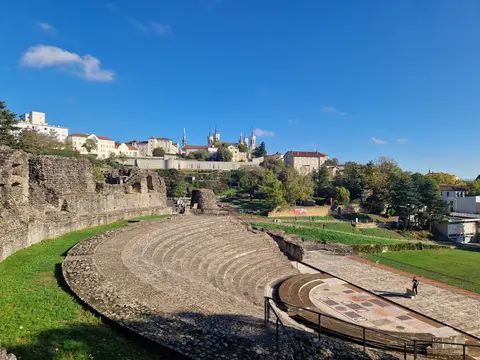
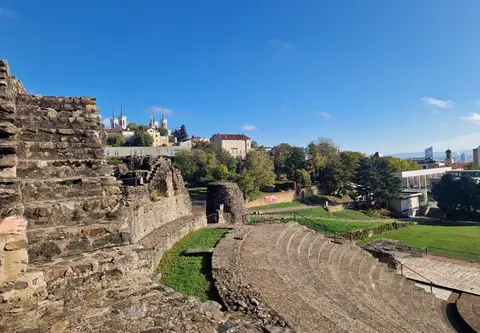
The sequence starts on Fourvière hill, where Roman refugees expelled from Vienne during conflict with the Allobroges were settled by order of the Roman Senate in 43 BC (historian Dio Cassius records the foundation) as Colonia Copia Felix Munatia, soon called Lugdunum. Scholars trace the Gallic root Lugdunon to the Celtic god Lug ("light" or "crows") and dunos ("hill-fort"), matching the ninth-century Endlicher Glossary translation "Desired Mountain," while Condate ("confluence") designated an earlier Gallic sailors' and fishermen's hamlet below near Saint-Vincent. Recognising the meeting of two navigable rivers, Rome made Lugdunum Caput Galliae, capital of Gallia Lugdunensis and starting hub of imperial roads. Emperors Claudius (whose speech supporting Gallic senators survives on the Lyon Tablet) and Caracalla were born here. Today Fourvière retains the Ancient Theatre of Fourvière, the Odeon, and the Amphitheatre of the Three Gauls, while early Christian martyrs Blandina, Pothinus, Epipodius, and second-century Greek bishop Irenaeus established the primatial see still held by the Archbishop of Lyon.
Burgundian resettlement followed the 437 destruction of Worms, with Lugdunum becoming capital of the Kingdom of the Burgundians in 461 after establishment in 443. The 843 Treaty of Verdun assigned Lyon to Emperor Lothair the First, before incorporation into the Kingdom of Arles and the Holy Roman Empire in 1033. French royal control followed only in the fourteenth century, by which time settlement had stepped down from the western ridge onto the Saône bank. On that riverbank rose the late eleventh-century Manécanterie (scola cantorum), the Cathedral of Saint John the Baptist (1160 to 1481) with rare stylistic unity, and Saint-Paul Church (twelfth to sixteenth centuries). Nearby stands the Church of Saint-Nizier, begun in the fourteenth century with a Flamboyant nave, classical façade, neo-Gothic spire, and a sixteenth-century doorway carved by Philibert Delorme. Across the Saône on the southern Presqu'île, the Romanesque Basilica of Saint-Martin-d'Ainay (1107) and fourteenth-century Gothic Église Saint-Bonaventure anchored early expansion.
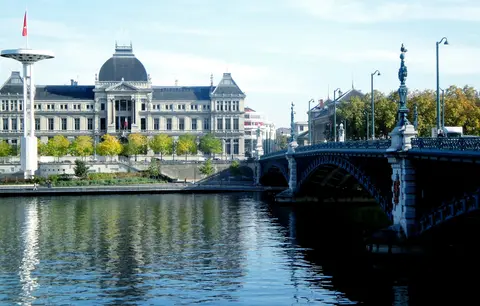
Renaissance Silk Trade, Traboules, and the Canut Slopes
Historian Fernand Braudel observed the constant economic bipolarity between Paris and Lyon from the late Middle Ages to industrialisation. Royal fairs introduced by Italian merchants in the late fifteenth century made Lyon France's economic counting house. Its open-air Bourse (built 1749) functioned as a public exchange even after international banking moved toward Genoa and Amsterdam. Silk production forged strong Italian architectural and literary ties, uniting French writers Louise Labé, Maurice Scève, and Antoine Héroet in the same milieu as Italian exiles such as Luigi Alamanni and Gian Giorgio Trissino. Meanwhile, Vieux Lyon's Saint-Paul, Saint-Jean, and Saint-Georges lanes filled with courtyard hôtels particuliers. Key survivors include the Thomassin House on Place du Change (late thirteenth century, enlarged fifteenth century), Maurice Scève's house (1493), and the Chamberlain's mansion (1495 to 1516). They sit near the Claude de Bourg House (1516), Hôtel de Bullioud by Philibert Delorme, and the Mannerist House of the Lions (1647).
Religious conflict scarred the city during the 1572 St Bartholomew's Day Massacre, and worse violence struck during the French Revolution. After Lyon supported the Girondins against the National Convention in 1793, Revolutionary troops besieged the city for over two months until October 1793. On 12 October 1793 the Convention renamed Lyon Commune-Affranchie ("Emancipated Commune"), executing over 2,000 citizens under Jean-Marie Collot d'Herbois and Joseph Fouché and tearing down buildings around Place Bellecour. Napoleon ordered reconstruction a decade later, after intermediate Directory unrest that included a commissioner's assassination in 1797. Even earlier on the Presqu'île, classical civic landmarks had anchored the island between rivers. These included Jules Hardouin-Mansart's Hôtel de Ville (1646 to 1703) on Place des Terreaux, the monumental seventeenth- and eighteenth-century Hôtel-Dieu hospital along the Rhône, and Quai Lassagne (1760). Nearby stood Soufflot's Loge du Change, begun in 1745 and completed in the late eighteenth century, which later served as a Protestant church.
Nineteenth-century industrial silk weaving next climbed northern La Croix-Rousse ("the hill that works"). Purpose-built canut tenements erected in the first half of the nineteenth century rose five or six storeys with tall bays for Jacquard looms. Exemplified by the House of 365 Windows and the Courtyard of the Voracious (Cour des Voraces), those workshops fed fierce worker uprisings in 1831 and 1834. Later in 1894, anarchist raids in January and February preceded the June 1894 assassination of President Sadi Carnot in Lyon by Sante Caserio. Across both Vieux Lyon and Croix-Rousse, covered passages called traboules let silk carriers cross whole city blocks sheltered from rain. Decades later during Second World War occupation under Klaus Barbie, French Resistance fighters used those same traboules to evade Gestapo raids. They operated there until the First Free French Division and Forces Françaises de l'Intérieur liberated Lyon on 3 September 1944.
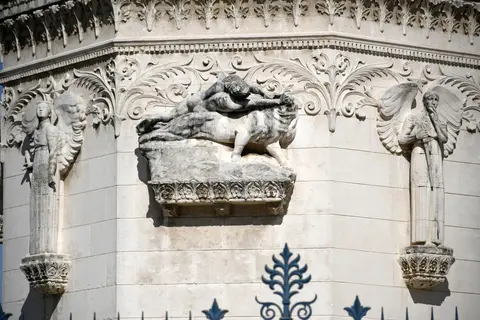
Confluence Topography Between Two Rivers and Two Hills
Geomorphology explains how Lyon avoided overwriting its own past. The city sits wedged between the steep western drop of Fourvière ("the hill that prays"), the broad northern plateau of Croix-Rousse, and the flat eastern plain across the Rhône. Outside the inscribed zone on that eastern plain, modern La Part-Dieu holds Gare de Lyon-Part-Dieu and high-rise towers, while the sixth arrondissement holds Parc de la Tête d'or. Between the rivers, the Presqu'île peninsula concentrates classical avenues from Place des Terreaux through pedestrian Rue de la République to Place Bellecour, France's third-largest public square, tapering south to the river Confluence.
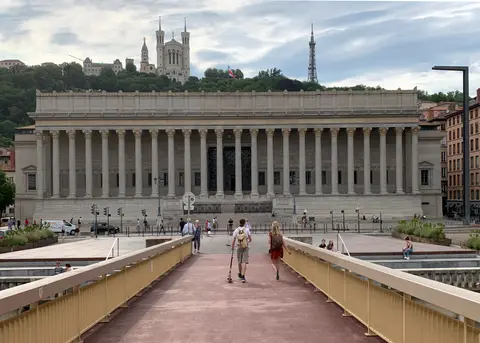
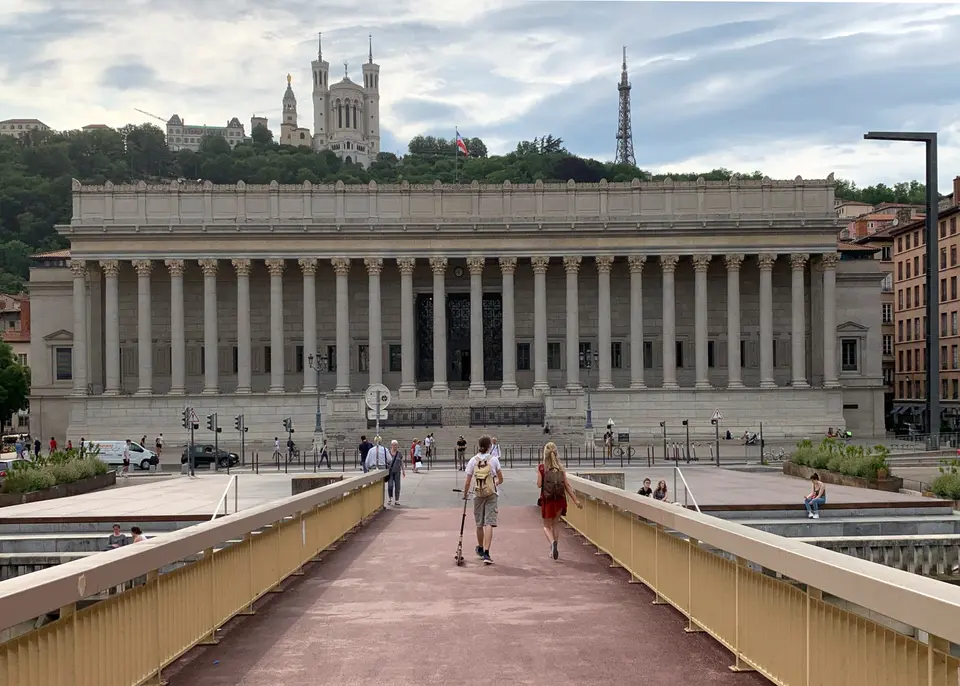
Later nineteenth- and twentieth-century additions capped the skyline without erasing earlier districts. In 1862 Lyon inaugurated its first funicular railway up the steep hills. Between 1872 and the late nineteenth century, the Basilica of Notre-Dame de Fourvière joined the Eiffel-inspired Tour métallique on the western crest. Later, between 1927 and 1933, modernist architect Tony Garnier built the Weaving School, continuing Lyon's silk-era building tradition into modern urban form.
Today the commune of Lyon holds 519,127 inhabitants (2023) within 48 square kilometres across nine numbered arrondissements created between 1852 (when La Croix-Rousse, La Guillotière, and Vaise were annexed) and 1964. It sits embedded inside the 534-square-kilometre Metropolis of Lyon, which reached 2,338,789 metropolitan inhabitants in 2023. Lyon ranks as France's second-largest student city with nearly 200,000 university students and hosts Interpol, the International Agency for Research on Cancer, and Euronews. The metropolis also builds banking, biotech, and software industries and prepares to co-anchor the 2030 Winter Olympics. Safeguarding plans for Vieux Lyon and the Croix-Rousse slopes operate with a Traboules Restoration Plan, an Illumination Plan, a Public Domain Charter, and Heritage Workshops. Together they coordinate municipal, metropolitan, and state oversight across the 427-hectare site and its buffer zone, regulating building height alterations, courtyard restoration, and façade repairs across this living urban centre.
District Access Across Four Inscribed Quarters
Most of the 427-hectare site consists of living urban neighbourhoods where public streets, squares, and designated traboules are accessible on foot without admission tickets. Heritage agreements balance ongoing residential occupation against preservation of historic courtyards and elevations.
| Complex Zone | Key Highlights | Access & Ticket Rule |
|---|---|---|
| Fourvière Hill (Roman Lugdunum & Basilica) | Ancient Theatre of Fourvière, Odeon, Gallo-Roman museum, Basilica of Notre-Dame de Fourvière | Outdoor Roman theatres and basilica nave are open-access; museum galleries require an admission ticket. Check official schedules. |
| Vieux Lyon (Saint-Paul, Saint-Jean & Saint-Georges) | Cathedral of St John the Baptist, Manécanterie, Renaissance courtyards, and covered traboules | Streets, cathedral nave, and signposted traboule passages are free to enter during daytime hours; respect residents' quiet rules inside private yards. |
| Presqu'île Peninsula (Terreaux to Ainay) | Hôtel de Ville, Place des Terreaux, Place Bellecour, Church of St Nizier, Basilica of St-Martin-d'Ainay | Public squares and church naves are open to visitors; check municipal announcements for interior Hôtel de Ville tours and civic events. |
| Slopes of La Croix-Rousse | Canut silk tenements, Courtyard of the Voracious, Amphitheatre of the Three Gauls, stepped traboules | Hillside staircases and public traboules have open pedestrian access; check local heritage office listings for guided workshop demonstrations. |
| Saône & Rhône Confluence Quays | Historic riverfront facades, Quai Lassagne, and southern Confluence meeting point of both rivers | Riverside promenades and footbridges are permanently open-access; check museum tickets individually at the southern Confluence tip. |
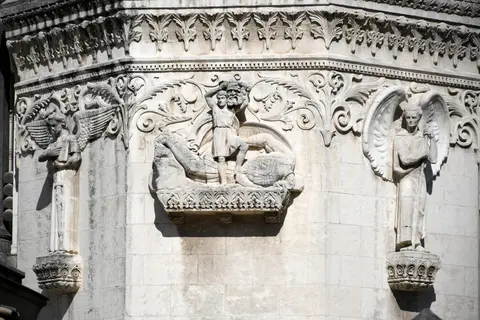
Three Material Layers Visible in Lyon's Street Fabric
Even on a brisk architectural walk between rivers, three physical building features explain why Lyon reads like an open textbook of French and Italian urban craft.
- Four-Metre Canut Workshop Ceilings: On the Croix-Rousse slopes around the Cour des Voraces, notice the unusually tall window bays stacked closely up five or six storeys, engineered specifically to admit natural daylight onto vertical Jacquard silk looms.
- Traboule Courtyard Thresholds: In Vieux Lyon's Saint-Jean quarter, look for inconspicuous street doors marked with heritage plaques that open onto cool stone corridors, vaulted spiral stair towers, and open-air Italianate courtyard galleries linking parallel streets.
- Roman Reused Blocks at Ainay and Fourvière: On Fourvière hillside examine the tiered semicircular seating of the Roman theatre, then compare it with the Basilica of Saint-Martin-d'Ainay on the Presqu'île, where twelfth-century Romanesque masonry preserves early abbey proportions in the heart of classical Lyon.
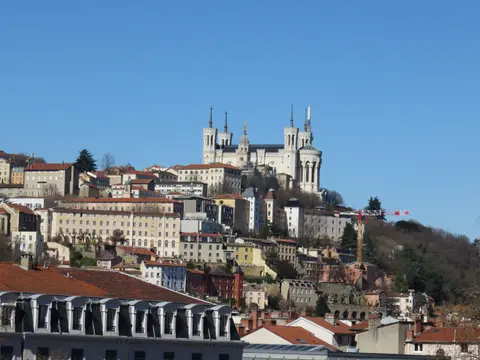
Sequencing the Hills and Riverbanks of Lyon
Walking Lyon chronologically from west to east clarifies the entire city in a single day. Start by ascending Fourvière via the 1862 funicular corridor to inspect the Roman theatres, then descend on foot into Renaissance Vieux Lyon. Trace signed traboules around Saint-Jean Cathedral before crossing the Saône bridges onto the classical Presqu'île and climbing into the silk-workers' slopes of Croix-Rousse. Lyon's humid subtropical climate averages 4.1 °C in January and 22.6 °C in July with 820 mm of annual rainfall. Recorded extremes range from minus 24.6 °C in 1938 to 41.4 °C in August 2023, making spring, early summer, and autumn ideal for steep stair walks. Early December brings the four-day Fête des Lumières illumination festival starting on 8 December, continuing a civic light tradition that still defines Lyon's winter nights. Allow unhurried time along both riverbanks so the shift from Roman hilltop stone to Renaissance courtyards and nineteenth-century silk workshops registers clearly on foot.
To map neighbourhood dining, funicular stops, and riverside strolls in detail, continue into our Lyon travel guide, or explore comparable European historic centres in the UNESCO World Heritage Atlas. Linking Fourvière's Roman theatre, Vieux Lyon's stone passages, and Croix-Rousse's silk-workers' stairways in one continuous descent makes Lyon's eastward urban shift unmistakable on foot.