Quick Field Data
- UNESCO Inscription: 1997 · Criteria (i), (ii), (iii), (iv), (v), expanded in 2000 to bring the ensemble to nine gardens
- Scale & Footprint: 11.922 hectares divided among nine enclosed gardens in Suzhou and nearby Tongli, anchored by the 5.2-hectare Humble Administrator's Garden
- Access & Ticketing: Separately ticketed municipal heritage parks administered by the Suzhou Municipal Garden and Landscape Administration Bureau, requiring timed entry slots during peak spring and autumn blooms
- Arrival Logistics: 30 kilometres southeast of Sunan Shuofang International Airport (WUX), with frequent high-speed rail connections via Shanghai Hongqiao International Airport (SHA) at 68 kilometres and Shanghai Pudong International Airport (PVG) at 113 kilometres
Scholar Reclusion and Miniature Mountain-Water Philosophy
Suzhou's garden tradition grew out of a long civic lineage dating back to the sixth century BCE, when the city served as capital of the State of Wu and royal hunting parks stood beyond the walls. Private residential gardens began appearing around the fourth century and reached full maturity from the mid-Ming to early Qing dynasties, when more than 200 private gardens operated inside Suzhou's canal-laced grid. More than 50 gardens appear across historic urban surveys, and 69 preserved gardens remain in the city today. Of these, UNESCO selected nine works dating from the eleventh to nineteenth centuries, eight inside Suzhou and one in the nearby water town of Tongli, to represent the finest surviving expressions of Chinese Mountain and Water design.
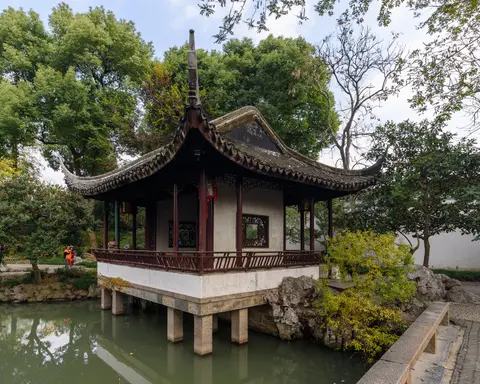
Built behind street-facing residential compounds rather than on vast rural estates, each classical garden creates a self-contained microcosm from four core materials identified by museum curator Xue Zhijian: stone, plants, architecture and water. Retired magistrates, poets and painters influenced by the unconstrained freehand brushwork of traditional Chinese landscape painting sought spiritual reclusion inside a single urban residence without abandoning civic life. Rather than laying out straight symmetrical avenues, garden masters including Zhang Liang, Ji Cheng, Ge Yuliang and later Chen Congzhou deliberately broke sightlines with whitewashed partition walls, zigzag bridges, pierced lattice windows and winding covered corridors so every corner reveals a fresh framed view. Imperial estates such as the Chengde Mountain Resort directly imitated this subtle East Yangtze Delta idiom.
Historical records give Suzhou's gardens rare documentary continuity across dynasties. Chronicles of Suzhou Municipality, Wu County and Tongli Town, along with the Pingjiang city map inscription, preserve early site layouts. Twentieth-century architectural surveys documented joinery proportions, plaques and rock compositions. Major titles include Tong Jun's 1937 Record of Jiangnan Gardens, Yao Chengzu's 1937 Ying zao fa yuan (Rules of Traditional Architecture) and Liu Dunzhen's 1979 Classical Gardens of Suzhou. Since 1949, when Suzhou Municipality established its dedicated conservation agency, the Suzhou Municipal Garden and Landscape Administration Bureau has enforced strict buffer-zone building rules under the City Master Plan. These regulations insist on traditional craft materials and minimal intervention to shield historic rivers, alleys and vernacular houses around each walled estate.
Humble Administrator's Garden and Three-Island Composition
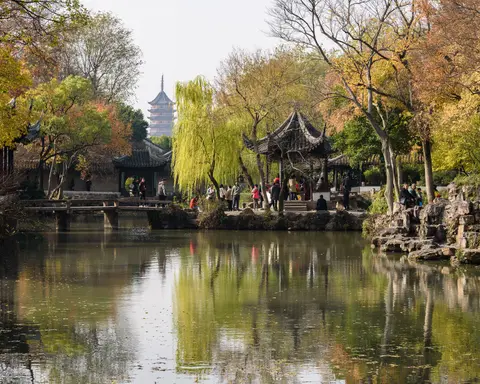
At 178 Northeast Street in Gusu District, the Humble Administrator's Garden (Zhuozheng Yuan) covers 78 mu, or 5.2 hectares (13 acres), making it the largest garden in Suzhou. Its grounds carry layered literary and religious memory, starting with Tang dynasty scholar Lu Guimeng's residence and a garden from the Southern Song Shaoxing era (1131 to 1162). In the Yuan dynasty, the space belonged to Dahong Temple, which later burned during the Ming conquest. In 1510, Ming Imperial Envoy Wang Xianchen retired home to Suzhou after a turbulent official career across demotions and promotions ending as magistrate of Yongjia county in Zhejiang. From 1513 to 1526, he spent 16 years shaping the grounds with close artistic guidance from his friend, the Suzhou painter and calligrapher Wen Zhengming. The garden takes its name from Jin writer Pan Yue's prose poem An Idle Life, which celebrates planting trees, building a house and irrigating vegetables as the proper rule for a retired official. Wen Zhengming recorded the estate in 31 paintings and poems in 1533 and a second album of 8 painted views in 1551.
Subsequent centuries fractured and reshaped the estate repeatedly. Wang's son gambled the estate away, and in 1631 Vice Minister of the Justice Board Wang Xinyi purchased and separated the eastern third, completing modifications by 1635 under the name Dwelling Upon Return to the Countryside. In 1738 Jiangsu Governor Jiang Qi acquired the central section and renovated it as Garden Rebuilt, while Chief Histographer Ye Shikuan bought the western section as the Garden of Books, later purchased in 1877 by Suzhou merchant Zhang Lüqian and renamed the Subsidiary Garden. Around 1735 teenage novelist Cao Xueqin is traditionally thought to have lived here, drawing visual scenery for Dream of the Red Chamber, and in 1860 Taiping prince Li Xiucheng occupied and remodelled the halls, shaping much of the current architectural character. Architectural historians Lou Qingxi and Liu Dunzhen note that despite successive rebuildings, the arrangement of rocks and water retains clear continuity with Ming and early-Qing principles. In 1949 the government reunited all three sectors and restored the grounds in 1952.
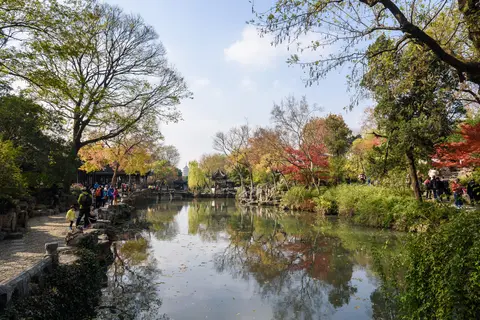
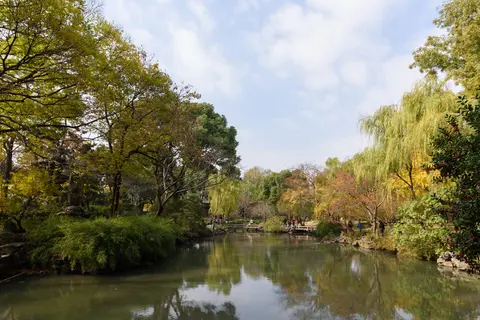
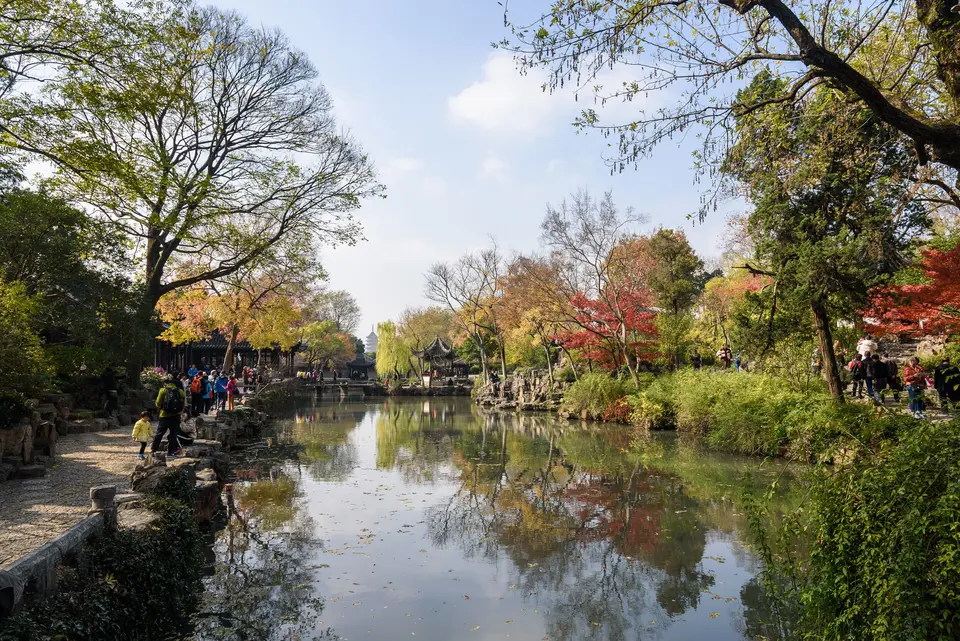
Water dominates the 5.2-hectare composition, connecting 48 buildings, 101 inscribed tablets, 40 steles, 21 ancient trees and over 700 Suzhou-style penjing miniature potted landscapes. South of the lake stand the residential quarters, opening onto an Eastern Garden centred on a lawn and pond ringed by crape myrtle trees evoking the Tang State Secretariat's Crape Myrtle Department nickname. The Central Garden surrounds the Surging Wave Pond with three islets echoing mythical Penglai islands of the eastern sea. Half the size of the central zone, the Western Garden is built around a north-south pond and central islet. Seasonal planting shifts colour and scent throughout the calendar, pairing spring peonies and summer lotus with autumn osmanthus and winter plum blossom.
Lingering Garden, Covered Walkways and Inscribed Partner Parks
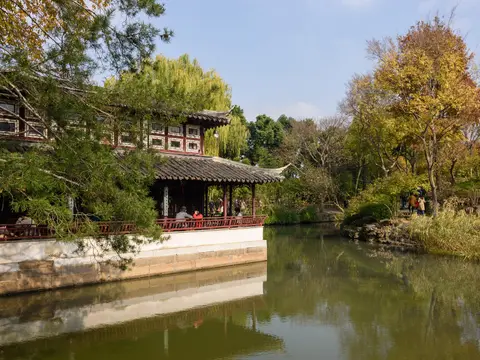
Outside Changmen Gate at 338 Liuyuan Road, the Lingering Garden (Liu Yuan) occupies 23,310 square metres and illustrates how architectural massing and rock collecting balanced water scenery. Commissioned in 1593 by exonerated official Xu Taishi and designed by stonemason Zhou Shicheng as the East Garden, the compound became renowned for its Shi Ping Peak rockery modelled on Tiantai Mountain in Putuo. County magistrates Jiang Yingke and Yuan Hongdao both acclaimed the estate, with Yuan praising it in Sketches of Gardens and Pavilions as the finest garden south of the Yangtze River. In 1798, official Liu Su reconstructed the estate around pine and bamboo groves under the theme Cold Green Village, inspired by verse pairing bamboo colour with limpid water. He added 12 prized scholar stones to his stone forest, built the Celestial Hall of Five Peaks and opened the garden to the public from 1823.
After Taiping-era turmoil damaged the walls, Hubei provincial treasurer Sheng Kang spent three years from 1873 to 1876 rebuilding the grounds and moving the towering Auspicious Cloud Capped Peak limestone monolith into the eastern courtyard. He adopted the homophonous name Liu Yuan to evoke leisure while honouring the former owner, a restoration praised by scholar Yu Yue in Notes on Lingering Garden. Inherited by Sheng Xuanhuai, abandoned in 1911 and degraded into cavalry horse stables during the Sino-Japanese War, the garden reopened under municipal renovation in 1954. Four themed quarters (East, Central, West and North) divide the compound, with pavilions and halls occupying one third of the area and tied together by 700 metres of continuous covered walkways. The oldest Central quarter encircles a pool and yellow-granite grotto sculpted by artist Zhou Binzhong. Behind the Old Hermit Scholars' House, the East quarter frames the Cloud Capped Peak and the Small Court of Stone Forest. Meanwhile, the West quarter favours natural slopes, an artificial hill and a penzai courtyard. Two UNESCO Intangible Cultural Heritage arts, Pingtan ballad storytelling and Guqin zither music, also survive within its halls.
Seven additional inscribed gardens round out the serial listing across Suzhou's historic core and surrounding canal town. Canglang Pavilion, the earliest of the nine, dates to the early eleventh century on the site of an older destroyed garden and faces a perimeter moat rather than solid outer walls. Lion Grove Garden preserves dense, labyrinthine Taihu limestone grottos, while the compact Master of the Nets Garden concentrates courtyard residences and an intimate central pool into an efficient residential plan. Mountain Villa with Embracing Beauty, Garden of Cultivation, Couple's Garden Retreat and Tongli's Retreat and Reflection Garden complete the nine-site ensemble, each demonstrating local adaptations of courtyard scale, water edges and scholar dwellings.
Suzhou Classical Garden Zones and Entry Conditions
Because each garden sits in a separate historic lane within Gusu District or outer Tongli, planning visits by neighbourhood prevents crossing the old city repeatedly during peak traffic.
| Complex Zone | Key Highlights | Access & Ticket Rule |
|---|---|---|
| Humble Administrator's Garden (Gusu Northeast) | 5.2-hectare three-part water garden, Surging Wave Pond islands, 48 halls, 700 penjing and Suzhou Garden Museum zone | Separate entry ticket required; advance timed reservation strongly advised during peak spring, summer lotus and autumn months |
| Lingering Garden (Changmen Northwest) | 23,310-square-metre four-quarter layout, 700-metre covered corridor, Cloud-Capped Peak stone and Pingtan or Guqin halls | Individually ticketed heritage site; connected interior walkways open to foot traffic with quiet-zone etiquette inside music pavilions |
| Central & Southern Suzhou Trio | Master of the Nets Garden, Canglang Pavilion moatside colonnade and Couple's Garden Retreat canal frontage | Each garden operates independent ticketing; compact alleys favour walking or canal-side transit over private vehicles |
| Lion Grove, Cultivation, Embracing Beauty & Tongli | Labyrinthine limestone grottos, Mountain Villa rockery and Retreat & Reflection Garden in Tongli water town | Individual admission per garden; Tongli sits outside central Gusu District and requires a dedicated half-day transit hop |
Three Design Details to Examine Inside Suzhou's Gardens
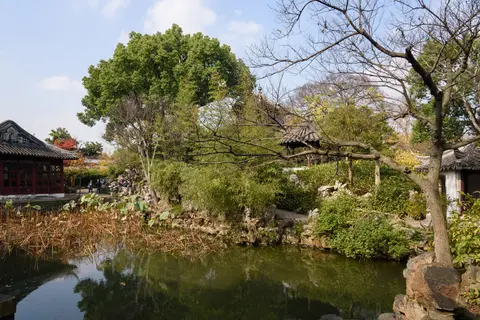
First, stand beside the southern pond edge inside the Humble Administrator's Garden and look northwest above the low tiled roofs and cedar branches. Designer Wang Xianchen and his successors used borrowed scenery (jiejing) to pull the distant brick silhouette of Beisi Pagoda directly into the garden frame, visually extending a 5.2-hectare enclosure across the wider Suzhou skyline.
Second, trace the 700-metre covered gallery linking the four quarters of the Lingering Garden. Instead of leaving blank brick walls, builders inserted pierced lattice leak-windows in varied geometric and floral patterns along the corridor, each framing small bamboo courtyards, yellow-granite rocks or calligraphic steles while shifting light across the floor paving as clouds move overhead.
Third, inspect how jagged rocks pierce through partition walls in corners of the Humble Administrator's Garden and around the Auspicious Cloud Capped Peak at the Lingering Garden. By overlapping weathered Taihu limestone directly through structural plaster rather than lining stones in neat museum rows, builders tricked visitors inside dense urban streets into reading small residential courtyards as cliff paths on natural mountains.
Seasonal Planning and Canal Links Around Suzhou
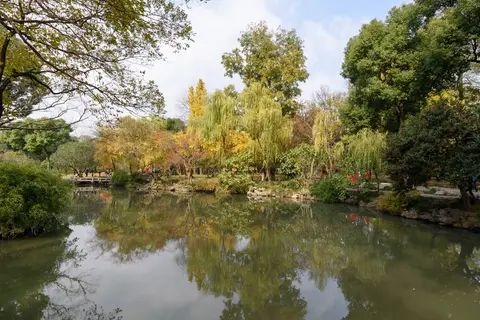
Each season changes the visual emphasis across Suzhou's 69 preserved gardens: spring brings peonies into bloom, summer fills the Surging Wave Pond with lotus leaves, autumn scents the courts with osmanthus and winter strips the willows back to reveal bare stone and plum blossoms. Entering at opening time lets visitors study poetic plaques, carved timber brackets and water reflections before tour groups crowd the narrow zigzag bridges and covered galleries.
Sunan Shuofang International Airport (WUX) lies 30 kilometres away, while rapid intercity rail connects central Suzhou to our Shanghai destination guide, just 80 kilometres east (with Hongqiao Airport 68 kilometres and Pudong Airport 113 kilometres from Suzhou). Travellers building an East Asian heritage loop can pair Suzhou's scholar courtyards with imperial palace gardens and canal towns across the UNESCO World Heritage Atlas.