Quick Field Data
- UNESCO Inscription: Ref. 345 · Cultural Site · Inscribed 1997 · Criteria (ii), (iv)
- Scale & Footprint: 11 hectares covering the walled hilltop citadel, double ramparts, Château Comtal, and Basilica of Saints Nazarius and Celsus within the 65-square-kilometre municipality of Carcassonne
- Access & Ticketing: Managed by the Centre des Monuments Nationaux with municipal authorities; outer streets and the lices perimeter corridor are open without charge, while Château Comtal and the inner wall walk require paid admission checked via the official monument site
- Arrival Logistics: 93 kilometres from Toulouse-Blagnac Airport (TLS) via the A61 motorway or Gare de Carcassonne rail connections; Carcassonne Salvaza Airport (CCF) sits 5 kilometres away with limited European budget passenger routes
Late Roman Castellum Beneath Medieval Ramparts
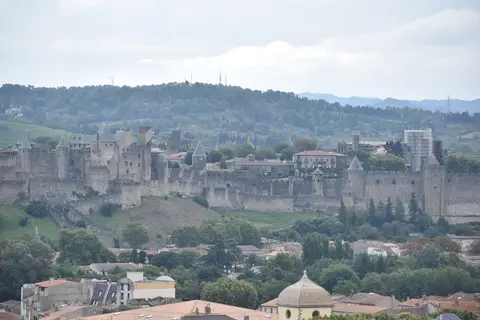
Rising on a rocky outcrop along the right bank of the River Aude in southern France's Occitania region, the Cité de Carcassonne commands an ancient overland route connecting the Atlantic Ocean to the Mediterranean Sea and the Massif Central to the Pyrénées. The wider town territory spans roughly 65 square kilometres watered by the Aude, Fresquel, and Canal du Midi, giving the citadel commanding elevation over surrounding plains and AOC vineyards. Archaeological finds trace initial human occupation across the district to around 3500 BC, before Celtic Volcae Tectosages fortified the hilltop during the sixth century BC as the trading oppidum of Carsac. Recognising the strategic ridge, Roman legions fortified the plateau around 100 BC and developed the colonia known sequentially as Julia Carsaco, Carcaso, and Carcasum.
By the third century AD, mounting frontier insecurity prompted Roman builders to encase the town inside heavy defensive stonework, establishing a fortified castellum explicitly recorded by 333 AD. This Late Roman circuit comprised thirty-four to forty semicircular towers, each rising roughly 14 metres tall and spaced between 18 and 30 metres along the perimeter wall, pierced by around 40 original entrances. Crucially, the lower courses of the northern inner ramparts survive directly from these Gallo-Roman ramparts, displaying flat horizontal bands of red fired brick alternating with stone blocks beneath shallow terracotta tile roofs. Roughly two-thirds of the later medieval inner enclosure overlaps those late-antique Roman foundations, including the northern tower later repurposed as the thirteenth-century Inquisition Tower.
Imperial authority fractured across Septimania in the fifth century. Visigothic King Theodoric II held Carcassonne from 453 and secured official Roman cession in 462. He reinforced the Gallo-Roman walls without altering their ground trace and initiated an early basilica precursor beneath today's church. Visigothic defenders repelled Frankish ruler Clovis in 508. Centuries later, Muslim Arab and Berber armies entered Septimania in 719 and overthrew local Visigothic governance in 720. The Frankish reconquest of Narbonne in 759 under Pepin the Short ended forty years of occupation. Romantic tradition credits a châtelaine named Lady Carcas with tossing a wheat-fed pig over the wall and ringing victory bells after a five-year siege against Charlemagne, so a soldier cried Carcas sonne. Historians recognise that tale as a sixteenth-century invention, commemorated today by a neo-Gothic column portrait beside the Narbonne Gate.
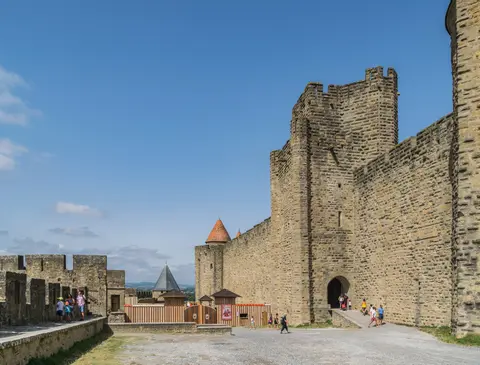
Trencavel Rule, the 1209 Siege, and Royal French Extensions
Feudal governance evolved through counts tied to neighbouring Razès, beginning with Charlemagne's contemporary Bello, founder of the three-century Bellonid dynasty. Lordship passed by marriage in 1067 to Raimond-Bernard Trencavel, viscount of Albi and Nîmes. Alternating alliances with Barcelona and Toulouse brought an architectural flowering to the hilltop despite citizen revolts in 1107 and 1120. In 1096 Pope Urban II blessed the foundation stones of the Basilica of Saints Nazarius and Celsus. Later, in 1130, Viscount Bernard Aton began building the Château Comtal against the western Roman curtain wall and repaired the entire circuit. The citadel and two outer suburbs, Bourg Saint-Vincent to the north and Bourg Saint-Michel to the south, then held an urban population of three to four thousand residents.
Religious conflict abruptly reshaped the stronghold. Because Occitan Cathars flourished across Trencavel domains, Pope Innocent III summoned northern barons in 1208 to wage the Albigensian Crusade. On 1 August 1209, crusading forces led by Papal Legate Abbot Arnaud Amalric encircled the Cité. Cut off from water and outside relief, Viscount Raimond-Roger de Trencavel negotiated surrender on 15 August to spare his townspeople, who were expelled wearing only their shirts as the outer suburbs burned; Trencavel himself died of dysentery inside his own dungeon on 10 November 1209. Simon de Montfort received the forfeited viscounty and strengthened the walls until his death at Toulouse in 1218.
When Simon's heir Amaury de Montfort proved unable to hold the lands, he ceded them to French King Louis VIII. That cession prompted a brief 1224 recapture by Raimond II Trencavel before a decisive royal expedition in 1226 turned Carcassonne into crown property. Even a 1240 siege by Trencavel's son failed. Annexed formally to the Kingdom of France in 1247, Carcassonne became the southern frontier bastion facing the Crown of Aragon under the 1258 Treaty of Corbeil. Louis IX, Philip III, and Philip IV added massive royal fortifications through the early 14th century. Engineers replaced decayed Roman inner stretches with twenty-six circular towers and added Château Comtal's drawbridge, ditch, and advanced entrance barbican between 1240 and 1250. Builders wrapped a brand-new outer rampart studded with nineteen round towers, including three projecting barbicans, creating a 3-kilometre concentric circuit of 52 towers and barbicans. Only the great barbican was later lost, leaving a fortress so formidable that Edward the Black Prince bypassed its walls in 1355 while devastating the lower town.
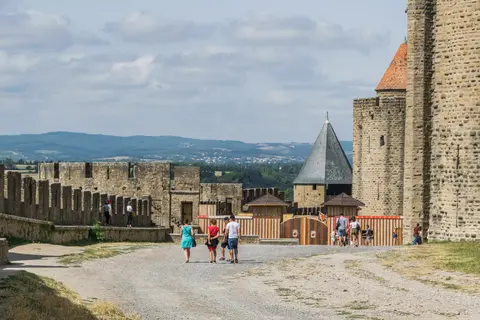
Double-Enclosure Defence and the Textile Ville Basse
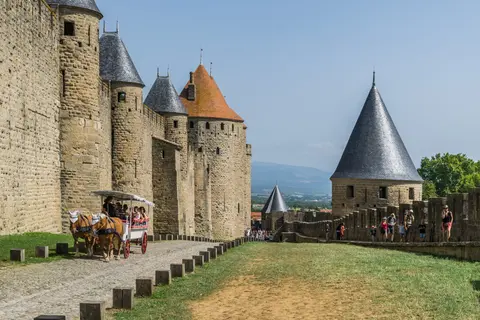
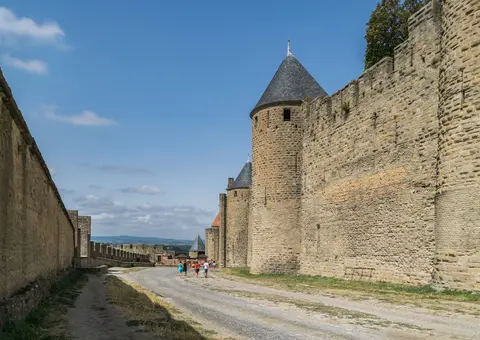
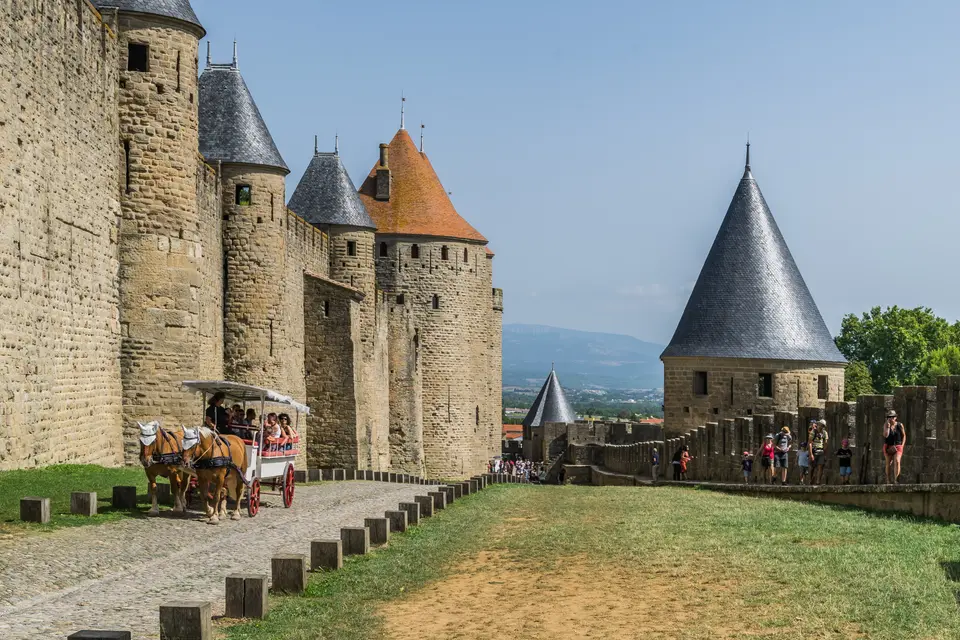
Carcassonne's double-ring architecture forced attacking armies through layered traps. Beyond outer moats, storming parties faced two monumental gatehouses: the elaborated eastern Porte Narbonnaise and the steep western Porte de l'Aude climbing from the river slope. Once inside the cleared corridor between both rings, known as the lices, attackers came under crossfire from higher inner towers. Those upper walls held square beam sockets supporting cantilevered timber siege galleries called hourds, enabling garrison troops to step past the masonry face and drop stones vertically onto sappers.
Across the Aude, Louis IX planted the planned Ville Basse (Bastide Saint-Louis) for displaced citizens. That settlement anchored the economic town that today spans the river bridge and crosses the Canal du Midi via Pont Marengo to Gare de Carcassonne. Once the 1659 Treaty of the Pyrenees annexed Roussillon to France, Carcassonne ceased acting as a frontier garrison. Its citadel walls fell silent while the Ville Basse flourished as a woollen textile hub, hailed in 1723 by economic historians as Languedoc's leading manufacturing centre. Citizens erected the Hôtel de Rolland town hall in 1761 next to churches such as Carcassonne Cathedral and Saint-Vincent before Ottoman textile markets collapsed in the late eighteenth century.
Modern Carcassonne balances citadel tourism with winemaking across a major AOC winegrowing district, footwear, rubber, and textile manufacturing, and performing arts training at the MKE Academy. Boat traffic moves along the Canal du Midi, which runs through town near the Aude and Fresquel rivers some 80 kilometres east of Toulouse. Five minutes by road sits the recreational Lac de la Cavayère. Local identity preserves Occitan heritage together with fierce sporting passion, with rugby league side AS Carcassonne wearing the citadel silhouette on its crest. The Tour de France regularly stages finishes here, including editions in 2004, 2006, 2016, and 2018. In July 2021, Mark Cavendish equalled Eddy Merckx's record of 34 stage wins in Carcassonne, and in July 2025 Tim Wellens claimed Stage 15 from a breakaway.
Viollet-le-Duc, Slate Roofs, and Nineteenth-Century Conservation
Neglect accelerated following the French Revolution. In November 1793 town officials burned Cité archives, and in 1804 Napoleon officially demilitarised the fortress, passing fortification property to municipal authorities. Stripped of stones and crowded with lean-to houses wedged directly into medieval towers, the citadel deteriorated so severely that an official 1849 French government decree ordered its demolition. Outrage erupted locally, led by Carcassonne antiquary and mayor Jean-Pierre Cros-Mayrevieille and France's first monument inspector Prosper Mérimée, building upon the 1840 historical monument classification to reverse the demolition order.
Already restoring the Basilica of Saints Nazarius and Celsus, architect Eugène Viollet-le-Duc accepted the fortification commission in 1853, launching from the west and southwest ramparts before reconstructing the Porte Narbonnaise towers. Over twenty-six years until his death in 1879, carried onward by pupil Paul Boeswillwald and architect Nodet, Viollet-le-Duc cleared encroaching houses from the lices, consolidated towers, and capped turrets across the skyline. Contemporary critics strongly attacked his use of dark northern French slate and tall conical spires where Mediterranean Occitania traditionally laid pale, shallow-pitched terracotta tiles, and twentieth-century restorers briefly swapped coverings before scholarship reassessed the coherence of his structural work. Today the Centre des Monuments Nationaux conserves the enclosed monument while Carcassonne's municipal planning easements eliminate roadside parking immediately beneath the walls to protect surrounding views for roughly three million annual visitors.
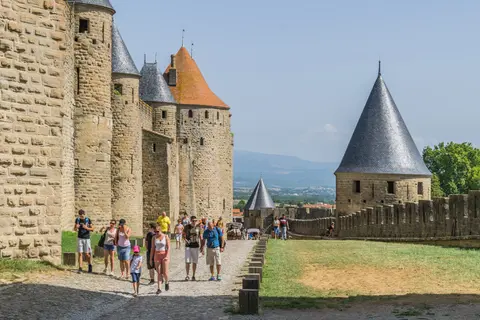
Visitor Circuits Across the Double Enclosures
Because Carcassonne remains an inhabited historic precinct receiving around three million visitors each year, access splits clearly between free pedestrian streets and ticketed rampart interiors.
| Complex Zone | Key Highlights | Access & Ticket Rule |
|---|---|---|
| Outer Lices & Porte Narbonnaise | Walkway between the two concentric walls, Lady Carcas pillar replica, and twin-tower eastern drawbridge gate | Free pedestrian access year-round; wheeled traffic and immediate perimeter parking are strictly restricted |
| Cité Lanes & Basilica of Saints Nazarius and Celsus | Intra-muros medieval streets, Romanesque-Gothic basilica nave, and fourteenth-century stained glass windows | Open free to pedestrians; maintain quiet conduct inside active worship spaces of the basilica |
| Château Comtal & Inner Ramparts | Twelfth-century viscomital keep, Gallo-Roman lower northern towers, Inquisition Tower, and elevated hoarding walks | Paid timed entry via the Centre des Monuments Nationaux; verify current ticket rules online before arrival |
| Ville Basse & Pont Vieux | Louis IX planned lower town, Carcassonne Cathedral, Church of Saint-Vincent bell tower, and Aude river views | Open civic quarters across the bridge; railway station connections link directly across Pont Marengo |
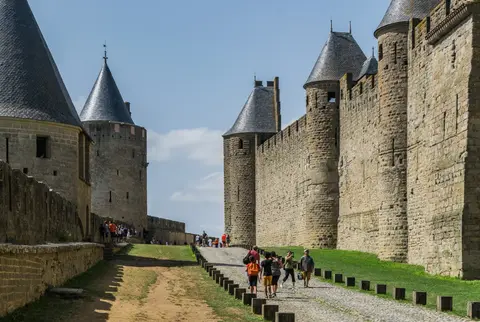
Masonry Joints, Siege Hoarding Sockets, and Slate Crowns
Walking the perimeter from the Porte Narbonnaise around the northern flank before entering Château Comtal reveals three diagnostic details embedded directly in the citadel masonry.
- Roman Brick-Banded Masonry Under Medieval Ashlar: Inspect the lower courses of the northern inner towers between the medieval stone blocks. Distinct horizontal courses of flat red Roman brick and shallower masonry heights betray the fourth-century castellum footprint incorporated directly beneath thirteenth-century royal extensions.
- Square Beam Holes for Wooden Siege Hoarding: Look just below the crenellations along the outer and inner curtain walls. Evenly spaced square sockets pierced straight through the limestone masonry once anchored cantilevered timber galleries, allowing archers and defenders to command the blind dead zone at the wall base.
- Slate Cones vs Southern Terracotta and Vaulted Basilica Stability: Compare the steep slate-covered cones Viollet-le-Duc brought from northern France against shallow red terracotta roofs on nearby southern sections. Then step inside the Basilica of Saints Nazarius and Celsus to see how internal vault equilibrium holds up the Gothic choir without exterior flying buttresses.
Arrive early in the morning to walk the sunlit eastern ramparts and the lices before midday crowds bottleneck narrow inner streets, keeping in mind that warm summers above 28 degrees Celsius give way occasionally to intense autumn storms as seen in October 2018. Pair Languedoc's fortified hilltop with France's Mediterranean coast in our Marseille travel guide or discover additional fortified towns across the UNESCO World Heritage Atlas.