Quick Field Data
- UNESCO Inscription: 1996 (Ref. 781), historic fortified mountain city in Castilla-La Mancha, central Spain; Criteria (ii) and (v).
- Scale & Footprint: 22.79-hectare walled historic centre and suburbs resting 956 to 1,000 metres above sea level between the Júcar and Huécar gorges.
- Access & Ticketing: Designated a Historic Ensemble under Law 16/1985 and coordinated by the Royal Board of the City of Cuenca; verify local cathedral, Spanish Abstract Art Museum and municipal monument admission schedules.
- Arrival Logistics: International flights land at Adolfo Suárez Madrid-Barajas Airport (MAD), 131 kilometres northwest, linking southeast via Madrid (139 kilometres air distance, 170 kilometres overland) by high-speed rail and motorway.
From Moorish Qal'at Kūnka Fortress to Castilian Royal City in 1177
Balanced atop a narrow limestone spur on the western edge of Spain's Iberian System mountains, walled Cuenca earned the nickname Eagle's Nest. Two deeply carved river canyons, the Júcar to the west and the Huécar to the east, converge below sheer cliffs climbing to 1,000 metres above sea level. Whereas Roman rule built lowland provincial towns nearby at Segobriga, Ercavica and Gran Valeria, this rocky promontory remained uninhabited until Muslim armies arrived after 714 AD. Recognising the natural defence between twin gorges, Islamic rulers erected a formidable fortress called Qal'at Kūnka ringed by a one-kilometre defensive wall.
By the 10th century AD, Cuenca thrived as a stronghold of the Arabised Berber Banū Zennum lineage inside the Caliphate of Córdoba, drawing wealth from regional agriculture and woven cloth workshops. After Córdoba fractured into competing taifa kingdoms during the early 11th century, Cuenca fell under the Taifa of Toledo until Sancho Ramírez of Aragon laid an unsuccessful siege in 1076. King Yahya al-Qadir lost Toledo in 1080 and signed treaties at Cuenca seeking military help from Alfonso VI of León and Castile. Following Christian defeat at Sagrajas in 1086, Taifa ruler Al-Mu'tamid of Seville captured Cuenca before his daughter-in-law Zaida delivered the fortress to Castilian troops briefly in 1093.
Almoravid forces retook Qūnkah in 1108, holding the gorge bastion through shifting Andalusi alliances and local independence under Muhammad ibn Mardanis from 1147 until 1172. After a five-month Castilian siege failed against Almohad relief columns, a coalition under King Alfonso VIII of Castile joined Ferdinand II of León, Alfonso II of Aragon and the Military Orders of Calatrava, Santiago and Montegaudio from Epiphany 1177. Cut off from North African aid under commander Abu Bakr, the lower town fell on 21 September 1177 and the citadel surrendered in October. Alfonso VIII soon issued Cuenca's influential Latin municipal charter, the Fuero, while the Diocese of Cuenca arose in 1183 under second bishop Saint Julian and Alfonso X granted city status in 1257.
During subsequent centuries of Castilian rule, livestock herding and booming woollen textile and wall-hanging looms brought steady urban growth across the ridge. Queen Eleanor, wife of Alfonso VIII and daughter of England's Henry II and Eleanor of Aquitaine, attracted French and Anglo-Norman master masons who shaped early Christian monuments above former Islamic foundations. A documented Sephardic Jewish community lived in Cuenca from 1177 until Spain's 1492 expulsion decree, while Inquisition courts pursued converso families in trials spanning 1718 to 1725. That long economic golden age ebbed abruptly during the 18th century when King Carlos IV barred Cuenca workshops from competing with Madrid's Real Fábrica de Tapices.
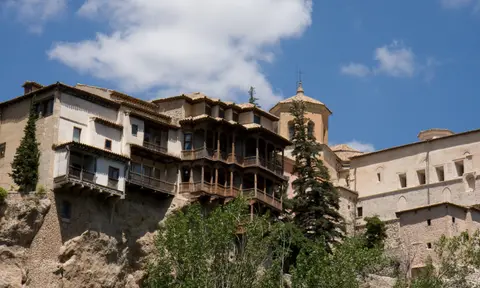
Hanging Houses, Cuenca Cathedral, and Clifftop Religious Monuments
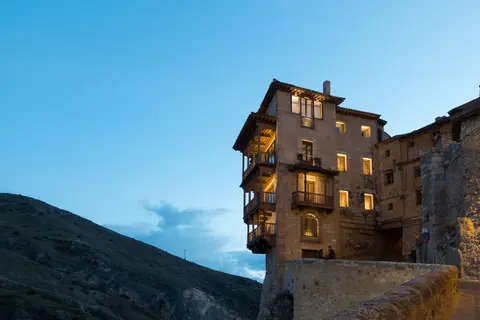
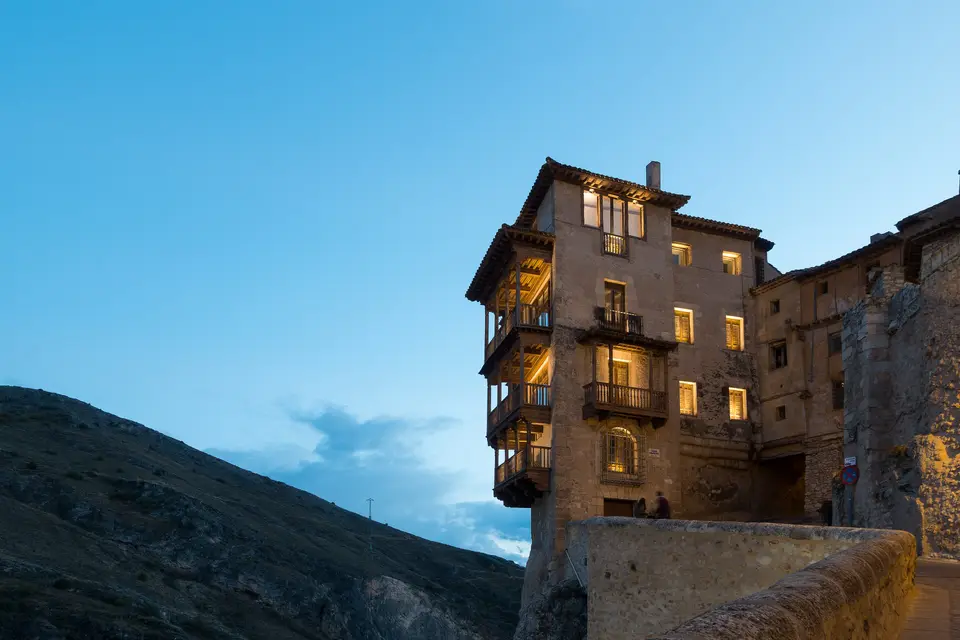
What is Cuenca Spain famous for today centres visually on the dramatic Cuenca Spain Hanging Houses, called Casas Colgadas, projecting directly over the Huécar cliff face. Similar timber-balconied clifftop houses once stretched along much of the eastern defensive wall near the Episcopal Palace, though only a small cluster survives today. Anchored directly into vertical rock beds, the famous trio of multi-storey houses preserves wooden cantilevered balconies documented in the 15th century and largely rebuilt in tall narrow form during the 16th century. Refurbished in the 1920s after serving as private dwellings, council quarters and even a traditional mesón dining room, these cliffside landmarks now house Cuenca's Museo de Arte Abstracto Español.
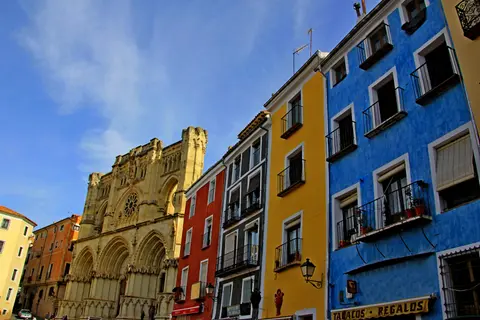
Directly opposite the Hanging Houses spans the tall pedestrian San Pablo Bridge across the narrow Huécar canyon toward the historic San Pablo Convent terrace. Built originally from 1533 to 1589 before collapsing and later reopening as a narrow steel-and-wood footbridge, this crossing frames clear canyon views of the overhanging wooden balconies. Walking inward from the gorge rim enters Plaza Mayor, Cuenca's sloping triangular civic square framed by brightly painted townhouses, vaulted town hall arches and monumental stone facades. From this elevated spine narrow stone lanes climb northward into the Castillo quarter just outside ancient walls where scattered Moorish citadel fragments overlook both valleys.
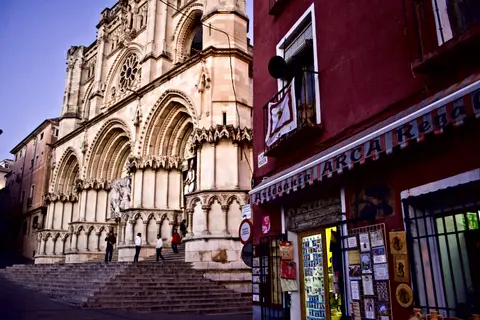
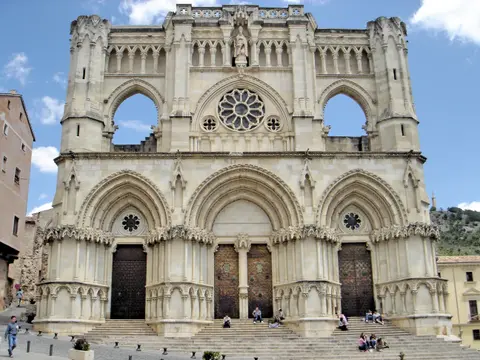
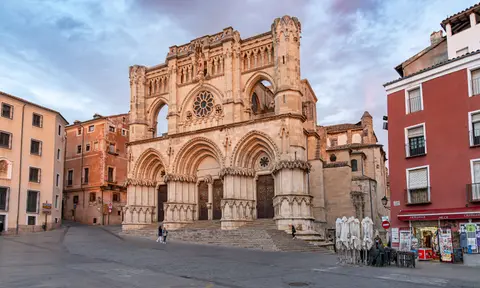
Dominating Plaza Mayor rises the Cathedral of Our Lady of Grace and Saint Julian, begun in 1182 over the former Great Mosque and completed around 1270. Influenced by Queen Eleanor's Anglo-Norman tastes and French master builders, it ranks beside Ávila's cathedral as the earliest Gothic cathedral built anywhere in Spain. Later generations layered a 15th-century double apse ambulatory (doble girola), Esteban Jamete's 16th-century Renaissance arch, Ventura Rodríguez's 18th-century iron-gated high altar and twin restored Julián de la Orden baroque organs completed in 2009. After the tall Giraldo bell tower collapsed in 1902 and crushed the old front, architect Vicente Lámperez built the current facade flanked by twin unfinished towers, while green marble columns frame Saint Julian's altar and Unum ex septem chapel plaques inside.
Compact parish churches and stone shrines line steep stepped streets across the 22.79-hectare upper town between Plaza Mayor and the Castillo walls. Ascending San Pedro Street leads to the Church of Saint Peter at Plaza del Trabuco, rebuilt during the 18th century by José Martín de la Aldehuela with an octagonal exterior shell enclosing a circular sanctuary. Just below Plaza Mayor down a steep narrow passageway sits the 13th-century Church of Saint Michael, expanded in the 15th century with a northern nave, crowned by an Esteban Jamete dome and restored under municipal care for Cuenca's Religious Music Week concerts. Neo-Gothic Iglesia del Salvador and surviving medieval noble houses further anchor this unbroken cliffside townscape.
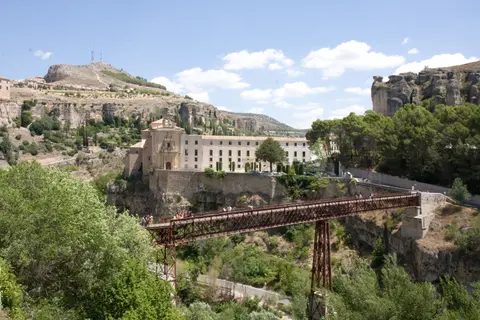
Urban Depopulation Cycles and Conservation Under the Royal Board
Economic decline following the 18th-century textile ban paradoxically saved Cuenca's historic ridge from wholesale Victorian demolition and concrete sprawl. Following severe contraction to around 5,000 inhabitants and heavy destruction during the Napoleonic War against French troops, 19th-century railways and timber trades lifted Cuenca modestly to 10,000 residents despite further 1874 Carlist War fighting. Early 20th-century turbulence brought the 1902 cathedral tower collapse, attacks on local religious institutions including Bishop Cruz Laplana y Laguna, and Spanish Civil War upheaval ending in 1938 Nationalist capture. Heavy post-war migration toward Catalonia, the Basque Country and Germany slowed hill rebuilding before modern growth from the 1960s and 1970s expanded downward onto flat lowland plains southwest across the Huécar River, leaving the tight upper walled quarter unusually intact.
Today strict legal tiers safeguard the 22.79-hectare walled zone while addressing delicate social and structural pressures facing older mountain towns. Designated a Sitio Pintoresco (Historic Scenic Site) in 1963 and a Historic Ensemble under Spanish Historic Heritage Law 16/1985, the city falls under Castilla-La Mancha planning rules, general urban zoning and the Special Plan for Cuenca's Old Quarter and Hoces. The Royal Board of the City of Cuenca consortium coordinates restoration across Town Hall and regional culture departments so every documented facade repair uses compatible stone, timber and traditional proportions. Active priorities balance rising tourist traffic, commercial crowding in public squares, narrow street mobility and declining permanent hillside residents through sensitive rehabilitation, public transit links and contemporary cultural hubs including concert spaces, science exhibits and local digital fab labs. Careful maintenance across vernacular residential blocks helps preserve everyday community life inside upper streets while welcoming day visitors safely above both gorges.
Access Zones Across Cuenca's Gorge Spur and Castillo Suburb
Studying a Cuenca Spain map highlights a steep north-to-south limestone peninsula dividing high historic quarters from modern lowland streets below the gorges. Check local opening times for museums and cathedral chapels before walking uphill from lowland bus stops.
| Complex Zone | Key Highlights | Access & Ticket Rule |
|---|---|---|
| Plaza Mayor & Gothic Cathedral | Anglo-Norman Gothic cathedral (1182 to 1270), double ambulatory, Jamete arch and Town Hall vaults. | Open pedestrian plaza; verify cathedral entrance schedules and organ concert notices at local ticket desks. |
| Hanging Houses & San Pablo Bridge | 15th-to-16th-century clifftop Casas Colgadas, Spanish Abstract Art Museum and high Huécar canyon footbridge. | Pedestrian rim walkways and bridge open daily; check museum entry rules and gallery hours before visiting. |
| Upper Castillo Quarter & San Pedro | Remains of Moorish Qal'at Kūnka fortress walls, octagonal-interior San Pedro church and panoramic gorge overlooks. | Steep cobbled uphill lanes beyond upper city walls; local buses and taxis ease steep climbs from lower town. |
| Lower New Town & Huécar Promenade | Lowland rail approach, river canyon footpaths, municipal concert hall and views upward toward clifftop ramparts. | Flat paved riverfront routes below historic cliffs linking railway arrival zones with hillside paths. |
Three Clifftop and Gothic Engineering Details in Cuenca
- Cantilevered Wooden Balconies at Casas Colgadas: Gaze across from San Pablo Bridge to see multi-storey timber beams anchored deep into vertical limestone ledges high above the Huécar riverbed.
- Unaligned Cathedral Naves and Double Ambulatory: Walk inside Cuenca Cathedral to notice slightly shifted axial lines leading toward green marble altars, Esteban Jamete's Renaissance portal and twin restored Baroque organs.
- Octagonal Exterior Over Circular Nave at San Pedro: Compare exterior eight-sided stone walls at Plaza del Trabuco with the smooth circular interior rebuilt by José Martín de la Aldehuela.
Best Time to Visit Cuenca Spain and Rail Routes From Madrid
Visitors asking is Cuenca Spain worth visiting quickly see its clifftop houses towering above twin green canyons. Elevation between 956 and 1,000 metres across Spain's inner Meseta plateau produces hot summer afternoons and chilly winter nights. Late spring and early autumn mark the best time to visit Cuenca Spain, offering crisp sunny mornings and comfortable evenings for climbing between riverbanks, San Pablo Bridge, Plaza Mayor and Castillo ruins. Spending one full day or staying one quiet night lets visitors see the illuminated Hanging Houses at dusk after daytime coach crowds depart.
Because the historic spur rises abruptly between the Júcar and Huécar valleys, pacing routes downhill from the Castillo quarter toward Plaza Mayor and San Pablo Bridge avoids tiring vertical ascents. Stopping inside shaded cathedral aisles or the Museo de Arte Abstracto Español offers quiet midday relief when Meseta sun warms limestone squares. Combined walking circuits easily link medieval churches, cliffside overlooks and riverside promenades into one rewarding regional itinerary.
Organising travel from Cuenca Spain to Madrid or arriving on a direct excursion requires minimal planning via Spain's central transport network. Travellers researching how to get to Cuenca from Madrid take high-speed trains or highway coaches running roughly 170 kilometres southeast (139 kilometres air distance) from Madrid straight to Cuenca's lowland terminals before transferring uphill by local bus or taxi into Plaza Mayor. International visitors arrive primarily at Adolfo Suárez Madrid-Barajas Airport (MAD), situated 131 kilometres northwest of Cuenca's historic centre. Continue exploring fortified hilltop towns across Europe inside our UNESCO World Heritage Atlas.