Quick Field Data
- UNESCO Inscription: 2002 · Criteria (i), (ii), (iii), (iv)
- Scale & Footprint: 4.86 hectares set 5 metres below surrounding ground level in Bodh Gaya, enclosing the 50-to-55-metre main brick temple, Bodhi Tree, six inner sacred spots, votive stupas and the southern Lotus Pond
- Access & Ticketing: Administered under the 1949 Bodh Gaya Temple Act by the Bodhgaya Temple Management Committee (BTMC) with Archaeological Survey of India conservation oversight; entry is free with strict shoe removal and security rules
- Arrival Logistics: 16 kilometres from Gaya district headquarters and 115 kilometres south of Patna in Bihar, just 7 kilometres from Gaya Airport (GAY)
The Bodhi Tree, Vajrasana Throne and Seven Enlightenment Weeks
Standing near the banks of the Phalgu river 115 kilometres south of Patna in Bihar, the Mahabodhi Temple Complex marks the supreme pilgrimage centre of the Buddhist world. According to sacred tradition around 589 BCE, young prince Siddhartha Gautama sat beneath a peepul tree (Ficus religiosa) on this spot and after three days and three nights of meditation attained Enlightenment, becoming the Buddha. Because the site sits 5 metres below surrounding modern street level, visitors descend east steps along a stone path into a sunken enclosure structured around seven places associated with the seven weeks immediately following that event.
Directly behind the western rear wall of the main temple grows the giant sacred Bodhi Tree, regarded as a direct descendant of the original tree under which the Buddha spent his first week. Seated at its base against the temple facade sits the polished sandstone slab known as the Vajrasana (Diamond Throne), installed by Mauryan Emperor Ashoka between 260 and 233 BCE to fix the exact seat of awakening. To the north of the main entrance path on raised ground rises Animeshlochan Chaitya (the unblinking shrine), where the Buddha stood gazing gratefully at the tree during the second week. Immediately beside the northern temple wall runs Ratnachakrama, a carved stone platform decorated with raised lotus pedestals marking the 18 paces the Buddha walked during his third week.
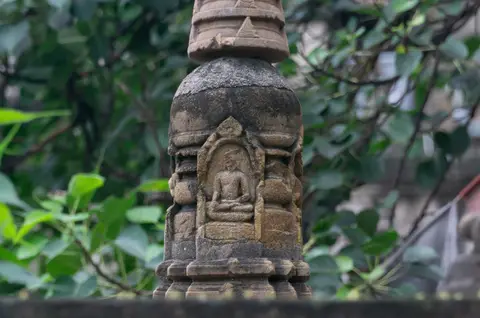
Continuing clockwise links the remaining episodes across the compound. Near the northeastern enclosure sits Ratnaghar Chaitya for the fourth week. Just inside the eastern steps, a stone pillar marks the Ajapala Nigrodh site associated with the fifth week and Brahman dialogues, also linked in tradition with Mucilinda the serpent king. Outside the main enclosure walls to the south lies the tranquil Lotus Pond for the sixth week, followed by the Rajyatana Tree southeast of the sanctuary where the seventh week concluded. Buddhist mythology collected in the Jatakas calls this Bodhimanda the navel of the earth, able alone to bear the weight of Awakening. Texts relate that no plant grows within one royal karisa if no Bodhi tree stands there, and a new tree sprang up on Gautama's birth. At the close and rebirth of each cosmic kalpa, this spot vanishes last and reappears first marked by blooming lotuses. Concentric inner, middle and outer boundaries now shield the sunken complex and southern Lotus Pond with circulating walkways laid across two or three levels.
Mauryan Foundations, Sunga Railings and Gupta Brick Engineering
Archaeology confirms continuous veneration from at least the third century BCE, roughly two centuries after the Buddha's lifetime. Around 260 BCE (also cited around 250 BCE), Mauryan Emperor Ashoka visited Bodh Gaya, erected a protective shrine around the Bodhi Tree (since vanished), installed the carved sandstone Vajrasana, set up a memorial column and placed black-stone footprints (Padas) of the Buddha along the approach. Early relief depictions of Ashoka's tree-shrine survive on the Sanchi toranas (around 25 BCE) and Bharhut stupa railings, matching excavated archaeological traces around the Vajrasana.
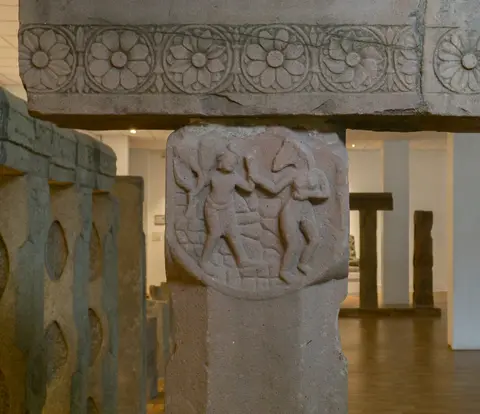
During the subsequent Sunga dynasty in the second and first centuries BCE, patrons added pot-based columns along the walking path and surrounded the shrine with carved sandstone balustrades (vedika) around 150 BCE. Decorated with narrative panels and medallions showing figures, animals and lotus motifs akin to Bharhut and Sanchi Stupa No. 2, those stone posts were later extended with coarse granite pillars down to the end of the Gupta period in the seventh century. Today many genuine Sunga sandstone and Gupta granite posts sit safely inside the neighbouring Bodh Gaya ASI Museum and Kolkata's Indian Museum, replaced outdoors by protective plaster and stone replicas.
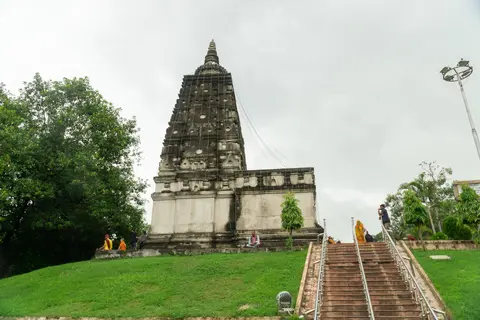
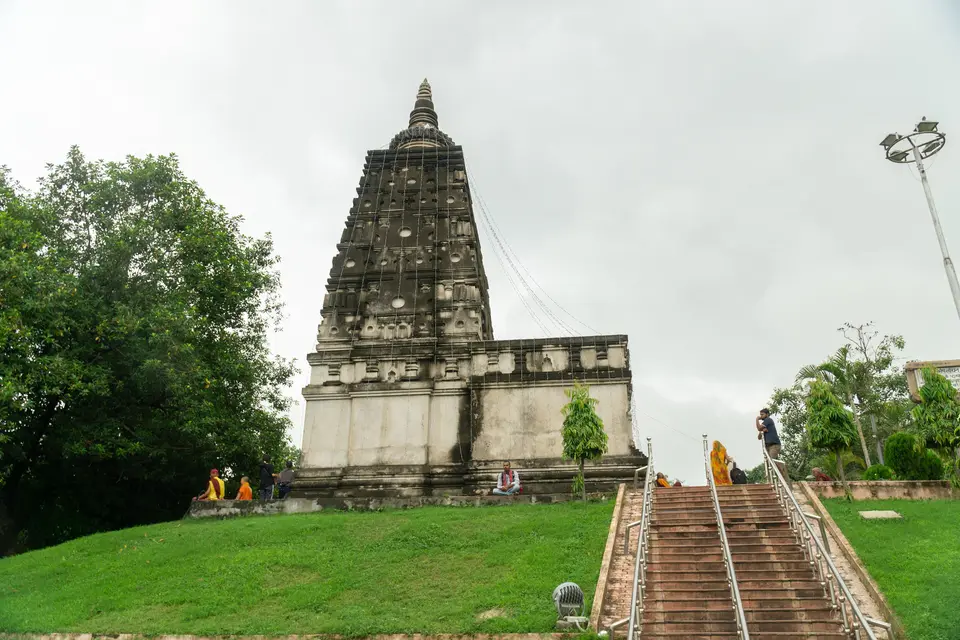
Rising straight out of the sunken courtyard, the towering brick Mahabodhi Temple dates mainly to the fifth and sixth centuries during the late Gupta era. Even so, a terracotta plaque from Kumrahar dated 150 to 200 CE with Kharoshthi writing and Huvishka coins indicates an earlier second-to-third-century precursor already shared its stepped pyramidal silhouette. Influenced by Gandharan stepped stupas such as Jaulian, the sanctuary marks the pivotal transition from aniconic relic-cult stupas toward figurative image temples enshrining sculpted Buddhas and Bodhisattvas. Later Hindu brick architecture widely copied this format. Moving away from solid relic mounds meant engineering load-bearing brick walls strong enough to vault an interior image chamber while supporting a tall stepped tower overhead. This created an architectural prototype copied centuries later by Buddhist builders in distant kingdoms. Builders raised an 11-metre-high main wall entered from east and north above a moulded basement trimmed with honeysuckle and geese friezes, tiered rows of Buddha niches and chaitya motifs. Overhead, a straight-sided curvilinear shikhara rises 50 to 55 metres (180 feet) to an amalaka disc and kalasha finial, flanked at the parapet corners by four smaller Buddha-shrine towers. Inside the east-facing forecourt and vestibule lies the main sanctum housing a gilded seated Buddha over 5 feet tall touching the earth as witness to Awakening. Above sits an upper meditation hall reserved for senior monks where quiet devotion continues above courtyard traffic.
Monastic Patronage, Abandonment and Nineteenth-Century Recovery
Across fifteen centuries, international Buddhist kingdoms poured resources into Bodh Gaya. Fifth-century Chinese pilgrim Faxian recorded three active monasteries staffed by monks supported by surrounding villages. A sixth-century donative inscription left by Sri Lankan monk Mahanaman also documents a temple built near the Bodhimanda. Following disruptions from Huna invasions and early raids such as Muhammad bin Qasim's campaigns, Mahayana Buddhism revived strongly under the Pala Empire between the eighth and twelfth centuries. Eleventh-century Chinese inscriptions record five monks, including one dispatched on behalf of the Song Emperor. Four diplomatic Burmese repair missions started under King Kyansittha through the fourteenth century, alongside patronage from local Pithipatis rulers of Magadha.
After the fall of the Palas and twelfth-century raids by Turkic forces under Qutb al-Din Aibak and Bakhtiyar Khilji, the temple entered long abandonment from the thirteenth to eighteenth centuries, prompting Burmese Buddhists in the thirteenth century to build a replica Mahabodhi temple in Myanmar. Visiting in 1234, Tibetan monk Dharmasvamin described local monks sealing the inner Buddha image behind brick to protect it while only Sri Lankan monks slept in the courtyard, noting the invaders left the unadorned Vajrasana undisturbed. Late fourteenth-century abbot Sariputra repaired damaged portions including the gandola before departing for Nepal in the fifteenth century, while a Hindu Mahant residence later left a fifteenth-to-sixteenth-century memorial opposite the central walkway.
Revival began in the nineteenth century when Burmese kings funded complex repairs, followed in the 1880s by a major British colonial restoration campaign and additional late twentieth-century conservation. Owned by the State Government of Bihar and managed under the Bodh Gaya Temple Act of 1949, the complex is overseen by the Bodhgaya Temple Management Committee (BTMC) and an Advisory Board meeting every three to four months. Staffed by 85 regular personnel and over 45 support workers under Archaeological Survey of India conservation oversight and funded largely by devotee donations, the committee enforces Heritage Impact Assessments against urban encroachment while deploying solar energy and low-pollution measures across the 4.86-hectare precinct.
Mahabodhi Temple Complex Zones and Pilgrimage Rules
Because the complex operates primarily as a living devotional space rather than a ticketed monument museum, strict footwear, security and circulation customs govern every terrace.
| Complex Zone | Key Highlights | Access & Ticket Rule |
|---|---|---|
| Main Temple Sanctum & Upper Hall | Fifth-to-sixth-century 50-to-55-metre brick shikhara, gilded earth-touching Buddha and upper monk meditation chamber | Free entry; footwear must remain at outer shoe racks; phones, cameras and heavy bags face strict security restrictions inside |
| Bodhi Tree, Vajrasana & Ratnachakrama | Direct descendant Ficus religiosa, Ashoka's third-century BCE sandstone throne and 18-pace lotus walking platform | Open circumambulation and silent seated meditation areas; protective fencing prevents touching the sacred Bodhi trunk |
| Votive Stupa Fields & Lotus Pond | Hundreds of carved stone votive stupas south and north of the path plus seventh-week Rajyatana and sixth-week Lotus Pond | Walk-in pedestrian circulation along sunken two- and three-tier walkways and outer pond paths outside the core enclosure |
| Bodh Gaya ASI Museum (Adjacent) | Original 150 BCE Sunga carved sandstone railing pillars, seventh-century granite extensions and excavated sculptures | Separate modest museum entry outside the temple gates; essential stop to inspect authentic Mauryan and Sunga stonework |
Three Carved and Structural Details Inside the Bodh Gaya Enclosure
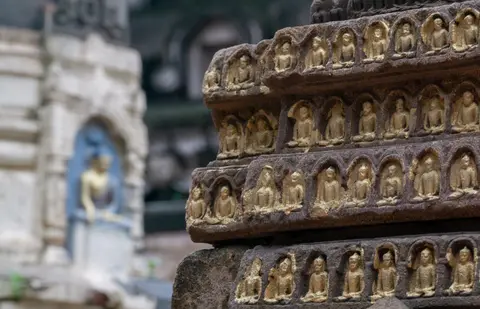
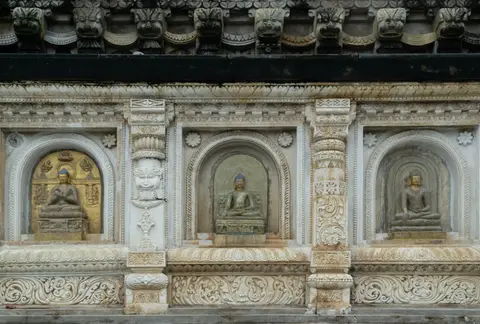
First, look closely along the outer 11-metre basement wall of the main brick temple before entering the dark eastern doorway. Beneath later stucco repairs, alternating moulded bands of geese and honeysuckle motifs support deep arched chaitya niches sheltering seated and standing Buddhas, revealing how late Gupta builders moulded architectural ornament in durable brick and lime plaster rather than carved sandstone.
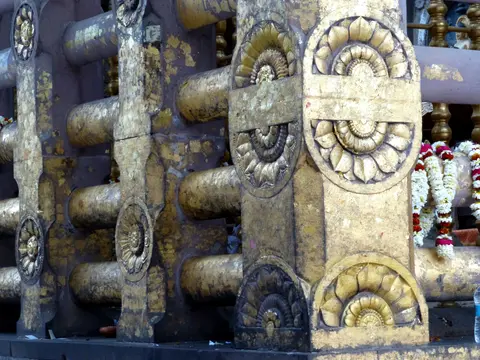
Second, walk along the northern flank of the temple beside Ratnachakrama to inspect the stone lotus medallions set at steady intervals along the raised plinth. Counting the carved stone blossoms lining the 18-pace platform shows how architectural stonework turns the narrative of the Buddha's third meditative week into an explicit physical walkway.
Third, compare the replica sandstone railing posts ringing the temple basement with the weathered originals preserved inside the nearby Bodh Gaya ASI Museum. Inspecting the museum pieces highlights the shallow Sunga bas-relief depth of 150 BCE medallions carved with human faces, animals and stupa vignettes beside much coarser seventh-century Gupta granite extensions.
Pilgrimage Calendar and Rail Links Across Bihar and Uttar Pradesh
Cool dry months from late autumn through early spring offer comfortable temperatures in the sunken courtyard and draw international monastic delegations who gather under the Bodhi Tree for chanting and meditation. Visiting around dawn lets travellers observe lamps lit beside the votive stupa clusters before large midday pilgrim lines fill the eastern steps. Shoes must be left at outer gate racks, and strict rules govern phones, cameras and heavy bags before you descend into the quiet precinct. Plan enough unhurried time to walk slowly along the concentric terrace levels past the seventh-week Rajyatana and fourth-week Ratnaghar markers and pause beside the calm southern Lotus Pond. Outside the gates, spend an extra hour inside the Bodh Gaya ASI Museum comparing its authentic Mauryan and Sunga stone panels with the outdoor courtyard replicas.
Gaya Airport (GAY) stands just 7 kilometres from the temple, while Gaya Junction railway station 16 kilometres north connects Bihar directly across the Gangetic plain on main east-west rail corridors linking eastern India with the central plain. Overland road transfers from either hub run straightforwardly along flat rural highways into Bodh Gaya's temple district. Pair Bodh Gaya's Enlightenment sanctuary with the ancient Sarnath deer park outside Varanasi, 215 kilometres west, or trace other South Asian Buddhist monuments in our UNESCO World Heritage Atlas.