Quick Field Data
- UNESCO Inscription: 2002 · Criteria (i), (iii) and (iv) · Ref. 954
- Scale & Footprint: 60,100 hectares (601 square kilometres) set inside a 4,300-square-kilometre South Sinai Nature Protectorate Reserve cradling Mount Sinai and surrounding granite valleys
- Access & Ticketing: Managed jointly by the autonomous Greek Orthodox Archdiocese of Sinai (Church of Sinai), Egypt's Supreme Council of Antiquities and the South Sinai Nature Protectorate, with controlled visitor routing through a side entrance
- Arrival Logistics: Reached via Sharm El Sheikh International Airport (SSH, 76 kilometres southeast) and highland roads extending 313 kilometres southeast of Cairo
Granite Peaks, Byzantine Walls and Sacred Traditions of Three Faiths
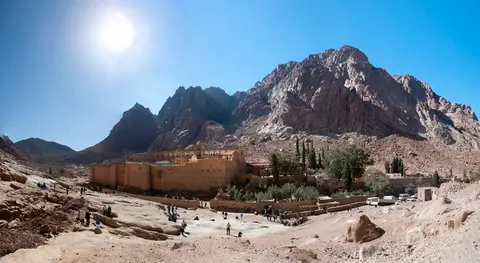
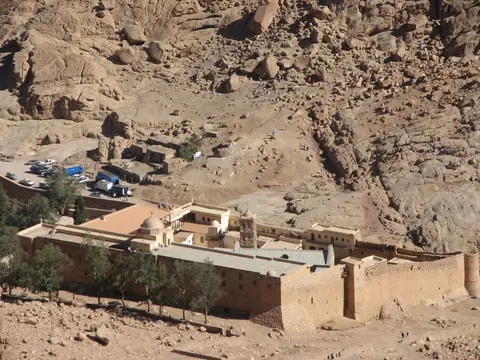
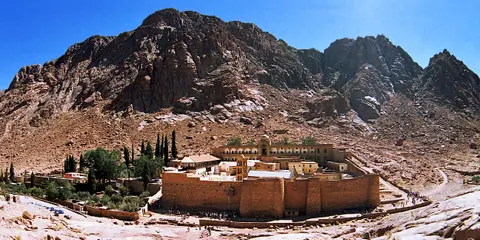
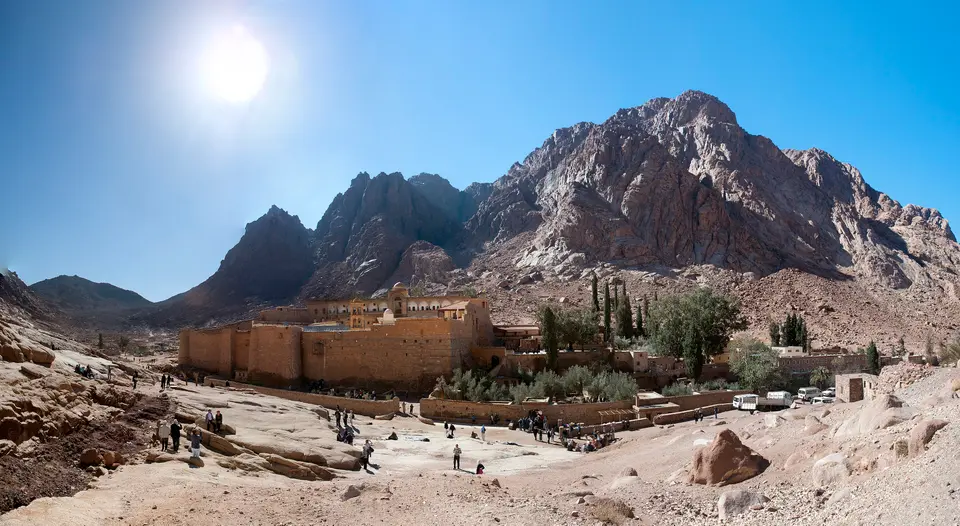
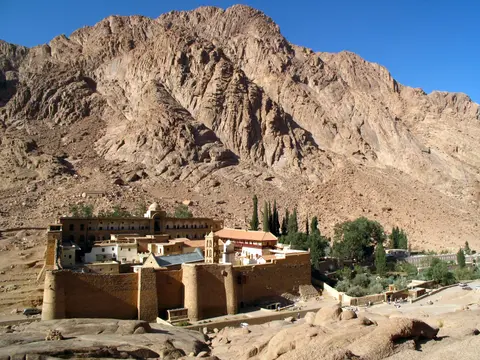
Tucked into a high granite canyon beneath three rugged Sinai peaks, Saint Catherine Area occupies 60,100 hectares revered jointly by Judaism, Christianity and Islam. Directly behind the fortified walls rise Willow Peak (identified by scholars as a candidate for biblical Mount Horeb, roughly 1 kilometre or 0.62 miles west) and Jebel Arrenziyeb (around 1 kilometre south). Mount Sinai (Jabal Musa) stands roughly 2 kilometres or 1.2 miles south, where scripture records Moses receiving the Tablets of the Law. Climbing the historic Path of Moses (Sikket Sayidna Musa) up Jebel Musa passes two arched stone gateways, the Gate of Stephen and the Gate of the Law. Beyond ruined pilgrim chapels, the path reaches an archaeological summit bearing both a small chapel and a mosque.
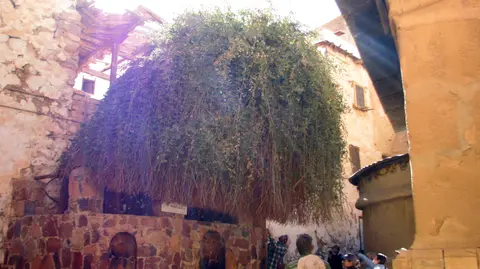
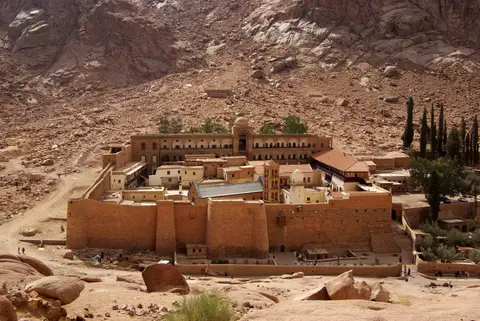
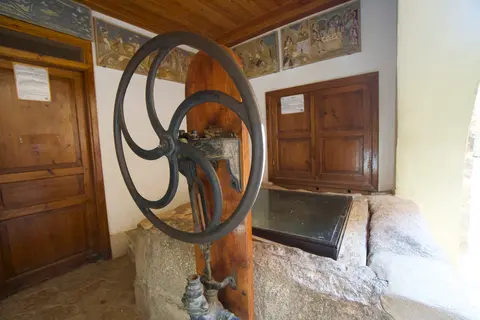
Written records of Christian monastic presence around Mount Sinai begin in 381 to 386 AD with the Latin travel diary Itinerarium Egeriae penned by pilgrim Egeria from western Europe. Empress Consort Helena, mother of Constantine, had already ordered the Chapel of the Burning Bush built over the shrub revered as the bush seen by Moses. Between 548 and 565, Byzantine Emperor Justinian (reigning 527 to 565) erected massive granite perimeter walls around the sanctuary, establishing the world's oldest continuously inhabited Christian monastery still functioning for its original purpose. Inside those walls stand the Burning Bush enclosure and the Well of Moses, traditionally linked to Moses meeting Zipporah and still a primary water source. The compound also preserves the oldest known surviving king post timber roof truss in the world.
During the seventh century, isolated desert hermits disappeared across Sinai, leaving the fortified monastery as the surviving religious stronghold, accessible until the twentieth century only via an elevated door high in the perimeter wall. Centuries after its founding, relics attributed to Saint Catherine of Alexandria were brought to the shrine, and her patronage gradually renamed the monastery, whose patronal festival remains the Feast of the Transfiguration. The monastery drew medieval pilgrims from across Europe during Crusader rule until 1270, enriching dependencies stretching from Egypt and Palestine to Crete, Cyprus, Syria and Constantinople. Despite sharp bitterness between Orthodox and Latin churches during the Crusades, both Byzantine emperors and rulers of the Kingdom of Jerusalem patronised the sanctuary. Inside the precinct stands a Fatimid-era mosque converted from an existing chapel in 1106 AD during the 909 to 1171 Fatimid Caliphate. Used regularly through the thirteenth-century Mamluk period and restored in the early twentieth century, it stands beside a monastery archive holding a copy of the Ashtiname of Muhammad promising protection to the monks. Throughout the Middle Ages, monks of Arab, Greek, Syrian, Slavonic and Georgian backgrounds shared worship here before Ottoman-era regional shifts and depopulation of Transjordanian Christian towns left the community predominantly Greek Orthodox. From the 1480s onward, donations from Wallachian princes supported the sanctuary, later commemorated in the 1895 desert memoir Le désert by French novelist Pierre Loti.
Monastic Libraries, Palimpsest Recovery and Stainless Steel Storage
Founded between 527 and 565, Saint Catherine's monastery library ranks as the world's oldest continuously operating library and preserves the second-largest early collection of manuscripts and codices on Earth after the Vatican Library. Its shelves hold rare works in Greek, Christian Palestinian Aramaic, Syriac, Georgian, Arabic, Ge'ez, Latin, Armenian and Church Slavonic with scarce Hebrew and Coptic volumes. The library also preserves a ninth-century copy of supplementary books from the Georgian Chronicles (Mok'c'evay K'art'lisay). Untouched by Byzantine Iconoclasm and never sacked during medieval wars, the monastery shelters the finest early encaustic icon collection anywhere, including the earliest known Christ Pantocrator and oldest surviving early biblical icon. Over 120 Crusader-style icons produced by thirteenth-century artists working in Sinai also survive here, many evidently painted by Latin monks residing in or around the sanctuary during the Crusader presence.
Modern manuscript scholarship repeatedly focused international attention on these storerooms. In May 1844 and February 1859, German scholar Constantin von Tischendorf located the fourth-century Codex Sinaiticus (collecting further folios in 1855 and 1857 for St. Petersburg and Leipzig). Although long disputed, an 1869 donation act signed in Cairo by Archbishop Callistratus on 13 November confirmed an imperial gift from Tsar Alexander II before Soviet authorities sold the Codex to the British Museum in 1933. Missing fragments later resurfaced inside the monastery's 1975 St George Tower New Finds and again before September 2009. In February 1892, Scottish twin scholars Agnes Smith Lewis and Margaret Dunlop Gibson discovered the Syriac Sinaiticus palimpsest. They returned in 1893 with Cambridge colleagues Francis Crawford Burkitt, Robert Lubbock Bensly and J. Rendel Harris to photograph and catalogue the Syriac and Arabic holdings.
Since 2011, the international Sinai Palimpsests Project has applied narrowband multispectral imaging to erased parchments where monks washed off earlier text with citrus juice or scraped leaves clean for reuse. By June 2018, researchers had identified over 160 palimpsests and recovered more than 6,800 text pages, now hosted digitally by UCLA Library. Recoveries include 108 previously unknown Greek poem pages, the oldest-known medical recipe attributed to Hippocrates, and an apocryphal Transitus Mariae witness. Imaging also revealed lost martyrdom narratives including Patriklos of Caesarea Maritima and rare scripts such as Caucasian Albanian and Christian Palestinian Aramaic. Following extensive architectural renovation assisted by the University of the Arts London's Ligatus Research Centre at the end of 2017, the Saint Catherine Foundation launched the Stainless Steel Boxing Project. The initiative houses 2,187 parchment manuscripts individually inside fireproof 304-grade stainless steel cases cut by guillotine and punched by CNC press. Cases are lined with inert Plastazote foam and acid-free card stock with spines facing away from handles, preventing off-gassing acid damage from wooden boxes, insect attack and fire destruction via oxygen starvation.
Bedouin Stewardship, Rock-Slide Hazards and Modern Conservation
Across fifteen centuries, survival in an extreme mountain basin required continuous collaboration between monks and local Bedouin communities, even amid periods of acute tension such as fifteenth-century Mamluk decline. Monastic numbers dropped from hundreds in the mid-fourteenth century to a few dozen by Martin von Baumgarten's 1507 visit following a Bedouin sack in 1505. Earlier, Dominican theologian Felix Fabri had documented lush monastic orchards of salad herbs, grain, figs, pomegranates, almonds and over three thousand olive trees supplying lamp oil and food. Medieval stonework across the outer fortress displays historic repairs carried out jointly by monastic builders and local Bedouins using granite from surrounding valleys.
Legal protection begins with 1988 Prime Ministerial Decree No. 613 (amended 1994), establishing the 4,300-square-kilometre Nature Protectorate under Egyptian Law 102/1983. Heritage statutes include Protection of Antiquities Law No. 117 of 1983 (amended 2010, 2018 and 2020) and Environment Law No. 4 of 1994. Urban Harmony Law No. 114 of 2006, Building Law No. 119 of 2008 and the 2020 Saint Catherine City Master Plan reinforce site controls. Day-to-day oversight coordinates Egypt's Supreme Council of Antiquities at El-Tor with the Nature Protection Sector, which protects endemic mountain flora and Bedouin agricultural traditions. Monastic stewardship rests with the autonomous Church of Sinai under its abbot-archbishop, whose jurisdiction links uniquely to the Greek Orthodox Patriarchate of Jerusalem. Recent years brought sensitive security and legal developments, including a 2017 attack on a nearby security checkpoint. On 28 May 2025, an Ismailia Court of Appeal cadastre ruling confirmed state antiquity classification and monastic usufruct rights amid Egypt's state-led Great Transfiguration tourism project. Diplomatic reassurance between Cairo and Athens followed on 4 June 2025, ahead of the 30 October 2025 enthronement of Archbishop Symeon VI.
Physical conservation focuses urgently on visitor pressure and mountain hazards. Because heavy visitor traffic threatened both monastic tranquillity and delicate interiors, authorities introduced a controlled side-wall visitor circuit and an inner museum, while shielding the Burning Bush behind a stone protective wall higher than human height after pilgrims repeatedly picked leaves for blessings. Engineers continuously monitor steep granite canyon slopes above the walls to mitigate rock-slides triggered by winter snow-melt, minor earthquakes, heavy foot traffic and rare once-a-century flash floods, while regulating growth in the neighbouring service town of Saint Catherine.
Complex Access Zones and Pilgrim Trails at Saint Catherine
Visiting Saint Catherine Area spans two distinct terrains: the compact sixth-century fortified sanctuary in the valley mouth and the steep granite mountain ascent above it.
| Complex Zone | Key Highlights | Access & Ticket Rule |
|---|---|---|
| Monastery Courtyard & Basilica | Justinian granite ramparts, Chapel of the Burning Bush, Well of Moses, Fatimid mosque (1106 AD) and ancient king post basilica roof | Entered via the regulated side-wall visitor circuit during designated visiting windows; modest clothing covering shoulders and knees required |
| Monastic Icon Gallery & Library Precinct | Encaustic sixth-century Christ Pantocrator, Crusader icons and museum displays drawn from manuscript and liturgical treasuries | Inner museum and gallery operate controlled visitor routes protecting light- and humidity-sensitive artworks; library archives remain scholar-only |
| Path of Moses & Jebel Musa Summit | Sikket Sayidna Musa stone stairway, Gate of Stephen, Gate of the Law, ruined chapels and summit chapel-mosque pair | Requires registration with Protectorate guards and accompaniment by local Bedouin mountain guides along designated trail corridors |
| Saint Catherine Town & Protectorate Basin | Wadi gardens, Bedouin orchards, Nature Protectorate headquarters and surrounding Willow Peak and Jebel Arrenziyeb trails | Open service valley outside monastery walls; backcountry trekking inside the wider reserve requires Protectorate permits and guides |
Three Historic and Technical Details to Observe at Saint Catherine
Looking closely inside the walls and up the granite canyon reveals physical survivals rarely preserved elsewhere in the Mediterranean:
- World's Oldest Surviving King Post Roof Truss: Inside the main basilica church ordered under Emperor Justinian between 548 and 565, look upward toward the original carved cypress ceiling beams, preserving the earliest intact king post structural truss known in architectural history.
- Fatimid Mosque Standing Beside the Christian Basilica: Notice the small stone mosque (converted in 1106 AD) tucked inside the fortified precinct walls opposite the church bell tower, visually illustrating centuries of shared Abrahamic reverence and medieval protection compacts.
- Protective Wall Around the Burning Bush: Inspect the high stone masonry wall encircling the sacred bramble outside the basilica apse, built roughly two decades before UNESCO reviews to prevent devotional leaf-picking from killing the rootstock while allowing open-air sunlight.
Seasonal Timing and Linking Saint Catherine with Cairo
Sitting high inside the South Sinai massif, Saint Catherine Area experiences sharply cooler weather than Red Sea coastal resorts, with winter snow-melt and bitter pre-dawn summit winds contrasting against hot midday sun in summer valleys. Spring and autumn provide crisp mountain visibility for ascending the Path of Moses and mild courtyard temperatures when visiting the monastery, while Egyptian administrative residency rules requiring 10 years of residence for monastic leadership remain closely watched together with civic heritage initiatives.
Positioned 76 kilometres inland from Sharm El Sheikh International Airport (SSH) and 313 kilometres across Sinai from Cairo, Saint Catherine pairs naturally with Egypt's Islamic and Coptic monuments documented in our Cairo travel guide. Discover other enduring monastic fortresses and desert sacred sites across our UNESCO World Heritage Atlas.