Quick Field Data
- UNESCO Inscription: Cultural site inscribed in 1999 (Ref. 913) under criteria (i) and (iv).
- Scale & Footprint: 50.8 hectares in Nikko, Tochigi Prefecture, spanning 103 religious structures (9 National Treasures and 94 Important Cultural Properties) across Futarasan-jinja, Tosho-gu, and Rinno-ji within a 373.2-hectare forested buffer zone.
- Access & Ticketing: Managed separately by the three religious precincts, the grounds operate with technical oversight from the Foundation for Preserving Nikko Shrines and Temples. Individual gates and mausolea sell separate tickets, including Sanbutsudo, Taiyuin Reibyo, Tosho-gu, and Shinkyo Bridge. Check official shrine and temple notices for restoration scaffolds and entry closures.
- Arrival Logistics: Narita International Airport (NRT, 129 kilometres southeast) and Tokyo Haneda International Airport (HND, one hundred and thirty-four kilometres south) handle major international and domestic air traffic. Closer Fukushima Airport (FKS, ninety kilometres north) carries limited scheduled routes, while central Tokyo lies 119 kilometres south.
Sacred Mountain Origins from Shodo Shonin to the Tokugawa Shogunate
Positioned on forested mountain slopes in northern Kanto's Tochigi Prefecture, Nikko's sanctuaries grew out of ancient mountain worship long before Tokugawa carpenters carved a single gilded beam. As far back as the Yayoi period, agricultural communities across the plains below revered volcanic Mount Nantai (also called Futarasan) as a living kami dwelling (go-shintai). Its mountain streams supplied water and life to lowland rice paddies, while the peak's steep outline echoed phallic stone rods uncovered at earlier Jomon sites. In 766, Buddhist monk Shodo Shonin (735 to 817) sought mountain solitude deep in Tochigi to found the monastic base that became Rinno-ji. He followed in 767 with Futarasan-jinja shrine and in 782 with an inner sanctuary (Oku-no-miya) atop Mount Nantai, where archaeologists later recovered Nara-period ritual instruments and ancient relics confirming its early origin.
Subsequent visits by Buddhist masters Kukai (founding Takino Shrine) and Ennin (building the Sanbutsudo) anchored Nikko as a major Tendai training centre merging ascetic Shugendo mountain worship with Buddhist cosmology, collectively termed the Nikko-sansha. Although warrior clans such as the Late Hojo and Toyotomi Hideyoshi later seized shrine estates during the Sengoku era, Nikko rose to unmatched national prominence in the early 17th century following the death of Tokugawa Ieyasu (1543 to 1616), founder of the Tokugawa shogunate. Fulfilling Ieyasu's desire for mountain guardianship, his son Tokugawa Hidetada commissioned retainer Todo Takatora to construct the initial Tosho-gu mausoleum in 1617 while rebuilding adjacent Futarasan Shrine. Third shogun Tokugawa Iemitsu (1604 to 1651) radically expanded Tosho-gu into its lavishly carved form and later received his own shrine-style mausoleum, Taiyuin Reibyo, completed in 1653.
Throughout the Edo period, Tokugawa rulers reinforced political legitimacy through stately imperial processions marching from Edo along the Cedar Avenue of Nikko (Nikko Kaido). Thousands of towering cryptomeria trees planted in the early 17th century still frame the hillside sanctuaries today, uniting architecture and forest inside a single protected cultural landscape inside Nikko National Park.
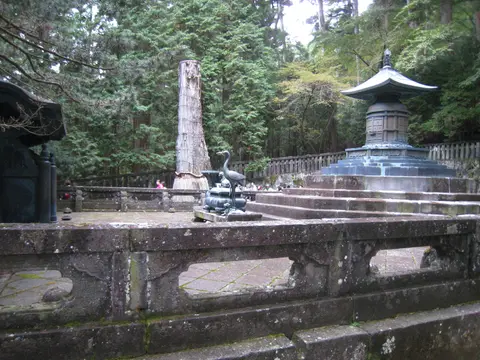
Gongen-zukuri Mausolea Across Tosho-gu, Futarasan, and Rinno-ji
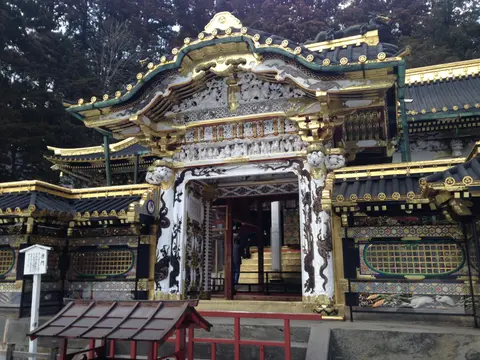
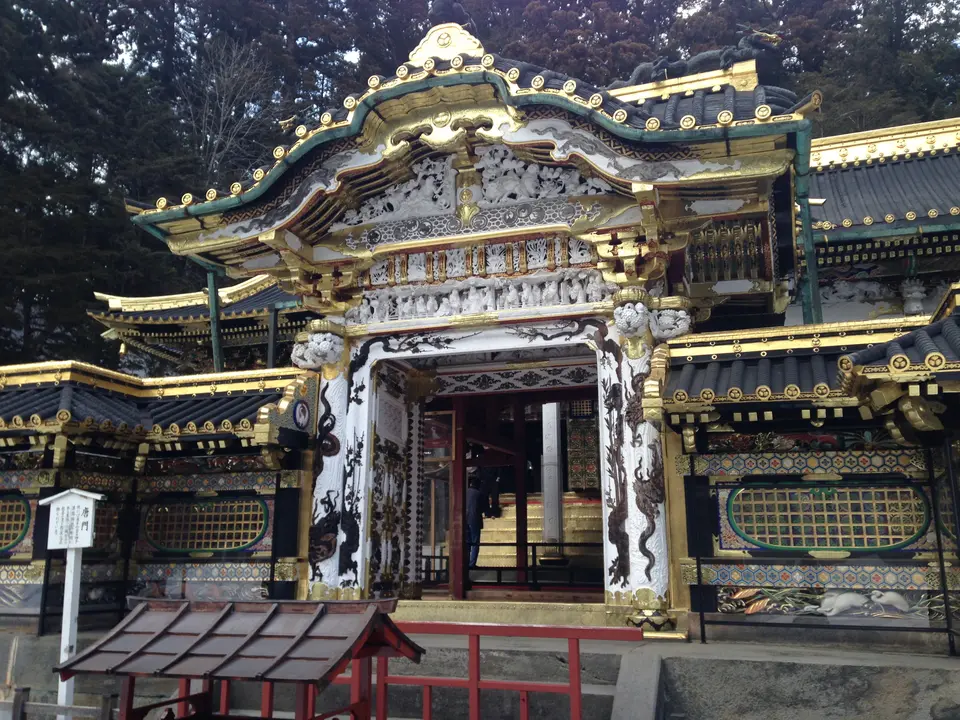
Three overlapping religious institutions hold the 103 designated buildings across the 50.8-hectare hillside site, carefully arranged along rising forested terraces to create shifting visual vistas. Tosho-gu occupies the central slope with 42 nominated structures, comprising 8 National Treasures and 34 Important Cultural Properties dedicated to the deified spirit of Tokugawa Ieyasu. Entering past stone torii and the five-storey pagoda leads uphill to the ornate Yomeimon gate, nicknamed higurashi no mon no kei because spectators could examine its deep-relief painted surfaces until sundown without tiring. Beyond the white-ornamented Karamon gate, deep timber corridors and the main halls lead to hundreds of stone steps ascending through dense cryptomeria woods to a plain bronze urn holding Ieyasu's remains beneath an imperial torii inscribed by Emperor Go-Mizunoo. The shrine also holds two National Treasure swords, and in 2008 Yuri Kawasaki became the first female Shinto priest ever to serve at Tosho-gu.
West of Tosho-gu stands Futarasan-jinja, retaining 23 Important Cultural Property structures on the grounds where it was relocated in 1617. Both Futarasan and Utsunomiya Futarayama Jinja claim the historic ichinomiya rank of former Shimotsuke Province mentioned in the 927 AD Engishiki, sparking long-standing scholarly debate. After losing extensive medieval estates during Sengoku warfare to the Late Hojo clan and Toyotomi Hideyoshi, Futarasan regained prosperity when Tokugawa Hidetada and allied daimyo rebuilt its main halls beside Tosho-gu. The shrine honours Okuninushi-no-Mikoto (deity of agriculture, medicine, nation-building, and protective magic), Tagorihime no Mikoto (one of the three Munakata goddesses), and Ajisukitakahikone (deity of agriculture and thunder). Spanning 3,400 hectares (second in area only to Ise Grand Shrine), its wider precincts cover Kegon Falls and eight Nikko peaks: Mt. Nantai, Mt. Nyoho, Mt. Taro, Mt. Oku-Shirane, Mt. Maeshirane, Mt. Omanago, Mt. Komanako, and Mt. Akanagi. Within these bounds stand 11 Important Cultural Property buildings at the main shrine, seven at the 1096 Middle Shrine on Lake Chuzenji (reconstructed 1699), the summit Oku-no-miya, and two National Treasure swords. Below the main hillside compound, Futarasan maintains the vermilion-lacquered Shinkyo Sacred Bridge over the Daiya River (28 metres long, 7.4 metres wide, and 10.6 metres high), honoured among Japan's three finest bridges. Legend recounts that priest Shodo could not ford the swollen river during his 766 ascent of Mount Nantai. The ten-foot-tall deity Jinja-Daiou released blue and red snakes from his right arm that formed a rainbow sedge bridge. Known as Yamasugeno-jabashi (Snake Bridge of Sedge), it follows its 1636 pattern and opened to the public in 1973 after centuries restricted to Imperial court messengers.
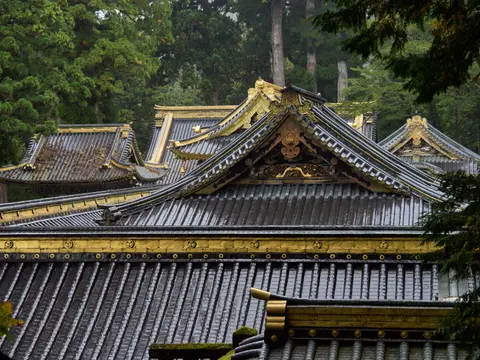
Forming the Buddhist third pillar, Rinno-ji remains a living centre for Tendai ascetic training and contributes 38 buildings to the World Heritage count. Its National Treasure complex unites the Honden, Ainoma, and Haiden of Taiyuin Reibyo, lauded by UNESCO as a pure masterpiece of architecture and decoration, alongside 37 Important Cultural Properties. Inside Rinno-ji's monumental Sanbutsudo (Three Buddha Hall), gold-leafed statues of Amida, Senju Kannon, and Bato Kannon represent Buddhist manifestations of the three mountain kami of Futarasan. Both Tosho-gu and Taiyuin Reibyo bring the Edo-period Gongen-zukuri plan to full maturity, joining the main sanctuary (Honden) and worship hall (Haiden) via a connecting chamber (Ainoma) under layered black, gold, and vermilion lacquer eaves.
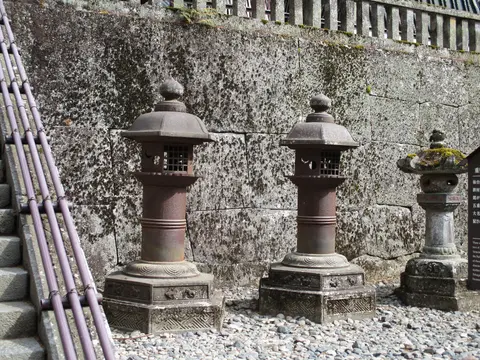
Earthquake Pagodas, Active Rituals, and Strict Heritage Conservation
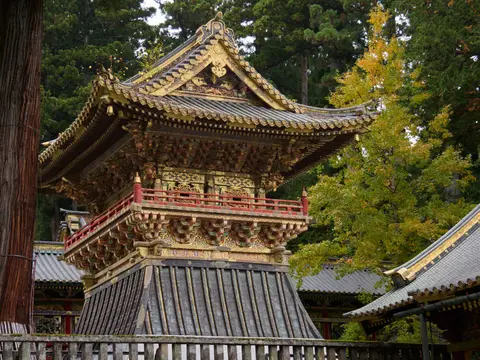
Despite opulent decoration, Nikko's master builders engineered hidden resilience into wooden frames exposed to mountain moisture, seismic tremors, and fire hazards. Tosho-gu's five-storey pagoda, originally donated by a daimyo in 1650 and rebuilt in 1818 after fire destroyed the first tower, tiers its five ascending eaves to represent earth, water, fire, wind, and void. Hanging down through the centre of that timber tower, a heavy central wooden column known as a shinbashira suspends from iron chains rather than resting solidly on the ground, swaying independently to absorb seismic shockwaves during earthquakes.
Active worship sustains both Shinto and Tendai Buddhist traditions across every season. Each spring and autumn, Tosho-gu reenacts Edo-era shogunal marches with processions of a thousand warriors, while Futarasan-jinja observes its annual main festival from April 13 to April 17. Inside Rinno-ji's Great Goma Hall, Tendai priests preserve the secret Chinjō Yasha ritual handed down from Saicho's four esoteric Tendai rites. The hidden state-protector deity Chinjō Yasha, a manifestation of Vaisravana, is unveiled once every nine years in Nine Star Astrology's Go-o Chugu year, most recently on 3 February 2023. Adjacent to Shoyo-en Garden, the Homotsu-den Treasure House exhibits roughly 50 early Buddhist artworks at a time. It also guards the 59 Nara- and Heian-period handscrolls of the Daihatsu nehankyo shuge, a designated National Treasure.
Conservation rests on continuous traditional restoration overseen by the Foundation for Preserving Nikko Shrines and Temples under Japan's 1950 Cultural Properties Law and 1957 Natural Parks Law. Whenever fires, storms, falling trees, or earthquakes damage timber structures, conservation architects and engineers employed by the Foundation follow original plans and archived historical records. Repairs preserve exact colour palettes, lacquerwork, decorative reliefs, traditional building techniques, and original material species wherever possible across active religious sanctuaries. Reserved Forest, Scenic Zone, and Nikko City Townscape Ordinance controls safeguard the 50.8-hectare core and 373.2-hectare buffer zone along surrounding mountain ridges, overlapping Nikko National Park outside the southeast urban margin. Automatic fire alarms, hydrants, lightning arresters, and organised shrine fire brigades operate alongside public fire services. Technical and financial guidance comes from Japan's Agency for Cultural Affairs, Tochigi Prefecture, and Nikko City.
Nikko Sanctuary Compounds, Sub-Shrines, and Combined Ticketing
Visitors walk smoothly between all three religious precincts via broad cedar-shaded stone stairways rising gently from the Daiya River bridgehead up the hillside slope.
| Complex Zone | Key Highlights | Access & Ticket Rule |
|---|---|---|
| Shinkyo Sacred Bridge (Daiya River) | 28-metre vermilion bridge rebuilt on its 1636 design above gorge rapids | Paid pedestrian crossing over the bridge; riverbank viewing free from road bridge |
| Rinno-ji Temple & Taiyuin Reibyo | Sanbutsudo Three Buddha Hall, Shoyo-en Garden, Homotsu-den treasury, and Iemitsu's 1653 tomb | Separate temple precinct tickets for Sanbutsudo, Shoyo-en, and Taiyuin Reibyo |
| Nikko Tosho-gu Precinct | Five-storey pagoda, sacred horse stable, Yomeimon, Karamon, and Ieyasu's bronze urn tomb | Main precinct admission required; Nemuri-neko and upper tomb pathway included or tiered |
| Futarasan-jinja Main Precinct | 1617 main sanctuary halls, historic ritual lanterns, and forest approach paths | Outer courtyard accessible freely; inner sacred garden charges small shrine entry |
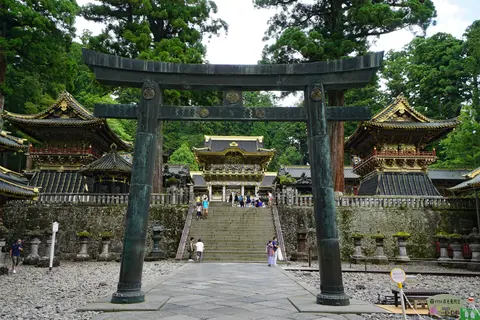
Three Carved and Structural Details to Examine at Nikko
Beneath the dazzling gold leaf and cedar canopy, three specific spots reveal both playful Edo sculpture and quiet structural engineering.
- Three Wise Monkeys on the Sacred Stable: On the unlacquered wooden frieze of Tosho-gu's sacred horse stable, inspect the carved relief sequence depicting monkeys covering eyes, ears, and mouth, illustrating Confucian Analects precepts within an everyday military stablehouse.
- Nemuri-neko Above the Sakashitamon Corridor: Just beyond Yomeimon above the gateway leading toward the hundreds of stone steps up to Ieyasu's urn, spot the modest painted woodcarving of a sleeping cat attributed to Hidari Jingoro, carved in quiet contrast beside sparrows on the reverse panel.
- Suspended Shinbashira Pagoda Column: Check informational displays beside Tosho-gu's 1818 five-storey pagoda showing how the massive central timber mast hangs clear of the ground on metal chains inside the frame to dampen earthquake vibration.
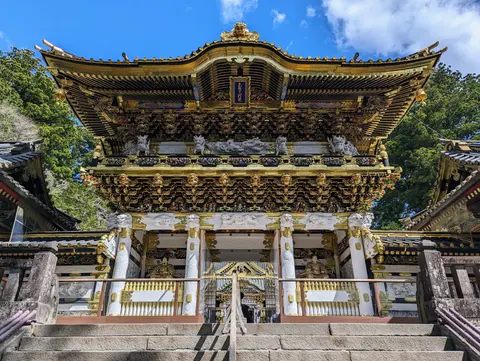
Cedar Avenue Arrivals, Mountain Seasons, and Pairing with Tokyo
Mountain elevation cools Nikko noticeably compared with Tokyo's lowland plain. Spring brings delicate blooms around April and May together with Futarasan's mid-April festival, summer shelters shaded cedar walks from lowland heat, and late October to November colours maple trees around Taiyuin, Shoyo-en, and the Daiya River gorge in intense crimson and gold. Winter dustings of snow accentuate the vermilion and black-lacquered eaves, though stone staircases require cautious footwear.
Limited express trains make Nikko an easy mountain sanctuary extension when planning urban itineraries in our Tokyo travel guide, situated 119 kilometres south with fast rail links to Narita and Haneda airports. Readers tracing further historic shrines, castles, and forest temples across East Asia can explore neighbouring sites inside the UNESCO World Heritage Atlas.