






















Begijnhof Beguinage, Minnewater Lake & Hidden Godshuizen Walk
Walk the peaceful southern gateway of Bruges: the UNESCO-listed 1245 Princely Beguinage, Minnewater (Lake of Love), and six hidden 14th-century Godshuizen almshouses.
In the southern curve of the Bruges canal ring, where the waters of the Ghent barge canal widen into the tree-lined basin of Minnewater before splitting into the inner Reien, lies the city's most serene architectural landscape. Here you can cross a three-arched stone bridge into the 1245 Princely Beguinage Ten Wijngaerde (Begijnhof), inscribed by UNESCO as part of the Flemish Béguinages World Heritage site. Outside its gates, you can follow a quiet path through six medieval Godshuizen (almshouses) where charitable housing founded by 14th-century trade guilds still operates today.
| Stop on the Sanctuary Walk | Admission Cost (Nov 2026) | Opening Hours | What Makes It Special |
|---|---|---|---|
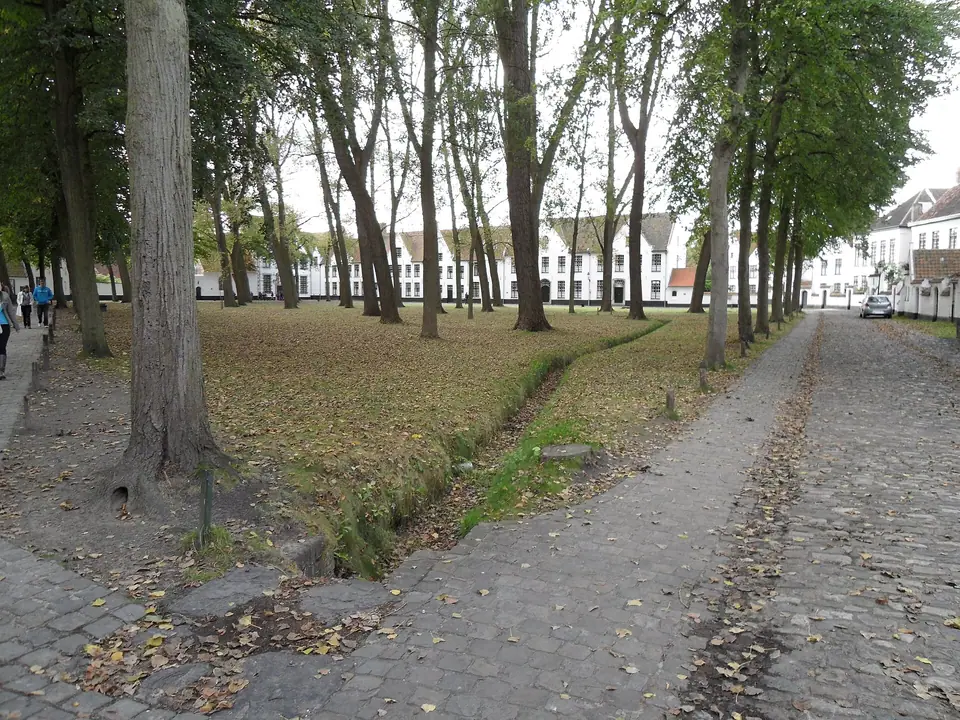
| 1. Princely Beguinage Ten Wijngaerde. | Courtyard & Church free; Beguine House Museum €2.00. | Courtyard gates open daily 06:30 to 18:30. | 30 whitewashed 16th-to-18th-c. houses around a silent poplar and daffodil lawn. |
| 2. Minnewater (Lake of Love) & Sashuis. | Free public park &. Bridge 24/7. | Always open (best at 08:00 or sunset). | 1519 Poertoren gunpowder tower, 1584 Sashuis lock house &. Resident swans. |
| 3. Godshuizen De Nieuwe Pastorie & Fontaine. | Free courtyard access (respect residents' silence). | Daytime hours (09:00 to 18:00). | 17th-century walled charity cottages on Boeveriestraat and Kreupelenstraat. |
| 4. Godshuizen De Meulenaere & Sint-Jozef. | Free courtyard access. | Daytime hours (09:00 to 18:00). | 1613 flower-filled brick courtyard on Nieuwe Gentweg 8 to 22. |
The Princely Beguinage Ten Wijngaerde (Begijnhof, Founded 1245)
Cross the arched stone Wijngaerde bridge at the northern end of Minnewater and pass beneath the 1776 gateway (crowned by a statue of St Elizabeth of Hungary) into another century. Founded in 1245 by Countess Margaret of Constantinople, the Prinselijk Begijnhof Ten Wijngaerde ("Princely Beguinage of the Vineyard") was built as a self-contained, walled village for Beguines (begijnen), . These unmarried and widowed lay religious women of the Middle Ages dedicated their lives to prayer, nursing, and textile work without taking irreversible monastic vows of poverty or surrendering their personal property.
Unlike nuns in a closed convent, each Beguine earned her own living and rented her own cottage around the central lawn of tall poplar trees. She also remained free to leave the community and marry if she chose. Bruges's last traditional Beguine passed away in 1928, and the thirty whitewashed brick houses mostly date from the 16th to 18th centuries. Since 1927, the community has been cared for by Benedictine sisters of the Priory of Ten Wijngaerde together with single women of Bruges. Walking the cobbled perimeter path around the orchard lawn is free daily between 06:30 and 18:30. Notice the signs asking visitors to maintain silence inside the enclosure. Immediately to the right of the main gate, pay €2.00 (as of November 2026, open 10:00 to 17:00) to step inside the Begijnhuisje (Beguine's House Museum). Inside, you can see a preserved 17th-century kitchen, a lace-pillow parlour, and an enclosed courtyard garden.
Minnewater ("Lake of Love"): Medieval Harbour and the Legend of Minna
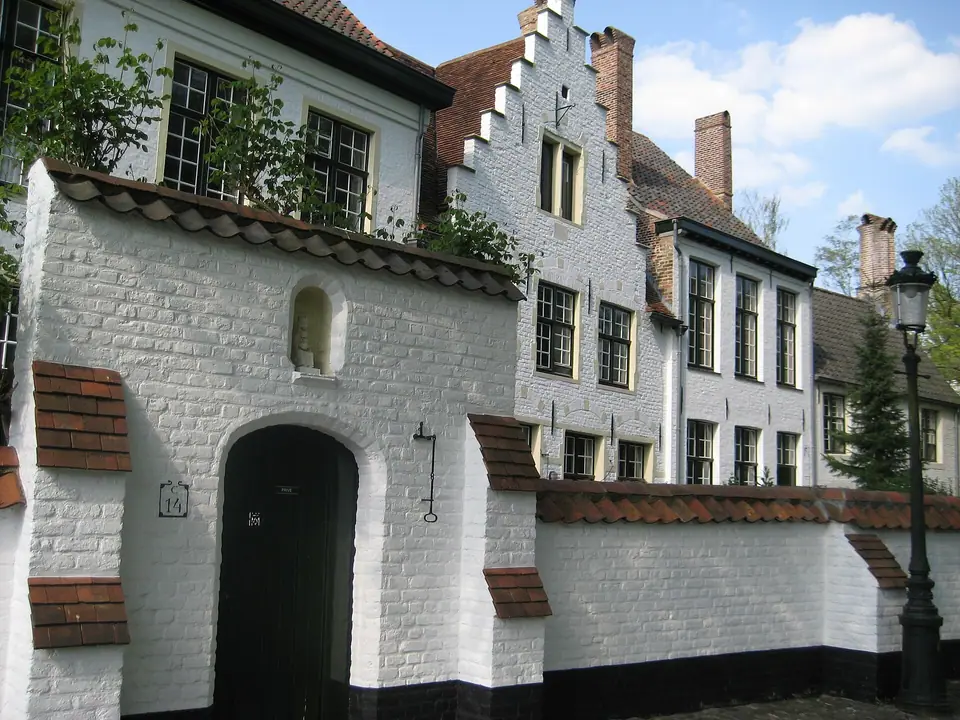
Stepping back out of the Beguinage bridge brings you directly onto the banks of Minnewater. Nineteenth-century Romantic poets translated Minnewater as "Lake of Love" and invented the legend of the maiden Minna. In reality, the basin's true history is far more practical, and equally fascinating.
During the Middle Ages, Minnewater functioned as an engineered hydraulic reservoir and inner barge harbour where the water levels of the Reie were regulated before entering the city canals. Walk across the long stone Minnewaterbrug (Lovers' Bridge) at the southern end of the lake for the classic panorama of the 1893 neo-Gothic Kasteel de la Faille and the Church of Our Lady spire. At the western end of the bridge stands the 1398 to 1519 Poertoren (Gunpowder Tower), part of the medieval water-gate fortifications. At the northern lock stands the 1584 Sashuis (Lock-Keeper's House), whose five iron sluice gates still control water flow into the Dijver today.
How to find Bruges's hidden Godshuizen (14th-to-17th-Century Almshouses)
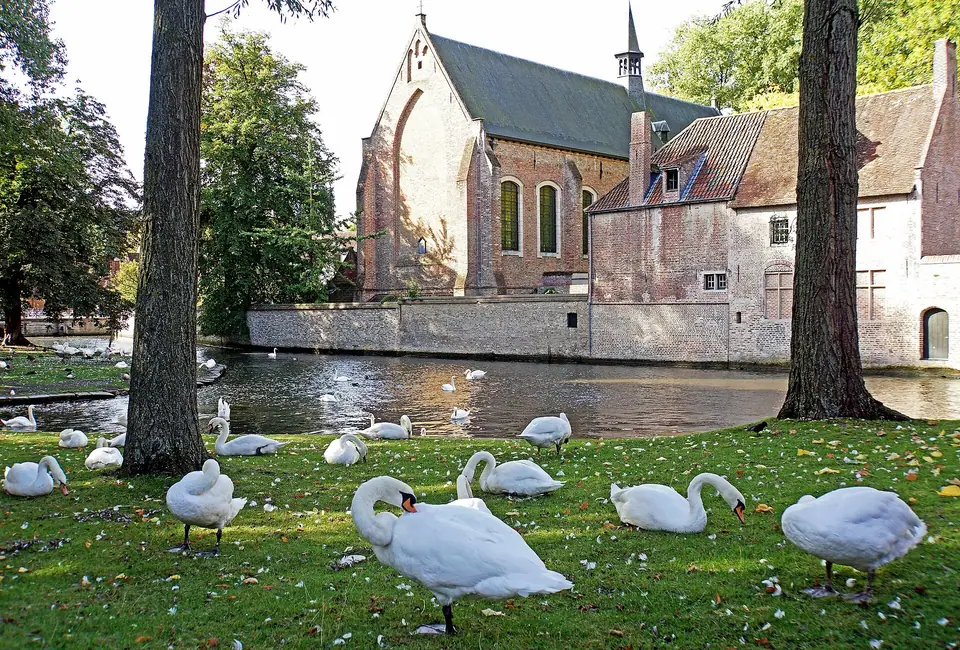
While thousands of visitors walk through the Begijnhof daily, very few know that Bruges preserves 46 historic Godshuizen ("Houses of God" or almshouses) scattered down quiet residential side streets. Beginning in the 14th century, wealthy Bruges merchants, nobles, and craft guilds endowed walled clusters of tiny whitewashed brick cottages around flower gardens. These charity foundations provided free, dignified housing for elderly guild members and widows in exchange for daily prayers for the founder's soul.
Astonishingly, more than forty of these medieval complexes are still owned by the Bruges Public Centre for Social Welfare (Mintus) and modernized inside as social housing for local seniors today. Because their outer street doors look like private walls, you can walk right past them unless you know which wooden doors to push open during daytime hours (09:00 to 18:00, always enter quietly and never look into windows):
- De Meulenaere & Sint-Jozef (Nieuwe Gentweg 8 to 22, 4 minutes northeast of Minnewater). Founded in 1613 and 1699, this double complex of 24 whitewashed cottages surrounds one of the prettiest manicured boxwood-and-rose gardens in Bruges.
- Spanoghe (Katelijnestraat 8, 2 minutes north of the Begijnhof). Push open the unassuming door right on busy Katelijnestraat to discover a silent 1680 courtyard of five tiny brick houses.
- De Pelikaan (Groenerei 8 to 12). Built in 1714 along the quiet Groenerei canal, marked above its doorway by a carved stone relief of a pelican feeding its chicks with its own blood (symbolising Christian charity).
- De Vos ("The Fox", Noordstraat 6 to 14, near Walplein). This almshouse was founded in 1713 with a central pump and brick chapel right behind De Halve Maan Brewery.
While walking the cobbled path inside the Princely Beguinage, step quietly into the 1605 Gothic-Baroque Beguinage Church of St Elisabeth on the eastern side of the green. The simple whitewashed interior reflects the contemplative daily liturgy of the Benedictine sisters who sing Vespers here in the late afternoon.
On the eastern side of Minnewater Park, look for the brick facade of Huize Minnewater and the quiet footpath along the outer moat. Walking ten minutes northeast brings you to the 1369 Gentpoort (Ghent Gate), one of Bruges's four surviving medieval city gates.
To map a longer self-guided almshouse walk across the city, pick up the printed Godshuizen walking map (€3.00). Copies are sold at the Visit Bruges tourist office inside the ’t Zand Concertgebouw and at Brugge Railway Station.
Where it is
- 1Begijnhof Beguinage, Minnewater Lake & Hidden Godshuizen Walk
- Ostend-Bruges International Airport (OST) · about 24 km from here in a straight line
- Directions in Google Maps
Traveller tips
Real advice from people who have been to Bruges. Every tip is read by our team before it goes live.
No tips yet. Been here? Yours could be the first.
Thank you! Your tip will appear here after a quick review.
More in Bruges
Continue exploring Bruges with related neighbourhood, food, and planning guides
Flemish Primitives in Bruges: Groeningemuseum, Memling & Michelangelo
Bruges, Belgium
Basilica of the Holy Blood, Veneration Schedule & Jeruzalemkerk Guide
Bruges, Belgium
De Halve Maan Brewery, Underground Beer Pipeline & Historic Taverns
Bruges, Belgium
What to Eat in Bruges: Certified Chocolatiers, Flemish Stews & Waffles
Bruges, Belgium
