




















Flemish Primitives in Bruges: Groeningemuseum, Memling & Michelangelo
Explore Bruges's three world-class art collections along Dijver and Mariastraat: Jan van Eyck at the Groeningemuseum, Hans Memling at St John's Hospital, and Michelangelo's Madonna.
In the 15th century, while Florence pioneered linear perspective in tempera and fresco, workshops in Burgundian Bruges transformed northern painting. Court painter Jan van Eyck (c. 1390 to 1441), Petrus Christus, Hugo van der Goes, Hans Memling, and Gerard David perfected translucent oil glazes on Baltic oak panels. Known to art history as the Flemish Primitives (Early Netherlandish painters), their mastery of microscopic detail and reflected light made Bruges panels the most coveted luxury artworks in Renaissance Europe. Today, three monuments within a 300-metre walk along Dijver and Mariastraat display these masterpieces in their original city.
| Museum / Monument | Single Ticket / Pass (Nov 2026) | Hours & Closed Day | essential Masterworks Inside |
|---|---|---|---|
| 1. Groeningemuseum (Dijver 12). | €15.00 adult (or free with €33 Musea Brugge Card). | 09:30 to 17:00; Closed Tuesdays. | Jan van Eyck's Madonna with Canon van der Paele (1436), Bosch's Last Judgement & Gerard David. |
| 2. Museum Sint-Janshospitaal (Mariastraat 38). | €15.00 adult (or free with €33 Musea Brugge Card). | 09:30 to 17:00; Closed Mondays. | Hans Memling's Shrine of St Ursula (1489), St John Altarpiece, 13th-c. oak attic &. Pharmacy. |
| 3. Church of Our Lady (Onze-Lieve-Vrouwekerk). | Nave free; Museum zone €8.00 (or free with Musea Card). | Mon to Sat 09:30 to 17:00, Sun 13:30 to 17:00 (Museum zone). | Michelangelo's marble Madonna and Child (1504) & Burgundian ducal tombs. |
| 4. Gruuthusemuseum (Dijver 17). | €15.00 adult (or free with €33 Musea Brugge Card). | 09:30 to 17:00; Closed Tuesdays. | 15th-century wooden prayer oratory connecting directly into the Church of Our Lady. |
Groeningemuseum: Jan van Eyck, Hieronymus Bosch, and Gerard David
Set back inside a quiet, tree-shaded garden courtyard at Dijver 12, the Groeningemuseum (€15.00 adult or included in the €33.00 Musea Brugge Card as of November 2026, closed Tuesdays) traces six centuries of Belgian visual art. Its rooms span from the 1430s through 20th-century Flemish Expressionism and Surrealism. Head straight to Galleries 1 through 4, where the lighting is calibrated to illuminate the early oak panels:
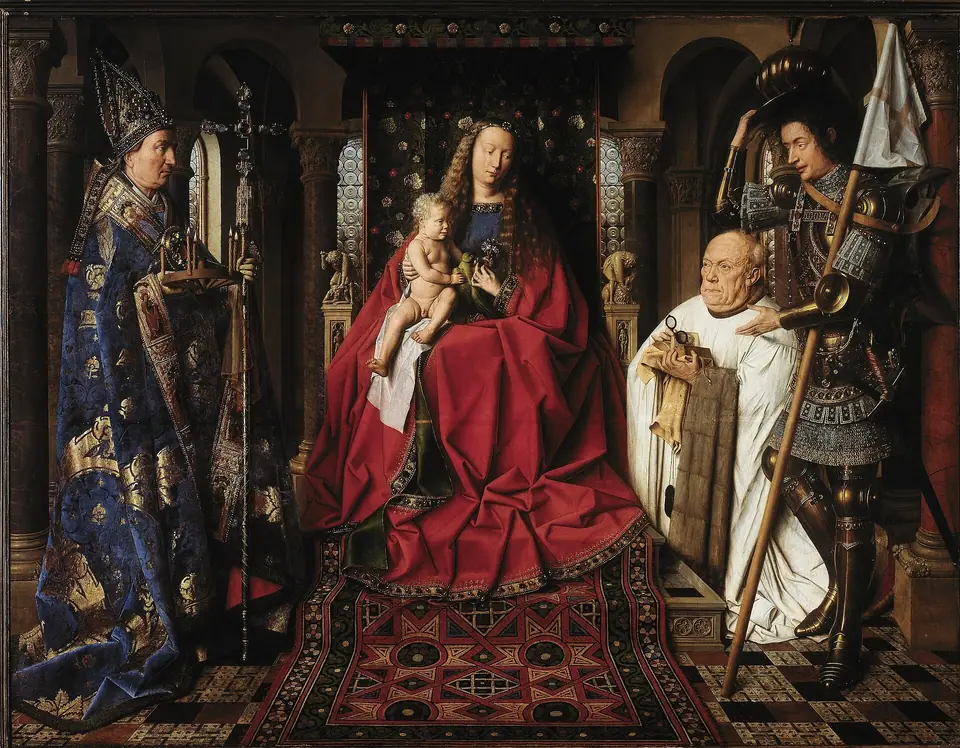
- Jan van Eyck, Madonna with Canon Joris van der Paele (1436). Painted in van Eyck's Bruges studio for the papal scribe Joris van der Paele, this work served as a memorial altarpiece in Saint Donatian's Cathedral. It remains the largest painting van Eyck ever completed outside the Ghent Altarpiece. Step close to inspect the optical realism that stunned 15th-century Europe: the elderly canon holds a pair of convex reading glasses whose lens distorts the Latin letters on his prayer book beneath it. Individual grey stubble hairs and swollen temporal veins mark his face. A rich Oriental carpet curls at the Virgin's feet. Even the red-robed Virgin and Child are reflected upside-down in the polished breastplate and shield of St George. Nearby hangs van Eyck's intimate 1439 portrait of his wife, Margaret van Eyck, inscribed on its original frame with his personal motto, "Als Ich Can" ("As best I can").
- Gerard David, The Judgement of Cambyses (1498). The Bruges aldermen commissioned this twin panel for the courtroom of the Town Hall on Burg Square as a warning against judicial corruption. It depicts the Persian king Cambyses arresting the bribed judge Sisamnes and having him flayed alive in public.
- Hans Memling, Hugo van der Goes, and Hieronymus Bosch. Do not miss Memling's serene 1484 Moreel Triptych, featuring the wealthy Bruges spice merchant Willem Moreel with his wife and eleven children. Nearby hang Hugo van der Goes's emotionally charged Death of the Virgin and Hieronymus Bosch's fantastical Last Judgement triptych.
Museum Sint-Janshospitaal: Hans Memling in His Original 12th-Century Hospital
Five minutes west at Mariastraat 38 stands the Sint-Janshospitaal (Museum St John's Hospital) (€15.00 or Musea Brugge Card, closed Mondays). Founded in the mid-12th century to care for indigent pilgrims and sick townspeople, its cavernous brick hospital wards remained in medical use until 1976. The Augustinian nuns and brothers who governed the hospital believed caring for the soul through art was as vital as caring for the body.
Inside the medieval hospital chapel and wards hangs the world's finest in-situ group of paintings by German-born Bruges master Hans Memling (c, 1430 to 1494). The centrepiece is the 1489 Shrine of St Ursula, a miniature carved gothic cathedral of gilded oak. Its six painted side panels narrate the legend of St Ursula travelling down the Rhine to Cologne and Rome with razor-sharp architectural accuracy. Beside it hang the monumental 1479 St John Altarpiece (whose background depicts Bruges's medieval crane unloading wine barrels), the 1487 diptych of Maarten van Nieuwenhove (with a convex mirror reflecting the room behind them), and the Triptych of Jan Floreins. Before leaving, take the lift or stairs up to the 13th-century monumental oak roof truss, one of the oldest timber roof frames in Europe. Afterwards, cross the courtyard into the preserved 1645 monastic Apothecary lined with Delftware herbal jars.
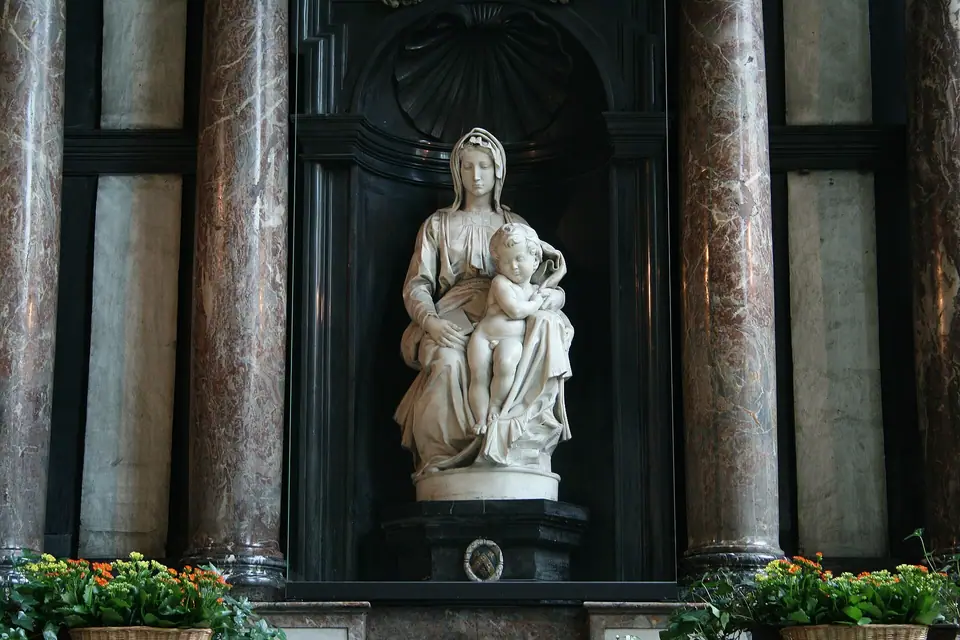
Church of Our Lady: Michelangelo's Bruges Madonna and the Burgundian Tombs
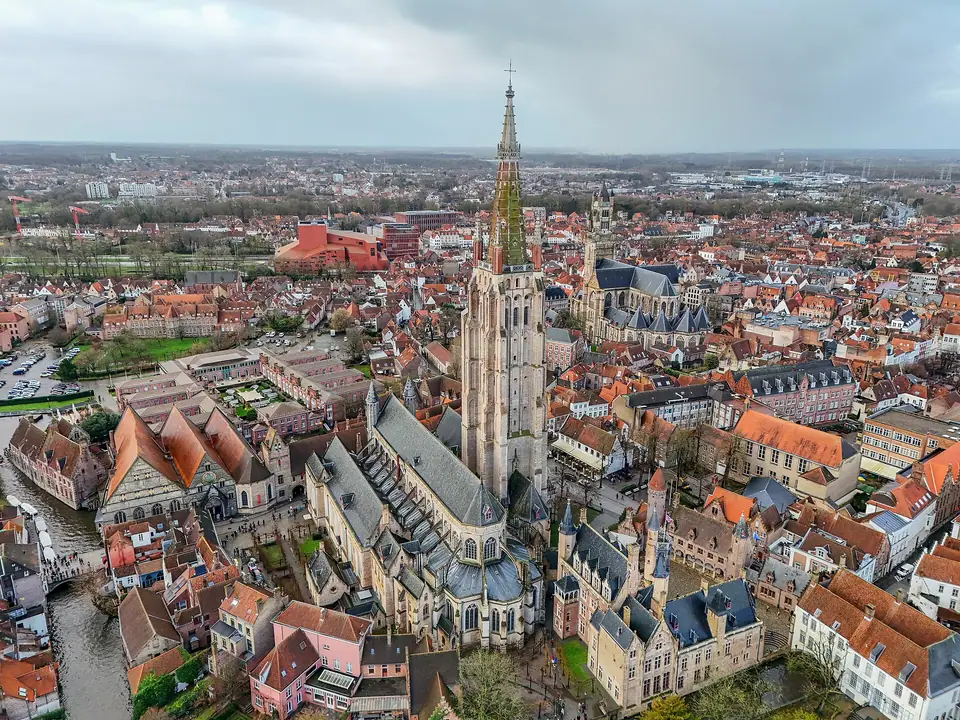
Directly opposite St John's Hospital rises the Church of Our Lady (Onze-Lieve-Vrouwekerk), whose 115.6-metre (formerly measured at 122 m) spire is the second-tallest brickwork tower in the world after Landshut in Germany. While walking the outer nave is free, paying the €8.00 museum zone ticket (included in the Musea Brugge Card) grants access to two extraordinary treasures:
- Michelangelo's Madonna and Child (1501 to 1504). Standing in the southern aisle inside a black-and-white marble Baroque altarpiece is the only sculpture by Michelangelo Buonarroti to leave Italy during his lifetime. Michelangelo sculpted this white Carrara marble group right as he was finishing the Florence David. Purchased in 1506 for 100 gold ducats by the Bruges wool merchants Jan and Alexander Mouscron, it was donated to their family chapel in 1514. The statue was looted twice, first by French Revolutionary soldiers in 1794 and again by Nazi forces in September 1944 before Allied "Monuments Men" recovered it from the Altaussee salt mine in 1945. It shows a solemn Virgin looking downward while the infant Jesus steps upright into the world.
- Mausoleums of Mary of Burgundy and Charles the Bold. In the high choir stand two gleaming gilded-copper and black touchstone Renaissance tombs. The earlier monument was crafted between 1495 and 1502 for Duchess Mary of Burgundy, who died at age 25 in 1482 after falling from her horse during a falconry hunt. Beside her lies the companion tomb commissioned in 1558 by King Philip II of Spain for her father, Charles the Bold. Glass floor panels beneath the tombs let you peer down into the 13th- and 14th-century frescoed brick burial vaults discovered during excavations in 1979.
Directly behind the Groeningemuseum garden stands the 18th-century mansion of Arentshuis (Dijver 16; €8.00 single ticket or included free with the Musea Brugge Card). Its upper floor is dedicated to the Anglo-Belgian artist Frank Brangwyn (1867 to 1956), while the ground floor hosts rotating exhibitions above the idyllic Arentshof canal bridge.
Inside the Gruuthusemuseum (Dijver 17), take time to follow the chronological route from 15th-century Burgundian tapestries and Gothic woodcarvings to 17th-century Bruges bobbin lace and an original 18th-century guillotine from the French Revolutionary period.
All four museums along Dijver and Mariastraat provide free cloakroom lockers in the entrance hall where you must store backpacks and wet umbrellas before entering the climate-controlled painting galleries.
Where it is
- 1Flemish Primitives in Bruges
- Ostend-Bruges International Airport (OST) · about 25 km from here in a straight line
- Directions in Google Maps
Traveller tips
Real advice from people who have been to Bruges. Every tip is read by our team before it goes live.
No tips yet. Been here? Yours could be the first.
Thank you! Your tip will appear here after a quick review.
More in Bruges
Continue exploring Bruges with related neighbourhood, food, and planning guides
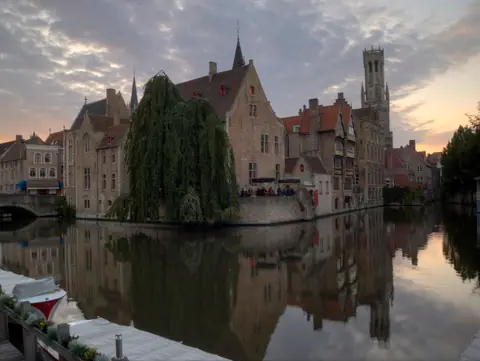
3-Day Bruges Itinerary: Medieval Canals, Flemish Masters, Beer & Damme
Bruges, Belgium
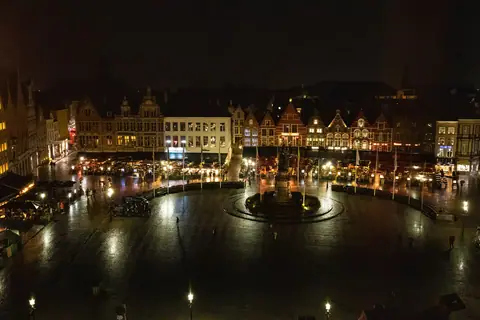
Markt Square, Belfort Climb & Burg Square Town Hall Guide
Bruges, Belgium
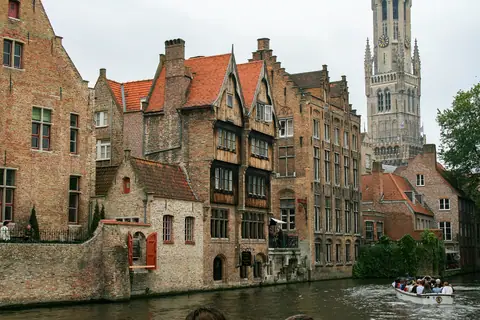
Bruges Canal Boat Tours, Rozenhoedkaai & Secret Bridges Walk
Bruges, Belgium
Basilica of the Holy Blood, Veneration Schedule & Jeruzalemkerk Guide
Bruges, Belgium
