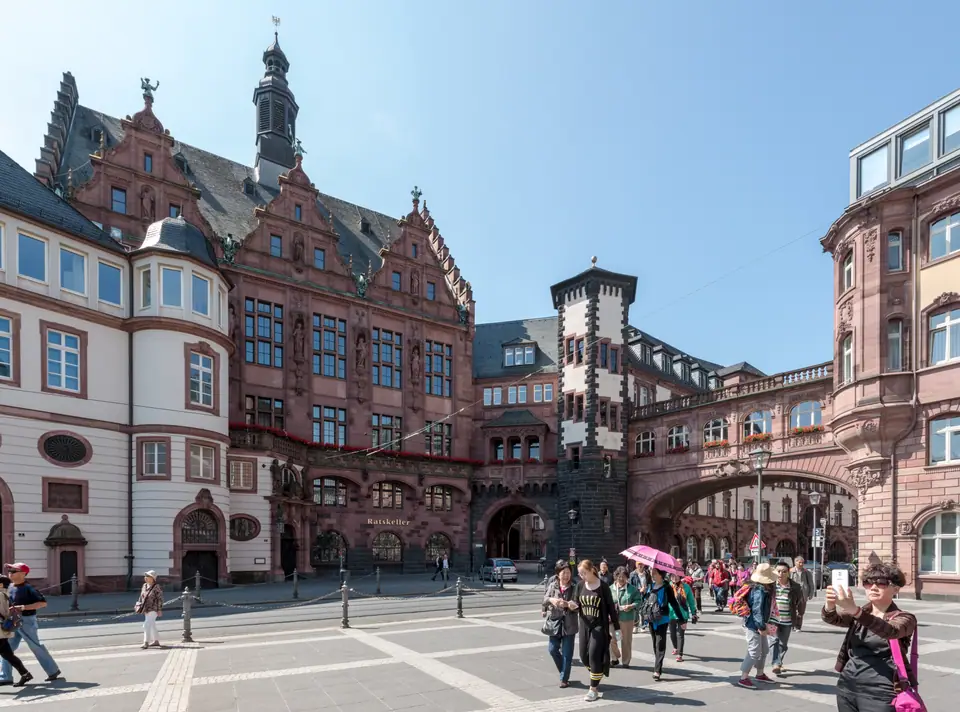
Photo: Dietmar Rabich · CC BY-SA 4.0
Dom-Römer Quarter: Reconstruction Behind the Römerberg
Urban history essay tracing Frankfurt's Römer city hall, imperial coronations, March 1944 destruction, Brutalist demolition and 2018 Dom-Römer quarter.
Stand on the cobbles of Römerberg square and two colliding centuries face each other across open stone. Westward stand the three stepped gables of the Römer city hall, while directly eastward opens a tight lane network that spent nearly 40 years buried beneath monumental postwar concrete. Few modern European city centres tore down a brutalist municipal complex to restore medieval plot widths as boldly as Frankfurt did here.
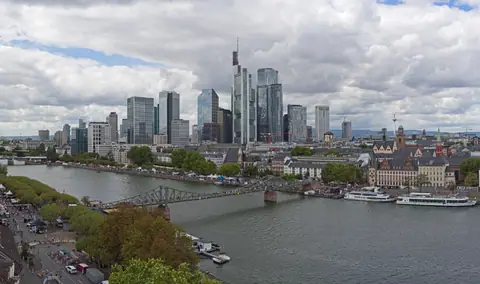
Reading the Dom-Römer quarter carefully turns a brief camera stop into a revealing urban-history lesson. Pair this walk with our riverfront itinerary before stepping west toward nearby civic halls.
Imperial Coronations and the 1405 Town Hall
Long before high-rise finance dominated the horizon, this compact riverfront parish staged the Holy Roman Empire's grandest political ceremonies. Emperor Charles IV's 1356 Golden Bull confirmed Frankfurt as the permanent electoral site for German kings and future emperors. City government soon anchored right on Römerberg. In 1405, Frankfurt's council bought nine medieval townhouses led by Haus zum Römer, linking them into a municipal complex that still operates as the city hall today.
Guild merchants, visiting envoys and local councillors filled the open square outside its gables throughout the fair seasons. Narrow wooden alleys behind the hall tightened around parish yards linking market stalls straight toward the cathedral portal.
From Kaiserdom Altar to Kaisersaal Banquet
Between 1562 and 1792, 10 imperial coronations unfolded inside Gothic Kaiserdom Sankt Bartholomäus. Its soaring 95-metre tower still anchors the eastern end of the quarter, offering 328 narrow stone steps for panoramic views across the rooftops. Once crowned beside the cathedral altar, each newly anointed ruler walked west along the tight Krönungsweg (Coronation Path) toward Römerberg. Lavish state banquets unfolded upstairs inside the Römer's painted Kaisersaal, while temporary plaza fountains flowed with wine for cheering crowds below.
March 1944 Destruction and Postwar Arguments
Before 1944, Frankfurt guarded one of Central Europe's largest timber-framed old towns. Carved oak overhangs leaned closely over winding alleys connecting the cathedral, medieval guild rooms and riverbank piers. Allied wartime bombing raids between 1939 and 1945, shattering the historic core catastrophically during firestorms in March 1944, killed roughly 5,500 residents and reduced almost the entire wooden district to ruins in seconds.
City engineers steadily restored the gutted Römer shell during the 1950s so civic administration could keep its medieval address. Beyond those western gables, fierce postwar arguments dragged on for years. Planners clashed between bringing back narrow historic lanes or sweeping old property lines away beneath modern administrative offices.
The 1980s Ostzeile and the Concrete Interlude
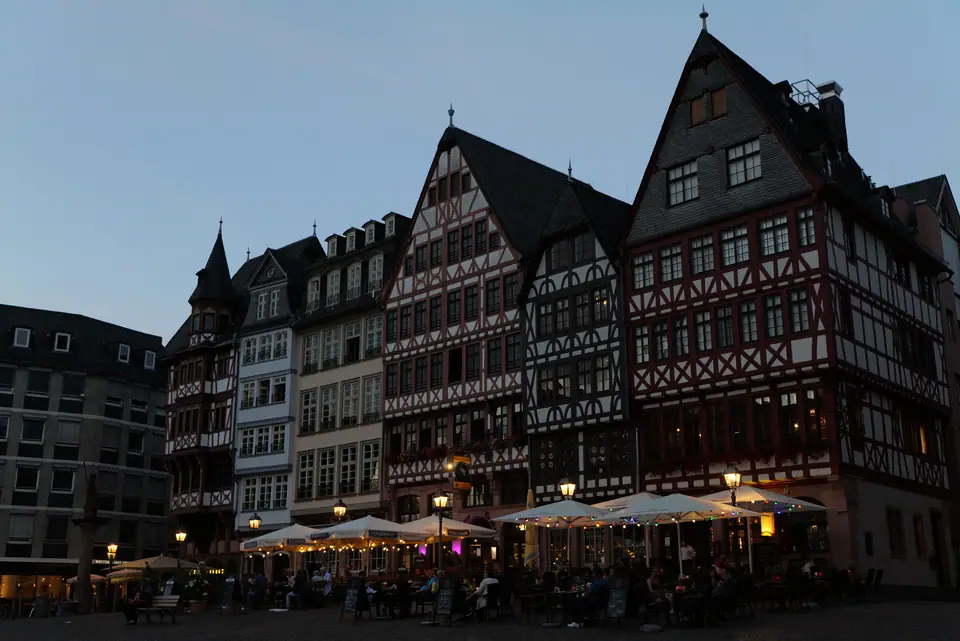
Between 1972 and 1974, municipal leaders chose modernism and built the hulking brutalist concrete Technisches Rathaus (Technical City Hall) across the rubble between Cathedral and Römer. That architectural friction sharpened dramatically during the 1980s. Frankfurt faithfully reconstructed the picturesque half-timbered Ostzeile houses lining the eastern edge of Römerberg, leaving grey concrete cantilevers looming directly behind carved historic gables.
Citizen campaigns advocating for historic lane dimensions finally carried the council vote. Between 2010 and 2011, clearing the concrete deck completely by 2012, the city demolished the massive Technisches Rathaus less than forty years after it had opened.
How the 2018 Dom-Römer Neue Altstadt Works
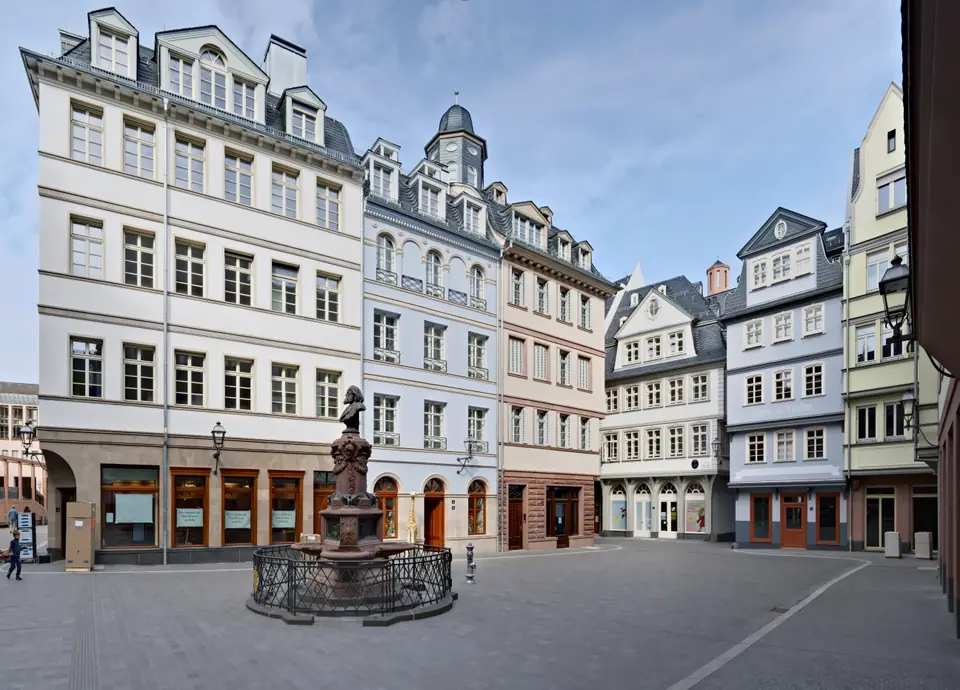
Constructed between 2012 and 2018 across roughly 7,000 square metres reclaimed from concrete foundations, the Dom-Römer Neue Altstadt reopened in stages. Foot traffic returned in May 2018 ahead of formal street festivities from 28 to 30 September 2018. Urban designers rejected giant monolithic blocks and respected narrow medieval plot lines to erect 35 individual townhouses. Fifteen buildings stand as scrupulous historical reconstructions backed by pre-war photographs and surveys. Twenty restrained contemporary houses sit beside them, adopting traditional Main sandstone trims, pitched slate roofs and vertical window bays.
Narrow alleys bend gently rather than running on rigid postwar grids. Small courtyards, carved wooden doorframes and natural stone pavements recover the human walking scale lost for decades. Ground-level shops hold bakeries, craft rooms and quiet cafés that keep the square lived-in rather than purely museum-bound.
Goldene Waage, Hühnermarkt and the Archaeological Garden
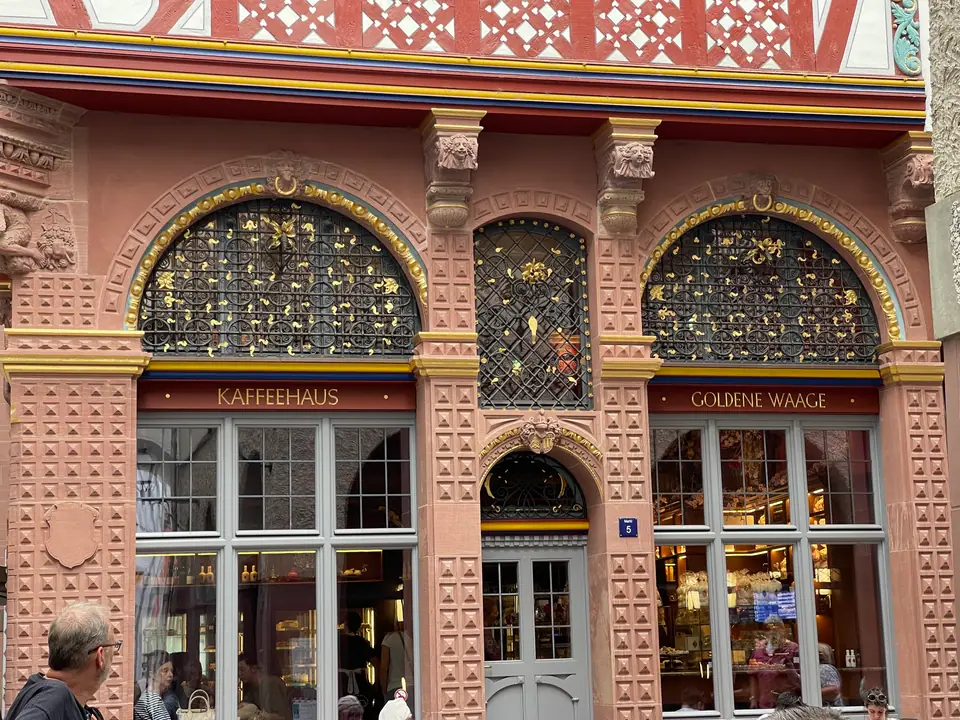
Walking west from the Kaiserdom doorway down the restored Krönungsweg shows how cleanly those 35 townhouses interlock. Immediately south beside the cathedral rises the highlight of the 15 historical reconstructions: the 1619 Renaissance Haus zur Goldenen Waage. Look closely at its ornate timber brackets, painted green shutters and elevated rooftop Belvederchen pavilion overlooking cathedral buttresses. Afternoon sunlight picks out gilded shop signs swinging neatly above paved granite gutters.
Just west opens pocket-sized Hühnermarkt square around the bronze monument to Frankfurt dialect poet and satirist Friedrich Stoltze (1816 to 1891). Cafe tables spill calmly across the sunny corner during warm weather while tour groups gather around the fountain edge. Next to Hühnermarkt, contemporary civic hall Stadthaus am Markt protects the subterranean Archäologischer Garten.
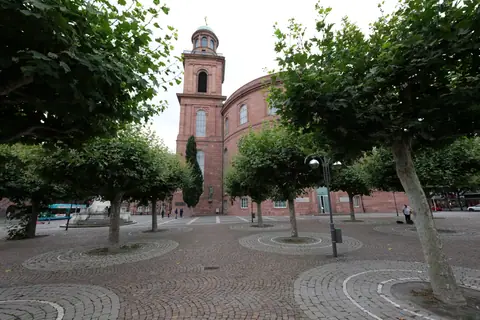
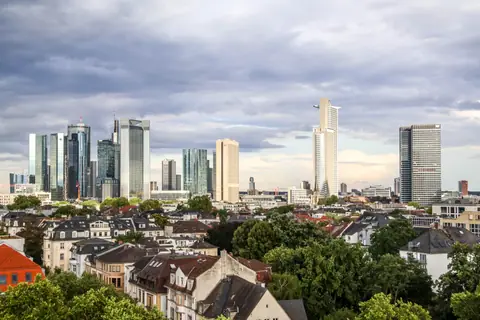
Stepping down slightly exposes excavated Roman walls and Carolingian masonry from Charlemagne's imperial Kaiserpfalz franconofurd royal court directly beneath street cobbles. Walkers notice immediately how layered sandstone foundations bridge centuries of civic trade and government. Returning past those carved facades late in the evening reveals warm lantern light without midday tour crowds. Visitors comparing varied postwar German rebuilding choices often contrast this fine-grained quarter with Dresden's monumental baroque square. Close nearby stand Paulskirche, Goethe-Haus (1749 birthplace rebuilt in 1947), and Bankenviertel's glass towers rising behind Römer roofs.
Where it is
- 1Dom-Römer Quarter
- Frankfurt Main Airport (FRA) · about 13 km from here in a straight line
- Directions in Google Maps
Stations and taxi ranks: OpenStreetMap. Airports: OurAirports. Distances are in a straight line.
Traveller tips
Real advice from people who have been to Frankfurt. Every tip is read by our team before it goes live.
No tips yet. Been here? Yours could be the first.
Thank you! Your tip will appear here after a quick review.
More in Frankfurt
Continue exploring Frankfurt with related neighbourhood, food, and planning guides