Photo: Leonhard Lenz · CC0
St Paul's Church and Germany's First Parliament
Political and architectural essay on St Paul's Church in Frankfurt: 1848 National Assembly, black-red-gold flag roots, 1948 rebuild and 2025-2026 access.
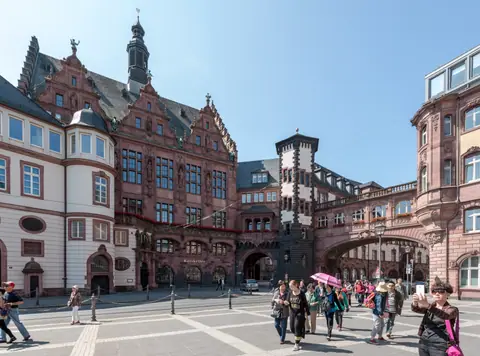
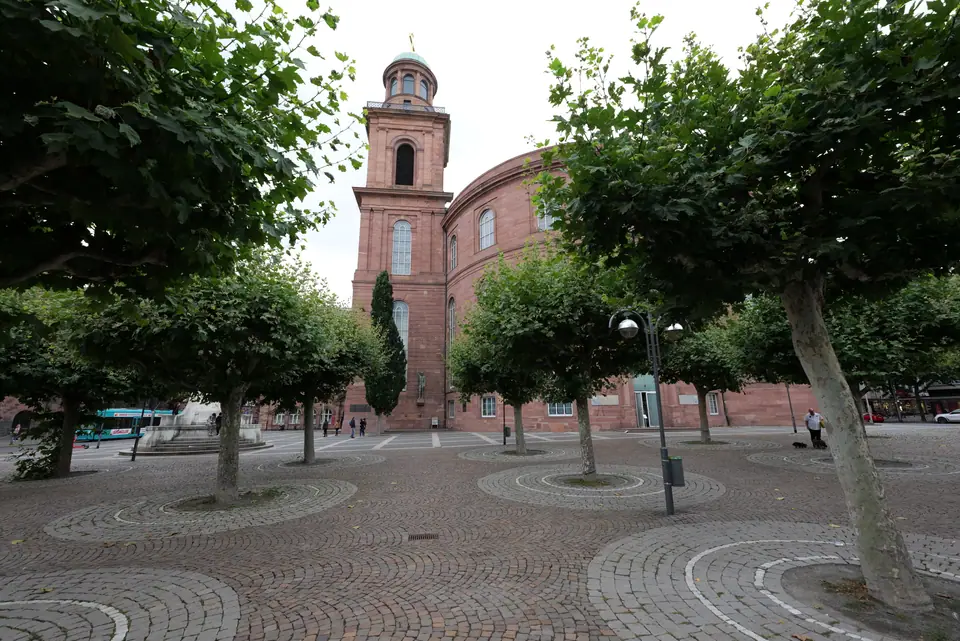
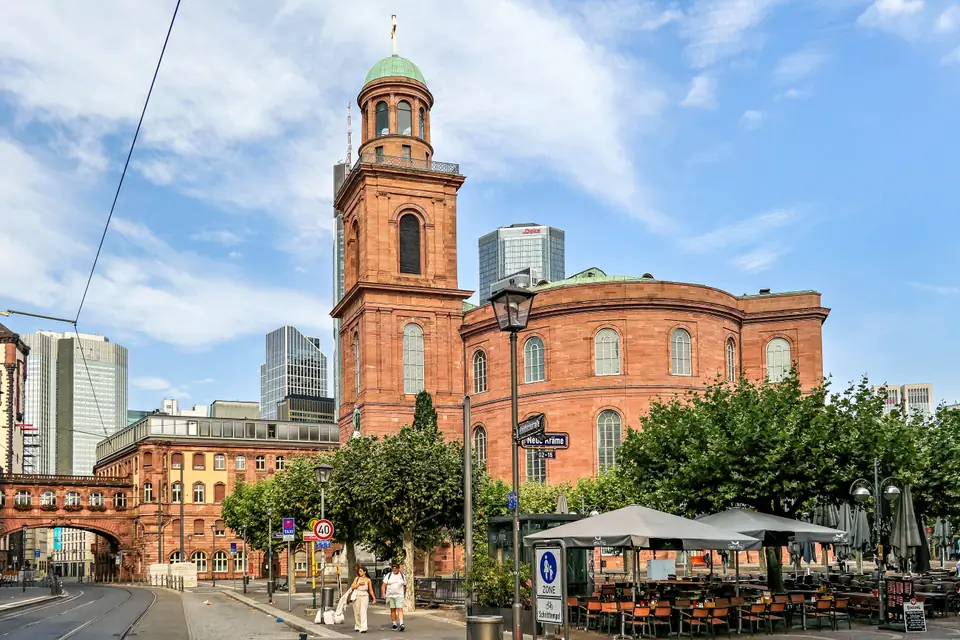
Walk one quiet block north-west off Römerberg and timber gables give way to a red sandstone rotunda standing alone in its paved plaza. Stripped of gothic tracery, gilded altars and parish pews, St Paul's Church, known everywhere in Germany as Paulskirche, carries extraordinary authority in European democratic history. Within this sweeping oval room, delegates drafted Germany's first national parliament charter in 1848, forging civic colours and rights still anchored in modern constitutional law.
Visiting Paulskirche takes under an hour. Understanding both its nineteenth-century debates and its current preservation work brings its severe walls alive before stepping back into adjacent Dom-Römer lanes.
From 1789 Lutheran Rotunda to Civic Auditorium
Late eighteenth-century Frankfurt demolished the ageing medieval Barfüßerkirche friary in 1786 to raise a modern Enlightenment preaching church. Civic leaders wanted an uninterrupted oval room where every listener could see the pulpit and hear spoken debate cleanly. Napoleonic occupations and municipal funding gaps dragged work out from 1789 until city architect Johann Friedrich Christian Hess finished the classical rotunda between 1829 and 1833.
Serving as Frankfurt's principal Lutheran parish pulpit until 1944, the hall relied on wide wooden galleries wrapping a bright floor. Those exact acoustic sightlines designed for sermons later made the oval an ideal chamber when political revolution swept Central Europe.
The 1848-1849 Frankfurt National Assembly
Revolutionary assemblies opened quickly here in 1848. Frankfurt had held sovereign Free City status since 1815, a standing it kept until Prussian annexation in 1866. Following a preparatory Vorparlament from 31 March to 3 April 1848, elected deputies launched Germany's first freely elected all-German parliament on 18 May 1848. For 377 tense days through 30 May 1849, the Frankfurter Nationalversammlung debated national unity, judicial checks and press liberty inside this red sandstone drum.
Although 649 seats were planned across German states, boycotts brought 585 elected deputies at opening. Around 800 delegates rotated through alternate seats over the turbulent session. Two decisive acts left permanent marks on German democracy. On 31 July 1848, deputies formally adopted black-red-gold (Schwarz-Rot-Gold) as national democratic colours, creating the heraldic parent of modern Germany's flag. On 28 March 1849, parliament passed the Paulskirchenverfassung establishing basic civil rights and federal constitutional governance.
Monarchical backlash crushed the assembly in spring 1849 when Prussian King Friedrich Wilhelm IV refused an elected imperial crown. Austria, Prussia and smaller states pulled back their backing soon after. Even in defeat, its human-rights chapters shaped both the 1919 Weimar Constitution and West Germany's 1949 Basic Law (Grundgesetz).
March 1944 Ruin and Rudolf Schwarz's 1948 Rebuild
Allied incendiary raids hit central Frankfurt fiercely on 18 March 1944. Firestorms gutted the Paulskirche roof and timber galleries while leaving scarred sandstone walls standing above ruins. Rebuilding that shell posed a vital moral question for postwar Frankfurt, which briefly hoped to become West Germany's capital. Local architect Rudolf Schwarz led the Planungsgemeinschaft Paulskirche on a fast civic reconstruction.
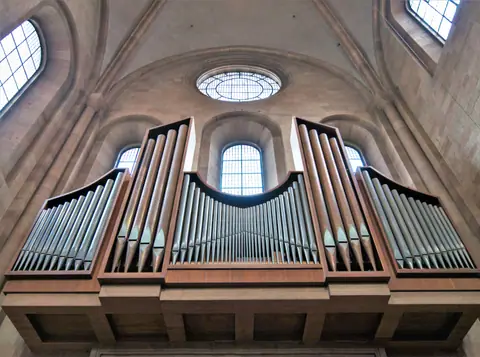
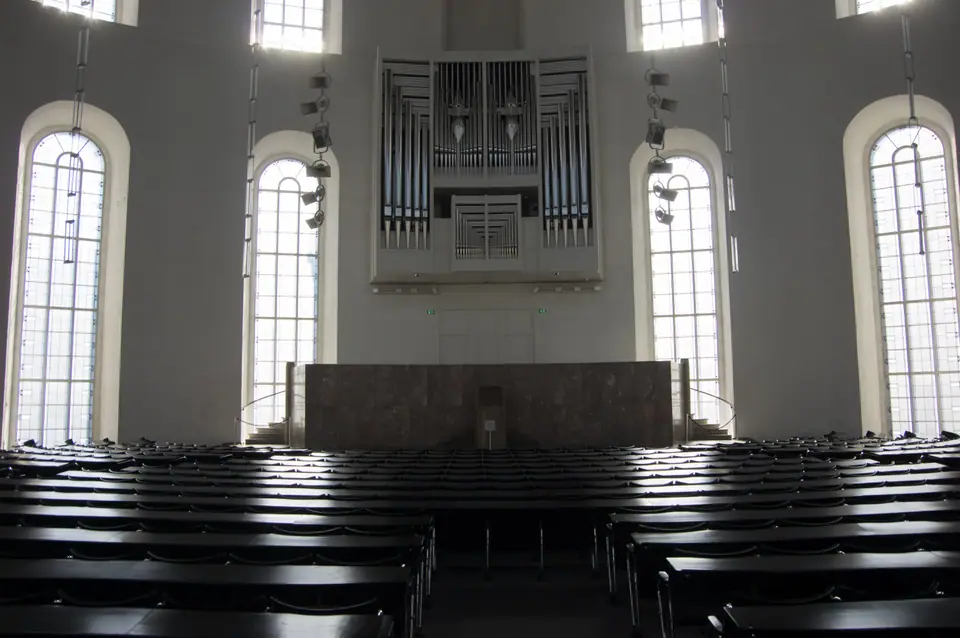
Schwarz stripped away ornate nineteenth-century balconies in favour of bare masonry walls, dark timber benches and tall plain windows. He rejected cosmetic ornament so the chamber would carry spare civic gravity. Reopened ceremonially on 18 May 1948 for the exact centenary of Germany's first national parliament, Schwarz expressed his stark design intent cleanly:
Inside this stripped postwar rotunda reopened for the 1848 centenary, architect Rudolf Schwarz sought a severe civic hall where no untrue word would remain possible.
Postwar Speeches and October Literary Ceremonies
Even after Bonn won the postwar capital vote, Paulskirche stayed Germany's leading podium for historic democratic speeches. Visiting heads of state, Nobel laureates and civic reformers stood on its plain stone platform across decades of division and unity. On 25 June 1963, U.S. President John F. Kennedy spoke inside Schwarz's spare hall, reminding crowds that the West's future rested on Atlantic partnership. His visit underscored how closely West German recovery tied itself back to the ideals of 1848.
Every October during the Frankfurter Buchmesse, writers and publishers fill the circular timber benches for the Peace Prize of the German Book Trade (Friedenspreis des Deutschen Buchhandels). Live broadcasts carry those acceptance speeches into living rooms across Europe, keeping the round sandstone hall active inside contemporary public life.
Planning a Visit During 2025-2026 Restoration Work
Frankfurt's city government is advancing a multi-million-euro preservation plan for the Paulskirche monument. Plans pair that restoration with an adjoining Haus der Demokratie (House of Democracy), whose winning urban-architectural concepts went on public display in late 2025. While design and engineering preparations advance ahead of heavy structural works, the hall continues staging civic events and lower-level displays tracing the 1848 debates. Informative historical panels in the ground floor hall outline key delegates, contested maps and revolutionary pamphlets cleanly.
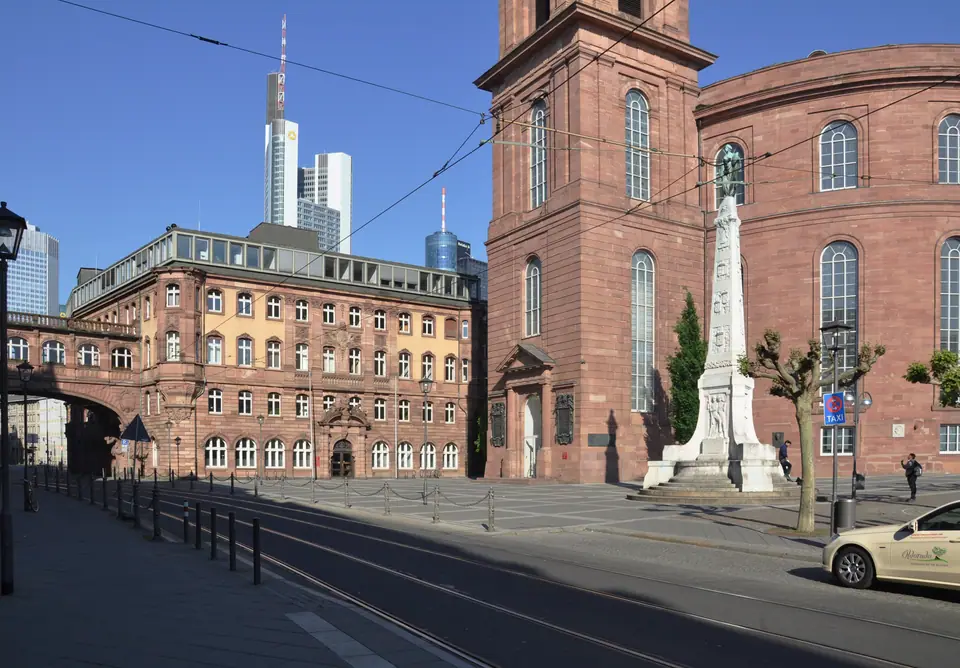
Because formal municipal ceremonies and technical surveys regularly close doors with little warning, opening times vary week by week. Verify official Visit Frankfurt or city alerts before mapping a morning around interior entry. Even when heavy oak doors stand locked for private briefings, the circular sandstone exterior rewards a quiet perimeter loop. Brass plaques around the courtyard frame clear historical summaries for readers pausing outside in daylight. Walk outside afterwards past the allegorical Paulsplatz Unity Monument toward central tram lines or catch northbound trains from Hauptbahnhof to Berlin.
Where it is
- 1St Paul's Church and Germany's First Parliament
- Frankfurt Main Airport (FRA) · about 13 km from here in a straight line
- Directions in Google Maps
Stations and taxi ranks: OpenStreetMap. Airports: OurAirports. Distances are in a straight line.
Traveller tips
Real advice from people who have been to Frankfurt. Every tip is read by our team before it goes live.
No tips yet. Been here? Yours could be the first.
Thank you! Your tip will appear here after a quick review.
More in Frankfurt
Continue exploring Frankfurt with related neighbourhood, food, and planning guides