Photo: Szczecinolog · CC BY-SA 4.0
Things to Do in Gdańsk
The core Gdańsk sights: Long Market, Artus Court, St. Mary's tower climb, the restored Crane, Mariacka Street, the Shipyard and Westerplatte.
Short answer: spend your opening morning walking the Royal Way from the Golden Gate to the Green Gate. Climb St. Mary's Basilica tower and tour the newly restored medieval Crane on the waterfront. Give half a day each to the European Solidarity Centre and the Museum of the Second World War. Round out the trip along amber porches on Ulica Mariacka and the headland at Westerplatte.
Long Market and Neptune's Fountain
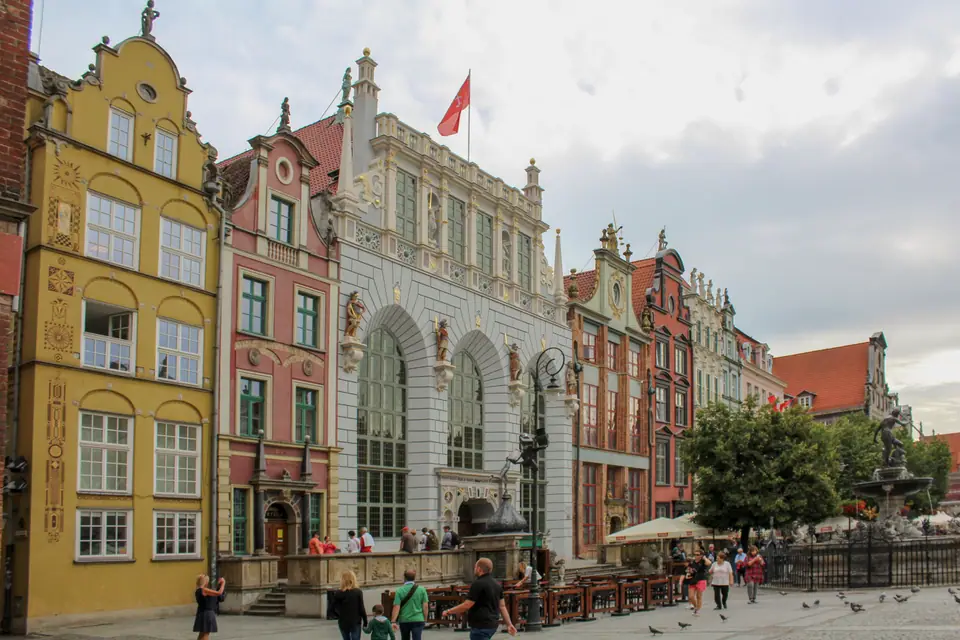
Pedestrian Długa Street opens seamlessly into Long Market (Długi Targ), forming one continuous ceremonial axis lined with narrow merchant facades. Directly before Artus Court stands Neptune's Fountain, designed by Abraham van den Blocke. Cast in bronze between 1612 and 1615 by Peter Husen, the fountain was unveiled on 9 October 1633.
Early morning walks reveal clear sightlines down towards the Green Gate before outdoor restaurant tables spread across the stone paving. Notice the iron trident fence framing the basin, added later in the seventeenth century to protect the bronze work.
Artus Court and the Main Town Hall
Rising beside the fountain, Artus Court (Dwór Artusa) functioned from the fourteenth century as a guildhall and meeting space for Hanseatic merchants. Inside its lofty Gothic-Renaissance hall rises a remarkable survival: the 10.64-metre ceramic tiled stove constructed between 1545 and 1546 by master potter Georg Stelzner. Roughly 530 glazed ceramic panels cover its surface with portraits of European rulers and coats of arms.
Next door stands the Main Town Hall (Ratusz Głównego Miasta), seat of Gdańsk municipal authority from the mid-fifteenth century until 1921. Museum of Gdańsk galleries inside display restored civic rooms, topped by the gilded Red Hall ceiling. In warmer months, seasonal tower entry lets visitors climb above 80 metres for broad views across terracotta roofs and river bends.
Ulica Mariacka and the Great Mill
Running parallel behind Long Market towards St. Mary's Basilica, cobbled Ulica Mariacka preserves Gdańsk's signature stone entry porches (przedproża). Carved drainage gargoyles, weathered stone balustrades and cellar amber shops line both sides of the narrow lane. Late afternoon light softens the brickwork once day-trip groups thin out towards the river quay.
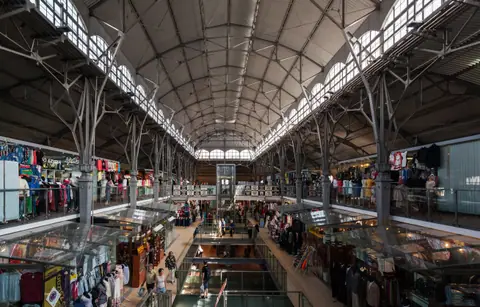
Continue 15 minutes north-west across the canal to the Great Mill (Wielki Młyn), a fourteenth-century Teutonic watermill powered historically by the Radunia Canal. Inside, the modern Amber Museum opened in July 2021 displays Baltic resin specimens, translucent white amber pieces and trapped prehistoric insects. Two blocks further stands intact St. Nicholas' Basilica right beside the 1896 Hala Targowa market hall.
St. Mary's Basilica and the Motława Crane
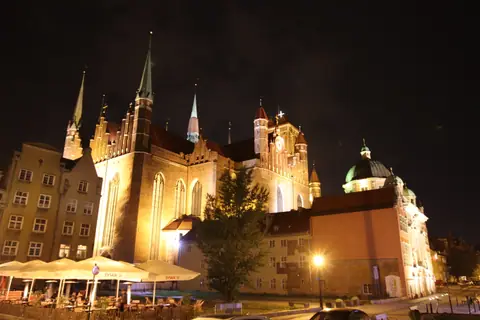
Stretching 105.5 metres in length across central Gdańsk, St. Mary's Basilica anchors the entire skyline with brick Gothic mass and crisp whitewashed star vaults. Inside, pause below Hans Düringer's astronomical clock built between 1464 and 1470. You can also tackle roughly 405 stone spiral and timber steps up the bell tower for a panoramic city sweep.
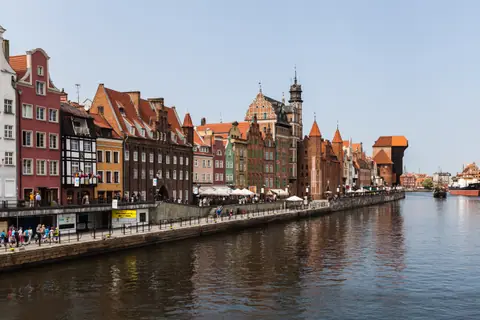
Down on the Długie Pobrzeże river embankment, the medieval port Crane (Żuraw) built from 1442 to 1444 reopened on 30 April 2024 following a thorough multi-year conservation project. Lighter oak boards and a restored six-metre double wooden treadwheel show clearly how harbour crews hoisted cargo and fitted ship masts. Both buildings are detailed in our Main Town heritage guide.
Motława footbridges and Ołowianka Island
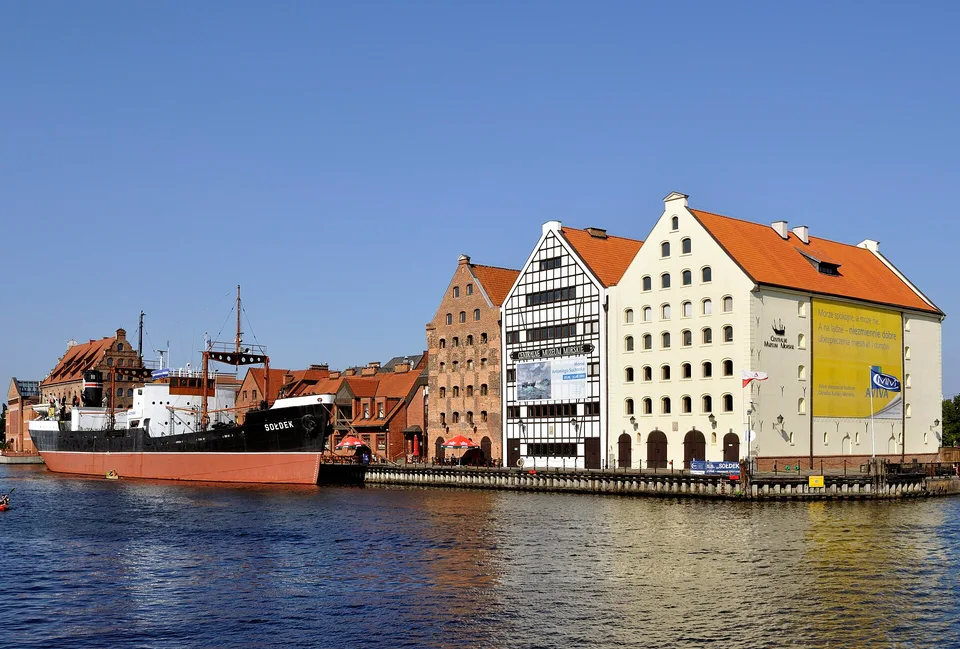
From the riverside promenade beside the Crane, cross the pedestrian swing footbridge onto Ołowianka Island. Right on the quay rests the black steel hull of SS Sołdek, launched in 1948 as the first ocean-going ship built in post-war Polish yards. Its cargo holds and steam engine room operate as a National Maritime Museum floating exhibit.
Right beside the ship stand the converted nineteenth-century granary buildings of the National Maritime Museum, paired with the brick Polish Baltic Philharmonic hall across the courtyard. Loop back south across the 2020 rotating footbridge onto Granary Island for quiet evening strolls and waterfront dining away from busy Długa terraces. Those calm island quarters and riverfront hotels are compared in our accommodation guide.
Solidarity Plaza and the shipyard cranes
Ten minutes north of the Main Town stands Solidarity Square, marked by three 42-metre steel crosses unveiled on 16 December 1980 outside Gate No. 2. Behind the monument rises the Corten-steel European Solidarity Centre, opened in August 2014. Its seven exhibition halls hold roughly 2,000 items including the wooden strike demand boards, covered in our Solidarity and Shipyard guide.
Once museum doors shut, walk into the surrounding Imperial Shipyard streets around 100cznia and Ulica Elektryków, following marked heritage signposts past preserved brick workshops and active dry docks. Steel dockyard cranes rise directly above street-food containers, independent bars and summer concert courtyards.
Westerplatte, the WWII Museum and Tricity rail
Central Brabank holds the deep underground galleries of the Museum of the Second World War beneath a 40-metre leaning concrete tower. Plan at least half a day for its European halls, pairing them with a hot meal stop from our Gdańsk dining guide. Out on the wooded harbour peninsula reached by ZTM Bus 106, Westerplatte preserves Guardhouse No. 1 and the granite Coast Defenders Monument overlooking the Baltic shipping channel.
Save a final full day for easy commuter rail excursions out to Oliwa Cathedral, Sopot Pier, Gdynia Quay and Malbork Castle. Weekly municipal closures cluster around Monday and Tuesday across different institutions, so verify exact opening schedules on official museum portals before heading out each morning.
Where it is
- 1Gdańsk
- Gdańsk Lech Wałęsa Airport (GDN) · about 12 km from Gdańsk in a straight line
- Directions in Google Maps
Stations and taxi ranks: OpenStreetMap. Airports: OurAirports. Distances are in a straight line.
Traveller tips
Real advice from people who have been to Gdańsk. Every tip is read by our team before it goes live.
No tips yet. Been here? Yours could be the first.
Thank you! Your tip will appear here after a quick review.
More in Gdańsk
Continue exploring Gdańsk with related neighbourhood, food, and planning guides