


























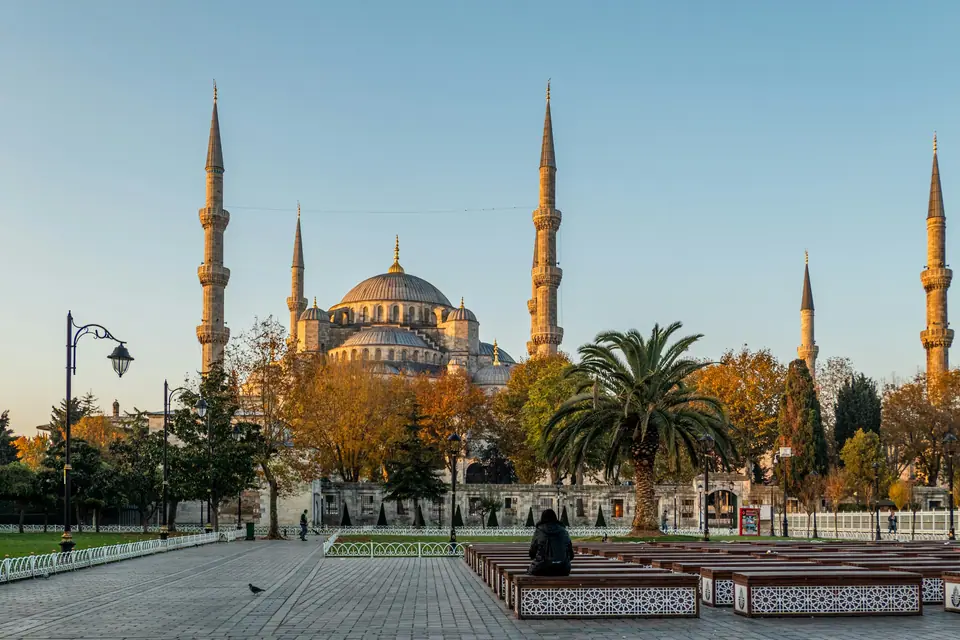
Photo by Lewis J Goetz on Unsplash
Best Things to Do in Istanbul: 14 Palaces, Mosques & Ferry Routes
From sixth-century Byzantine vaults and Ottoman palace courtyards in Sultanahmet to Mimar Sinan hilltop mosques, covered bazaars, and Asian-side food markets.
Most of Istanbul's world-renowned imperial monuments stand within a fifteen-minute walk of one another on the high ridge of Sultanahmet. The secret to a memorable trip is resisting the temptation to spend all your time inside that single square kilometre. Pair two major historic landmarks each morning with a walk through working merchant quarters or a hilltop mosque courtyard. Spend your late afternoons on a public ferry crossing the Bosphorus to the Asian shore. We map out these exact daily pairings step by step in our Istanbul 3-day itinerary.
The Sultanahmet Imperial Core: Hagia Sophia, Blue Mosque & Topkapı Palace
- Hagia Sophia (Ayasofya-i Kebir Cami-i Şerifi, Postcode 34122). Completed in just five years under Byzantine Emperor Justinian I and consecrated in 537 CE, Hagia Sophia stood as the largest vaulted interior in Christendom for nearly a millennium. Its central dome spans 31 metres in diameter and rises 55.6 metres above the floor. Forty arched ribs and four massive pendentives carry that weight. Foreign sightseeing visitors enter via the ticketed south ramp to explore the upper galleries and thirteenth-century Deësis mosaic, as detailed in our Hagia Sophia guide.
- The Blue Mosque (Sultanahmet Camii) & the Roman Hippodrome. Directly facing Hagia Sophia across the park, Sultan Ahmed I commissioned architect Sedefkâr Mehmed Ağa to build this six-minaret imperial mosque between 1609 and 1616. Its cascading domes are lined inside with more than 20,000 handmade ceramic tiles fired in the kilns of İznik in shades of cobalt, turquoise, and emerald. Admission is completely free outside prayer times. On exiting the western gate, walk along the ancient Hippodrome of Constantinople (Atmeydanı). Three ancient monuments still stand on its central spine. You will see the Obelisk of Theodosius erected here in 390 CE, the bronze Serpent Column cast in 479 BCE, and the tenth-century Walled Obelisk.
- Topkapı Palace (Topkapı Sarayı). Occupying the breezy headland of Sarayburnu where the Golden Horn, Bosphorus, and Sea of Marmara meet, Topkapı served as the primary seat of the Ottoman sultans for four centuries. Sultan Mehmed II began construction in 1460 across four successive landscaped courtyards. Inside sit the Imperial Council chamber (Divan-ı Hümayun), the domed palace kitchens holding Chinese celadon porcelain, and the Sacred Relics chamber. Don't miss the Imperial Treasury with the 86-carat Spoonmaker's Diamond (Kaşıkçı Elması) and the 400-room Imperial Harem. Allow three full hours and remember the palace closes every Tuesday.
Underground Reservoirs & Archaeological Treasures
- Basilica Cistern (Yerebatan Sarnıcı) / Binbirdirek Cistern (Cistern of Philoxenos): Constructed under Emperor Justinian in 532 CE beneath the former Stoa Basilica, the Basilica Cistern measures 138 by 65 metres. It once stored up to 80,000 cubic metres of water piped from the Belgrade Forest. Elevated steel walkways lead past 336 marble columns arranged in 12 rows of 28. At the far northwest corner sit two repurposed Roman blocks carved with upside-down and sideways Medusa heads. Five minutes southwest near Sultanahmet Square lies the fourth-century Binbirdirek Cistern. It is a quieter, drier subterranean chamber supported by 224 double-stacked marble columns engraved with Greek masons' marks.
- Istanbul Archaeology Museums (İstanbul Arkeoloji Müzeleri). Tucked along the leafy downhill lane between Topkapı's First Courtyard and Gülhane Park, this three-building complex was founded by scholar Osman Hamdi Bey in 1891. Inside the neoclassical Main Building stands the fourth-century BCE marble Alexander Sarcophagus from Sidon, carved in high relief with battle scenes. Across the courtyard stand the 1472 Tiled Kiosk (Çinili Köşk) and the Museum of the Ancient Orient. There you can see glazed brick lions from Babylon's Ishtar Gate and the 1259 BCE Treaty of Kadesh, the oldest surviving written peace treaty in history.
Mimar Sinan Mosques, Historic Bazaars & Sixteenth-Century Hamams
- Süleymaniye Mosque (Süleymaniye Camii, Postcode 34116). Crowning the city's Third Hill above the Golden Horn, chief imperial architect Mimar Sinan built this masterwork between 1550 and 1557 for Sultan Süleyman the Magnificent. Its 53-metre dome, acoustic terracotta resonators, and peaceful stone forecourt feel far calmer than Sultanahmet. Behind the mosque sit the octagonal mausoleums (türbe) of Süleyman and his wife Hürrem Sultan, next to a wide terrace overlooking Galata and the Bosphorus.
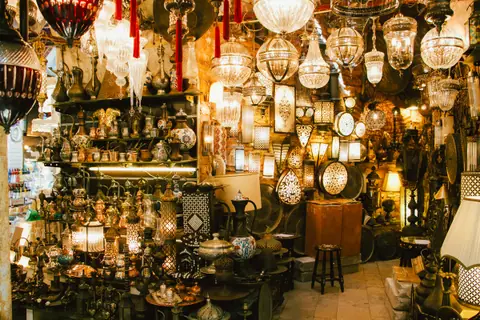
- The Grand Bazaar (Kapalıçarşı) & Spice Bazaar (Mısır Çarşısı). Founded in 1461 around two vaulted stone bedesten halls, the Grand Bazaar encompasses 61 covered streets and over 3,000 shops. Walk downhill from its northeast gates along Mahmutpaşa Yokuşu to reach the L-shaped 1664 Spice Bazaar at Eminönü. Sample pistachio-stuffed lokum (Turkish delight) and visit the tile-wrapped 1563 Rüstem Pasha Mosque just west of the market.
- Traditional Ottoman Bathhouses (Hamam, hah-MAHM). Experience a classic steam soak and coarse silk-mitt scrub (kese, keh-SEH) followed by an olive-oil soap foam massage on a heated marble belly stone (göbek taşı). Three authentic sixteenth-century baths built by Mimar Sinan welcome visitors with separate male and female sections. Choose between the 1584 Çemberlitaş Hamamı near the Grand Bazaar, the 1556 Haseki Hürrem Sultan Hamamı by Hagia Sophia, or the 1580 Kılıç Ali Paşa Hamamı in Karaköy.
Across the Water: Bosphorus Palaces, Galata, Balat & Kadıköy
Round out your trip by exploring the shores north and east of the Historic Peninsula. Take a public Bosphorus ferry from Eminönü or Karaköy across to Kadıköy (postcode 34710) on the Asian side. Graze through the open-air produce and pickle lanes around Güneşlibahçe Sokak before walking the coastal path around Moda at sunset. Along the European Bosphorus waterfront stands Dolmabahçe Palace (dol-mah-bah-CHEH), completed in 1856 by Armenian court architects Garabet and Nigoğayos Balyan. The palace contains 285 rooms, a 4.5-tonne Bohemian crystal chandelier in the Ceremonial Hall, and the room where Republic founder Mustafa Kemal Atatürk died on 10 November 1938. Further west along the Golden Horn, ride the T5 tram to Fener and Balat (34087). Here steep cobbled lanes pass painted timber houses, the red-brick 1882 Phanar Greek Orthodox College, and the prefabricated 1898 Bulgarian St Stephen Church cast from 500 tonnes of iron. Finish across the bridge in Galata beneath the 62.5-metre cylinder of the 1348 Genoese Galata Tower before strolling up pedestrian İstiklal Avenue to Taksim Square.
Where it is
- 1Istanbul
- Istanbul Sabiha Gökçen International Airport (SAW) · about 30 km from Istanbul in a straight line
- Directions in Google Maps
Stations and taxi ranks: OpenStreetMap. Airports: OurAirports. Distances are in a straight line.
Traveller tips
Real advice from people who have been to Istanbul. Every tip is read by our team before it goes live.
No tips yet. Been here? Yours could be the first.
Thank you! Your tip will appear here after a quick review.
More in Istanbul
Continue exploring Istanbul with related neighbourhood, food, and planning guides
Best Time to Visit Istanbul: Weather, Tulip Season & Holiday Dates
Istanbul, Turkey
What to Wear in Istanbul: Mosque Dress Code, Shoes & Seasonal Packing
Istanbul, Turkey
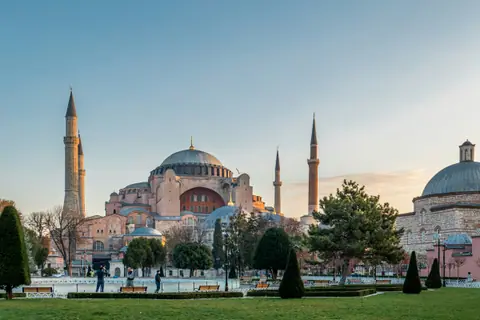
Hagia Sophia Guide: Gallery Tickets, Entrance Route & Mosaics
Istanbul, Turkey
Grand Bazaar Istanbul Guide: Walking Route, Gates & Bargaining
Istanbul, Turkey
