


























Place Masséna, Promenade du Paillon and Avenue Jean-Médecin: Red Arcades & Urban Park
Walk the central axis of modern Nice, from Joseph Vernier's 1843 to 1844 red-ochre arcades and the 20-hectare Promenade du Paillon water mirror to Avenue Jean-Médecin.
Where the nineteenth-century expansion of Nice meets the western edge of Vieux-Nice, three interconnected civic spaces form the pedestrian spine of the modern city: the red-ochre arcades of Place Masséna, the green corridor of the Promenade du Paillon, and the north-south shopping artery of Avenue Jean-Médecin.
1. Place Masséna and the Promenade du Paillon Water Mirror
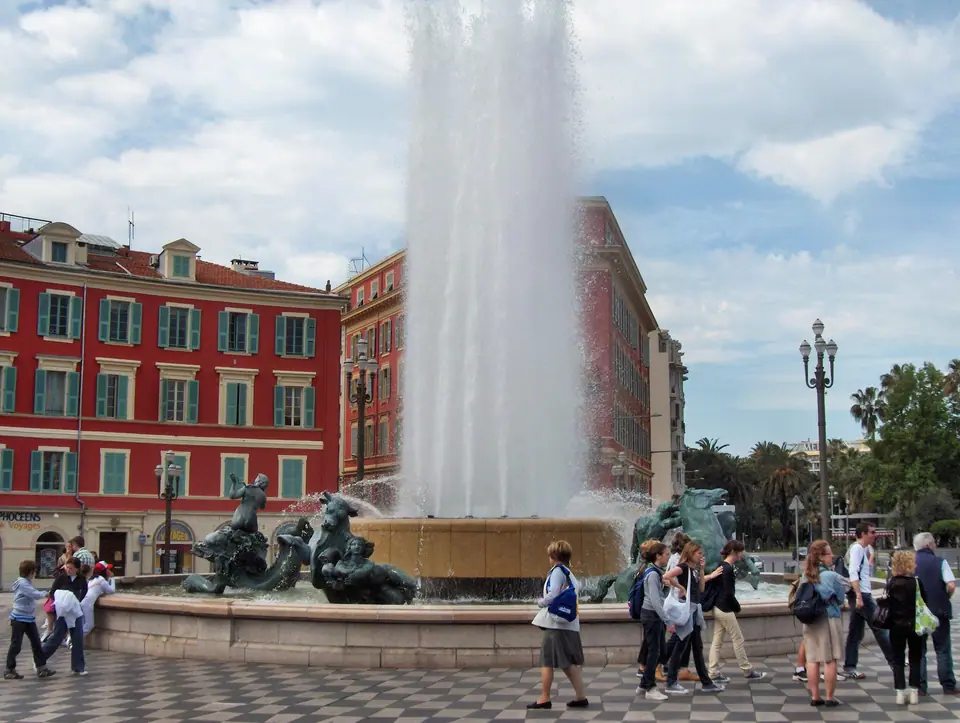
Named in honour of Nice-born Imperial Marshal André Masséna, Place Masséna was the centrepiece of the urban modernisation plans drawn up by the Sardinian Consiglio d'Ornato following a royal circular of 24 April 1824. After early studies in 1825 by architect Jean-Antoine Scoffier and surveyor Louis Trabaud were ratified by King Charles-Albert's letters patent on 26 May 1832, architect Joseph Vernier designed the main square in 1843 to 1844 on the model of Piazza Vittorio Veneto in Turin, framing the plaza with uniform red-ochre buildings set over deep pedestrian porticos.
Originally divided into northern and southern halves by the Paillon river and later occupied by the Municipal Casino (demolished in 1979), the square was fully pedestrianised during the construction of Tram Line 1 from 2003 to 2007. Today black-and-white geometric paving links the Fontaine du Soleil (crowned by a white marble statue of Apollo ringed by five bronze horses and planetary deities) with Catalan artist Jaume Plensa's 2007 installation Conversation in Nice, whose seven illuminated kneeling figures atop high poles represent the seven continents.
After engineers began vaulting over the lower course of the Paillon river in 1868, the reclaimed deck upstream of Place Masséna was successively occupied by the Municipal Casino, exhibition halls (1954), and the central bus station and car park (1973). Beginning in 2010 with the demolition of the old bus station in a 40-million-euro civic project, landscape architect Michel Péna created the Promenade du Paillon (Coulée Verte), inaugurated on 26 October 2013 along a 1.2-kilometre corridor from the Jardin Albert Ier to the National Theatre and MAMAC, and extended by a further 1 kilometre and 8 hectares on 18 October 2025 to reach 20 hectares in total.
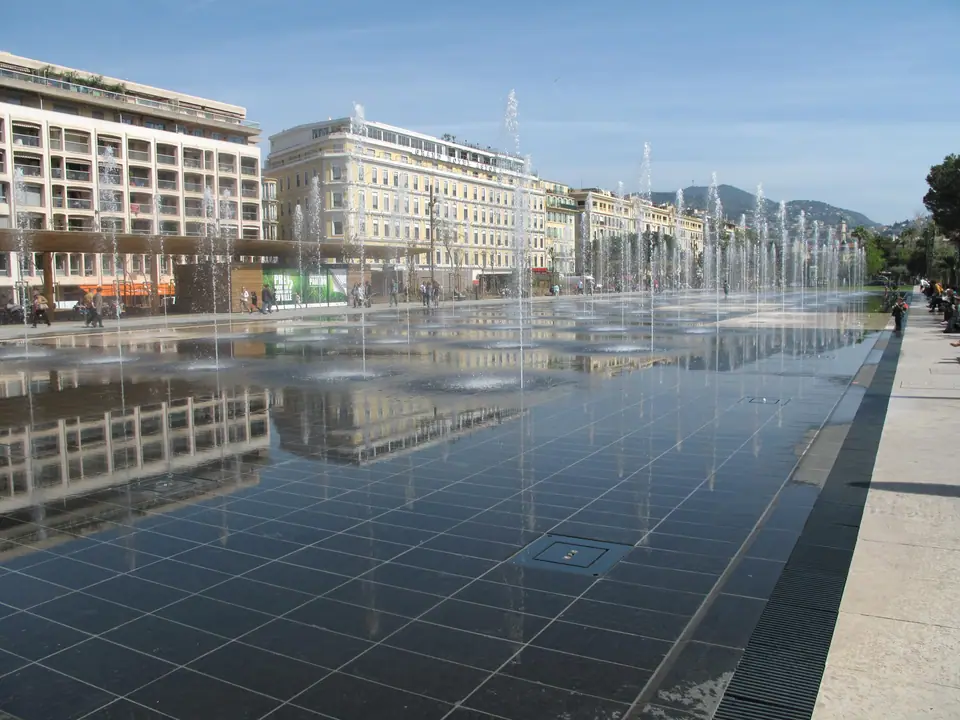
Planted with 1,600 trees, 6,000 shrubs, and 50,000 perennials representing botanical zones across the globe, the park's focal point beside Place Masséna is a 3,000-square-metre granite water mirror (miroir d'eau) equipped with 128 programmable water jets alongside a 1,400-square-metre mist plateau (plateau des brumes).
2. Avenue Jean-Médecin and Basilique Notre-Dame
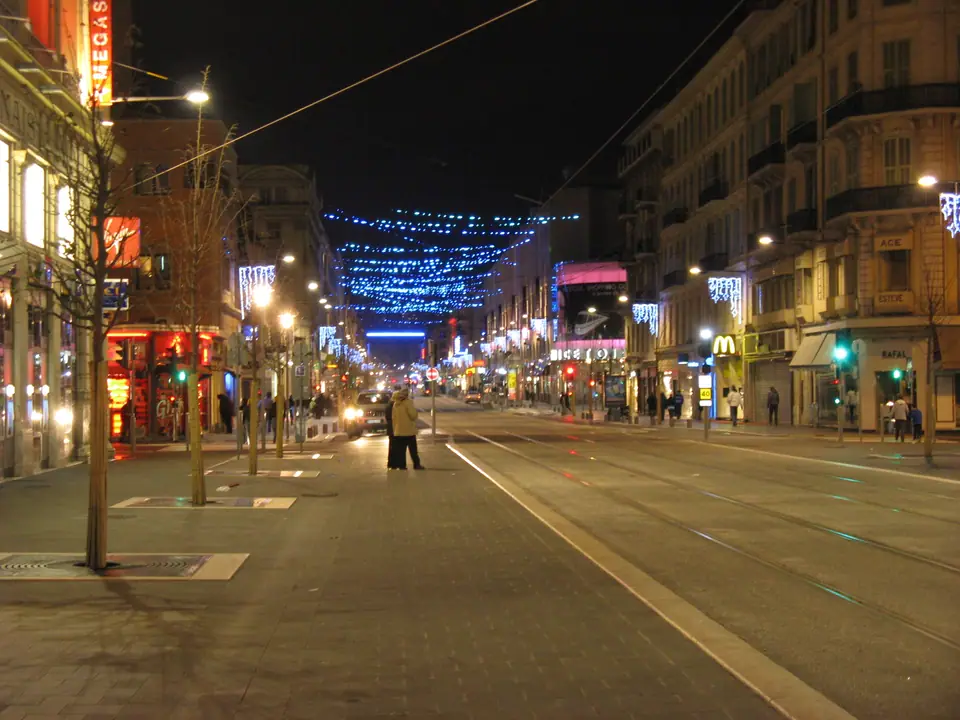
Laid out in 1864 along the natural floor of the Saint-Michel valley to connect Place Masséna with the newly opened Gare de Nice-Ville, the city's primary shopping street was successively named Avenue du Prince-Impérial, Avenue de la Gare (1870), Avenue de la Victoire (1918), and in 1966 Avenue Jean-Médecin, honouring the mayor who governed Nice for 33 years. Walking along this avenue in July 1947, Niçois composer Henri Betti conceived the opening nine notes of the international standard C'est si bon.
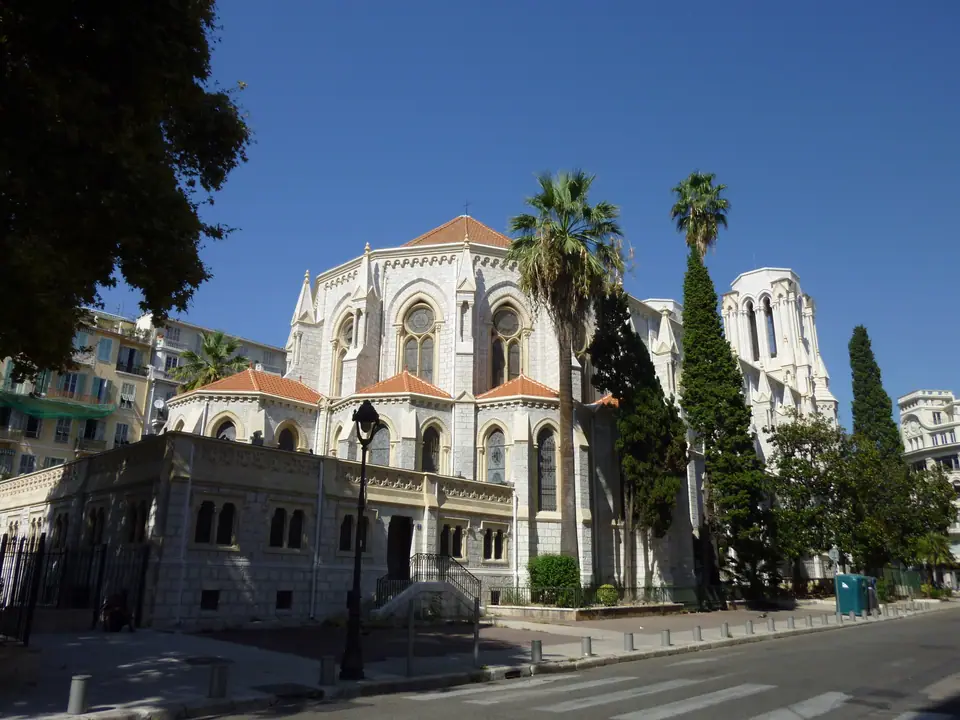
Beginning at the red-ochre arcades occupied by Galeries Lafayette since 1916, the avenue passes Sébastien-Marcel Biasini's 1890 Crédit Lyonnais palace, the six-storey 10,000-square-metre 1913 Belle Époque Riviera Building (now Fnac), and Charles Dalmas's 1921 BNP Paribas building before reaching the Basilique Notre-Dame-de-l'Assomption. Designed by architect Charles Lenormand in French neo-Gothic style inspired by the cathedrals of Paris and Angers to symbolise Nice's post-1860 union with France, it was built between 1864 and 1879 with twin 31-metre square towers framing a sculpted Assumption rose window (consecrated on 12 March 1925 and declared a minor basilica by Pope Paul VI on 16 April 1978), making it the largest church in Nice.
Traveller tips
Real advice from people who have been to Place Masséna, Promenade du Paillon and Avenue Jean-Médecin: Red Arcades & Urban Park. Every tip is read by our team before it goes live.
No tips yet. Been here? Yours could be the first.
Thank you! Your tip will appear here after a quick review.
More in Nice
Continue exploring Nice with related neighbourhood, food, and planning guides
Best Time to Visit Nice: Mediterranean Climate, Sea Temperatures & Carnival Season
Nice, France
Where to Stay in Nice: Vieux-Nice, Carré d'Or, Cimiez & Le Port Compared
Nice, France
Nice 3-Day Itinerary: Old Town, Promenade des Anglais, Cimiez & Coastal Capes
Nice, France
What to Eat in Nice: Socca, Salade Niçoise, Pan Bagnat & Pissaladière
Nice, France
