


























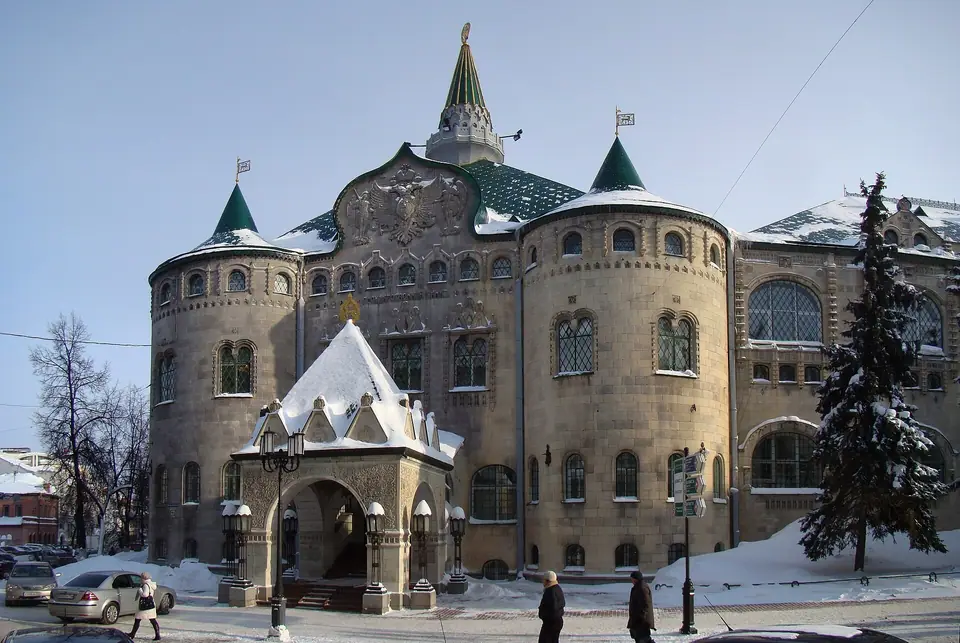
Bolshaya Pokrovskaya Street and the 1913 Neo-Russian State Bank
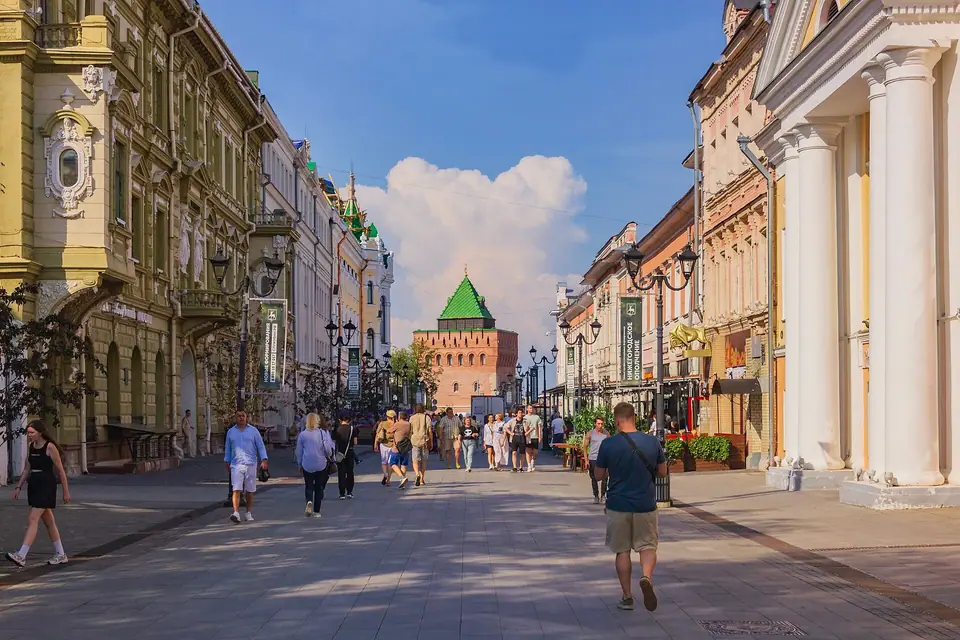
Stretching about 2.2 km across four squares, the Upper Town's pedestrian spine showcases the 1913 State Bank castle and the 1896 Drama Theatre.
Running southwest from Minin and Pozharsky Square outside Dmitrievskaya Tower of the Nizhny Novgorod Kremlin to Lyadov Square, Bolshaya Pokrovskaya Street (affectionately called Pokrovka by locals and named after the former Church of the Intercession of the Holy Virgin) is the historic main thoroughfare of the Upper Town. Formed as a noble and merchant avenue by the late eighteenth century, the street measures about 2.2 kilometres in total length, of which roughly 1.3 kilometres from Minin and Pozharsky Square form a granite-paved pedestrian promenade lined with bronze genre sculptures.
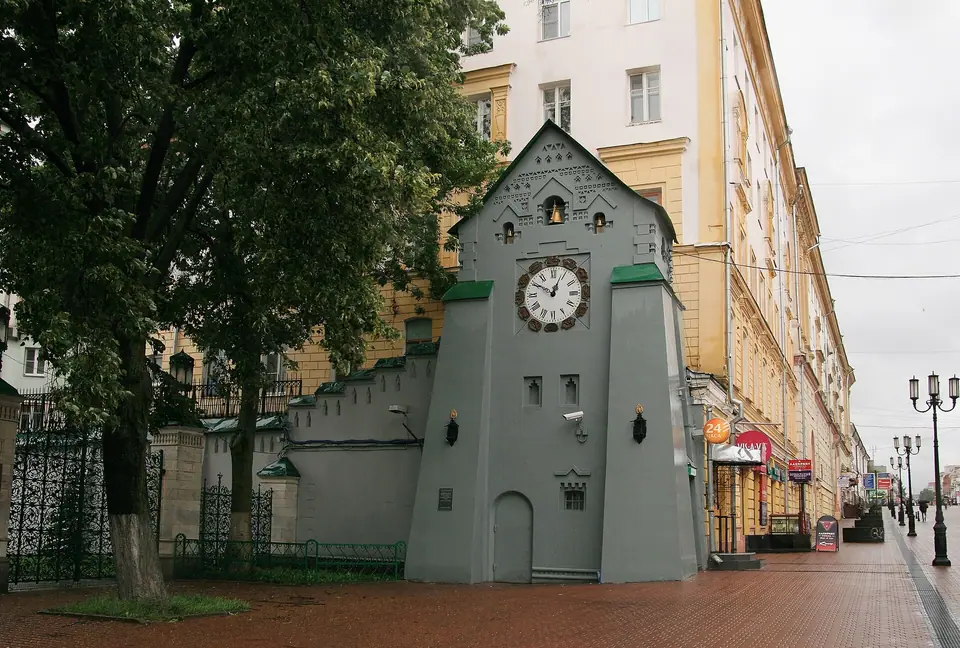
The 1913 Neo-Russian State Bank at No. 26
The architectural centrepiece of Bolshaya Pokrovskaya is the Nizhny Novgorod branch of the State Bank at no. 26. Designed by academician Vladimir Pokrovsky to mark the 50th anniversary of the State Bank of the Russian Empire and the 1913 Tercentenary of the House of Romanov, the Neo-Russian white-stone complex was built between 1911 and 1913, the year Emperor Nicholas II visited the city during the Romanov Tercentenary. Resembling a seventeenth-century boyar palace and medieval fortress, its exterior features a tented porch carved with the imperial double-headed eagle, a wrought-iron grille, and a side archway topped by a clock tower painted with signs of the Zodiac. Inside, the vaulted banking halls are covered in painted Old Russian-style interiors depicting the history of Russian trade, the Nizhny Novgorod militia of 1612, and traditional crafts.
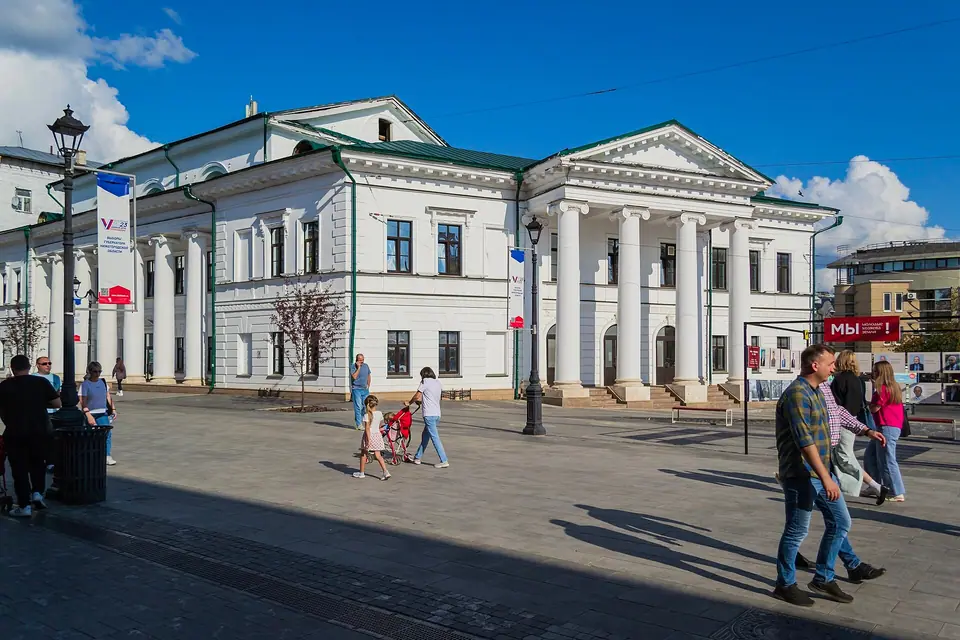
The 1896 Drama Theatre, City Duma and Noble Assembly
At the start of the street (no. 1, facing Minin and Pozharsky Square) stands the 1904 Palace of Labour (formerly the City Duma building designed by Vladimir Tseidler), alongside the 1913 Rukavishnikov Bank at no. 2. On Teatralnaya Square at no. 13 rises the Nizhny Novgorod State Academic Drama Theatre named after M. Gorky: founded in 1798 by Prince Nikolai Shakhovskoy, the company moved into its current Renaissance Revival building designed by St. Petersburg academician Viktor Schröter on 14 (26) May 1896 for the opening of the All-Russia Industrial and Art Exhibition. Further along at no. 18 stands the classical House of the Assembly of the Nobility, built between 1822 and 1826 by architect Ivan Efimov.
Four Squares, Historic Tram and Street Sculptures
Bolshaya Pokrovskaya connects four public squares: Minin and Pozharsky Square, Teatralnaya Square, Maxim Gorky Square (centred on a 1952 bronze statue of the writer by sculptor Vera Mukhina and served by Gorkovskaya Metro Station), and Lyadov Square. Bronze street sculptures of a photographer with his dog, a postman with a bicycle, and a fashionably dressed lady line the pavement beside traditional bakeries and cafés.
Traveller tips
Real advice from people who have been to Bolshaya Pokrovskaya Street and the 1913 Neo-Russian State Bank. Every tip is read by our team before it goes live.
No tips yet. Been here? Yours could be the first.
Thank you! Your tip will appear here after a quick review.
More in Nizhny Novgorod
Continue exploring Nizhny Novgorod with related neighbourhood, food, and planning guides
Nizhny Novgorod 3-Day Itinerary: Kremlin, Strelka, Cableway and Gorodets
Nizhny Novgorod, Russia
Nizhny Novgorod: Upper Bluffs, Strelka and Seasons
Nizhny Novgorod, Russia
Things to Do in Nizhny Novgorod: Kremlin Wall Walk, Strelka and Rivers
Nizhny Novgorod, Russia
Nizhny Novgorod Kremlin: 13 Brick Towers and Archangel Cathedral
Nizhny Novgorod, Russia
