


























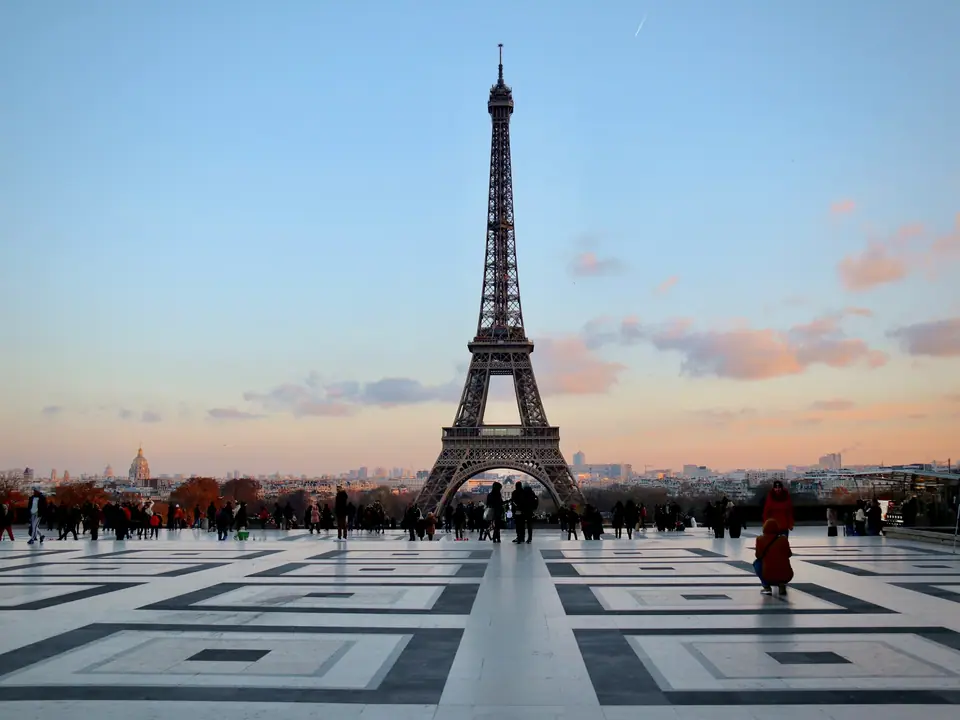
Photo by Fabien Maurin on Unsplash
Eiffel Tower Guide: Summit vs 2nd Floor Tickets, Stairs & Viewpoints
How to choose between the 276-metre summit lift and the 674-step stair climb, when online tickets drop, and where to photograph the tower from outside.
Engineers Maurice Koechlin and Émile Nouguier designed the Eiffel Tower (La Tour Eiffel) with architect Stephen Sauvestre in the workshop of Gustave Eiffel (goos-TAHV eh-FELL). Crews built the tower in two years, two months, and five days. It served as the grand entrance arch for the 1889 Exposition Universelle marking the centennial of the French Revolution. Workers assembled 18,038 puddle-iron parts held together by 2.5 million thermally driven rivets. Weighing 7,300 tonnes in structural metal (10,100 tonnes total), it stood at 300 metres upon opening. That height made it the world's tallest human-made structure for 41 years until New York's Chrysler Building in 1930. The tower reached 330 metres in March 2022 when a helicopter fitted a new six-metre radio antenna at the tip. Originally granted a 20-year permit and slated for dismantling in 1909, the monument survived. Gustave Eiffel saved it by installing a meteorology lab and military radio transmitter at the top.
The three public levels explained: 1st Floor, 2nd Floor, and the Summit
Before opening the official ticketing calendar, understand how the tower's three visitor platforms differ in height, perspective, and access:
- 1st Floor (Premier Étage, 57 metres above ground). Spanning 4,200 square metres, the widest platform features a transparent glass floor looking straight down at the security esplanade. Visitors can walk an outdoor historical trail displaying a spiral staircase section and the 1899 hydraulic pump machinery, or dine at Madame Brasserie.
- 2nd Floor (Deuxième Étage, 115 metres above ground) vs The Summit (Le Sommet, 276 metres above ground). Experienced Parisians and architectural photographers widely agree that the 2nd Floor at 115 metres offers the sharpest panorama of the capital. You stand high enough to see all 20 arrondissements. At the same time, you remain low enough to spot the Louvre glass pyramid and Notre-Dame's restored spire. You can also clearly pick out the gilded dome of Les Invalides and the white domes of Sacré-Cœur. It houses the one-Michelin-star restaurant Le Jules Verne, accessed via a private lift in the South Pillar. From the 2nd Floor, summit ticket holders queue a second time for glass-walled lifts up to the Summit at 276 metres. This platform is the highest public observation deck in the European Union. Up top, you find Gustave Eiffel's restored office with wax figures of Eiffel and Thomas Edison, a champagne bar, and a 70-kilometre horizon on clear days.
Ticket types compared and the 60-day online booking rule
Only buy tickets on the official website (ticket.toureiffel.paris). Third-party resellers routinely mark up prices by 100 to 200 percent under the guise of "skip-the-line" tours. The official site sells four distinct ticket types:
- Lift Ticket to the Summit (Billet Ascenseur Sommet). This ticket covers lift access from the ground esplanade to the 2nd Floor. It then includes the upper lift to the Summit (276 m) and stops at the 1st Floor on the way down.
- Lift Ticket to the 2nd Floor (Billet Ascenseur 2e Étage). Covers lift rides to the 2nd and 1st Floors without summit access. Note that you cannot upgrade a 2nd-floor ticket to the summit once up on the 2nd floor.
- Stairs Ticket to the 2nd Floor (Billet Escaliers 2e Étage). You climb the 674 steps inside the South Pillar up to the 1st Floor (328 steps) and 2nd Floor (another 346 steps) through the iron lattice. The climb takes 30 to 45 minutes at an easy pace with frequent rest landings, and you can ride the lift or walk down afterward.
- Stairs to 2nd Floor + Lift to the Summit (Billet Escaliers + Ascenseur Sommet). Combines the 674-step climb to the 2nd Floor with the upper lift to the 276-metre Summit. This hybrid option is often the smartest choice when standard all-lift summit slots are sold out.
When tickets go on sale. Online lift tickets open exactly 60 days in advance at midnight Paris time. Online stair tickets open 14 days in advance. If your preferred date shows sold out online, check again 7 days ahead when a secondary batch drops. You can also join the on-site ticket office queue at the base of the tower on a weekday morning.
Timing your visit, security perimeters, and the hourly 5-minute sparkle
A permanent bulletproof glass and metal security perimeter encloses the gardens directly beneath the four pillars. All visitors pass through airport-style bag screening at Entry 1 (South/Champ de Mars) or Entry 2 (East/Quai Jacques Chirac). That screening applies even if you only walk under the tower gardens without going up. Arrive 20 to 30 minutes before your timed ticket slot, as latecomers can lose their reservation. Leave suitcases or large rucksacks at your hotel because the Eiffel Tower has no luggage cloakroom.
Since New Year's Eve 1999/2000, the tower's golden floodlights and rotating roof beacon have been joined by 20,000 flashing LED bulbs (5,000 per side). Every evening after dusk, the tower sparkles for 5 minutes at the exact start of every hour until 23:00. A final 5-minute sparkle takes place at 23:45 before the lights switch off at 01:00. To reach the tower using our Paris transport guide, ride Metro Line 6 to Bir-Hakeim, which crosses a scenic iron viaduct over the Seine. You can also take Metro Line 9 to Trocadéro or RER C to Champ de Mars-Tour Eiffel.
The 5 best viewpoints to photograph the Eiffel Tower from outside
- Place du Trocadéro & Parvis des Droits de l'Homme (16th Arr.). Exit Trocadéro station (Lines 6 and 9) directly onto the elevated esplanade of the 1937 Palais de Chaillot. It offers the classic symmetrical front-on vista across the Warsaw Fountains and the Seine. Come within an hour of sunrise to have the marble terrace to yourself.
- Pont de Bir-Hakeim (15th/16th Arr.). Built between 1903 and 1905, this two-level steel bridge frames the Eiffel Tower beside its central brick-and-iron viaduct arches. Just south on the Île aux Cygnes stands Paris's miniature bronze Statue of Liberty.
- Champ de Mars Lawn & Avenue de Camoëns. Stretching 780 metres southeast from the tower's feet to the 1751 École Militaire, the Champ de Mars is ideal for an evening picnic. Across the river, the quiet cul-de-sac staircase of Avenue de Camoëns frames the tower between Haussmann limestone facades.
- Rue de l'Université & Tour Montparnasse (56th Floor, 210 metres). For a close-up street angle, walk to the western end of Rue de l'Université at the north corner of the Champ de Mars. For a wide twilight skyline panorama that puts the Eiffel Tower dead-centre against the city lights, ride the lift up the 210-metre Montparnasse Tower.
Where it is
- 1Eiffel Tower
- Paris-Orly Airport (ORY) · about 15 km from here in a straight line
- Directions in Google Maps
Stations and taxi ranks: OpenStreetMap. Airports: OurAirports. Distances are in a straight line.
Traveller tips
Real advice from people who have been to Paris. Every tip is read by our team before it goes live.
No tips yet. Been here? Yours could be the first.
Thank you! Your tip will appear here after a quick review.
More in Paris
Continue exploring Paris with related neighbourhood, food, and planning guides
Louvre Museum Guide: Entrances, 3 Wings, Masterpieces & Timed Tickets
Paris, France
Montmartre Walking Guide: Sacré-Cœur, Artists' Lanes & Vineyard Route
Paris, France
Where to Stay in Paris: Best Arrondissements & Neighbourhoods Compared
Paris, France
Paris 3-Day Itinerary: Step-by-Step First-Timer Route by Metro & Foot
Paris, France
