


























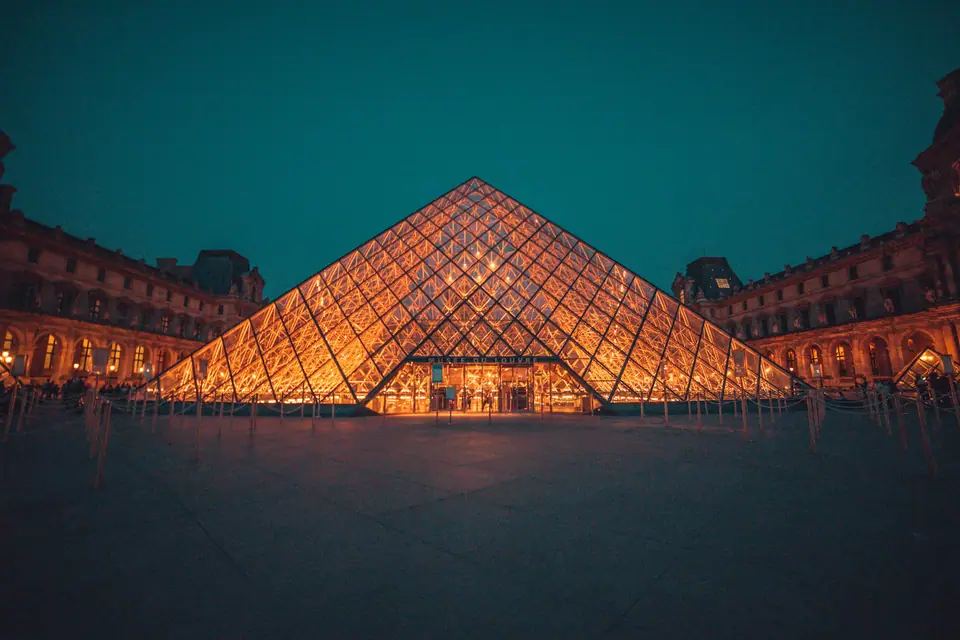
Photo by Bharat Patil on Unsplash
Louvre Museum Guide: Entrances, 3 Wings, Masterpieces & Timed Tickets
Which entrance skips the Pyramid queue, how the Denon, Sully, and Richelieu wings connect underground, and a focused 3-hour masterpiece route.
The Musée du Louvre is the largest art museum on earth. It spans 72,735 square metres of exhibition halls inside a royal palace that evolved over eight centuries. King Philip Augustus originally built a moated medieval fortress here around 1190 to guard the western Seine approach against Anglo-Norman raids. King Francis I transformed the keep into a Renaissance residence in 1546, and Henry IV and Louis XIV linked it to the Tuileries. During the French Revolution, the National Assembly opened the palace to the public as a national museum on 10 August 1793 with 537 paintings. Today nearly 35,000 artworks, from 4,000-year-old Mesopotamian steles to Delacroix's 1830 canvases, fill more than 400 rooms across 14.5 kilometres of corridors. Walking in without a spatial plan guarantees exhaustion within ninety minutes. Use the strategy below to see the highlights in three focused hours before continuing your Paris 3-day itinerary.
Booking rules, closed Tuesdays, and Friday night openings
Every visitor must book a mandatory timed-entry slot online via the official ticketing portal (ticket.louvre.fr) before arriving. That requirement includes Paris Museum Pass holders and European Union residents under 26 entitled to free admission. The Louvre is closed every Tuesday, as well as on 1 January, 1 May, and 25 December. On Mondays, Thursdays, Saturdays, and Sundays, galleries close at 18:00 (with room clearance starting 30 minutes prior). On Wednesdays and Fridays, the museum stays open late until 21:00. Booking a 17:30 or 18:00 Wednesday or Friday slot gives you the calmest gallery experience of the week.
Louvre entrances compared: Pyramide vs Carrousel du Louvre vs Passage Richelieu
Opened in 1989 and designed by Chinese-American architect I. M. Pei, the 21.6-metre-high glass and steel Pyramide rises in the Cour Napoléon. Composed of 673 diamond and triangular glass panes, it serves as the central underground hub beneath all three palace wings. However, queuing outdoors in the sun or rain at the Pyramid is rarely necessary if you use the underground shopping arcade access:
- Main Glass Pyramid (Cour Napoléon) vs Carrousel du Louvre (99 Rue de Rivoli / Metro Line 1 & 7). At the surface Pyramide, four colour-coded queues separate visitors with timed tickets (green line) from Paris Museum Pass holders (orange line). During busy morning hours or wet weather, walk instead to 99 Rue de Rivoli. You can also exit straight off Palais Royal-Musée du Louvre station (Metro Lines 1 and 7) into the underground Carrousel du Louvre shopping gallery. Its security checkpoint stands beside Pei's inverted glass pyramid (Pyramide Inversée). It feeds directly into the exact same subterranean Hall Napoléon lobby beneath the main Pyramid, sheltered from the weather.
- Passage Richelieu (Rue de Rivoli) & Porte des Lions (Quai François Mitterrand). Located between the Palais-Royal and the Cour Napoléon off Rue de Rivoli, the vaulted Passage Richelieu serves group bookings, museum members, and priority card holders. At the western riverside end of the Denon Wing near Pont Royal stands the smaller Porte des Lions entrance. When open, it provides direct access into the Italian and Spanish painting wing. Note that Porte des Lions has no cloakroom and closes on days with reduced staffing; always verify your ticket's designated entrance before setting out.
How the three wings work: Denon, Sully, and Richelieu
Once you descend beneath the glass Pyramid into the subterranean Hall Napoléon, leave coats and backpacks at the free self-service lockers (vestiaire). Bags larger than 55 by 35 by 20 cm are prohibited inside the museum. Pick up a free paper floor map in English or French, and look up at the three directional escalators leading into the horseshoe-shaped palace:
- Denon Wing (Aile Denon, South Wing along the Seine). This is the busiest and most celebrated wing in the palace. It holds Italian Renaissance painting (including the Mona Lisa), French canvases, Greek sculpture (Winged Victory of Samothrace), and Michelangelo's marbles.
- Sully Wing (Aile Sully, East Square around the Cour Carrée). Sully encircles the oldest Renaissance courtyard of the palace. It houses the 1190 medieval Louvre fortress moat walls in the basement (Level -1), Pharaonic Egyptian antiquities, and the Greek sculpture gallery holding the Venus de Milo.
- Richelieu Wing (Aile Richelieu, North Wing along Rue de Rivoli). Converted from the French Finance Ministry in 1993, this noticeably quieter wing holds two glass-roofed sculpture courtyards (Cour Marly and Cour Puget). It also displays the 1750 BCE Code of Hammurabi, Northern European painters (Vermeer, Rembrandt, Rubens), and the gilded Apartments of Napoleon III.
A realistic 3-hour masterpiece route (without corridor burnout)
Follow this sequential loop starting at the Denon Wing escalator the moment your morning or evening slot opens:
- Hour 1: Winged Victory, Grande Galerie, and Room 711 (Denon Level 1). Ride the Denon escalator up the Daru Staircase to stand directly before the Winged Victory of Samothrace (Victoire de Samothrace, c. 190 BCE), perched on its limestone ship's prow. Turn right through the barrel-vaulted Grande Galerie of Italian Renaissance panels into Room 711 (Salle des États). Along the way you pass works by Leonardo da Vinci, Raphael, and Titian. In Room 711 hangs Leonardo da Vinci's poplar-wood portrait Mona Lisa (La Joconde, painted c. 1503 to 1506, measuring just 77 by 53 cm) behind bulletproof climate-controlled glass. After viewing it, turn 180 degrees around in the exact same room to admire the largest painting in the Louvre. Paolo Veronese's 1563 canvas The Wedding at Cana (Les Noces de Cana) measures 6.77 by 9.94 metres and contains 130 life-sized figures.
- Hour 2: French Romanticism, Apollo Gallery, and Venus de Milo (Denon to Sully). Cross into neighbouring Room 700 (Salle Mollien) to see Théodore Géricault's 1819 The Raft of the Medusa. Beside it hangs Eugène Delacroix's 1830 Liberty Leading the People. Next door in Room 702 hangs Jacques-Louis David's 1807 The Coronation of Napoleon, measuring 6.21 by 9.79 metres. Walk through the gilded Galerie d'Apollon (Room 705, housing the surviving French Crown Jewels including the 140-carat Regent Diamond). Continue into the Sully Wing (Level 0, Room 345) for the marble Venus de Milo (c. 100 BCE). Then descend to Level -1 to walk beside the medieval stone keep moat of Philip Augustus.
- Hour 3: Cour Marly, Code of Hammurabi, and Napoleon III Apartments (Richelieu). Finish in the calm Richelieu Wing among the sunlit marble horses of the Cour Marly and the winged Assyrian bulls of Khorsabad (Room 229). Upstairs on Level 1 (Room 544) glow the crimson-velvet and crystal-chandelier Apartments of Napoleon III. Exit west into the Tuileries Garden or north into the 1633 Palais-Royal courtyard with Daniel Buren's 1986 striped columns, covered in our Paris things to do guide.
Where it is
- 1Louvre Museum
- Paris-Orly Airport (ORY) · about 15 km from here in a straight line
- Directions in Google Maps
Stations and taxi ranks: OpenStreetMap. Airports: OurAirports. Distances are in a straight line.
Traveller tips
Real advice from people who have been to Paris. Every tip is read by our team before it goes live.
No tips yet. Been here? Yours could be the first.
Thank you! Your tip will appear here after a quick review.
More in Paris
Continue exploring Paris with related neighbourhood, food, and planning guides
Where to Stay in Paris: Best Arrondissements & Neighbourhoods Compared
Paris, France
Paris 3-Day Itinerary: Step-by-Step First-Timer Route by Metro & Foot
Paris, France
Paris: Arrondissements, Museum Bookings & Local Rules
Paris, France
Best Things to Do in Paris: 12 Iconic Landmarks, Museums & Walks
Paris, France
