


























Photo: DALIBRI · CC BY-SA 4.0
Altes Rathaus and the Perpetual Imperial Diet of 1663 to 1806
Inside Regensburg's 1245 Old Town Hall, the Gothic Reichssaal where the Holy Roman Empire sat for 143 years, the Fragstatt basement, and tour-only rules.
Few municipal halls in Central Europe match the constitutional weight preserved behind the painted doorways of Regensburg's Altes Rathaus (Old Town Hall). Begun as civic independence took shape in 1245, its Gothic assembly halls grew from municipal dance rooms into the permanent seat of the Holy Roman Empire from 1663 until 1806. Because interior chambers operate solely through guided entry, checking tour times at Rathausplatz keeps a morning itinerary moving smoothly.
From 1245 Free Imperial City Charter to the 55-Metre Tower
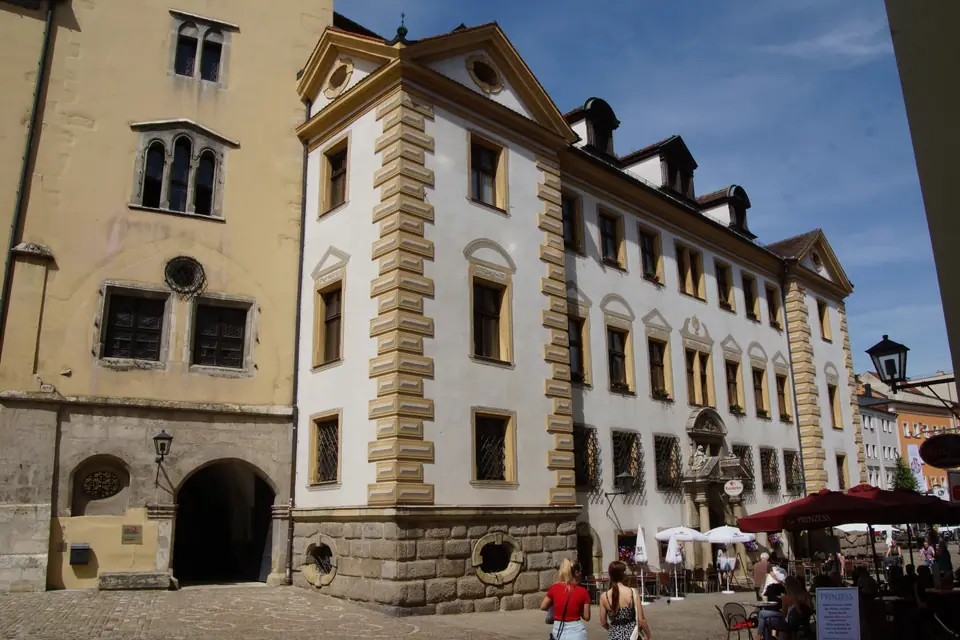
Work began shortly after Emperor Frederick II granted Regensburg Free Imperial City (Reichsstadt) privileges in 1245. Rising 55 metres high, the stone watchtower forms the oldest surviving core of the civic block linking Rathausplatz to Kohlenmarkt. Positioned squarely between Domplatz and Wahlenstraße's patrician limestone towers, the building anchored everyday town administration. Merchants and councillors grouped assembly rooms directly beside tall merchant houses. Warning bells mounted high overhead could summon guildsmen swiftly whenever Danube disputes or fire alarms broke out across medieval lanes.
Gothic Reichssaal, 1350 Bay Window and Schutz und Trutz
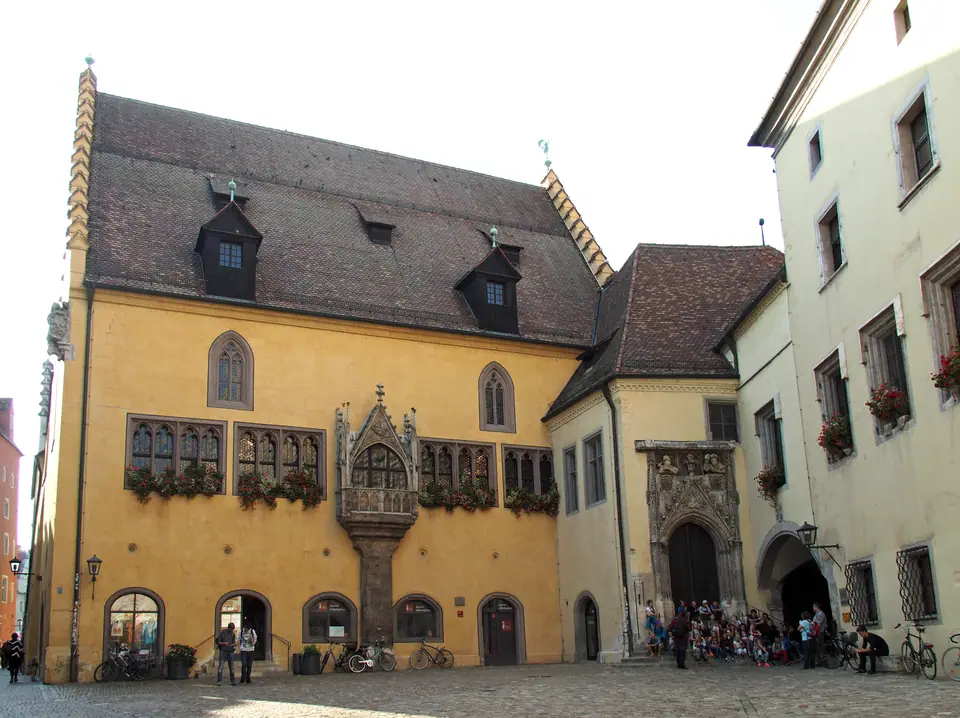
Between 1320 and 1330, city masons added the grand timber-vaulted Reichssaal (RYKHS-zahl) wing. Builders raised that hall originally not as an imperial parliament, but as a festive municipal dance room and ceremonial reception hall. Facing cobbled Rathausplatz protrudes an ornate c. 1350 Gothic bay window (Erker) from which civic decrees were read over market stalls. Beside the stone steps stands a late-Gothic pointed-arch portal carved with Regensburg's crossed silver keys. Two armoured stone half-figures guard the doorway under the local nickname Schutz und Trutz ("Protection and Defiance").
Why the 1663 Diet Never Dissolved After Westphalia
Imperial Diets had gathered periodically in Regensburg since 1541, one year before city leaders adopted the Protestant Reformation in 1542. From 1594 onward, assemblies convened exclusively inside the Old Town Hall complex. Everything shifted when Emperor Leopold I summoned the Estates on 20 January 1663 to raise funds against advancing Ottoman forces. Under the 1648 Peace of Westphalia, the Emperor could no longer pass imperial policy or new taxes without formal Diet consent. That constitutional shift gave town halls in Regensburg lasting diplomatic weight across Central Europe.
Princes and city envoys realised that dissolving the assembly would hand initiative back to Vienna, risking years without another summons. Delegates simply kept the session running past the 1684 Truce of Ratisbon. Because the Diet never formally closed, its 1654 decree kept the title Jüngster Reichsabschied ("Youngest Recess"). Across 143 unbroken years, roughly 70 foreign representatives joined Imperial Estates envoys inside town. Modern civic sources therefore call the Reichstag assembly a historical forerunner to German parliaments, the European Union, and the United Nations.
Thurn und Taxis Commissioners and the 1803 Mediatisation
Rather than residing in Regensburg personally, the Habsburg Emperor in Vienna sent a noble Principal Commissioner (Prinzipalkommissar) to uphold imperial protocol. Continuously from 1748 until 1806, that prestigious post stayed inside the postal House of Thurn und Taxis. Alexander Ferdinand served from 1741 to 1745 and again from 1748 to 1773. Karl Anselm followed from 1773 to 1797, then Karl Alexander from 1797 to 1806. Their stately palace still stands minutes south at Schloss St. Emmeram.
Imperial politics wrapped up dramatically on 25 March 1803 when the Diet passed the Reichsdeputationshauptschluss (German Mediatisation). That landmark decree secularised church principalities and placed Regensburg inside a temporary Principality of Regensburg. Following the formal dissolution of the Holy Roman Empire in 1806 and heavy fighting in the 1809 Battle of Ratisbon, Regensburg passed permanently into the Kingdom of Bavaria in 1810.
Inside the Reichstagsmuseum and the Fragstatt Interrogation Cellar
Stepping inside with a museum guide moves visitors abruptly from painted timber diplomacy down into grim medieval justice.
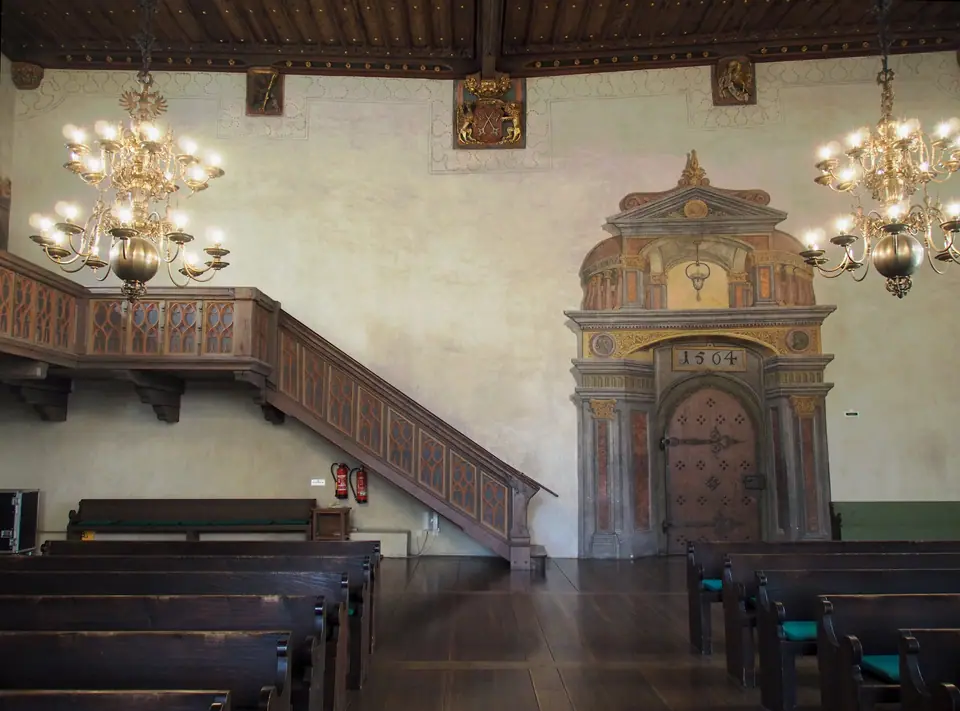
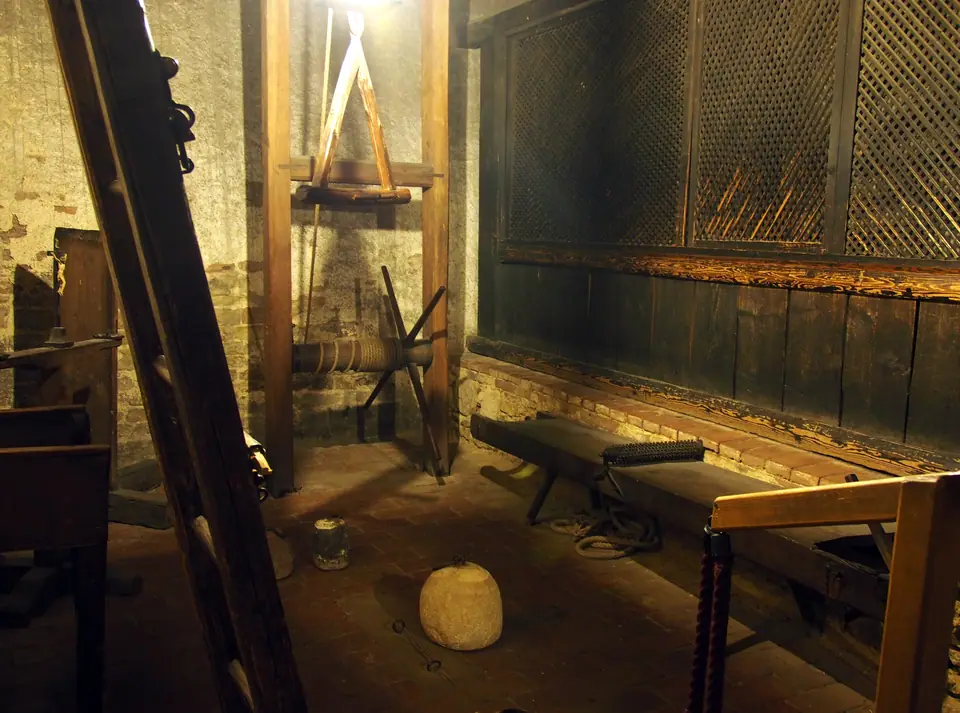
Upstairs inside the Reichstagsmuseum, guests cross hushed oak floorboards inside the Reichssaal beneath an intact medieval wooden ceiling. Beside the main chamber sit the Estates' consultation room and historic archival documents recalling centuries of slow bargaining. Steep stone stairs then drop far below street level into the cold, windowless basement Fragstatt (FRAHK-shtat). Original medieval masonry holds authentic wooden racks, leg irons, and judicial benches behind barred screens. Moving abruptly from painted diplomacy overhead down into damp stone cells exposes how civic magistrates extracted confessions right beneath receptions above.
Guided-Tour-Only Rules at Rathausplatz 4
Independent walk-in visits to the Reichssaal, Estates consultation room, and basement Fragstatt are strictly barred. Entry runs exclusively via guided tours booked at the Regensburg Tourist Information desk inside the building at Rathausplatz 4 (postcode 93047). Check daily English and German tour slots on tourismus.regensburg.de ahead of damp days noted in our seasonal planner. Historic masonry brings steep medieval cellar staircases and low stone lintels below street height, restricting mobility-aid access underground.
Café Prinzess and Don Juan de Austria Outside the Portal
Stepping back onto Rathausplatz brings European history back to street height. Directly across the cobbles at number 2 opens Café Prinzess, serving coffee since 1686 when thirsty Diet diplomats sought an evening salon. Walk around the western corner onto quiet Zieroldsplatz to find the bronze statue of Don Juan de Austria. Born in Regensburg in 1547 before commanding Habsburg fleets, his quiet corner square leads walkers smoothly back toward Domplatz and the Danube.
Where it is
- 1Altes Rathaus and the Perpetual Imperial Diet of 1663 to 1806
- Munich Airport (MUC) · about 77 km from here in a straight line
- Directions in Google Maps
Stations and taxi ranks: OpenStreetMap. Airports: OurAirports. Distances are in a straight line.
Traveller tips
Real advice from people who have been to Regensburg. Every tip is read by our team before it goes live.
No tips yet. Been here? Yours could be the first.
Thank you! Your tip will appear here after a quick review.
More in Regensburg
Continue exploring Regensburg with related neighbourhood, food, and planning guides
Altstadt 93047 to Island Stadtamhof: Where to Stay in Regensburg
Regensburg, Germany

April Calm, May Dult and Four Advent Markets: Regensburg Seasons
Regensburg, Germany
Wurstkuchl Charcoal Sausages, Regensburger Knacker and Sweet Mustard
Regensburg, Germany
Steinerne Brücke: Sixteen Arches Across 850 Years on the Danube
Regensburg, Germany
