


























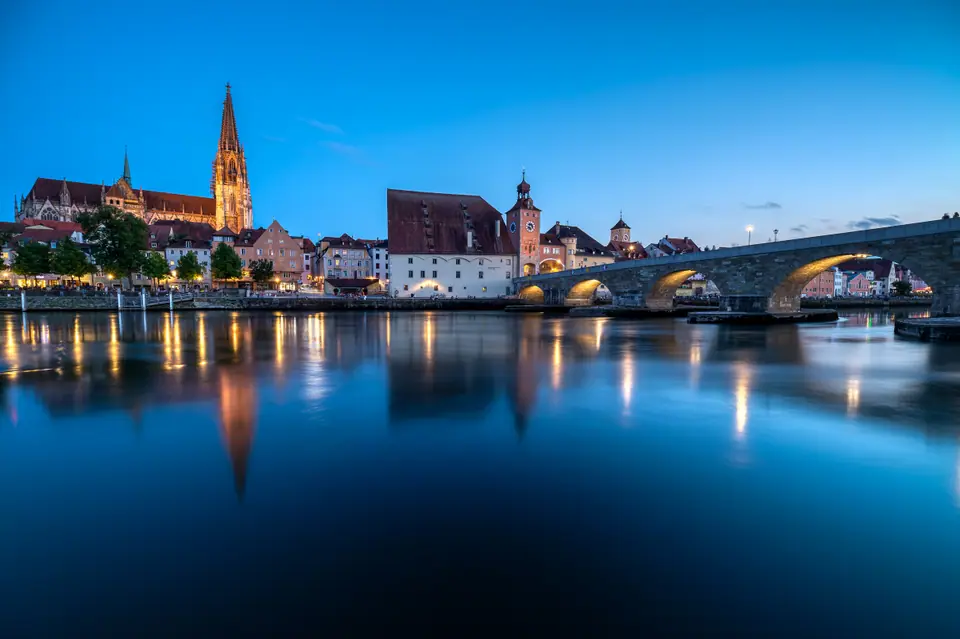
Photo: GZagatta · CC BY-SA 4.0
Steinerne Brücke: Sixteen Arches Across 850 Years on the Danube
How an 1135 dry riverbed produced Germany's oldest preserved stone bridge, its Debt Tower and Bruckmandl statue, 1945 war wounds, and 2018 restoration.
Walking across Regensburg's Steinerne Brücke (SHTY-ner-neh BRUE-keh) traces far more than a scenic postcard crossing between Old Town gables and northern riverbanks. Completed in 1146 as Germany's oldest preserved stone bridge, it stands over 850 years old today. Its sixteen rounded sandstone arches carried medieval wool wagons, crusading armies, and salt merchants across the Danube when no other fixed bridge stood between Ulm and Vienna. Restored thoroughly between 2010 and June 2018, the traffic-free deck now belongs wholly to pedestrians and cyclists.
1135 Dry Riverbed: Eleven Years That Built Sixteen Arches
Charlemagne had earlier thrown a temporary wooden span across the Danube roughly 100 metres east, yet winter ice floes and spring torrents doomed timber pilings repeatedly. Masons finally started permanent stone piers in 1135. An unusually hot, dry summer dropped Danube water levels low enough to hammer massive oak cofferdams deep into gravel beds. Working with striking speed for 12th-century engineering, builders finished the span in 1146 after barely 11 years.
Originally measuring 336 metres end to end, the bridge shrank slightly to its present 308.7 metres when builders absorbed its southernmost first pier inside the riverside Salzstadel salt store. That change trimmed 27.3 metres off its southern ramp. Spanning both the northern and southern Danube channels, its central arches stride cleanly across green Jahninsel beside neighbouring islands Oberer Wöhrd and Unterer Wöhrd.
Four-Metre Rapids, European Copies and the 1854 Bruckmandl
Wide triangular masonry cutwaters shield each pier against drifting winter ice packs while narrowing open river gaps down to as little as 4 metres in places. Squeezing heavy Danube currents between thick stone piers accelerates fierce swirling eddies known locally as the Donau-Strudel, long harnessed to power waterwheels along riverside mills. Across medieval Europe, masons studied Regensburg's masonry geometry closely. Later spans echoed its multi-arch template in Dresden's Augustus Bridge, old London Bridge, Avignon's Pont Saint-Bénézet, and Prague's Judith Bridge. Governed by an independent bridge administration that levied tolls and held its own surviving seal by 1307, the crossing powered Regensburg's rise to Free Imperial City wealth.
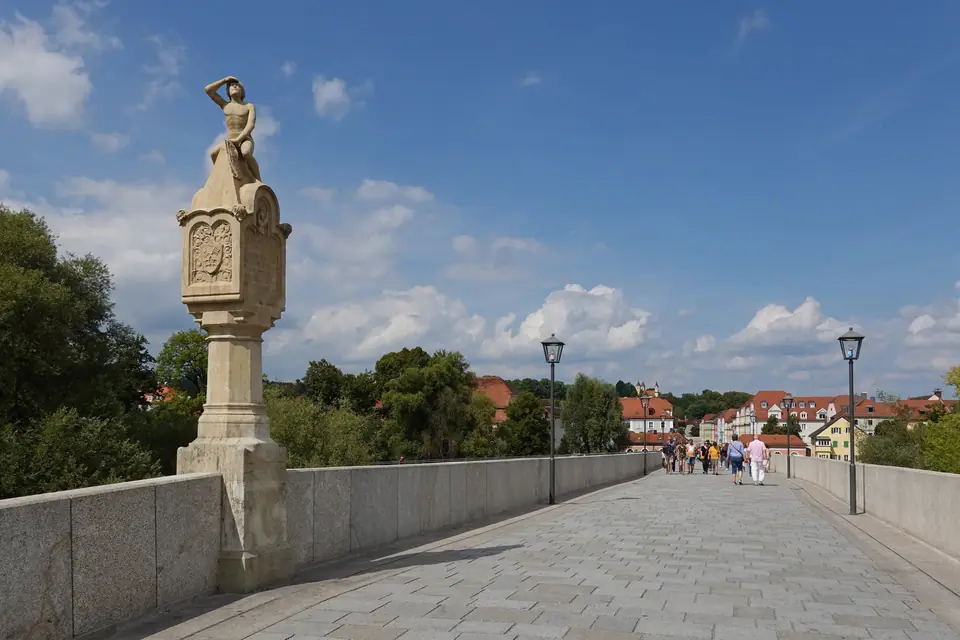
Halfway across the parapet perches Regensburg's miniature folk emblem, the Bruckmandl ("bridge mannikin"). Shading its brow against southern sunlight while gazing back toward Dom St. Peter, the current limestone figure was raised on 23 April 1854. Its carved motto reads "Schuck wie heiß" ("Gosh, how hot"), recalling the scorching dry summer of 1135. Its 1579 predecessor lost arms and legs during the 1809 Battle of Ratisbon and rests safely inside the Regensburg Museum of History.
Salt Store Piers, Debt Tower and Lost Gatehouses
Medieval defensive logic once turned the bridge into a gated river fortress guarded by three separate stone towers. Only the pink southern Brückturm survives above the Old Town entry, erected around 1300 and topped with its round clock after Thirty Years' War repairs in 1648. Used from the mid-16th century as a debtors' lockup earning the name Schuldturm (Debt Tower), its steep wooden stairs now house the Brückturmmuseum overlooking swirling currents and rooftops.
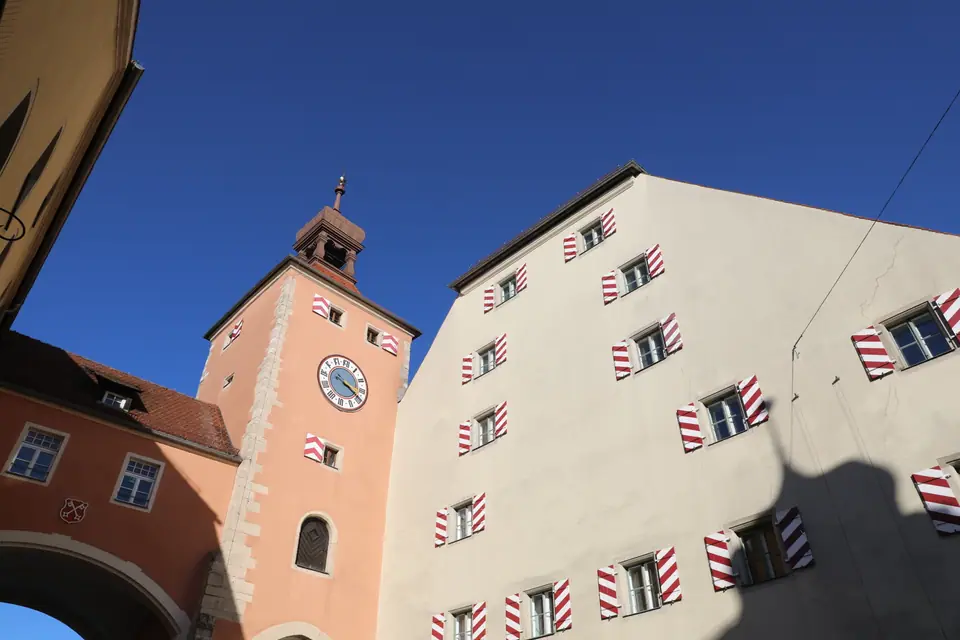
Two northern gate towers vanished during early modern town expansions and Napoleonic fighting. A central tower dating from around 1200 came down in 1784. The fortified northern Black Tower (late 12th century, strengthened 1383 to 1429) suffered heavy artillery scars in 1809 before demolition in 1810. Directly flanking the southern gatehouse stand the early 16th-century Amberger Salzstadel, the 1616 to 1620 Regensburger Salzstadel (housing the World Heritage Visitor Centre), and Historische Wurstkuchl tucked against medieval river defences.
Why the Devil's Bridge Race Legend Collapses on Dates
Local folklore animates the bridge's subtle horizontal bend with a colourful medieval rivalry. Legend tells how the master builder of the Cathedral and his ambitious apprentice raising the Stone Bridge wagered on who would finish faster. Falling behind, the bridge apprentice sealed a pact with the Devil, trading the first three souls across the new span for supernatural speed. Outsmarting the bargain, the builder chased a rooster, a hen, and a dog over the cobblestones first. Enraged, the Devil heaved upward against the masonry and bent its spine.
Checking historic stone chronologies punctures that tale cleanly by well over a century. Masons completed the Stone Bridge around 1146, whereas work on today's Gothic Dom St. Peter began between 1273 and 1275, leaving zero overlap between construction crews.
1945 Pier Demolition and the 2018 General Overhaul
For roughly 800 years, the Stone Bridge stood as Regensburg's sole permanent Danube crossing until modern steel spans arrived in the 1930s. Wartime disaster struck on 23 April 1945, when retreating German troops detonated explosives beneath the second and eleventh piers just ahead of advancing Allied columns. Temporary beams carried traffic until structural pier reinforcement ran from 1951 to 1962 and permanent masonry repairs wrapped up in 1967.
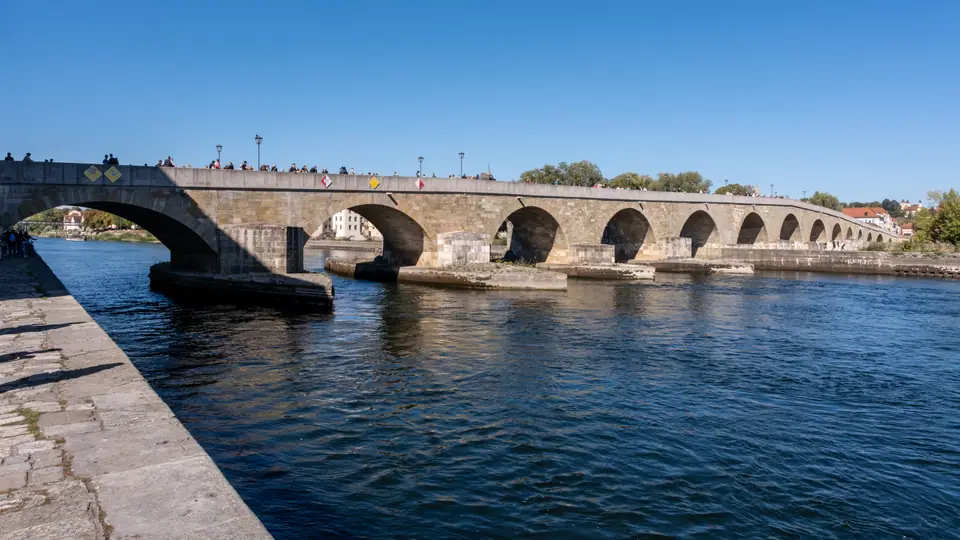
Decades of postwar cars, buses, and winter road salt chewed deeply into porous blocks until residents pushed back. Following a 1997 referendum banning private cars, city engineers closed the deck abruptly to buses and taxis on 1 August 2008 after structural balustrade tests failed impact safety rules. From 2010 to 2018, conservation crews carried out a twenty-million-euro general restoration, reopening the repaved span strictly for walkers and cyclists on 10 June 2018 using matching stone from an old quarry near Ihrlerstein.
Pedestrians, Cyclists and Both Danube Islands
Today, stepping onto the car-free paving at sunrise or dusk links central Old Town walks smoothly with grassy terraces on Jahninsel and Stadtamhof 93059 without engine noise. Pause near the Bruckmandl to line up the Salt Store gables, Brückturm clock, and twin Cathedral spires behind terracotta roofs before descending stone ramps onto shaded island paths.
Where it is
- 1Steinerne Brücke
- Munich Airport (MUC) · about 78 km from here in a straight line
- Directions in Google Maps
Stations and taxi ranks: OpenStreetMap. Airports: OurAirports. Distances are in a straight line.
Traveller tips
Real advice from people who have been to Regensburg. Every tip is read by our team before it goes live.
No tips yet. Been here? Yours could be the first.
Thank you! Your tip will appear here after a quick review.
More in Regensburg
Continue exploring Regensburg with related neighbourhood, food, and planning guides
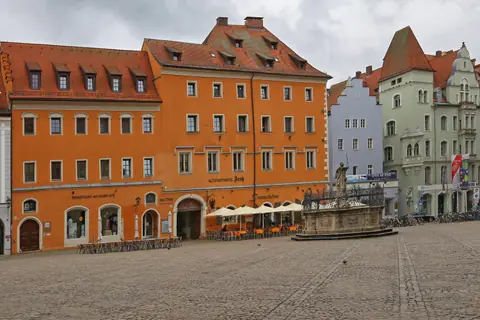
Schloss St. Emmeram to the Stone Bridge: Walking Regensburg
Regensburg, Germany
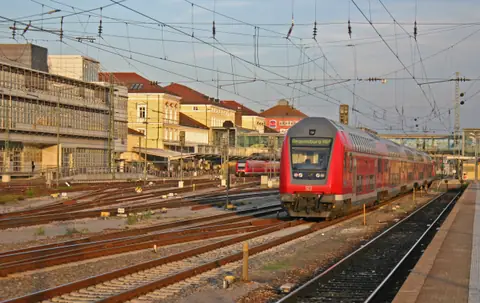
Regensburg Hauptbahnhof, Munich Airport Express and RVV Transit
Regensburg, Germany
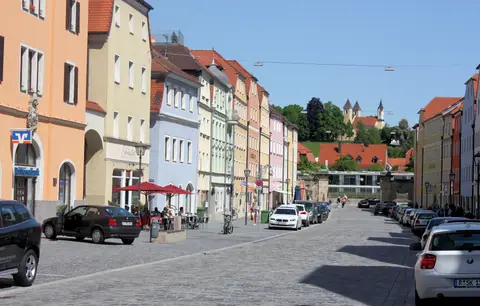
Altstadt 93047 to Island Stadtamhof: Where to Stay in Regensburg
Regensburg, Germany
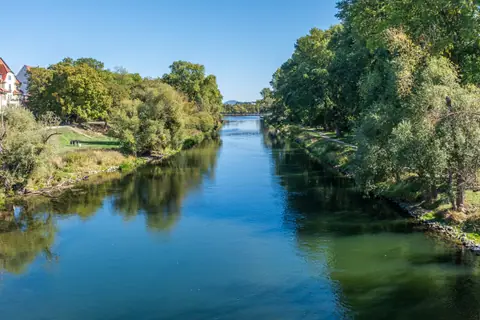
April Calm, May Dult and Four Advent Markets: Regensburg Seasons
Regensburg, Germany
