Bibi-Khanym & Siyob Bazaar Guide
Explore Bibi-Khanym Mosque, Saray Mulk Khanum Mausoleum, Hazrat Khizr Mosque, and Siyob Bazaar in Samarkand with ticket prices, non bread tips, and history
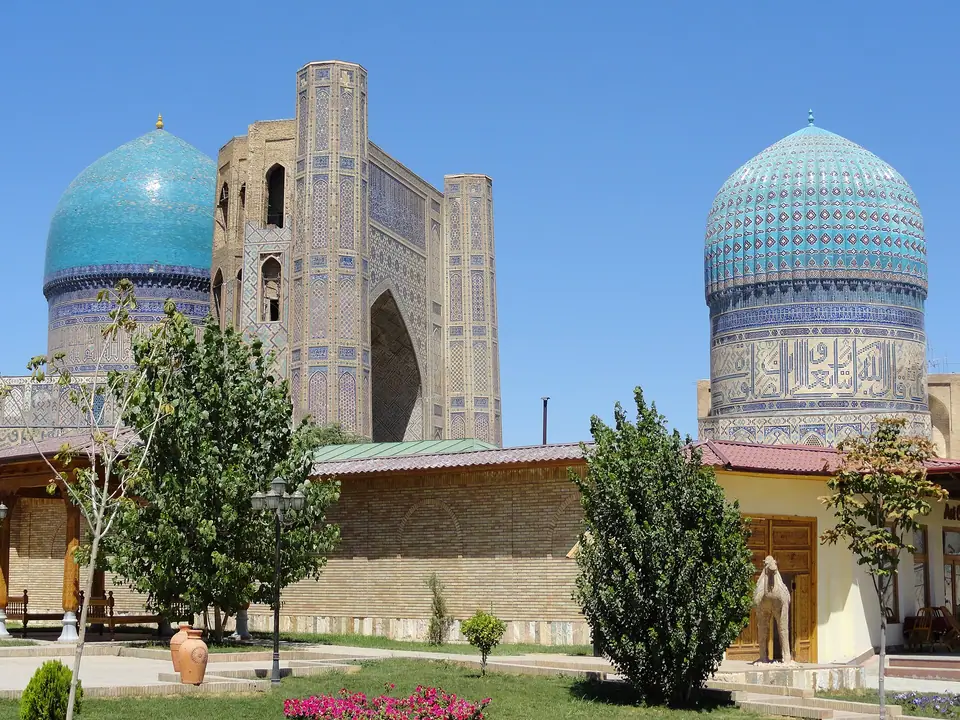
Five hundred metres northeast of Registan Square along Islam Karimov Street stands the Bibi-Khanym cluster. Here Timur's colossal Friday mosque meets the lively domes of Siyob Dekhqan Bazaar and the hillside shrine of Hazrat Khizr. Walking this 800-metre corridor gives you the sharpest contrast in Samarkand between 14th-century imperial ambition and everyday Uzbek market life.
| Stop on the Route | Entry Fee (Nov 2026) | Recommended Time | Key Highlight |
|---|---|---|---|
| 1. Bibi-Khanym Congregational Mosque. | 75,000 UZS (~5.90 USD). | 45 to 60 minutes. | 35 m entrance portal & Ulugh Beg's giant 15th-century marble Quran stand. |
| 2. Bibi-Khanym (Saray Mulk Khanum) Mausoleum. | 30,000 UZS (~2.40 USD). | 20 minutes. | Octagonal drum, stalactite vaulting & Gerasimov's 1941 queen excavation. |
| 3. Siyob Dekhqan Bazaar. | Free entry (07:00 to 19:00, slower Mondays). | 45 minutes. | Dedicated Samarkand non bread pavilion, dried melons & apricot nuts. |
| 4. Hazrat Khizr Mosque & Karimov Mausoleum. | Free entry (modest dress required). | 30 minutes. | 8th-century hillside foundation, carved elm iwan & best view of Bibi-Khanym. |
Bibi-Khanym Mosque (1399 to 1404): Timur's Elephant-Powered Juma Masjid
Upon returning to Samarkand from his Delhi campaign in May 1399, Amir Timur ordered a new Friday mosque (Masjid-i Jami). He intended its scale to surpass every house of prayer in the Islamic world. Court chronicler Sharaf ad-Din Ali Yazdi and Castilian envoy Ruy González de Clavijo recorded the scale of the workforce in 1404. Two hundred master masons and 95 Indian war elephants hauled 480 marble columns around a courtyard holding 10,000 worshippers.
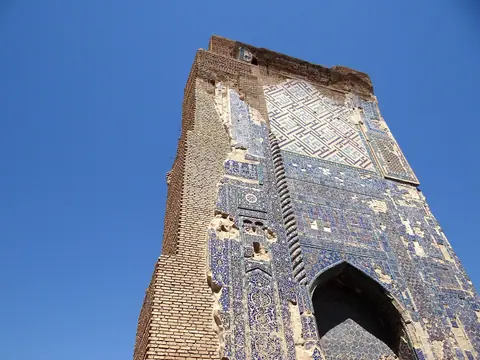
Returning from Anatolia in 1404, Timur was furious that the eastern entrance portal (pishtaq) stood lower than the opposite madrasah. He executed the supervisors and ordered the arch rebuilt to a height of 35 metres between 50-metre minarets. Yet building so high in baked brick without sufficient curing time proved structurally fatal: within years of completion, bricks and ceramic tiles began falling onto worshippers during Friday prayers. The catastrophic 1897 earthquake reduced the outer domes to picturesque ruins before Soviet and Uzbek conservators stabilised and partially reconstructed the complex from 1974 onward.
The Giant Marble Quran Stand (Lauh) and the Legend of the Architect's Kiss
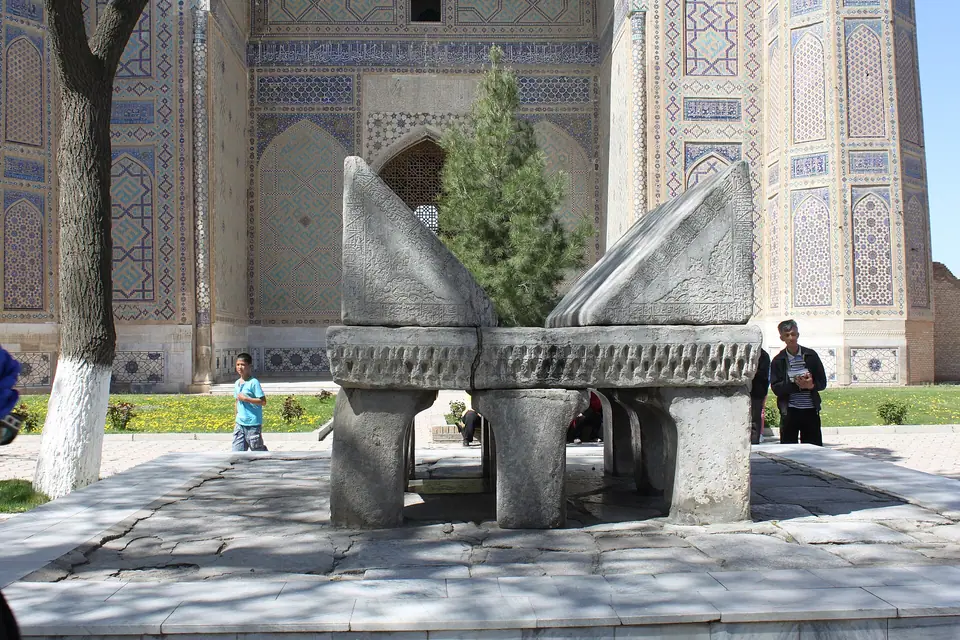
In the centre of the shaded mulberry courtyard of Bibi-Khanym Mosque sits the Lauh, an enormous carven white marble lectern (2.25 by 2.5 metres) commissioned by Ulugh Beg in the early 15th century to hold the massive Kufic Quran of Caliph Uthman. Now preserved in the Hast-Imam Library in Tashkent. Local folk tradition holds that women hoping to conceive children once crawled beneath the marble base of the stand.
Why is the mosque named Bibi-Khanym ("Senior Princess")? The title belonged to Saray Mulk Khanum (c, 1341 to 1406), Timur's chief consort and a direct descendant of Genghis Khan (whose bloodline allowed Timur to take the coveted title Gurkegen, "Son-in-Law" of the Chinggisid house). According to Samarkand legend, while Timur was away campaigning, Saray Mulk Khanum oversaw the construction of a madrasah directly opposite the mosque. The young Persian chief architect fell hopelessly in love with the queen and refused to finish the final dome arch unless she permitted him a single kiss on her cheek. The queen held up painted eggs to argue that all women are ultimately alike. In reply, the architect presented two crystal goblets of water and wine to prove that one burns like fire. He placed a kiss near her cheek so ardent that its warmth left a faint mark through her veil. Upon returning and discovering the mark, Timur ordered the architect seized (legend claims he sprouted wings from the minaret and flew to Mashhad) and decreed that women wear face veils.
Bibi-Khanym Mausoleum Across the Street
Directly across Islam Karimov Street from the mosque's eastern gate stands the slender brick Bibi-Khanym Mausoleum (1399 to 1404), the only surviving fragment of Saray Mulk Khanum's own madrasah. A separate 30,000 UZS (~2.40 USD as of November 2026) ticket grants entry to its octagonal chamber crowned with gypsum stalactite vaults. Downstairs lies the basement crypt where Gerasimov's 1941 team excavated the stone sarcophagi of Saray Mulk Khanum and her mother.
How to Navigate Siyob Bazaar and Hazrat Khizr Mosque
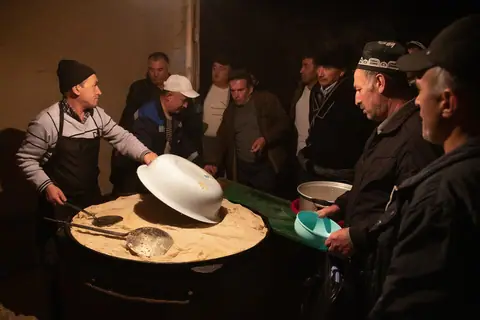
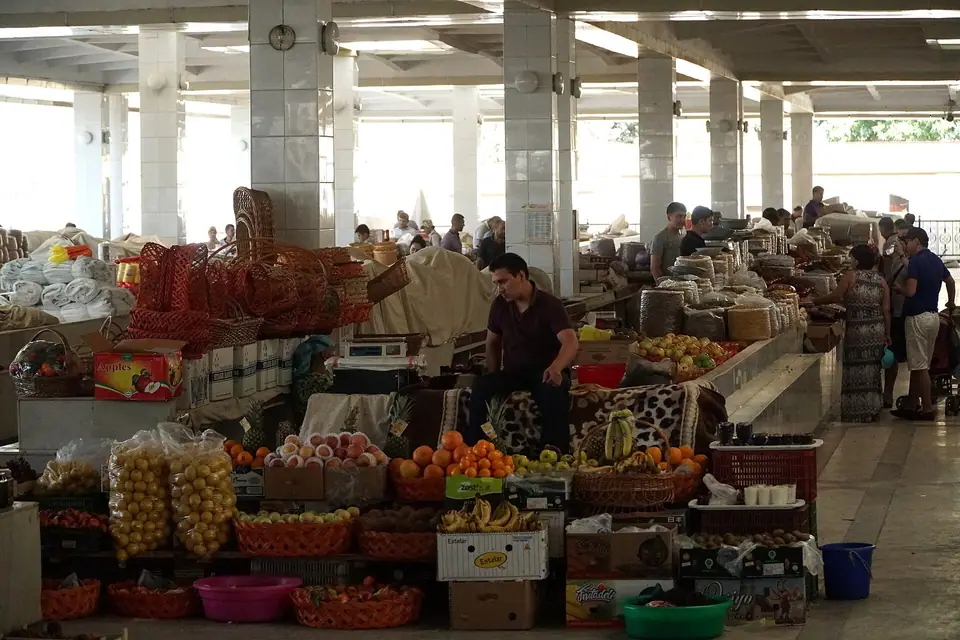
- The Samarkand Non Pavilion. Enter Siyob Dekhqan Bazaar through the tiled arch immediately north of Bibi-Khanym Mosque and turn left into the bread pavilion. Here women from the suburban village of Gala-Osiyo sell the heavy, thick-rimmed golden flatbreads (Samarkand patir and gala-osiyo non) baked in clay tandirs and glazed with sesame seeds and vegetable oil. ~10,000 to 20,000 UZS / ~0.80 to 1.60 USD per loaf as of November 2026.
- Dried Fruits, Nuts, and Bargaining Etiquette. Under the main blue dome, rows of stalls sell shur-danak. Apricot stones roasted in salted ash so the shells crack open revealing a sweet almond-like kernel. Black Kishmish raisins, sun-dried melon braids (qovun qoqi), and Samarkand milk-and-pistachio halva. Always ask the price per kilogram before tasting, and politely bargain 15% to 20% down from the initial tourist quote. Note that Mondays are cleaning days when roughly half the stalls close.
- Climb to Hazrat Khizr Mosque for the Panorama. From the northern gate of Siyob Bazaar, climb the pedestrian bridge stairs to the Hazrat Khizr Mosque. Founded in the 8th century over a Sogdian temple, it was rebuilt between 1854 and 1919 by Bukharan master Abduqodir bin Boqiy. Its painted wooden veranda (ayvan) offers the best elevated photo of Bibi-Khanym's turquoise domes. Next door stand the white-marble Islam Karimov Mausoleum and the path to Shah-i-Zinda.
While exploring the vast inner courtyard of Bibi-Khanym Mosque, walk into the side lateral domed galleries that once sheltered rows of 480 white marble columns brought from quarries near Gazgan and hauled by Timur's elephants. Although the 1897 earthquake toppled the hypostyle roofs of the side wings, dozens of carved marble column bases still line the gardens. They reveal the immense footprint of a hall built to hold every male citizen of 15th-century Samarkand.
Inside Siyob Bazaar, the layout follows a clean product grid beneath the soaring steel-and-blue canopies: the northern aisles nearest the Hazrat Khizr pedestrian bridge hold seasonal fresh produce, pomegranates, figs, and fragrant Uzbek torpedo melons. The central pavilion houses four concentric rings of dried fruits, salted apricot nuts, walnuts, and Samarkand milk halva. Meanwhile, the southern wing nearest Bibi-Khanym is dedicated entirely to warm tandir flatbreads and dairy stalls selling fresh kurt (salted dried yoghurt balls).
Keep small 5,000, 10,000, and 20,000 UZS banknotes handy when shopping inside Siyob Bazaar. Individual bread bakers and spice sellers rarely carry change for 100,000 UZS notes early in the morning.
Where it is
- 1Bibi-Khanym & Siyob Bazaar
- Samarkand International Airport (SKD) · about 5 km from here in a straight line
- Directions in Google Maps
Traveller tips
Real advice from people who have been to Samarkand. Every tip is read by our team before it goes live.
No tips yet. Been here? Yours could be the first.
Thank you! Your tip will appear here after a quick review.
More in Samarkand
Continue exploring Samarkand with related neighbourhood, food, and planning guides