


















Registan Square & Madrasahs Guide
Complete architectural and ticket guide to Registan Square in Samarkand: Ulugh Beg, Sher-Dor, and Tilya-Kori madrasahs, ticket prices, and light show times
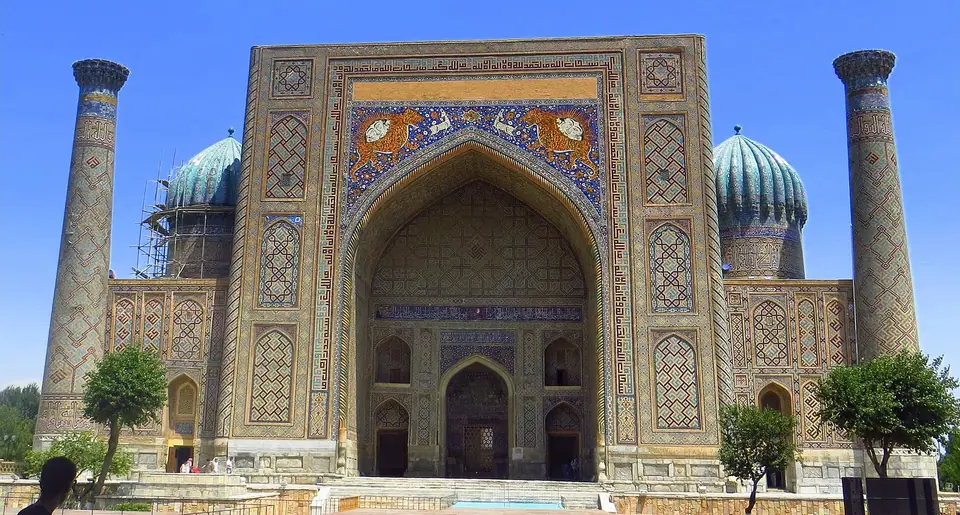
Framed on three sides by soaring glazed portals (pishtaqs), ribbed turquoise domes, and leaning corner minarets, Registan Square ("Sandy Place" in Persian) was the commercial and ceremonial heart of Timurid and Shaybanid Samarkand. Although travellers often assume all three buildings date from Amir Timur's reign, none were built by Timur himself. His astronomer-grandson Ulugh Beg constructed the western Ulugh Beg Madrasah between 1417 and 1420. Meanwhile, the eastern Sher-Dor Madrasah (1619 to 1636) and northern Tilya-Kori Madrasah (1646 to 1660) were erected more than two centuries later by the Ashtarkhanid governor Yalangtush Bakhodur to replace decaying 15th-century Timurid structures. This creates one of the most harmonious architectural ensembles in the Islamic world.
| Monument | Construction Dates & Patron | Architectural Signature | Interior Highlights |
|---|---|---|---|
| Ulugh Beg Madrasah (West). | 1417 to 1420 (Mirzo Ulugh Beg). | Star-constellation mosaic portal & two 33 m minarets. | Astronomy museum, two-storey student cells (hujras) & sun dial. |
| Sher-Dor Madrasah (East). | 1619 to 1636 (Yalangtush Bakhodur). | Roaring tiger-and-rising-sun mosaic spandrels & fluted domes. | Large arcaded courtyard, brick vaulted galleries & artisan studios. |
| Tilya-Kori Madrasah (North). | 1646 to 1660 (Yalangtush Bakhodur). | Two-tiered facade bridging madrasah & Juma mosque functions. | Gold-leaf (kundal) dome chamber & historical photo exhibition. |
Tickets, Opening Hours, and Entry Logistics (2026)
A single unified ticket stored on a QR receipt grants access to the Registan esplanade and the interiors of all three madrasahs. As of November 2026, the foreign adult entry fee is 100,000 UZS (~7.90 USD). Payment is accepted in Uzbek soums cash or by Visa/Mastercard at the official ticket pavilion on the southeastern corner of the plaza. The complex opens daily from 08:00 to 20:00 (remaining open until 21:00 or 22:00 during peak spring and autumn evenings).
Important re-entry rule: your Registan QR ticket is scanned at the turnstile for a single entry. Once you exit the turnstiles to have lunch or visit Bibi-Khanym Mosque, you cannot re-enter the inner courtyard without buying a new ticket. However, the raised southern stone viewing terrace facing all three madrasahs sits outside the ticket barrier and remains accessible free of charge 24 hours a day. This makes it the best vantage point for the evening light show.
Ulugh Beg Madrasah (1417 to 1420): The University of the 15th Century
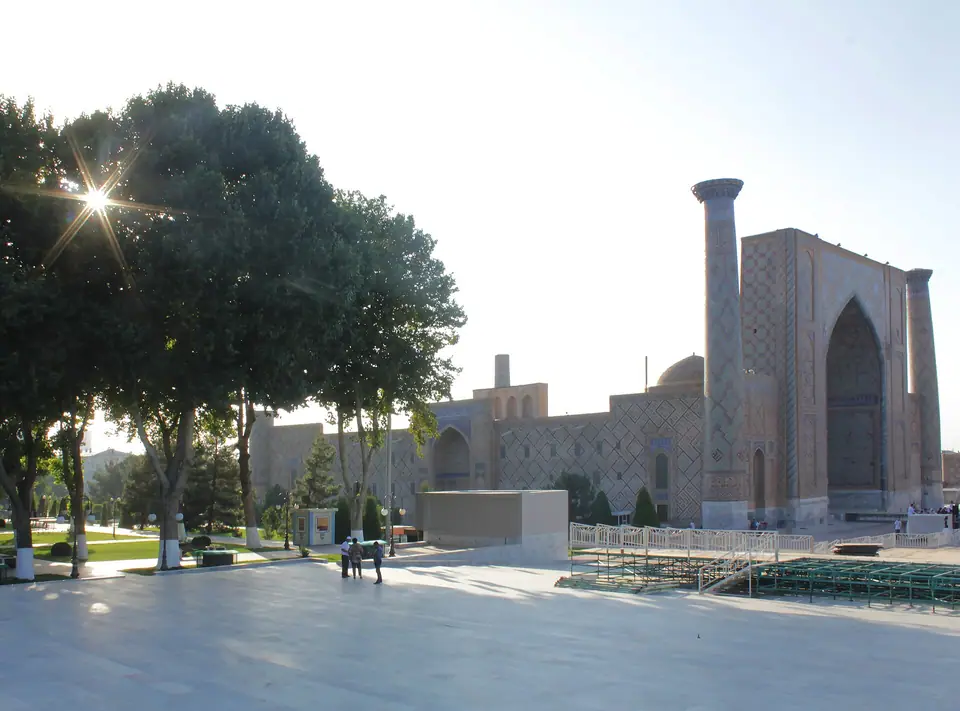
Standing on the western side of the plaza, the Ulugh Beg Madrasah is the only surviving 15th-century Timurid building on Registan Square. Commissioned by ruler and astronomer Mirzo Ulugh Beg in 1417 and completed in 1420, it functioned as an elite academy where more than 100 scholars, including the mathematician Qadi Zada al-Rumi, the astronomer Ali Qushji. The Persian poet Jami, taught mathematics, astronomy, philosophy, and theology. Look closely at the massive 34.7-metre entrance arch (pishtaq). Its spandrels are decorated not with floral vines, but with ten-pointed stars in cut glazed brick (banna'i) representing the night sky.
Step through the carved lancet portal into the square inner courtyard, which is lined with 50 two-storey student dormitory cells (hujras) and four deep vaulted lecture halls (darskhana). Notice the 33-metre-high northeast minaret, which developed a pronounced 1.8-metre lean after 19th-century earthquakes and was famously straightened in 1932 and 1965 using hydraulic jacks by Soviet engineers led by Vladimir Shukhov and Emmanuel Gendel. The former mosque hall at the rear of the courtyard houses an astronomy museum. Inside, displays showcase Ulugh Beg's Zij-i Sultani star tables, brass astrolabes, and links to the Ulugh Beg Observatory.
Sher-Dor Madrasah (1619 to 1636): The Roaring Tigers and Rising Suns
Directly opposite Ulugh Beg's academy stands the Sher-Dor Madrasah ("Having Tigers"). Architect Abduljabor built it between 1619 and 1636 for Governor Yalangtush Bakhodur over Ulugh Beg's collapsed 1424 khanqah. Although designed as a deliberate mirror reflection of Ulugh Beg Madrasah across the square, a 200-year accumulation of street silt meant Sher-Dor's foundations sits roughly two metres higher. Its builders added two towering ribbed turquoise side domes flanking the main portal.
Sher-Dor is famous across Central Asia for the bold mosaic filling its entrance spandrels. Defying strict aniconic tradition, two striped golden felines chase white fallow deer beneath human-faced rising suns. This ancient Persian astrological emblem (Shir-o-Khorshid, the Lion in the House of the Sun) became a national symbol of Uzbekistan and appears on the 200-soum banknote.
Tilya-Kori Madrasah (1646 to 1660): The Gilded Mosque Dome
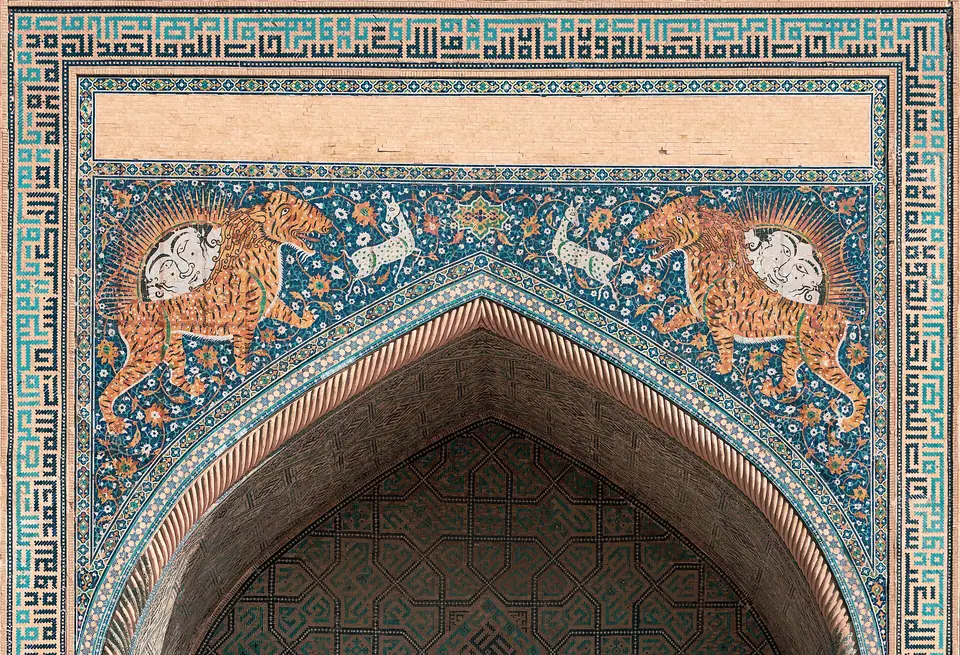
To close the northern side of the plaza where the 15th-century Mirzoi Caravanserai once stood, Yalangtush Bakhodur commissioned the Tilya-Kori Madrasah ("Gilded") in 1646. Because earthquakes had left nearby Bibi-Khanym Mosque in ruin, Tilya-Kori was built as a dual-purpose complex. Residential student cells line its northern wings, while a tall turquoise dome crowns the Friday mosque (Juma Masjid) on its western side.
Do not miss entering the western mosque sanctuary inside Tilya-Kori. Its interior walls and dome are covered from floor to apex in kundal, a relief-painting technique coated in real gold leaf over lapis-blue tempera. Look straight up at the sanctuary ceiling. Although it appears to rise into a deep concave dome, the surface is nearly flat, using diminishing gold medallions to create an optical illusion of height.
Evening Light Show and Minaret Climb Realities
- Nightly Illumination and 3D Mapping Show. Floodlights switch on across Registan Square around 20:00 each evening. Around 20:30 or 21:00 (depending on sunset timing and season), a 20-minute sound-and-light or 3D projection-mapping show narrating Silk Road history plays across the three portals. Watch free of charge from the stepped stone amphitheatre on the southern side of the square.
- The Unofficial Minaret Climb Note. Access up the narrow spiral brick staircase (73 steep steps, barely 60 cm wide) inside the southern minaret of Ulugh Beg Madrasah is officially closed to general ticket holders for preservation and safety reasons. Do not attempt to pay unofficial cash tips to guards if the gate is locked; for legal elevated views over Samarkand's domes, climb the hillside stairs to Hazrat Khizr Mosque near Shah-i-Zinda instead.
Inside the two-storey courtyard cells (hujras) of all three madrasahs, local master artisans now operate studios displaying copper chasing, miniature painting on Konigil mulberry paper, silk carpet weaving, and traditional woodcarving. Browsing these artisan cells is free of pressure to buy. When open for exhibitions, the upper balcony galleries of Sher-Dor and Ulugh Beg offer quiet views over the central courtyards.
Photographers should also walk completely around the exterior perimeter park behind Sher-Dor and Tilya-Kori Madrasahs. From the northeastern brick terrace behind Sher-Dor, you can study the external structural buttresses and the unglazed rear brickwork of the ancient Chorsu trading dome. This hexagonal 15th-to-18th-century market building behind Sher-Dor now functions as an art gallery, with the turquoise ribs of the side domes framed against the Zeravshan sky.
Restrooms, shaded benches, and small kiosks selling cold bottled water sit along the landscaped park flanking the eastern and western sides of the square outside the turnstiles. This makes it easy to take a thirty-minute break after spending two hours inside the three madrasah courtyards.
Where it is
- 1Registan Square & Madrasahs
- Samarkand International Airport (SKD) · about 5 km from here in a straight line
- Directions in Google Maps
Traveller tips
Real advice from people who have been to Samarkand. Every tip is read by our team before it goes live.
No tips yet. Been here? Yours could be the first.
Thank you! Your tip will appear here after a quick review.
More in Samarkand
Continue exploring Samarkand with related neighbourhood, food, and planning guides
Best Things to Do in Samarkand: Registan, Shah-i-Zinda & Silk Road Sights
Samarkand, Uzbekistan
How to Get to Samarkand: Afrosiyob High-Speed Train, Airport (SKD) & Borders
Samarkand, Uzbekistan
Best Time to Visit Samarkand: Seasonal Weather, Navruz & Silk Road Calendar
Samarkand, Uzbekistan
What to Wear in Samarkand: Mosque & Mausoleum Dress Code, Shoes & Seasonal Packing
Samarkand, Uzbekistan
