






















Konigil Paper Mill & Urgut Crafts
Visit the Konigil Meros waterwheel mulberry paper mill, Urgut's weekend suzani embroidery bazaar, and historic Khovrenko Winery in Samarkand.
Beyond its glazed domes, Samarkand served for over a millennium as the craft capital of Central Asia. Merchants across Asia and Europe prized its mulberry bark paper (Samarkand qog'ozi), silk suzani embroideries, ceramics, and Zarafshan wines. Today this artisan revival centres on Konigil Tourist Village along the shaded Siab stream 10 kilometres northeast of Registan Square. You can easily pair Konigil with a morning excursion to the mountain bazaar in Urgut.
| Craft Destination | Distance from Registan | Entry / Tasting Fee (Nov 2026) | Best Day & Time to Visit |
|---|---|---|---|
| 1. Konigil "Meros" Silk Paper Mill & Village. | 10 km northeast (15 to 20 min Yandex Go). | 40,000 UZS (~3.15 USD) workshop entry. | Daily 09:00 to 18:00 (shadiest midday escape in summer). |
| 2. Urgut Suzani & Craft Bazaar. | 38 km southeast (45 to 50 min taxi). | Free market entry. | Saturday & Sunday mornings 07:30 to 12:30 (also Wed). |
| 3. Khovrenko Winery & Wine Museum (1868). | 1.8 km west of Registan (Mahmud Kashgari St). | ~150,000 to 200,000 UZS (~12 to 16 USD) 10-wine flight. | Daily 10:00 to 18:00 (book 1 hour ahead for English tour). |
How Samarkand Paper Changed World History (751 CE to Konigil Today)
In July 751 CE, Arab Abbasid forces and Tang Dynasty Chinese armies clashed at the Battle of Talas near the modern Kazakh-Kyrgyz border. Among the Chinese soldiers and artisans captured and brought back to Samarkand were master papermakers. Samarkand craftsmen replaced Chinese bamboo with the inner bark of young mulberry trees (balkhi tut) and polished the sheets with agate stones. This durable, worm-resistant paper rapidly replaced papyrus and parchment across Baghdad, Damascus, and Europe.
Russian industrial factories drove Samarkand's last traditional paper watermills out of business in the 19th century. After a century of extinction, master restorer Zarif Mukhtarov revived the craft with UNESCO support by founding the Meros Paper Mill in Konigil in 1998. As you walk along the willow-shaded canal at Konigil (20,000 to 25,000 UZS Yandex Go ride from Registan; 40,000 UZS / ~3.15 USD workshop admission as of November 2026), you can watch every step of the 8th-century process in action:
- Stripping and Boiling. Autumn shoots of local mulberry bushes are stripped of their outer bark, and the fibrous inner bast is boiled for five to six hours in large cauldrons over wood fires.
- The Wooden Waterwheel Hammer (Charkhpalak): Powered by the fast-flowing Siab stream, a wooden waterwheel turns heavy trip-hammers. These wooden hammers pound the boiled mulberry fibres in stone mortars for seven hours into silky pulp.
- Moulding, Pressing, and Agate Polishing. Artisans dip reed mesh screens into vats of mulberry pulp, press the wet sheets under stone weights, and dry them on clay walls. Each dry sheet is then hand-burnished with a smooth conch shell or agate stone. This creates a glossy surface where ink only coats one side, allowing calligraphers to write on both sides of a thin sheet without bleed-through.
Beyond Paper in Konigil: Flaxseed Oil Presses, Pottery, and Riverside Plov
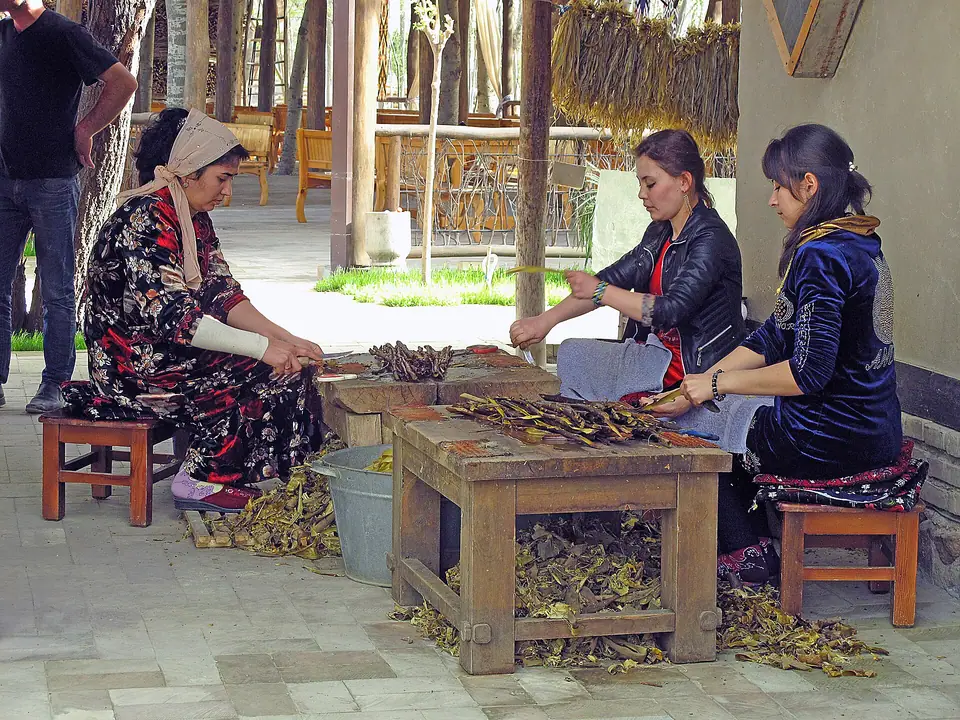
Over the past four years, Konigil has been expanded into a 2.2-kilometre riverside walking trail with shaded wooden bridges, waterwheels, and working artisan studios. Next to the Meros mill, step inside the traditional Juvoz oil mill. Here a weighted timber beam crushes roasted flaxseeds and sesame seeds into the dark zighir oil used in Samarkand's layered plov. You can also visit the Konigil pottery studio, which revives medieval Afrasiab lead-glazed earthenware, as well as a traditional water-powered flour mill. A riverside teahouse serves lunch on wooden tapchan platforms directly over the cold stream.
Saturday and Sunday Morning Trip to Urgut Suzani Bazaar
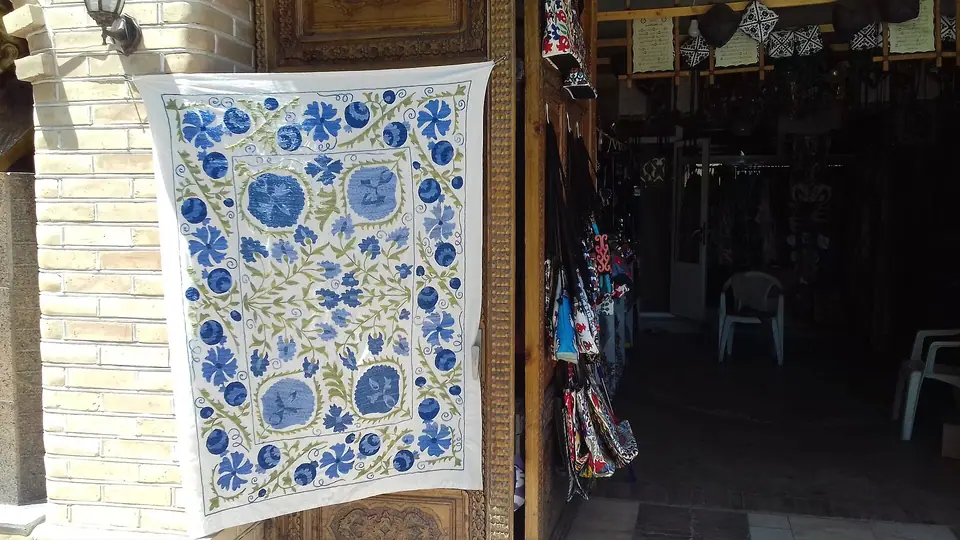
If your Samarkand dates fall on a Saturday or Sunday (or to a smaller degree Wednesday), set out at 07:30 by taxi 38 kilometres southeast to Urgut at the foot of the Zarafshan Mountains. ~80,000 to 120,000 UZS / ~6.30 to 9.50 USD one way by Yandex Go or shared taxi from the Registan/Kaftarchon stand as of November 2026. Urgut's covered bazaar is Uzbekistan's premier source for authentic suzani ("needlework") dowry hangings. Artisans embroider cotton and silk panels in dense bosma and ilmok stitches with crimson pomegranates and solar rosettes.
Unlike city souvenir shops around Registan that often mix machine-stitched synthetics with handwork, Urgut's upper textile rows bring together village embroiderers selling both newly stitched silk-on-cotton pieces (ranging from 400,000 UZS / ~32 USD for cushion covers to 2,500,000 to 6,000,000 UZS / ~200 to 480 USD for full natural-dye wedding suzanis as of November 2026) and vintage mid-20th-century tribal textiles, together with Urgut's distinctive amber-and-green glazed ceramics at the workshop of the Oblakulov family. 7th-generation master potters in Urgut. Flip every suzani over before buying: genuine hand embroidery shows irregular knots and thread jumps on the reverse, whereas machine chain-stitching looks uniform like a sewing machine seam.
Historic Wine Tasting at the 1868 Khovrenko Winery
Back in Samarkand's Russian quarter at Mahmud Kashgari Street 58 stands the Khovrenko Winery and Museum of Winemaking. It occupies the red-brick villa and cellars founded by merchant Dmitry Filatov in 1868 and expanded by Professor Mikhail Khovrenko in 1927. A guided tour and 10-glass tasting flight (~150,000 to 200,000 UZS / ~12 to 16 USD as of November 2026) explores the historic bottle library. You sample award-winning dessert wines like Gulyakandoz, Shirin, and Aleatiko together with aged Samarkand cognacs.
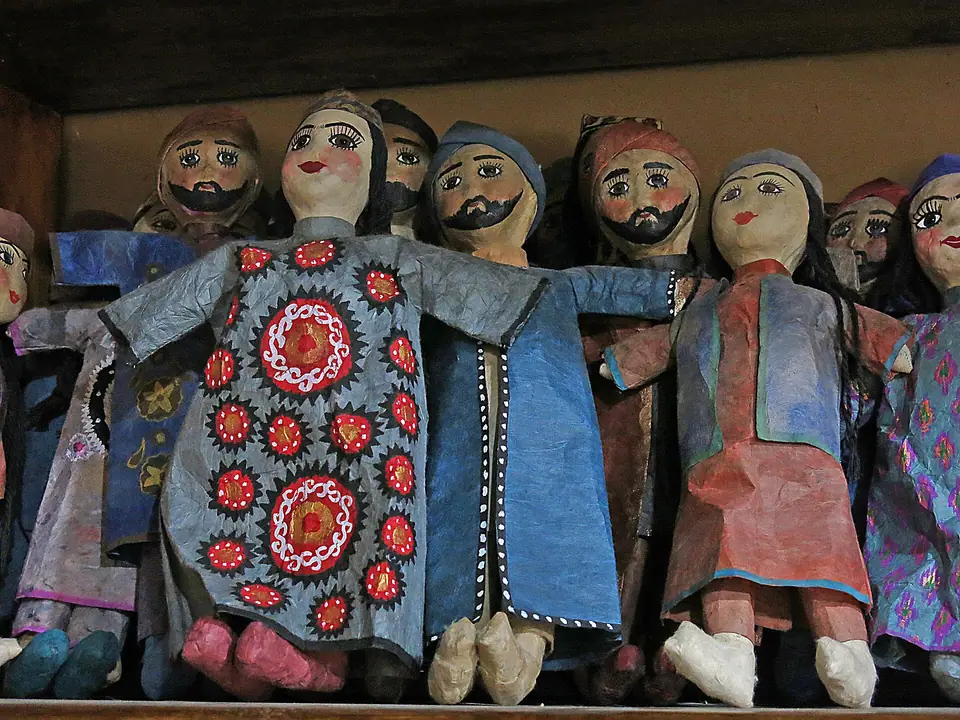
At the gift shop attached to the Konigil Meros Paper Mill, you can purchase loose sheets of genuine hand-burnished mulberry paper. ~15,000 to 40,000 UZS / ~$1.20 to $3.20 per sheet as of November 2026. Leather-bound sketchbooks, hand-painted Silk Road miniature bookmarks, and small dolls crafted from pressed mulberry pulp. Because real Samarkand mulberry paper contains zero wood-pulp acid, sheets produced at Konigil today have an archival lifespan of several hundred years and are used by international museums to restore medieval Islamic manuscripts.
If you visit Urgut on a weekday when the giant weekend suzani market is quiet, head instead to the hillside grove of Chor-Chinor ('Four Plane Trees') on the upper edge of Urgut town. Here a grove of ancient hollow Oriental plane trees (chinars) over 800 to 1,000 years old surrounds a cold mountain spring pond. The largest hollow tree trunk measures more than sixteen metres in circumference and once served as a small Sufi schoolhouse capable of seating ten students inside its living roots.
Combining morning suzani shopping in Urgut with a late lunch on the riverside tapchan platforms at Konigil village creates one of the most relaxing craft-and-countryside days in the Zeravshan Valley.
Where it is
- 1Konigil Paper Mill & Urgut Crafts
- Samarkand International Airport (SKD) · about 6 km from here in a straight line
- Directions in Google Maps
Traveller tips
Real advice from people who have been to Samarkand. Every tip is read by our team before it goes live.
No tips yet. Been here? Yours could be the first.
Thank you! Your tip will appear here after a quick review.
More in Samarkand
Continue exploring Samarkand with related neighbourhood, food, and planning guides