




















Best Things to Do in Samarkand: Registan, Shah-i-Zinda & Silk Road Sights
Explore Samarkand's essential sights, from the three madrasahs of Registan Square and the tiled mausoleums of Shah-i-Zinda to Gur-e-Amir and Ulugh Beg's Observatory.
No city along the Eurasian Silk Road matches the scale and colour intensity of Samarkand's 14th- and 15th-century Timurid monuments. In 1370, Amir Timur made Samarkand the capital of an empire stretching from Delhi to Damascus. He brought master builders, mosaicists, and astronomers from across the Islamic world to construct portals that touched the sky. Below, we rank the essential things to do in Samarkand with walking distances, optimum light windows, and dated November 2026 entry fees in Uzbek som. Pair this overview with our Registan Square guide and our Shah-i-Zinda tilework walk.
| Monument / Experience | Zone & Distance from Registan | Entry Fee (Nov 2026) | Suggested Duration & Best Light |
|---|---|---|---|
| 1. Registan Square (3 Madrasahs). | Central Core (0 km). | 100,000 UZS (~$7.80). | 2 to 2.5 hours; visit at 08:00 dawn and 20:30 light show. |
| 2. Shah-i-Zinda Necropolis. | Afrosiab Southern Slope (1.9 km NE). | 50,000 UZS (~$3.90). | 90 minutes; 07:30 to 09:00 before tour buses arrive. |
| 3. Gur-e-Amir & Ruhabad Mausoleums. | Timurid South Park (750 m SW). | 50,000 UZS (~$3.90). | 60 minutes; late afternoon and blue-hour floodlights. |
| 4. Bibi-Khanym Mosque & Siyob Bazaar. | Tashkent Pedestrian Ave (950 m NE). | Mosque 50,000 UZS (~$3.90); Bazaar free. | 90 minutes combined; mid-morning (09:30 to 11:30). |
| 5. Ulugh Beg Observatory & Afrosiab Museum. | Northern Hills (2.8 km to 3.8 km NE). | 40,000 UZS (~$3.10) each monument. | 2 hours combined; afternoon cultural pairing. |
| 6. Konigil Meros Silk Paper Mill. | Siab River Village (7.5 km E). | 25,000 UZS (~$2.00) workshop grounds. | 60 to 90 minutes; peaceful afternoon riverside walk. |
Stand inside the three madrasahs of Registan Square
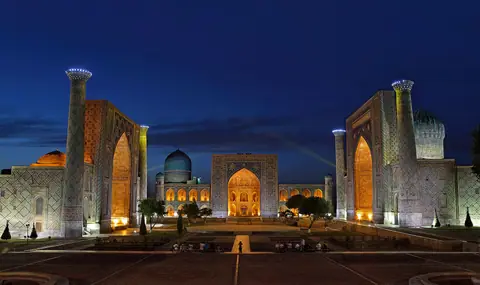
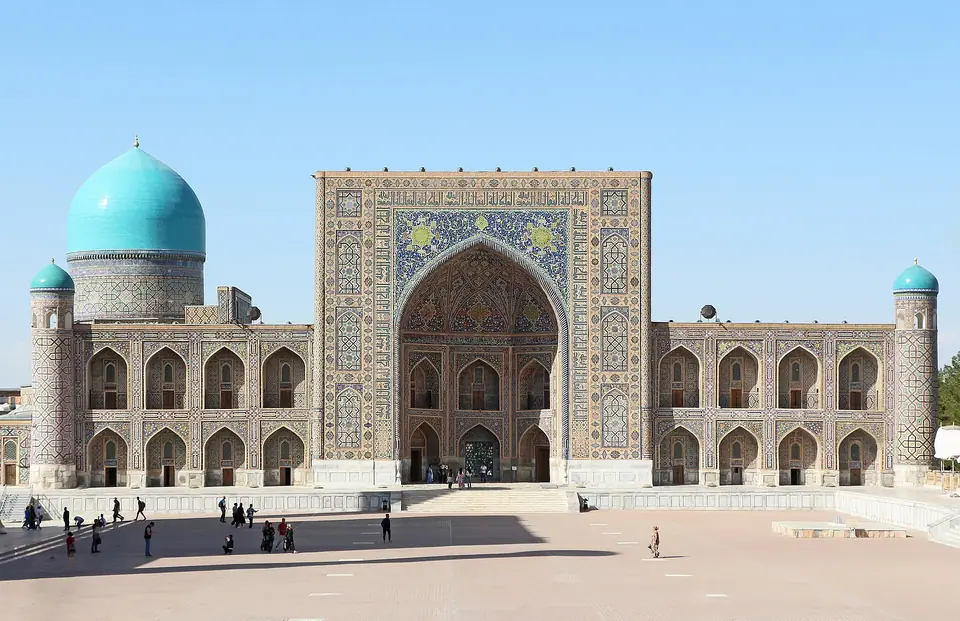
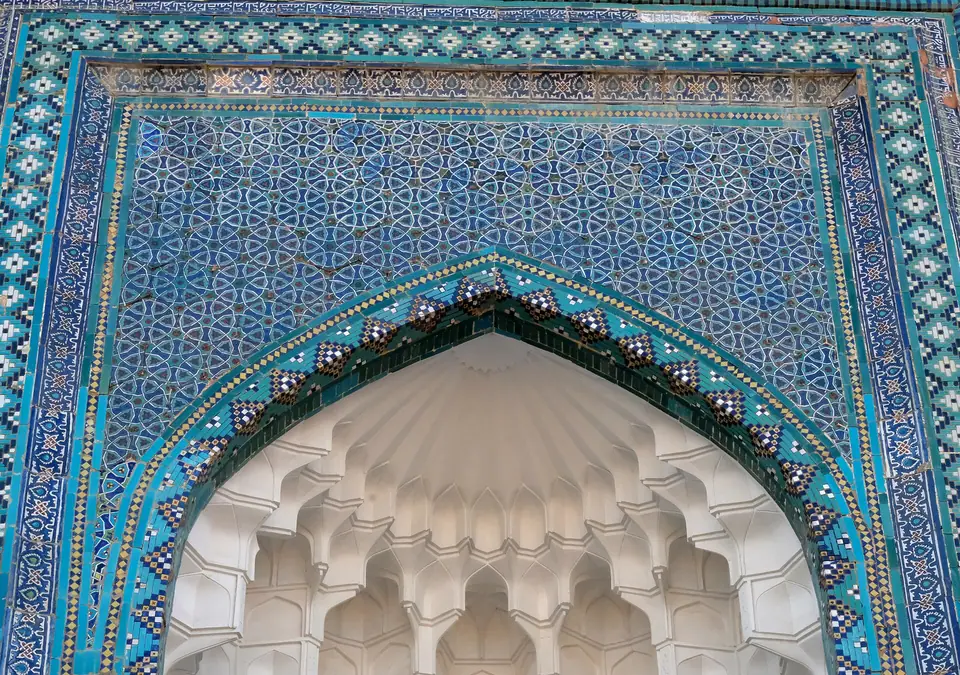
Soaring glazed portals (pishtaqs), fluted turquoise domes, and corner minarets frame three sides of Registan Square ("Sandy Place" in Persian). In medieval times, it served as the civic crossroads where royal decrees were trumpeted from copper horns. What makes the Registan architectural ensemble extraordinary is that its three Islamic universities (madrasahs) span two full centuries of evolution.
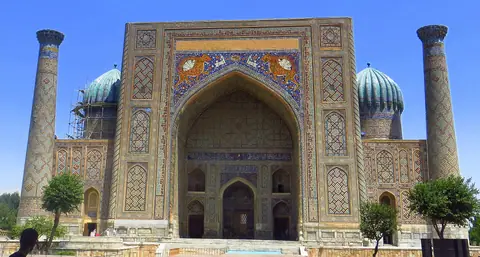
On the western flank stands the Ulugh Beg Madrasah (1417 to 1420), where Timur's astronomer-grandson personally lectured on mathematics beneath a portal inlaid with ten-pointed geometric star constellations. Directly opposite rises the Sher-Dor Madrasah (1619 to 1636), whose tympanum defies orthodox aniconic conventions by depicting two roaring golden snow-leopard-like lions carrying the rising sun on their backs while chasing white gazelles. Closing the northern side stands the Tilya-Kori Madrasah (1646 to 1660), whose mosque interior is covered in dazzling kundal gold-leaf relief that creates the illusion of a high concave dome above a flat ceiling.
Walk the avenue of glazed tombs at Shah-i-Zinda
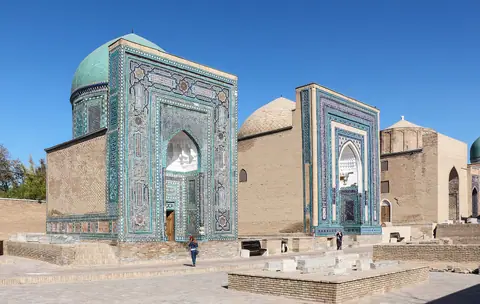
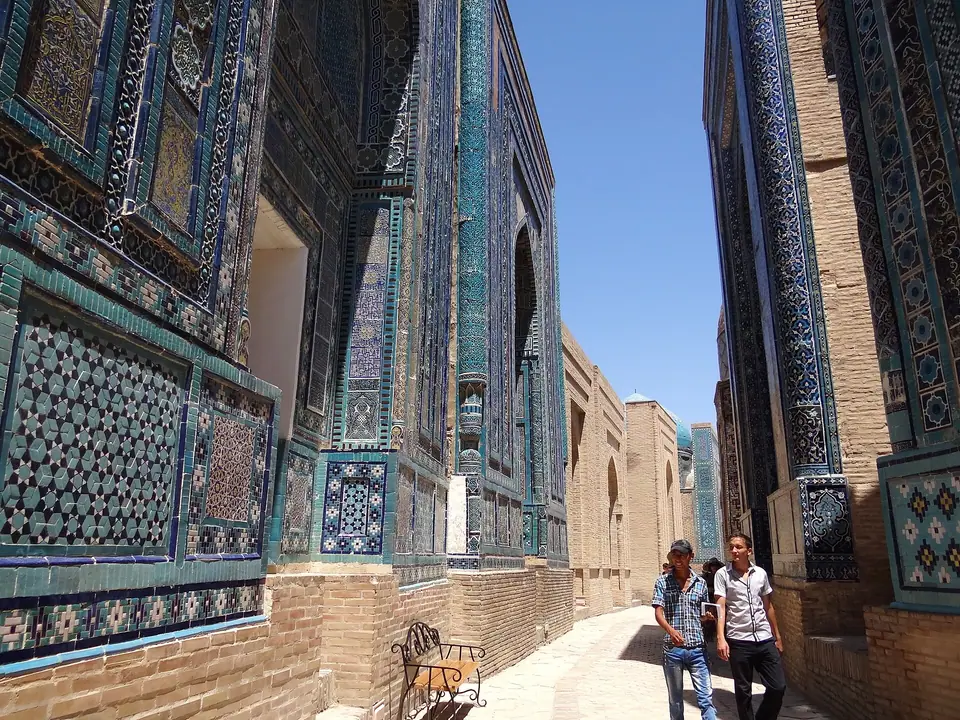
Cut into the southern slope of the ancient Afrosiab mound, Shah-i-Zinda ("The Living King") is a stepped sacred street of more than twenty-five mausoleums built between the 11th and 15th centuries. The necropolis grew around the 7th-century shrine of Qusam ibn Abbas, a cousin of the Prophet Muhammad who brought Islam to Sogdiana around 676 CE. According to local legend, he descended alive into a deep rock well after being struck during prayer.
In the late 14th century, Amir Timur's sisters (Shirin Bika Aka and Turkan Aka), wives (Tuman Aka), and generals built their jewel-box tombs along the narrow brick path leading up to the saint's shrine. Because every facade sits just three metres from the next, Shah-i-Zinda functions as an open-air encyclopaedia of ceramic craftsmanship, displaying unglazed 12th-century carved terracotta together with deep relief majolica, cobalt-and-gold cut-tile kashin mosaic. The starry octagram vault of the Mausoleum of Shadi Mulk Aga (1372). Read our Shah-i-Zinda guide for a portal-by-portal route.
Inspect the nephrite jade tomb of Amir Timur at Gur-e-Amir
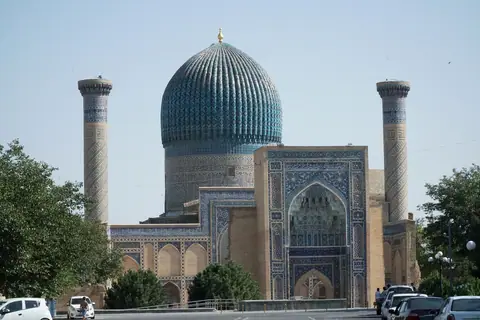
A 34-metre-high melon dome clad in sixty-four flutes of sky-blue tile crowns Gur-e-Amir ("Tomb of the King", 50,000 UZS as of November 2026). It serves as the dynastic mausoleum of Amir Timur together with his sons Shah Rukh and Miran Shah. His grandsons Muhammad Sultan and Mirzo Ulugh Beg. Timur originally commissioned the mausoleum in 1403 for his beloved heir Muhammad Sultan, who died on campaign in Anatolia. It became Timur's own tomb when the conqueror died of pneumonia at Otrar in February 1405 while marching toward Ming China.
Inside the gilded paper-mâché and honeycombed muqarnas chamber, nine ceremonial cenotaphs sit inside a carved marble lattice railing (the actual bodies rest in identical positions inside the plain brick crypt directly beneath the floor). At the centre lies Ulugh Beg's tribute to his grandfather: a two-piece block of dark green nephrite jade brought from Mogholistan in 1425, once the largest single carved jade stone in the world. Two hundred metres northwest across the park, pause at the austere brick Ruhabad Mausoleum (1380), built by Timur for the mystic Sheikh Burhaneddin Sagarji.
Marvel at the colossal Bibi-Khanym Mosque and Siyob Bazaar
Midway up pedestrian Tashkent Street rises the Bibi-Khanym Mosque. 1399 to 1404; 50,000 UZS as of November 2026. Financed with the treasury plundered during Timur's 1398 sack of Delhi and hauled into place by ninety-five Indian war elephants. Its main sanctuary portal soars 41 metres above a marble courtyard designed for 10,000 worshippers around Ulugh Beg's giant stone Quran stand (lauh). These colossal arches pushed medieval brick engineering to its absolute limit.
Immediately outside the mosque's northern wall buzzes Siyob Dehqon Bazaar (open Tuesday to Sunday from 06:30 to 18:30; closed Mondays for cleaning). Here hundreds of headscarfed bakers sell gleaming varnished wheels of Samarkand non bread together with pyramids of golden Kishmish raisins, salted apricot kernels buried in wood ash (shurdanak), saffron, and crystallised rock sugar (navat).
Trace Sogdian murals at Afrosiab and Ulugh Beg's giant sextant
North of Shah-i-Zinda extends the 220-hectare earthen plateau of Afrosiab, the pre-Mongol city of Samarkand destroyed by Genghis Khan in 1220. Inside the Afrosiab Museum (40,000 UZS as of November 2026), the centrepiece is an original 7th-century hall of polychrome frescoes from the palace of Sogdian King Varkhuman. The murals depict silk-robed ambassadors from Tang China, Korea, Chaganian, and Tibet arriving on camels, horses, and white elephants.
One kilometre further northeast stands the Ulugh Beg Observatory. 1420s; 40,000 UZS as of November 2026. Here the ruler-astronomer and scholars Qadi Zada al-Rumi and Jamshid al-Kashi built a three-storey circular observatory housing a 40.2-metre radius marble meridian arc (the Fakhri sextant). Using the surviving underground trench of this arc, Ulugh Beg compiled the 1437 Zij-i-Sultani star catalogue of 1,018 stars and calculated the length of the sidereal year to within 58 seconds of modern satellite measurements. See our Ulugh Beg Observatory and Afrosiab guide for details.
Visit the Konigil Meros Paper Mill and Tomb of Prophet Daniel
Below the northern cliffs of Afrosiab along the Siab stream stands the Mausoleum of Khoja Daniyar (Prophet Daniel) (35,000 UZS as of November 2026). Revered jointly by Muslims, Christians, and Jews, the shrine houses an 18-metre-long brick cenotaph above a healing spring and a 500-year-old pistachio tree. Fifteen minutes east by Yandex Go taxi in the riverside village of Konigil stands the Meros Paper Mill (25,000 UZS as of November 2026). Wooden waterwheels turning in the Siab canal power its revival of 8th-century Samarkand mulberry-bark paper (Samarkand kog'ozi).
Traveller tips
- Eat Samarkand plov for lunch between 11:45 and 13:30, not dinner. In Uzbekistan, massive cast-iron cauldrons (qozons) of traditional zigir osh (Samarkand plov) are unveiled at 11:30 for lunch and sell out completely by 14:00. See our Samarkand food guide for the best local plov centres.
- Check Monday bazaar closures. Siyob Bazaar closes on Mondays for weekly sanitation, though a few outside bread stalls remain open; schedule your bazaar and Bibi-Khanym walk for Tuesday through Sunday.
- Start your day at Shah-i-Zinda at 07:00 before tour coaches arrive. Because the tiled avenue of mausoleums is only three metres wide, arriving right when the gates open at 07:00 gives you forty-five minutes of empty morning light on the 14th-century terracotta portals.
- Time your plov lunch strictly between 11:45 and 13:15. Traditional Samarkand oshxonas cook their giant cast-iron cauldrons of layered zighir plov once a day for noon service. Arriving at noon guarantees the freshest cut of braised beef, sweet yellow carrots, and whole garlic heads before the cauldrons empty by 14:00.
- Look behind Gur-e-Amir to find the hidden Aksaray Mausoleum. Sixty metres behind the rear brick wall of Gur-e-Amir stands the restored 15th-century Aksaray Mausoleum. Its small separate ticket lets you walk down into an authentic subterranean Timurid brick burial vault that most visitors walk past.
Where it is
- 1Samarkand
- Samarkand International Airport (SKD) · about 5 km from Samarkand in a straight line
- Directions in Google Maps
Traveller tips
Real advice from people who have been to Samarkand. Every tip is read by our team before it goes live.
No tips yet. Been here? Yours could be the first.
Thank you! Your tip will appear here after a quick review.
More in Samarkand
Continue exploring Samarkand with related neighbourhood, food, and planning guides