Gur-e-Amir & Aksaray Crypt Guide
Guide to Gur-e-Amir Mausoleum in Samarkand: Amir Timur's dark green jade cenotaph, the 1941 Gerasimov excavation, Aksaray crypt, and Ruhabad Mausoleum.
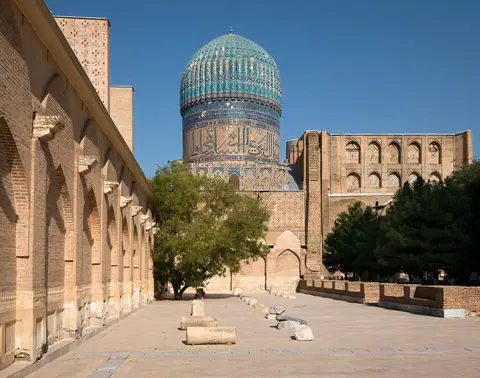
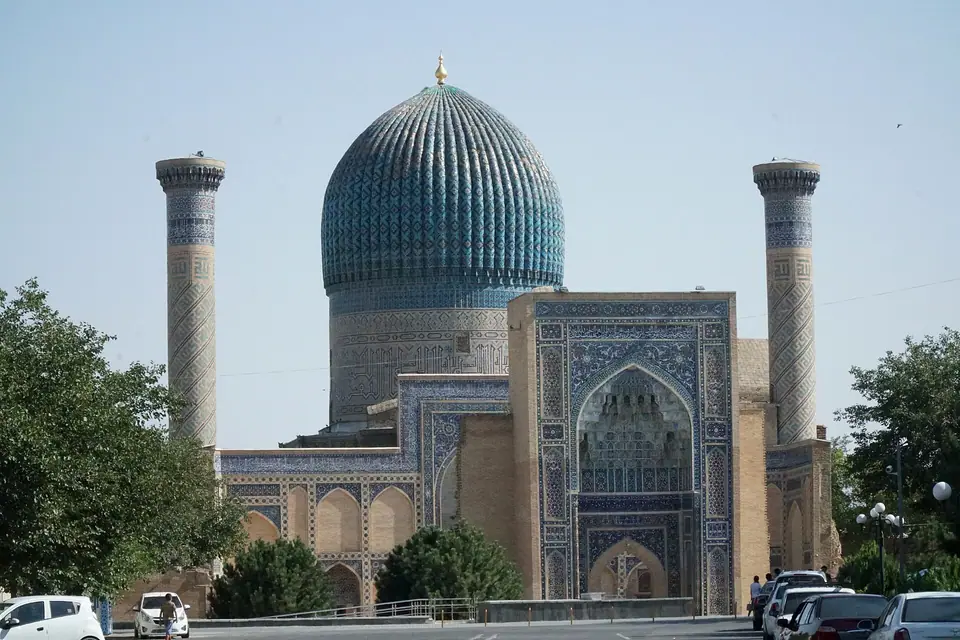
A 64-ribbed azure dome rises 34 metres above the mahalla 650 metres southwest of Registan Square to crown the Gur-e-Amir Mausoleum. Known in Persian as the "Tomb of the King", it holds the graves of Amir Timur, two of his sons, and his grandson Ulugh Beg. Its double-shell melon dome and gilt-and-lapis interior set a lasting imperial template. Timur's descendant Babur and the Mughals later carried this design to India at Humayun's Tomb and the Taj Mahal.
| Monument in the Ensemble | Walking Distance from Gur-e-Amir | Ticket Cost (Nov 2026) | Why Visit |
|---|---|---|---|
| 1. Gur-e-Amir Mausoleum. | 0 m (Main Courtyard). | 75,000 UZS (~5.90 USD). | Timur's dark green nephrite jade cenotaph & papier-mâché gold dome. |
| 2. Aksaray Mausoleum. | 60 m southeast (directly behind Gur-e-Amir). | 25,000 UZS (~2.00 USD). | Descend into an authentic subterranean brick Timurid burial crypt. |
| 3. Ruhabad Mausoleum. | 220 m north across the pedestrian plaza. | Free exterior / ~20,000 UZS interior. | 1380 austere pre-glazed brick tomb of mystic Sheikh Burhaneddin Sagarji. |
Why Amir Timur Was Buried in Samarkand Instead of Shakhrisabz
Amir Timur never intended to be buried in Gur-e-Amir. Decades earlier, he had prepared a subterranean white-limestone crypt for himself inside the Dorus Saodat complex in his hometown of Shakhrisabz, 85 kilometres south across the Zarafshan Mountains. The Gur-e-Amir complex in Samarkand was originally commissioned in 1403 after Timur's favourite grandson and designated heir, the 27-year-old Muhammad Sultan, died suddenly from battle wounds sustained in Anatolia. It adjoined a preexisting madrasah and khanqah that Muhammad Sultan had founded around 1399.
In February 1405, the 68-year-old Timur died of pneumonia at Otrar while marching against Ming China. Because winter snowstorms blocked the 1,788-metre Tahtakaracha Pass to Shakhrisabz, his body was brought to Samarkand instead. Timur's embalmed body was therefore brought to Samarkand and interred beside his grandson inside Gur-e-Amir, transforming the monument into the dynastic mausoleum of the Timurids.
Inside the Cruciform Hall: The Nine Cenotaphs and the Jade Block
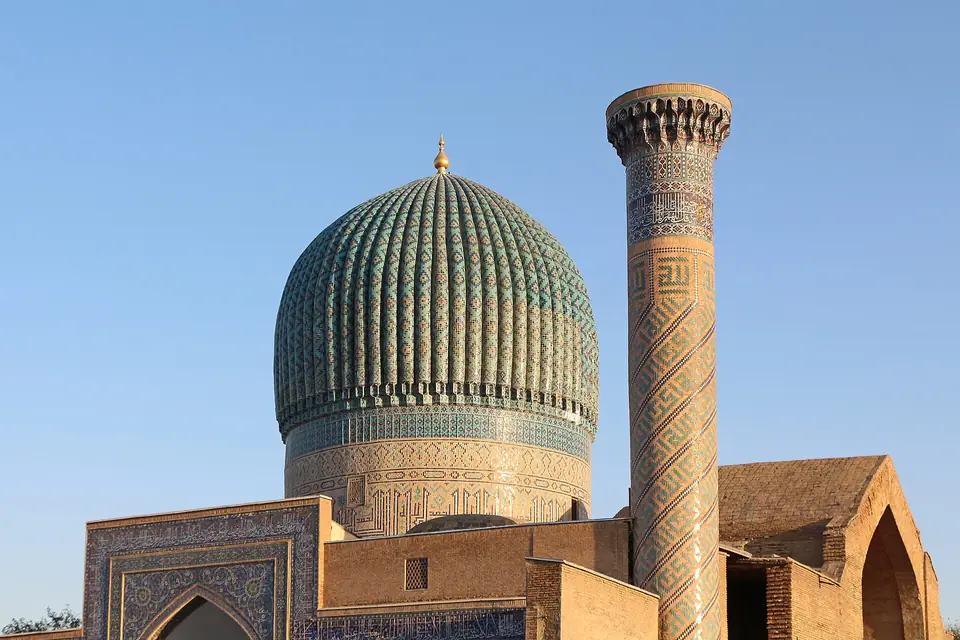
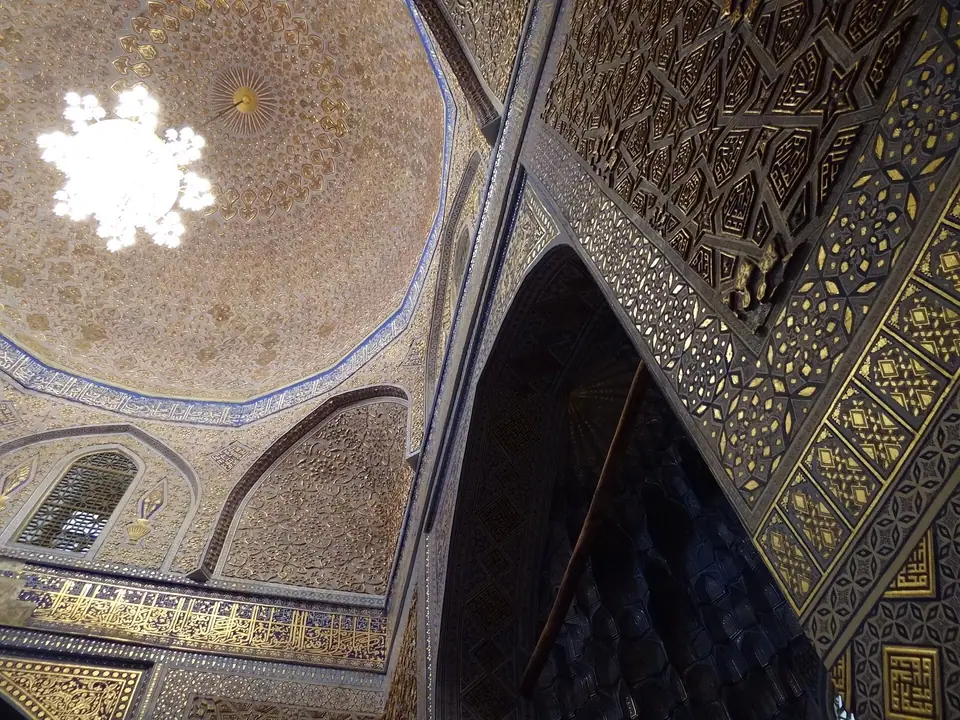
Enter through the 1434 portal built by Ulugh Beg and signed by the Isfahani mosaicist Muhammad ibn Mahmud. Crossing the courtyard past the foundations of the medieval madrasah brings you into the octagonal tomb chamber. Look up at the soaring interior dome: covered in gilded relief kundal and honeycomb muqarnas niches crafted from painted papier-mâché over brick, it glimmers like an inverted jewel box.
A carved white marble lattice balustrade installed by Ulugh Beg in 1424 encloses the central cenotaphs. The actual graves lie three metres directly below in a sealed brick crypt arranged in the exact same layout:
- Amir Timur (1336 to 1405). Marked at the centre by a solid block of dark green nephrite jade brought from Hotan by Ulugh Beg in 1425. The stone split in two after Persian ruler Nadir Shah briefly carried it to Mashhad in 1740 before returning it.
- Mir Sayyid Baraka (died 1403). Placed at the head of Timur's stone, at Timur's explicit request, lies his revered spiritual advisor from Andkhoy, together with a tall wooden ritual standard (tugh).
- Ulugh Beg (1394 to 1449). His tombstone sits to the right at the foot of Timur's stone, marking the astronomer-king who was assassinated on the orders of his own son Abd al-Latif in October 1449.
- Shah Rukh (1377 to 1447), Miran Shah (1366 to 1408), and Muhammad Sultan (1375 to 1403). Surrounding Timur lie his two sons and two grandsons.
The June 1941 Gerasimov Excavation and the "Curse of Timur"
In June 1941, a Soviet archaeological commission led by anthropologist Mikhail Gerasimov and orientalists Tashmuhammad Kari-Niyazov and Alexander Semenov descended into the sealed lower crypt of Gur-e-Amir to open the graves. Using forensic facial reconstruction on the skulls, Gerasimov confirmed medieval chronicles with remarkable precision. Timur's skeleton measured a tall 172 cm and showed severe fused knee and elbow damage. This confirmed why Persians called him Timur-i Lang ("Timur the Lame", rendered in English as Tamerlane). Meanwhile, Ulugh Beg's third cervical vertebra had been sliced clean through by a razor-sharp blade, confirming his 1449 beheading.
According to widespread Soviet and Uzbek urban lore, elders in Samarkand warned the expedition that opening Timur's tomb would unleash a catastrophic war. Timur's coffin was opened on 19 to 20 June 1941; less than 48 hours later, on the morning of 22 June 1941, Nazi Germany launched Operation Barbarossa against the Soviet Union. In November 1942, right before the turning point at the Battle of Stalingrad, Timur's remains were returned to Samarkand and reburied with full Islamic funeral rites.
Don't Miss the Aksaray Crypt and Ruhabad Mausoleum
While tourists cannot enter the lower burial vault of Gur-e-Amir, you can experience an authentic Timurid underground crypt just 60 metres behind Gur-e-Amir's rear wall at the Aksaray Mausoleum. Built in the 1470s, likely for descendants of Sultan Abu Sa'id. For a small separate fee (~25,000 UZS as of November 2026), you can walk down the narrow brick stairs into its octagonal subterranean burial chamber and see the gold-and-cobalt kundal dome above. Before leaving the plaza, walk 200 metres north along the granite esplanade to the Ruhabad Mausoleum (1380). Built of plain fired brick for Sheikh Burhaneddin Sagarji, it is one of the oldest monuments of Timur's reign.
When visiting Gur-e-Amir, take ten minutes to inspect the archaeological courtyard foundations immediately outside the main octagonal chamber. To the left (east) of the courtyard stand the brick walls and surviving corner arches of Muhammad Sultan's original 1399 madrasah, where young noblemen of the Timurid court were educated. Meanwhile, to the right (west) stood the vaulted khanqah hospice whose gigantic central dome collapsed in the 17th century. Between them, the 1434 entrance portal preserves exquisite star-shaped cut-tile mosaics signed by the Persian master craftsman Muhammad ibn Mahmud of Isfahan.
Side alcove diagrams explain how double-dome engineering gave Timurid builders both exterior height and interior proportion. The outer fluted turquoise melon dome rises 12 metres above the inner gilded ceiling, supported by hidden brick stiffening ribs.
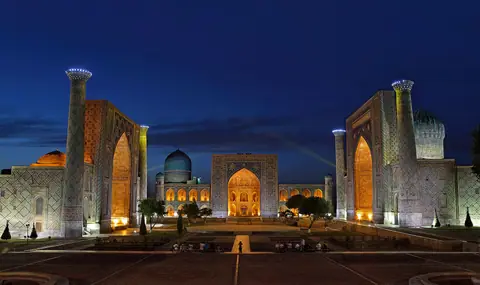
Returning to the Gur-e-Amir plaza after 20:00 is one of the quietest evening walks in Samarkand. Unlike Registan Square's crowded sound-and-light show, the floodlit azure dome of Gur-e-Amir glows peacefully above the surrounding mahalla lanes with only local families strolling across the granite esplanade.
Where it is
- 1Gur-e-Amir & Aksaray Crypt
- Samarkand International Airport (SKD) · about 6 km from here in a straight line
- Directions in Google Maps
Traveller tips
Real advice from people who have been to Samarkand. Every tip is read by our team before it goes live.
No tips yet. Been here? Yours could be the first.
Thank you! Your tip will appear here after a quick review.
More in Samarkand
Continue exploring Samarkand with related neighbourhood, food, and planning guides