




















Ulugh Beg Observatory & Afrosiab Guide
Visit Ulugh Beg's 1420s astronomical sextant, the 7th-century Sogdian Ambassadors' Painting at Afrosiab Museum, and the Tomb of Prophet Daniel in Samarkand
Northeast of the walled Timurid city rises the 220-hectare loess plateau of Afrosiab, the original Sogdian metropolis of Marakanda conquered by Alexander the Great in 329 BCE and razed by Genghis Khan in 1220 CE, together with Kuhak Hill. Here Amir Timur's grandson Mirzo Ulugh Beg constructed the world's most advanced pre-telescopic astronomical observatory in the 1420s. Combining the Afrosiab Museum, the Ulugh Beg Observatory, and the riverside Tomb of Prophet Daniel (Khodja Daniyar) creates a half-day route through 2,500 years of Silk Road diplomacy, mathematics, and interfaith pilgrimage.
| Site on the Northern Route | Entry Fee (Nov 2026) | Distance from Previous Stop | Essential Highlight |
|---|---|---|---|
| 1. Afrosiab Museum of Samarkand History. | 60,000 UZS (~4.75 USD). | 1.5 km north of Siyob Bazaar. | Original 650s CE Sogdian "Ambassadors' Painting" palace frescoes. |
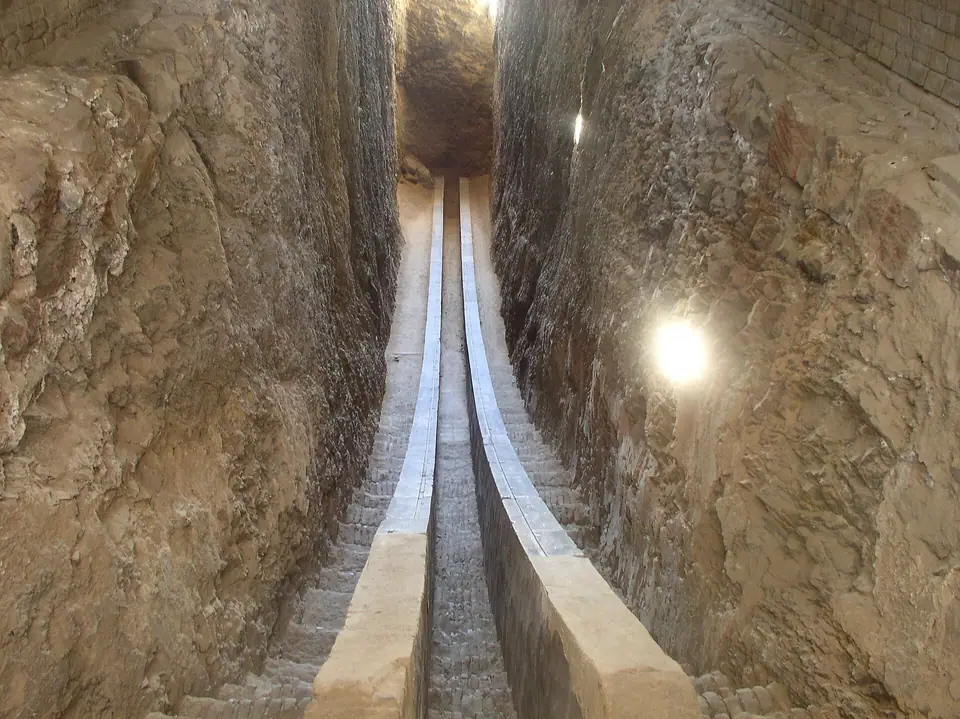
| 2. Ulugh Beg Observatory & Museum. | 75,000 UZS (~5.90 USD). | 1.2 km northeast along Tashkent Rd. | Subterranean 11 m marble trench of the 40.2 m Fakhri sextant. |
| 3. Tomb of Prophet Daniel (Khodja Daniyar). | 40,000 UZS (~3.15 USD). | 800 m west in the Siab River gorge. | 18-metre-long five-domed sarcophagus, natural spring & 500-year pistachio tree. |
Afrosiab Museum and the 7th-Century Sogdian "Ambassadors' Painting"
Before visiting the medieval Islamic monuments of Kuhak Hill, stop at the Afrosiab Museum on the southern edge of the archaeological mounds. Open 09:00 to 17:00 daily; 60,000 UZS / ~4.75 USD foreign entry as of November 2026. After Genghis Khan destroyed Samarkand's water canals in March 1220, the dry clay hills of Afrosiab remained abandoned. That desert soil preserved the palaces, Zoroastrian ossuaries, and frescoes of the Sogdians, who dominated Silk Road trade between China and Persia.
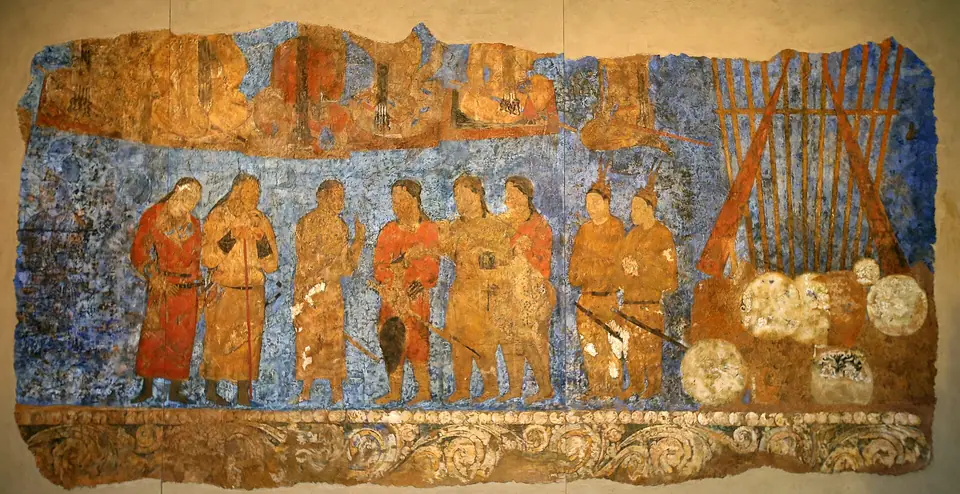
In the central circular hall hangs one of Central Asia's greatest archaeological treasures: the original four-wall Ambassadors' Painting. Archaeologist Lazar Albaum uncovered the frescoes in 1965 inside a palace hall built under Sogdian King Varkhuman (c, 650 to 675 CE). Protected behind glass and explained via multilingual audio-video projections, the murals depict a New Year (Nowruz) diplomatic procession:
- Western Wall. This panel depicts envoys from Chaganian (southern Uzbekistan), Tang China, and Korea, who are distinguished by their feathered hats. Nearby, long-haired Turkic military guards bring silk rolls and tributes to King Varkhuman, accompanied by a rare surviving Sogdian inscription directly naming the king.
- Southern Wall. A bridal or ceremonial procession leading four white sacred horses and riding camels and elephants toward a dynastic ancestral temple.
- Northern Wall. Chinese imperial life showing Emperor Gaozong hunting leopards among marshes while Empress Wu Zetian and court ladies sail in a dragon boat.
Ulugh Beg Observatory (1420s): Measuring the Year to Within One Minute
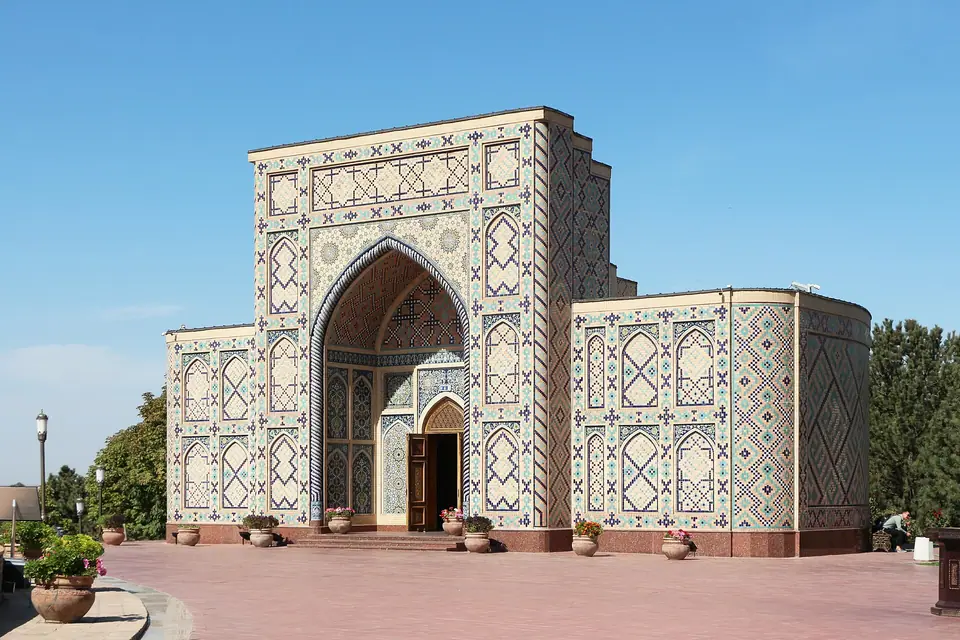
Continue 1.2 kilometres northeast up Kuhak Hill to the Ulugh Beg Observatory (open 08:00 to 20:00; 75,000 UZS / ~5.90 USD as of November 2026). Unlike his grandfather Amir Timur, who spent his life on horseback conquering Eurasia, Mirzo Ulugh Beg (1394 to 1449) governed Transoxiana for forty years as a practicing mathematician and observational astronomer. Between 1420 and 1428, assisted by scholars Jamshid al-Kashi, Qadi Zada al-Rumi, and Ali Qushji, Ulugh Beg built a three-storey cylindrical observatory measuring 46 metres in diameter and 30 metres high.
Because optical telescopes had not yet been invented, accuracy depended entirely on increasing the radius of the measuring instrument. Ulugh Beg and al-Kashi engineered a colossal Fakhri Sextant (Suds-i Fakhri) with a radius of 40.21 metres. To support its weight, builders carved its lower half into a deep vertical trench inside the bedrock of Kuhak Hill. At solar noon, a beam of sunlight pierced a small aperture high in the southern dome. The light moved across two parallel curved rails of white marble engraved with degree markings in Arabic Abjad numerals.
Using this stone sextant, Ulugh Beg's astronomers published the Zij-i Sultani (1437), cataloguing the exact positions of 1,018 stars. They calculated the sidereal year as 365 days, 6 hours, 10 minutes, and 8 seconds, within 58 seconds of modern satellite measurements, and measured Earth's axial tilt at 23°30'17''. After Ulugh Beg was assassinated by religious reactionaries and his son Abd al-Latif in 1449, the upper brick drum was dismantled for tiles. The underground marble arc remained lost beneath rubble until Russian archaeologist Vasily Vyatkin located its exact position from a 17th-century waqf land deed in 1908.
Tomb of Prophet Daniel (Khodja Daniyar Mausoleum)
From the observatory parking area, walk or take a two-minute taxi 800 metres west down into the quiet gorge of the Siab stream at the northern foot of the Afrosiab cliffs to visit the Mausoleum of Khodja Daniyar (Prophet Daniel). 40,000 UZS / ~3.15 USD as of November 2026. Muslims, Christians, and Bukharian Jews revere the shrine equally. Inside its five-domed brick hall rests an extraordinary 18-metre-long cenotaph draped in green velvet embroidered with gold verses.
According to Samarkand tradition, Amir Timur brought a relic (an arm bone) of the biblical Prophet Daniel from Susa (Shush in modern Iran) to protect Samarkand around 1400. When the camel carrying the relic struck the Siab cliff with its hoof, a mineral spring burst from the dry rock. Visitors still drink the cold spring water at the lower pavilion today. Two different legends explain why the grave measures 18 metres long: one states that Timur ordered an oversized tomb built so grave-robbers could never determine where the small relic was buried inside. The other claims that the prophet's bones miraculously grow half an inch every year. Outside the mausoleum Entrance stands a sacred 500-year-old pistachio tree that famously withered in the 1990s and blossomed green again in 1996 after being blessed by Patriarch Alexy II of Moscow.
Inside the circular museum on Kuhak Hill opposite the sextant trench, inspect 15th-century brass astrolabes and celestial globes. Glass cases also display facsimile folios of Ulugh Beg's star catalogue, the Zij-i Sultani. Completed in 1437 and translated into Latin at Oxford in the 17th century, Ulugh Beg's tables guided astronomers across Asia and Europe. They remained the world benchmark until Tycho Brahe's work over a century later.
When walking between the Afrosiab Museum and the Ulugh Beg Observatory, look out over the undulating brown hills of the 220-hectare Afrosiab archaeological reserve to the west. Beneath those grassy mounds lie eleven occupational layers spanning from the 7th century BCE through Persian, Greek, Kushan, and Sogdian rule. City life on the plateau ended in March 1220 when Genghis Khan smashed the lead-lined aqueduct (Juy-i Arziz).
At the Tomb of Prophet Daniel in the gorge below, shaded riverside benches offer a quiet break. From the gate, you can call a Yandex Go taxi to Registan or continue two kilometres east to Konigil.
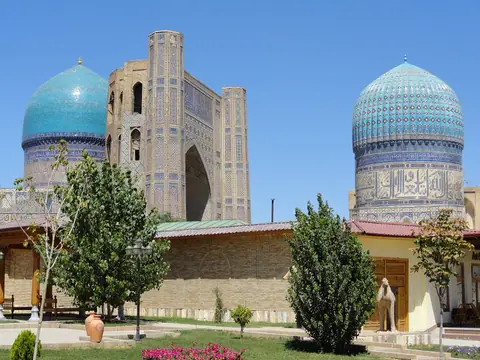
Shaded wooden benches and small neighbourhood bakeries line the pedestrian route between Gur-e-Amir, Registan Square, and Bibi-Khanym Mosque. Stopping for twenty minutes in the late afternoon lets you watch the light shift from bright turquoise to deep gold across the domes.
Where it is
- 1Ulugh Beg Observatory & Afrosiab
- Samarkand International Airport (SKD) · about 4 km from here in a straight line
- Directions in Google Maps
Traveller tips
Real advice from people who have been to Samarkand. Every tip is read by our team before it goes live.
No tips yet. Been here? Yours could be the first.
Thank you! Your tip will appear here after a quick review.
More in Samarkand
Continue exploring Samarkand with related neighbourhood, food, and planning guides