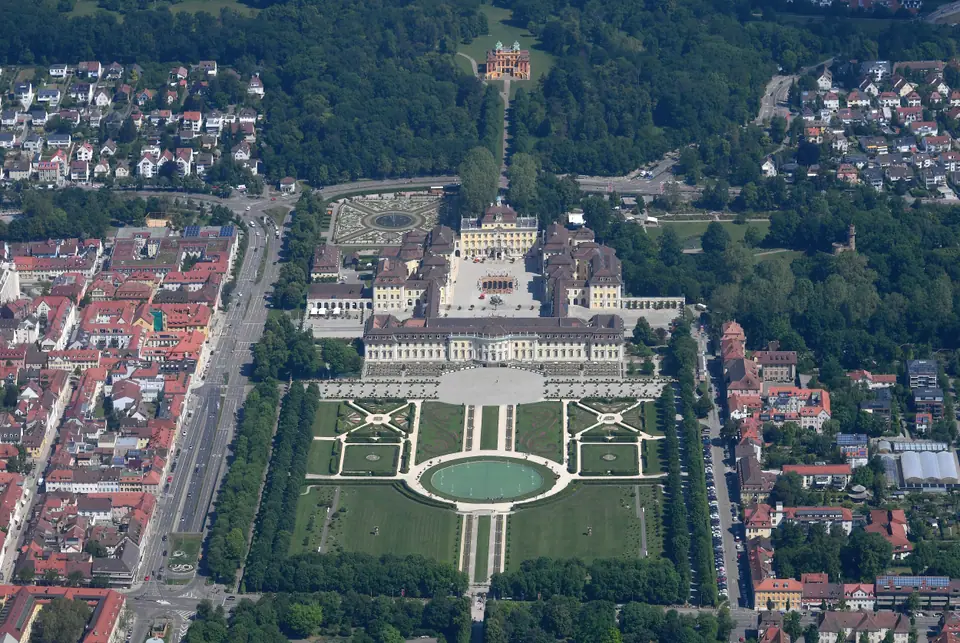
Photo: Carsten Steger · CC BY-SA 4.0
North on the S4 to Ludwigsburg's Baroque Palace
Direct 15-minute rail ride north to Germany's largest preserved Baroque palace complex, landscaped gardens, and two satellite pavilions.
Fifteen minutes north of Stuttgart's steep kettle bowl, flat Neckar plains open wide onto one of Germany's grandest court ensembles. Catch S-Bahn lines S4 toward Marbach or Backnang, or board S5 toward Bietigheim-Bissingen from central Stuttgart platforms. Frequent regional RE and MEX trains also reach Ludwigsburg in roughly 12 to 20 minutes from Hauptbahnhof. Once trains clear Zuffenhausen, vineyard ridges drop behind and wide agricultural terraces frame an open horizon. Always verify whether your service departs from the underground S-Bahn concourse or surface tracks during ongoing station works.
Stepping out at Ludwigsburg station puts you on the edge of a planned eighteenth-century town. Walk roughly 15 to 20 minutes east past arcaded Baroque façades around Marktplatz, where street cafés spill out beneath wide lime trees. Geometric street lines around the square trace directly back to the 1709 court expansion beside the palace walls. Alternatively, hop straight onto a local town bus running directly to the Schloss / Marstall palace gates.
452 Rooms Inside Germany's Swabian Versailles
Duke Eberhard Ludwig of Württemberg broke ground here in May 1704 on a modest summer hunting lodge. Building north of the basin gave him distance from conservative Stuttgart ministers and his estranged duchess. Early court architect Philipp Joseph Jenisch worked from 1704 to 1707 before Johann Friedrich Nette took charge. Italian-trained masters Donato Giuseppe Frisoni and Paolo Retti then scaled that retreat into a full Baroque court seat.
From 1709 onwards, planners laid out a geometric Baroque town right beside the expanding palace walls. When Eberhard Ludwig died in 1733, his cousin Duke Charles Alexander halted work amid master-builder fraud trials. The successor immediately moved royal offices back south to Stuttgart. That abrupt pause spared the eighteenth-century wings from heavy nineteenth-century overhauls and spared the complex major wartime damage. Today, Residenzschloss Ludwigsburg (LOOD-vikhs-boorg) holds 452 rooms across 18 linked buildings covering roughly 32 hectares. No larger preserved Baroque palatial complex survives anywhere in Germany.
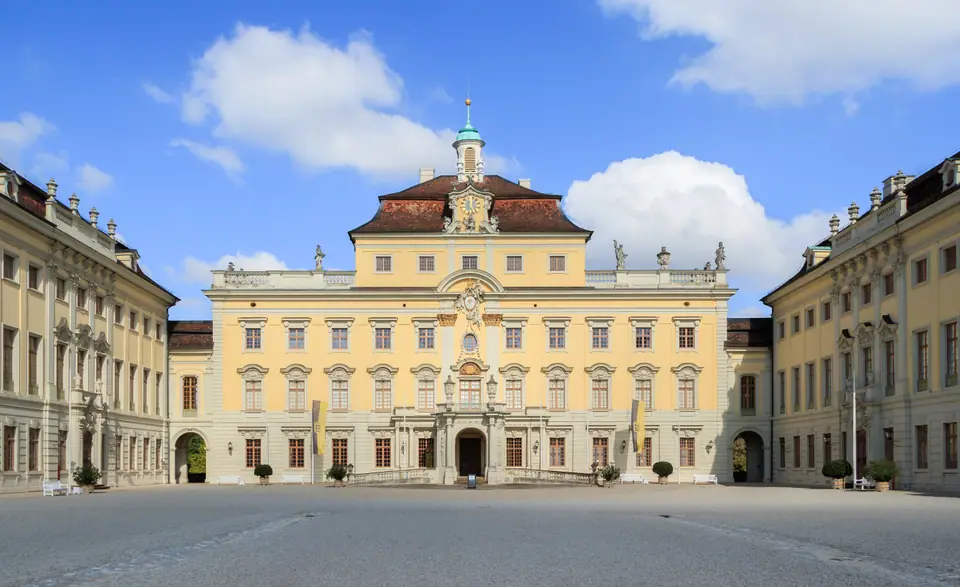
Entering the vast cobbled courtyard reveals tight symmetry framed by the Old Main Building, the Giant's Building, and low arcaded flanks. Guided interior routes lead visitors through the bright Marble Hall (Marmorsaal), the Gallery of Ancestral Portraits, and twin court chapels adorned in carved court stucco. Successive ducal suites display Baroque, Rococo, and Neoclassical rooms side by side in crisp sequence. Give yourself unhurried time between galleries because royal apartments stack tightly across upper palace wings.
Behind one discreet corridor door sits an extraordinary theatrical survival: the 1758 Schlosstheater. It keeps one of Europe's oldest functioning Baroque stage mechanisms completely intact beneath its painted auditorium. Wooden capstans, hemp rigging ropes, wave rollers, wind drums, and hand-shifted painted canvas wings still operate manually below the boards. Surrounding wings host the Ceramics Museum, a branch of Landesmuseum Württemberg showcasing rare Ludwigsburg porcelain. Nearby halls hold the Modemuseum charting eighteenth-to-twentieth-century dress, a Baroque Picture Gallery, and the family-oriented Kinderreich wing, giving indoor galleries real depth if rain rolls across the Neckar plain.
Blühendes Barock Gardens, Favorite and Monrepos
Wrapping cleanly around three sides of the palace wings stretches Blühendes Barock ("Blooming Baroque"). Landscaped in 1954 to mark the residence's 250th anniversary, its formal parterres recreate royal planting patterns from around 1800. Drawing roughly 520,000 to 550,000 visitors each year, formal lawns descend past stone fountains, floral parterres, and clipped hedges toward the eastern valley embankment. Families spend relaxed afternoons meandering past bird aviaries and interactive stations along the riverside Märchengarten fairytale trail. Late summer into autumn fills the outdoor terraces with themed sculptures at the annual pumpkin festival (Kürbisausstellung).
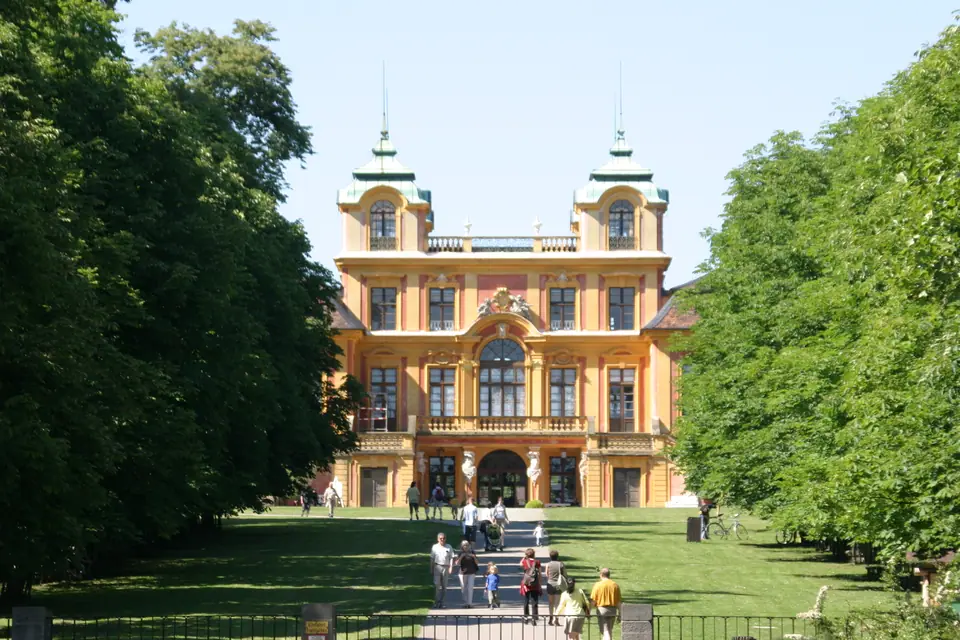
Continue straight north along shaded chestnut park avenues to leave coach crowds behind at two smaller royal retreats. Standing proud on a wooded crest rises yellow-stucco Schloss Favorite, built by Frisoni between 1717 and 1723. Designed originally as a compact porcelain-hunting maisonette, it gained refined Neoclassical rooms around 1800 under King Friedrich I. Guided tours walk through intimate salons framing views back toward the main palace towers and Stuttgart's distant hills.
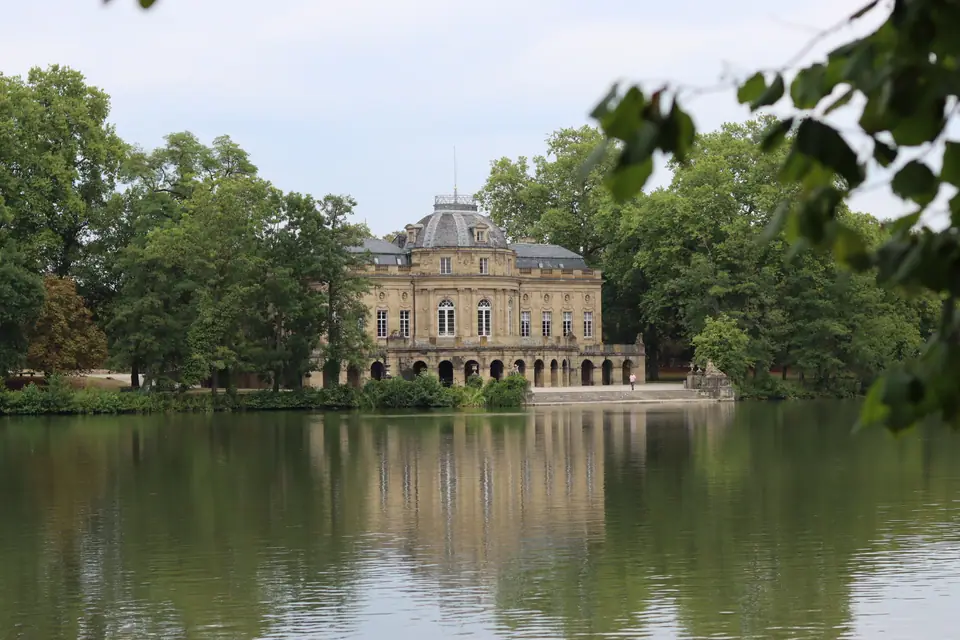
Three kilometres further northwest across 250 hectares of landscaped meadows and hillside vines sits white Rococo Seeschloss Monrepos. Shimmering beside its rowing pond, this lakeside pavilion remains privately held by the House of Württemberg. Interior chambers open exclusively during special concerts and staged events, while public lakeside paths stay open all year. Walking the unhurried trail connecting Residenzschloss, Favorite, and Monrepos lets you experience royal court grounds far away from downtown traffic.
Station Connections, Guided Slots and Garden Gates
- VVS transit coverage: Ludwigsburg sits inside outer VVS tariff zones included on both StuttCard PLUS and Deutschlandticket passes. Multi-zone day tickets from station machines work smoothly too, and frequent town buses link Ludwigsburg station directly to palace gates.
- Separate gates and seasonal hours: Blühendes Barock uses separate gates and entry passes from interior State Apartments and Schloss Favorite tours. Check the official site for Tuesday-to-Sunday schedules and winter adjustments between November and March before travelling north.
- Guided slots and small euro cash: Both the State Apartments and Schlosstheater require timed guided tours, with English departures scheduled less frequently than German slots. Carry modest euro cash as well as bank cards for Marktplatz bakeries and park kiosks. Frequent evening S4 and S5 trains make returning straight back to downtown dinner tables effortless. Pair this rail trip with bases in Mitte, Stuttgart-West, or Bad Cannstatt, confirm Hauptbahnhof S-Bahn platforms, or plan hilltop views in our Stuttgart attractions guide.
Where it is
- 1North on the S4 to Ludwigsburg's Baroque Palace
- Stuttgart Airport (STR) · about 23 km from here in a straight line
- Directions in Google Maps
Stations and taxi ranks: OpenStreetMap. Airports: OurAirports. Distances are in a straight line.
Traveller tips
Real advice from people who have been to Stuttgart. Every tip is read by our team before it goes live.
No tips yet. Been here? Yours could be the first.
Thank you! Your tip will appear here after a quick review.
More in Stuttgart
Continue exploring Stuttgart with related neighbourhood, food, and planning guides