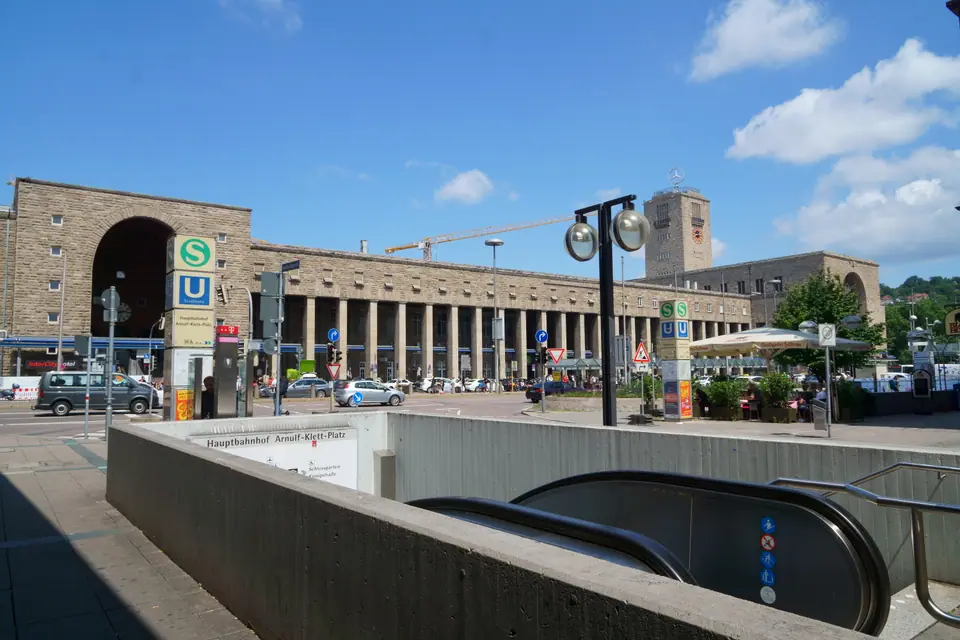
Photo: Giftzwerg 88 · CC BY-SA 3.0
Bonatzbau Meets Stuttgart 21: Tracks Under the Basin
Paul Bonatz's 1928 shell-limestone station, the 28 underground Kelchstützen, June 2026 Deutsche Bahn audit schedule, and passenger walkways.
No European rail station wears civic conflict and civil engineering quite as visibly as Stuttgart Hauptbahnhof. Standing where Königstraße meets Arnulf-Klett-Platz, the complex joins Paul Bonatz and Friedrich Eugen Scholer's severe 1928 limestone terminus directly onto a giant subterranean through-station pit. Decades of deep tunnelling, political marches, and platform shifts continue shaping German infrastructure debate and everyday rail transfers across Baden-Württemberg.
Bonatzbau Terminus vs Underground Stuttgart 21
Replacing a 16-track dead-end terminal across the basin floor with an 8-track subterranean through-station angled perpendicular beneath the street flipped station geometry completely. Under traditional stub-track operations, incoming fast trains pull to bumper stops inside Hauptbahnhof and back slowly back out along the same approach corridors. Routing trains straight through an underground pit aims to pass services directly beneath the stone facade toward Ulm and the airport instead. Comparing the 1928 stone terminal against the new concrete cavern clarifies why travellers still cross long fenced trenches between mainline trains and downtown pavements.
| Aspect | Historic Bonatzbau (Surface Terminus) | Stuttgart 21 (Deep Through-Station) |
|---|---|---|
| Lead architects | Paul Bonatz and Friedrich Eugen Scholer (1910 competition). | Christoph Ingenhoven with Frei Otto structural geometry. |
| Construction and opening | Built 1914 to 1928 (opened October 1922, heritage listed 1987). | Major clearing from 2010; phased commissioning 2027 to 2033. |
| Signature architecture | Dressed Württemberg shell limestone and 56 m clock tower. | 28 flared concrete Kelchstützen pillars topped by glazed light eyes. |
| Track layout | 16 surface stub tracks requiring train reversals. | 8 subterranean through-tracks connecting regional and fast corridors. |
Limestone Hall, Missing Star and the 2010 Rupture
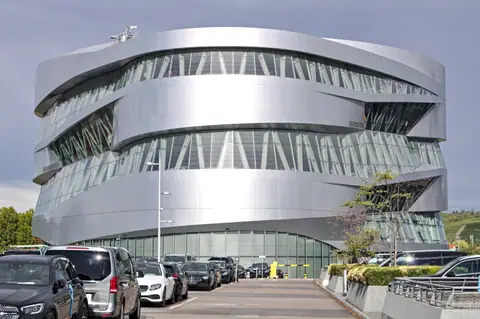
Paul Bonatz and Friedrich Eugen Scholer won the 1910 design competition for a bold stone terminus. Built in stages from 1914 to 1928 after an initial hall opened in October 1922, the Bonatzbau showcases local Württemberg Muschelkalk shell limestone. Heritage authorities listed the landmark in 1987 for its crisp vertical stone piers and 56-metre clock tower. From 1952 onward, an illuminated five-metre rotating Mercedes-Benz star crowned that tower roof as Stuttgart's visual badge. Engineers lifted the rotating star down in March 2021 during structural tower restoration, relocating it outdoors onto the stone plaza outside the Mercedes-Benz Museum in Bad Cannstatt.
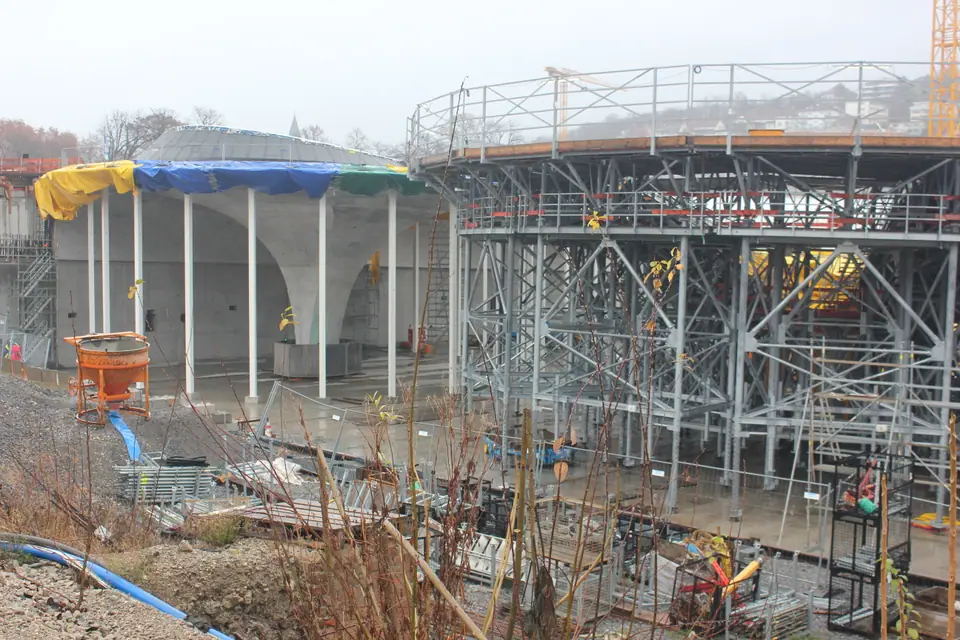
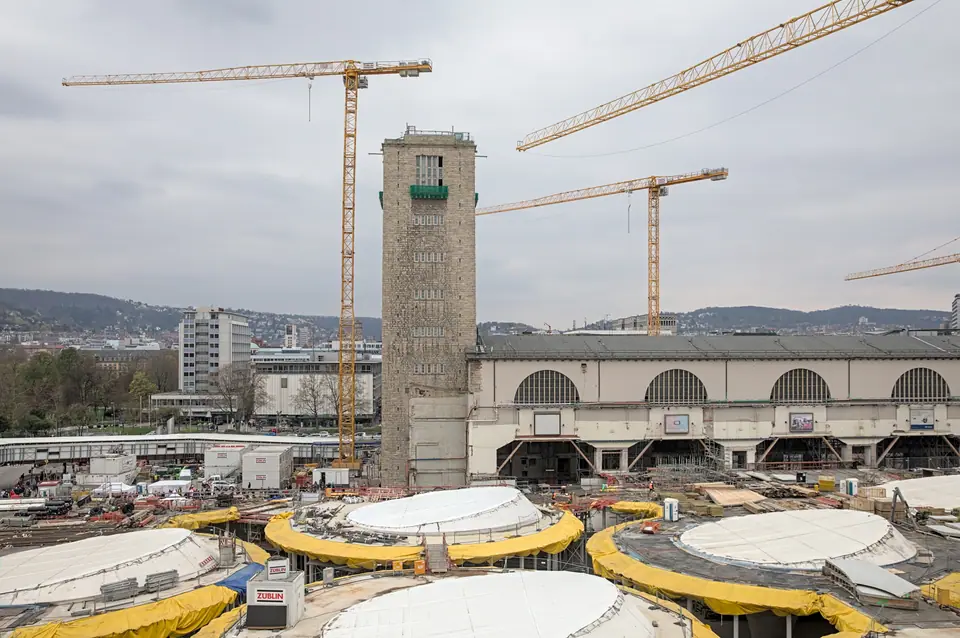
Behind the stripped limestone facade today, Christoph Ingenhoven's concrete trough rests around 28 flared concrete chalice columns (Kelchstützen). Their smooth curved ribs draw directly on late Stuttgart engineer Frei Otto's minimal-surface tensile research. Curved glass domes called Lichtaugen crown each concrete funnel to bring daylight straight onto deep platforms below street grade. Walking along outer viewing fences reveals how these thin concrete shells taper softly above the cavern to support landscaped Schlossgarten park lawns overhead.
Clearing ground for that sunken hall ignited fierce civic battles across town. Crews demolished Bonatz's north wing in 2010 and south wing in 2012 while felling centuries-old trees across Schlossgarten park. Public anger boiled over on 30 September 2010, remembered as Schwarzer Donnerstag ("Black Thursday"), when police deployed water cannons and pepper spray against demonstrators. On 27 November 2011, Baden-Württemberg voters still backed state funding by a 58.8 percent referendum majority, sealing tunnelling in place.
Verified 2026 Deutsche Bahn Audit and Station Status
June 2026 Deutsche Bahn commissioning update: DB CEO Evelyn Palla released a critical internal group audit in June 2026. The review exposed serious planning, execution, risk-control, and ETCS digital-signalling defects within DB Projekt Stuttgart-Ulm GmbH. Total projected project costs climbed toward 14.5 billion euros, prompting Deutsche Bahn to cancel its December 2026 opening target outright. Under the revised five-stage 2027-to-2033 programme, restored Bonatzbau concourse passages enter service at the end of 2027. The airport regional station opens for Tübingen, Reutlingen, and Ulm trains at the end of 2030, followed by the main deep Tiefbahnhof platforms at the end of 2031. Digitised S-Bahn trunk upgrades and Mittnachtstraße sit in July 2032, and the Pfaffensteig Tunnel routing Gäubahn trains via the airport concludes at the end of 2033.
Surviving Current Transfers at Surface Tracks 1 to 16
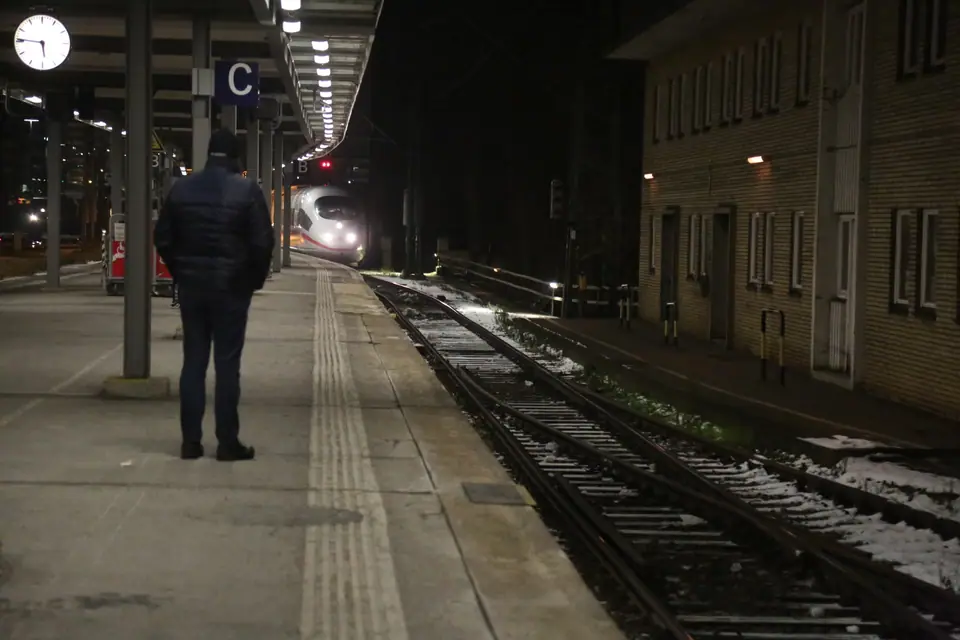
Underground mainline platforms stay shut throughout that staged timetable. Long-distance ICE services from Frankfurt and Munich still terminate outdoors right next to regional expresses bound for Tübingen, Esslingen, Ulm, and Heilbronn. Surface tracks 1 to 16 sit pushed roughly 150 metres north behind the historic stone wall. Reaching subterranean S-Bahn tracks, Stadtbahn trams, taxis, or Königstraße shops requires walking covered timber-and-steel bridges called the Südspange and Nordspange, nicknamed the Fernwanderweg. Exposed outdoor platforms turn cold and breezy in autumn rain, so keep waterproof outer layers handy between carriages and covered side bridges.
Yellow overhead direction boards mark pathways reliably between platform ends and city tram steps, yet stairs and narrow bends slow foot traffic whenever several long-distance trains unload together. Step outside the temporary concourse canopy and you can watch concrete Lichtaugen domes protruding above the fenced construction site beside Schlossgarten lawns. Follow station signage carefully around stairs and temporary lifts because construction trenches shift pedestrian corners periodically.
Add 10 to 15 extra transfer minutes to every rail connection passing through town. Travel with compact rolling luggage because peak commuter crowds jam temporary boardwalk lifts morning and evening. Check platform advisories in our Stuttgart station and airport guide before setting off, especially during school-holiday tunnel maintenance. Note that Hauptbahnhof concourse groceries remain open on Sundays while downtown retail closes under Sonntagsruhe rules. Pair your arrival with calm neighbourhood stays one stop out in Stuttgart-West instead of booking rooms right across from Arnulf-Klett-Platz cranes and hoardings.
Where it is
- 1Bonatzbau Meets Stuttgart 21
- Stuttgart Airport (STR) · about 11 km from here in a straight line
- Directions in Google Maps
Stations and taxi ranks: OpenStreetMap. Airports: OurAirports. Distances are in a straight line.
Traveller tips
Real advice from people who have been to Stuttgart. Every tip is read by our team before it goes live.
No tips yet. Been here? Yours could be the first.
Thank you! Your tip will appear here after a quick review.
More in Stuttgart
Continue exploring Stuttgart with related neighbourhood, food, and planning guides