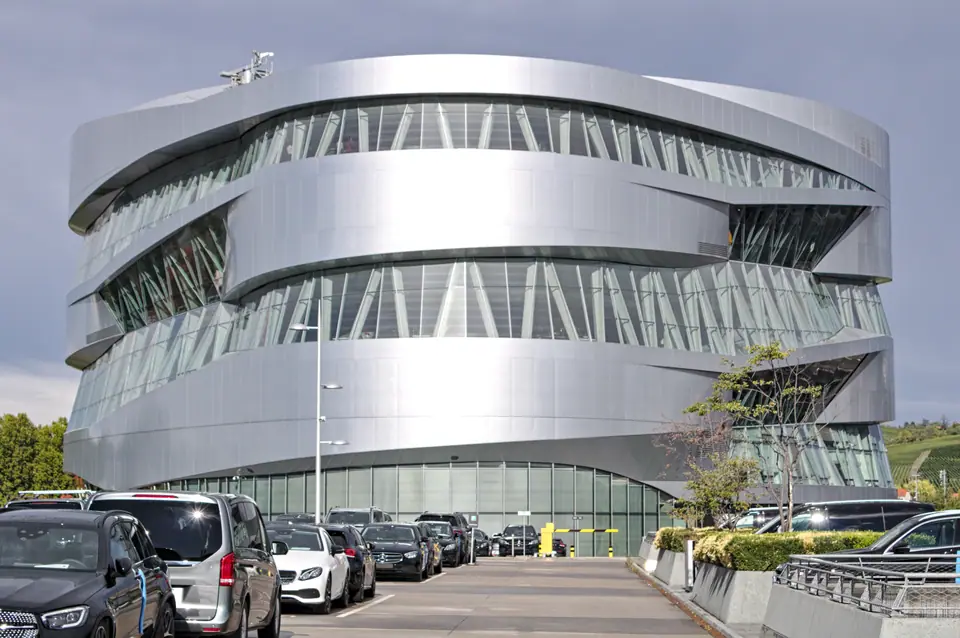
Photo: Alexander Migl · CC BY-SA 4.0
The Double Helix at Mercedes-Benz and Daimler's Workshop
Inside the nine-level UNStudio spiral at Mercedesstraße 100, the 1886 origins, racing Silver Arrows, and Daimler's greenhouse shed.
Automobile engineering sits deep in Stuttgart's identity, and no site frames that technical legacy more dramatically than Mercedesstraße 100 in Bad Cannstatt. Opened on 19 May 2006 to plans by Dutch architects Ben van Berkel and Caroline Bos of UNStudio, the building packs 16,500 square metres of gallery floor onto nine concrete levels. Its trefoil frame rises 47.5 metres above a tight 4,800-square-metre footprint right beside NeckarPark and MHP Arena. Brushed exterior aluminium wraps 1,800 uniquely cut triangular glass panels. Twin helical ramps wind downward like intertwined DNA strands without closed walls. Reach the site easily on S-Bahn line S1 to Neckarpark or Bus 45 from Bad Cannstatt.
Riding the Time-Capsule Lifts to 1886 at Level 8
Every visit begins cleanly at the summit rather than on the ground floor. Guests step into futuristic capsule-shaped lifts climbing silently up the sunlit 47.5-metre concrete atrium spine in roughly 25 to 30 seconds. Daylight filters steadily downward across raw exposed concrete balconies as lifts rise smoothly toward roof height. Doors slide open at Level 8 straight into the year 1886. Below those top landings, two intertwined concrete ramps sweep cleanly past glazed exterior facade windows without dark dividing hallways, keeping natural daylight flowing inward across every curve.
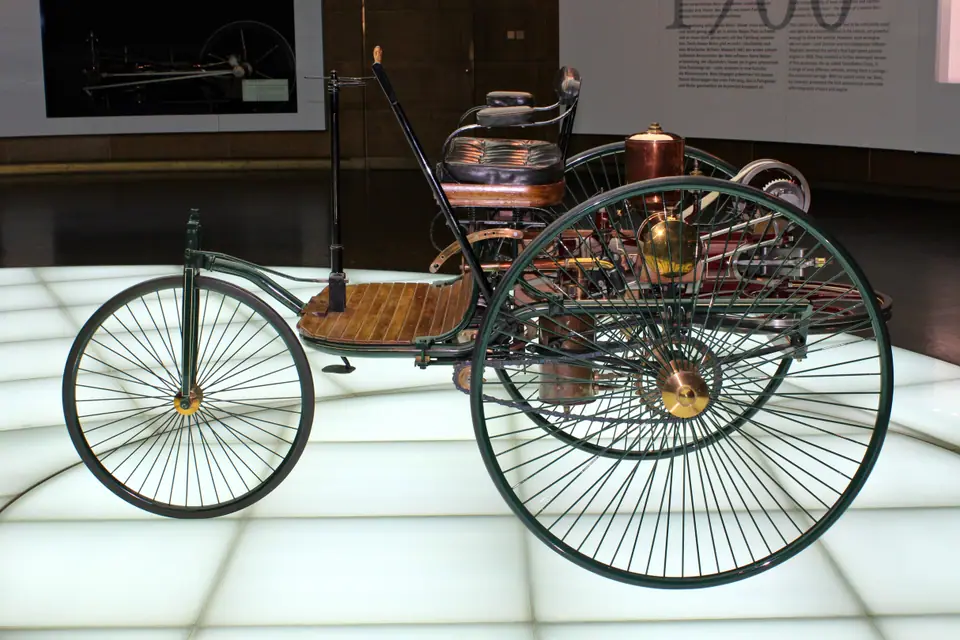
Facing the landing stands a full-scale white preserved horse, marking the swift shift away from animal horsepower. Opposite sit exact replicas of Karl Benz's three-wheeled Benz Patent-Motorwagen from Mannheim and Gottlieb Daimler's motorised four-wheel carriage (Motorkutsche) engineered in Cannstatt. Neither inventor had yet met the other when those experimental machines rattled down gravel lanes, decades before their rival companies merged.
Descending the Legend Route Through Racing Silver Arrows
From Level 8, the broad outer spiral leads guests down chronological Legend galleries spanned by 33-metre column-free concrete ceilings. Legend 1: Pioneers traces the invention of the automobile from 1886 to 1900 before brass-radiator early tourers built for Austrian consul Emil Jellinek turn toward pre-war supercharged roadsters. Early chain drives and wooden coachwork yield gradually to enclosed touring sedans and heavy pre-war grand-prix machines. Wartime sections give way gracefully to post-1950 rooms celebrating West Germany's Wirtschaftswunder expansion, highlighted by the gullwing 300 SL and early passenger safety shells.
Wide curved windows frame glimpses across neighbouring Bad Cannstatt factories and Neckar river docks as you descend slowly toward street grade. Audio guides included with standard entry tickets switch effortlessly between languages and age levels, helping casual visitors pick out landmark engine patents without stalling at every plaque.
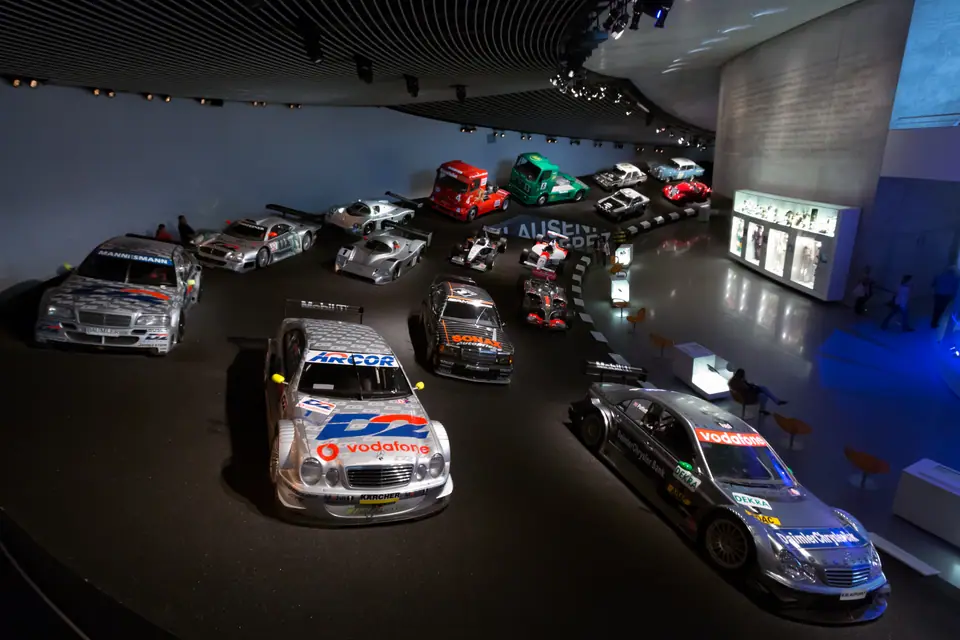
Down near the lower curves, motorsport dominates an entire sweeping wall built like a tilted racing circuit banking. Polished aluminium Silver Arrows (Silberpfeile) from 1930s grand-prix circuits line up beside touring sedans, Le Mans sports prototypes, and modern Formula challengers. Tilting the cars forward lets aerodynamics speak clearly without drowning guests in dry technical tables.
Branching Out Across the Collection Galleries and Plaza Star
Coiled inside the chronological descent, a tighter second ramp peels away at intermediate landings into five thematic Collection galleries. Instead of tracking calendar dates, these daylight rooms group working machines by practical civic role. Visitors switch freely across intermediate walkways between date-ordered halls and working vehicle rooms without climbing stairs twice. Buses and vans anchor the Gallery of Voyagers, while freight trucks and fire engines fill Carriers. Municipal Unimogs occupy Helpers before halls shift into Celebrities and Heroes.
Altogether, more than 160 historic and modern vehicles sit among over 1,500 exhibits down the helix. Back at ground level, step outside onto the stone forecourt facing NeckarPark stadium. Mounted outdoors on the plaza stands the original five-metre rotating Mercedes-Benz star. That landmark badge crowned Stuttgart Hauptbahnhof's Bonatzbau clock tower from 1952 until engineers lifted it down in March 2021 during tower renovations.
Crossing to Gottlieb Daimler's 1882 Greenhouse Workshop in Bad Cannstatt
Most visitors head back to S-Bahn station Neckarpark (Line S1) or board Bus 45 straightaway. Yet skipping one side street two kilometres northwest leaves out the motor story's real root. Follow Taubenheimstraße 13 along the leafy edge of Bad Cannstatt's Kurpark to inspect the Gottlieb-Daimler-Gedächtnisstätte (DAYM-ler geh-DEKHT-nis-shtet-eh). Bus 56 and Stadtbahn lines U1, U2, U13, and U19 stop minutes away near Kursaal and Uff-Kirchhof.
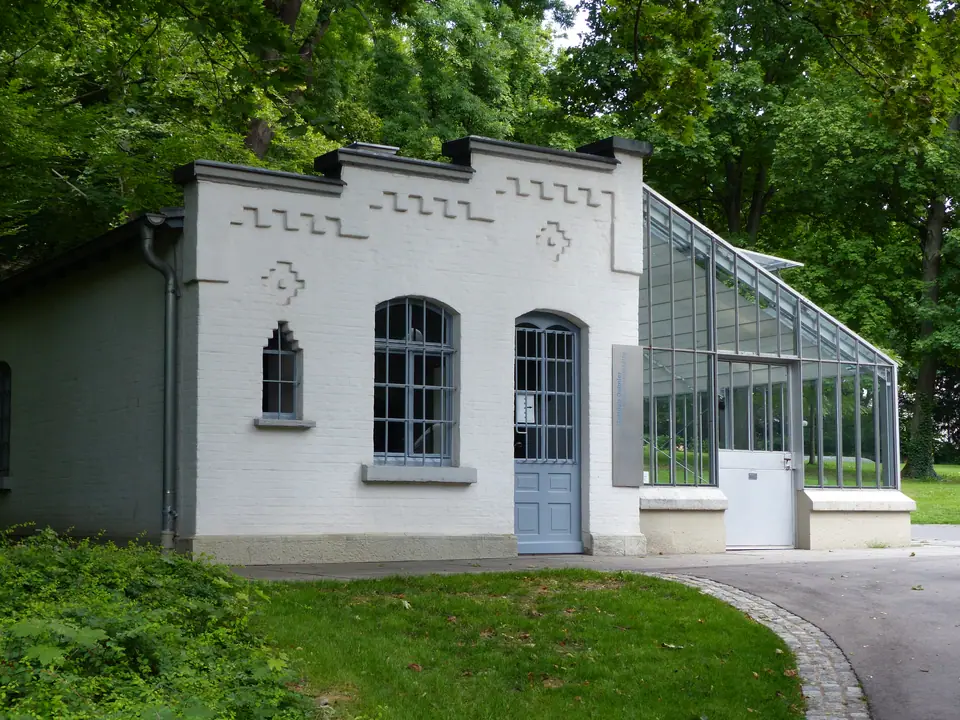
Here in 1882, Gottlieb Daimler and engineering partner Wilhelm Maybach bought a quiet villa and converted its brick-and-glass garden greenhouse into a secret workshop away from former employers. Under narrow glass panes, they engineered the compact high-speed four-stroke petrol engine nicknamed the Standuhr ("grandfather clock"). They soon bolted a lightweight unit onto a wooden frame to test their 1885 Reitwagen ("riding car"). Widely recognized as the world's first internal-combustion motorcycle, it rattled down quiet Cannstatt lanes before factory workshops shifted across to Seelberg hill.
Small display cabinets inside the restored brick pavilion preserve early cylinder castings, workbench tools, and drawings from before industrial assembly lines existed. Stepping directly onto shaded Kurpark paths right outside links Germany's motor origins cleanly back to quiet spa avenues.
Budget two to three unhurried hours inside UNStudio's spiral and 30 minutes at the Kurpark greenhouse. Both museums close on Mondays, so shift weekend mornings early using online timed entry slots. StuttCard PLUS covers Mercedes-Benz Museum admission and S1 or Bus 45 transit smoothly. Relying on VVS rail skips Bad Cannstatt's municipal diesel bans cleanly. After inspecting Daimler's engines, compare Zuffenhausen's Porsche Museum and downtown galleries or soak nearby in Bad Cannstatt mineral pools.
Where it is
- 1The Double Helix at Mercedes-Benz and Daimler's Workshop
- Stuttgart Airport (STR) · about 11 km from here in a straight line
- Directions in Google Maps
Stations and taxi ranks: OpenStreetMap. Airports: OurAirports. Distances are in a straight line.
Traveller tips
Real advice from people who have been to Stuttgart. Every tip is read by our team before it goes live.
No tips yet. Been here? Yours could be the first.
Thank you! Your tip will appear here after a quick review.
More in Stuttgart
Continue exploring Stuttgart with related neighbourhood, food, and planning guides