


























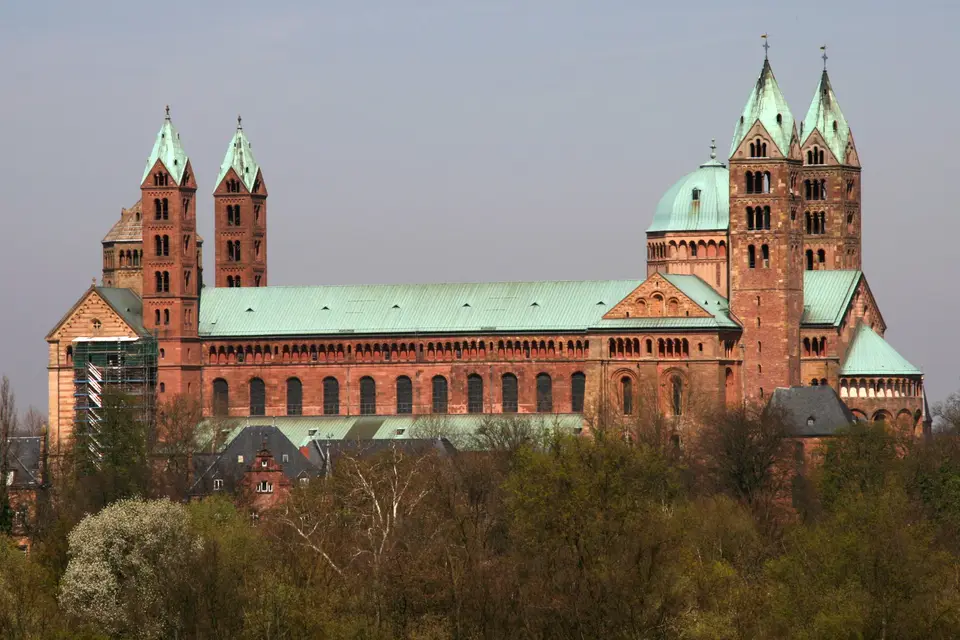
Quick Field Data
- UNESCO Inscription: 1981 · Cultural Criterion (ii).
- Scale & Footprint: Monumental Romanesque vaulted basilica with four towers and two domes rising above the left bank of the Rhine in a city of 42.58 square kilometres and approximately 50,000 inhabitants.
- Access & Ticketing: Located in the historic centre of Speyer, where visitors can enter the cathedral nave and the imperial crypt and combine the visit with the nearby 2021 World Heritage Judenhof.
- Arrival Logistics: Situated on the Schifferstadt-Wörth railway in Rhineland-Palatinate, 21 kilometres south-west of Heidelberg and 25 kilometres south of Ludwigshafen and Mannheim, with rail connections southward toward Zurich.
Salian Imperial Power and the First Consistently Vaulted Church in Europe
Standing on a river terrace at 92 metres elevation along the left bank of the River Rhine in Rhineland-Palatinate (Rheinland-Pfalz), 25 kilometres (16 miles) south of Mannheim and Ludwigshafen and 21 kilometres (13 miles) south-west of Heidelberg, Speyer Cathedral rises above one of the oldest cities in Germany. Placed on the UNESCO World Heritage Atlas in 1981 under cultural criterion (ii), this monumental Romanesque basilica crowned by four towers and two domes was established in 1030 by Emperor Conrad II (Konrad II), probably soon after his imperial coronation, as a flat-ceilinged basilica. For almost 300 years, the cathedral functioned as the burial place of the German emperors, housing beneath its high altar the tombs of eight German kings and Holy Roman Emperors.
Historically, artistically, and architecturally, Speyer Cathedral ranks as the largest and most important Romanesque monument erected during the era of the Holy Roman Empire. Conceived to project imperial authority across the Salian dynasty (1024 to 1125), the cathedral was built in conscious competition with the Abbey of Cluny, which stood as the architectural representative of papal opposition. Following his famous journey from Speyer, his favourite town, to Canossa in 1076 and his reconciliation with the Pope in 1077, Emperor Henry IV ordered sweeping renovations and extensions at the end of the 11th century. Under Henry IV's builders, the flat-timbered church of Conrad II was reconstructed as Europe's earliest and largest church structure vaulted consistently in stone.
Incorporating the general spatial layout of St Michael of Hildesheim, the cathedral brought to perfection an architectural plan that was subsequently adopted throughout the Rhineland. This Rhineland Romanesque plan is defined by the balanced equilibrium of its massive east and west structural blocks alongside the symmetrical placement of the four tall towers framing the central volume of the nave and transept. Two further structural innovations introduced during Henry IV's late 11th-century remodelling were firsts in architectural history: a monumental system of blind wall arcades strengthening the interior and exterior elevations, and an open gallery that encircles the entire building beneath the roofline.
Two Millennia Along the Rhine: From Noviomagus to the ShUM Community
The urban setting of Speyer (historically known in English as Spires and in Palatine German as Schbaija) reaches back more than two millennia, a span celebrated when the city marked its 2000th anniversary in 1990 just as the Cold War ebbed and the Federal Republic of Germany prepared for reunification. Known in the pre-Roman period by the Celtic name Noviomagus ("new field"), the site became a Roman military camp in 10 BC situated between the present town hall and the episcopal palace to guard the north-eastern frontier of the Roman Empire against Germanic tribes across the Rhine in Germania. Recorded as Noviomagus in AD 150 on the world map compiled by the Greek geographer Ptolemy, the settlement appeared in the 4th century on the Peutinger Map as Civitas Nemetum after the Germanic Nemetes tribe, and by 346 a Western Christian bishop for the town was documented for the first time. After Civitas Nemetum was destroyed in the 5th century, the town was re-established in the 7th century as Spira, named after a nearby Frankish settlement and the Speyerbach tributary that enters the Rhine here.
When Conrad II began construction of Speyer Cathedral in 1030, the town also erected its first 11th-century city wall. In 1084, the first Jewish community was established in Speyer, making the city one of the three ShUM cities, alongside Worms and Mainz, that formed the intellectual and spiritual centre of northern European Judaism during the Middle Ages (represented by scholars such as the 13th-century rabbi and tosafist Simha of Speyer, a signatory of the Takkanot Shum, Samuel of Speyer, and Judah ben Samuel of Regensburg). During the First Crusade (People's Crusade) of 1096, as Count Emicho's army slaughtered Jewish communities across the Rhineland on their way to the Holy Land, Speyer's Bishop John worked with local leader Yekutiel ben Moses to shelter the town's Jewish residents inside the episcopal palace and stronger fortifications outside the town, ruling that any person who harmed a Jewish resident would have his hands chopped off. Although the medieval community was later wiped out in the persecution pogrom of 1349, Speyer's medieval Judenhof, preserving the remnants of its medieval synagogue and intact subterranean ritual bath (mikve), was inscribed alongside Worms and Mainz as a UNESCO World Heritage Site in 2021 (ID 1636).
Free Imperial Town, the Protestation of 1529, and Modern Recovery
When the Roman Catholic bishop surrendered most of his civic rights in 1294, Speyer became an autonomous Free Imperial Town within the Holy Roman Empire, and from 1527 to 1689 it functioned as the seat of the Imperial Chamber Court. Across the 16th-century Protestant Reformation, the city stood at the centre of European religious history. Whereas the first Diet of Speyer in 1526 under Holy Roman Emperor Charles V decreed interim toleration of Lutheran teaching and worship, the second Diet of Speyer on 19 April 1529 saw Evangelical Lutheran states and princes deliver the famous Protestation at Speyer against anti-Reformation resolutions, giving birth to the term "Protestantism" and "Protestants." Between 1883 and 1904, the neo-Gothic Memorial Church (Gedächtniskirche) was erected in Speyer to commemorate the 1529 Protestation.
Later centuries brought repeated military trials to the city and its cathedral. Conquered in 1635 by Marshal of France Urbain de Maillé-Brézé and French commander the French nobleman duc de La Force (Marshal Jacques Nompar de Caumont) commanding the French Army of Germany, Speyer suffered severe damage in 1689 from invading Royal French forces, witnessed the 1703 Battle of Speyerbach amid the War of the Spanish Succession (1701 to 1714), and remained under French rule from 1792 to 1814 under the First French Republic and Napoleon Bonaparte's First French Empire (Emperor Napoleon I). After Napoleon's fall in 1816, Speyer served as the administrative capital of the Palatinate and the Bavarian Kingdom's Rhine District (the Bavarian Palatinate), holding that status for 129 years until World War II ended in 1945 (and in 1861 the cathedral witnessed Crown Princess Victoria introducing the future King Edward VII to his future wife Alexandra). In 1947, under post-war Western Allied occupation, the city became home to the State Academy of Administrative Science (now the German University of Administrative Sciences Speyer), and in 1959 Speyer twinned with the French cathedral city of Chartres, followed in 1989 by Ravenna in Italy. Across the centuries, Speyer has also nurtured prominent scholars, artists, and writers, from the 13th-century Franciscan choir master, composer, and poet Julian of Speyer (before 1225 to around 1250), scholastic philosopher Gabriel Biel (around 1415 to 1495), and humanist author Dietrich Gresemund (1477 to 1512) to physician and alchemist Johann Joachim Becher (1635 to 1682), 19th-century painter Anselm Feuerbach (1829 to 1880), and modernist painter Hans Purrmann (1880 to 1966). Today, governed as an independent city (Kreisfreie Stadt) divided into four Stadtteile with Speyer Airfield (Flugplatz Speyer) lying 4 kilometres south of the centre, Speyer preserves its Salian basilica and medieval Judenhof as twin monuments of European history. The sandstone walls rise high.
- Entry and Route Through Historic Speyer: Walk east from the medieval Altpörtel (Old Town Gate) past the baroque Dreifaltigkeitskirche (Trinity Church) directly to Speyer Cathedral, where you can trace the symmetrical eastern and western blocks, the encircling exterior dwarf gallery, the high groin vaults of Henry IV's nave, and the Romanesque crypt containing the royal and imperial tombs.
- Tickets and Viewpoints: Before arriving on the Rhine terrace, check the official site of Speyer Cathedral for crypt visiting schedules and guided tours before arriving. Combine your visit to the cathedral with the nearby Judenhof Speyer (synagogue ruins and medieval mikve), the Gedächtniskirche (Memorial Church), the Historical Museum of the Palatinate, and the Technikmuseum Speyer.
- Timing and Onward Connections: Hourly trains on the Schifferstadt-Wörth railway link Speyer with Karlsruhe and the Rhine-Neckar cities of Heidelberg, Mannheim, and Ludwigshafen, making it easy to pair a Rhine valley itinerary with our city guide to Zurich and our UNESCO World Heritage Atlas.
