


























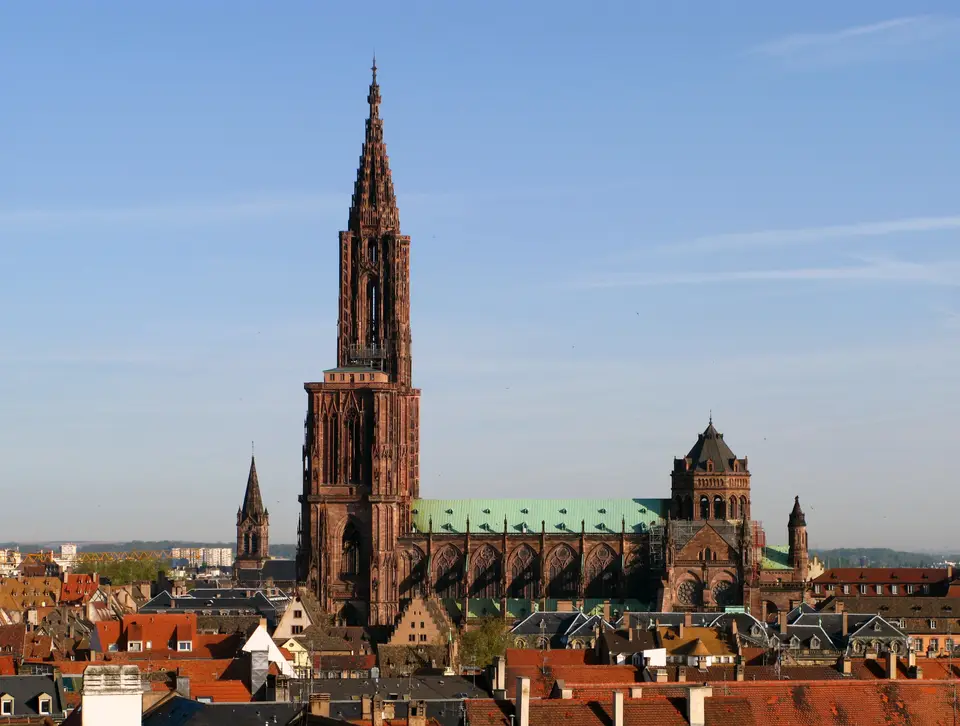
Quick Field Data
- UNESCO Inscription: 1988 (extended in 2017)
- Scale & Footprint: The 1.25-by-0.75-kilometre river island of Grande-Île enclosed by the Ill river and the Canal du Faux-Rempart, paired with the adjoining Neustadt quarter in Strasbourg, Bas-Rhin, Grand Est, France
- Access & Ticketing: Open pedestrian historic core crossed by bridges marked with 22 brass World Heritage plates, with individual admission rules for museums and church interiors; check the official site
- Arrival Logistics: Located in the Rhineland corridor of eastern France and easily paired with cross-border rail itineraries through Zurich
Two Urban Eras Bound by the Ill River and the Rhine Corridor
Set in the Bas-Rhin department of the Grand Est region in eastern France along the ancient riverbed of the Rhine, the World Heritage site of Strasbourg, Grande-Île and Neustadt brings together two complementary phases of European urban history. First inscribed on the World Heritage List in 1988 for the medieval and classical island heart of the Grande-Île (known in German as the Große Insel, or Large Island), the designation was extended in 2017 to incorporate the Neustadt, the ambitious new town planned and built under the German administration between 1871 and 1918. Enclosed on its southern edge by the principal watercourse of the Ill river and on its northern edge by the canalised arm of the Canal du Faux-Rempart, the Grande-Île forms an "ellipse insulaire" measuring roughly 1.25 kilometres (0.78 miles) in length by 0.75 kilometres (0.47 miles) in breadth across its longest and broadest dimensions. To mark its 1988 World Heritage status, 22 brass plates were set into the bridges that carry pedestrians and trams across the water onto the island.
At the time of the initial 1988 inscription, the International Council on Monuments and Sites recognised the Grande-Île as an old quarter that exemplifies medieval cities in Rhineland Europe. Structured around Strasbourg Cathedral, the island evolved over centuries as a cultural and commercial crossroads where French and Germanic architectural traditions met and enriched one another. Between the 15th and late 17th centuries, merchants and craftsmen raised timber-framed and stone Renaissance-style private residences tightly integrated into the medieval urban fabric, particularly in the western quarter of Petite France, where the city's tanners, millers, and fishermen lived and worked beside the divided channels of the Ill river, and around the former fluvial customs house, the Ancienne Douane. During the 18th century, after Strasbourg's integration into the kingdom of France, French classical architecture reshaped the civic profile of the island through monumental hôtels particuliers and aristocratic palaces.
From 1871 onwards, the German administration launched an ambitious urbanistic project beyond the Canal du Faux-Rempart that continued until 1918 and profoundly modified the face of the town. Combining Haussmannian boulevard concepts with a distinctly Germanic architectural vocabulary while putting into practice the urban design theories of Camillo Sitte, planners created the Neustadt as a modern, functional quarter that reflected the engineering advances and public hygiene policies developed between the late 19th and early 20th centuries. Wide tree-lined axes, public buildings, and landscaped river quays were deliberately aligned with visual perspectives back towards the medieval cathedral spire, uniting the ancient island and the imperial extension into a unified Rhineland urban landscape around the rivers and canals.
Gothic Spire Perspectives, Aristocratic Palaces, and Imperial Boulevards
The visual and symbolic pivot of both the Grande-Île and the Neustadt is Strasbourg Cathedral, a 15th-century Gothic masterpiece that ranks as the fourth-tallest church in the world. Shaped both by eastern Romanesque building traditions and by the Gothic structural innovations of the kingdom of France, while also drawing inspiration from Prague for the bold construction of its single spire, the red sandstone cathedral acted as a model and vector transmitting Gothic art eastwards across the Rhine. Within France, the centre of island just north of the cathedral lies Place Kléber, the city's central square, while four other centuries-old parish churches stand across the surrounding medieval quarters of the Grande-Île: St. Thomas, the church of St. Pierre-le-Vieux, the parish of St. Pierre-le-Jeune, and the historic eastern church on the island.
Around the cathedral and along the river embankments stand the imposing 18th-century hôtels particuliers and palaces that expressed secular and ecclesiastical power in Strasbourg. Chief among these is the Palais Rohan, designed beside the cathedral by the French king's architect, Robert de Cotte, as a benchmark of 18th-century French classical architecture. Nearby stand the Hôtel de Hanau, which now functions as the municipal City Hall; the 18th-century Hôtel des Deux-Ponts (where Ludwig I, of Bavaria was born and where the city's military governor now resides); the classical Hôtel de Klinglin; the aristocratic Hôtel d'Andlau-Klinglin; the Hôtel de Neuwiller; and the seat of the Archdiocese of Strasbourg inside the Episcopal Palace. At the western end of the Grande-Île, the half-timbered gables of Petite France overlook the covered medieval bridges of the Ponts Couverts and the upstream weir of the Barrage Vauban, which looks back across the canalised channels towards the cathedral spire.
Crossing the bridges over the Canal du Faux-Rempart into the Neustadt reveals how late-19th-century planners translated both Haussmannian boulevard geometry and Camillo Sitte's spatial principles into monumental stonework. Rather than isolating the new imperial district from the medieval island, the architects of the 1871-to-1918 extension oriented avenues, squares, and riverside embankments to frame the Gothic silhouette of the cathedral from every approach, while introducing modern water, sanitation, and transport infrastructure alongside Germanic civic facades.
This dialogue between the medieval and classical island of the Grande-Île and the planned imperial avenues of the Neustadt gives Strasbourg a dual urban character unique in Rhineland Europe. Where the Grande-Île preserves a compact network of narrow medieval lanes, timber-framed Renaissance merchants' houses from the 15th to the 17th centuries, and 18th-century French classical stone palaces clustered tightly around the cathedral, the Neustadt opens outward into broad tree-lined vistas, public gardens, and monumental river quays connected across the Ill river and its man-made waterways. Across both districts, the interplay of water channels, stone bridges, domestic Rhineland gables, classical palaces, and late-19th-century civic ensembles illustrates five centuries of urban design along the upper Rhine.
Walking From the Barrage Vauban Through Grande-Île to the Neustadt
Exploring Strasbourg with the UNESCO World Heritage Atlas is best organised as a continuous west-to-east pedestrian walk across the 1.25-by-0.75-kilometre island and over the canal bridges into the Neustadt. Starting on the panoramic terrace of the Barrage Vauban at the western edge of the island allows walkers to survey the defensive towers of the Ponts Couverts and the waterways of Petite France before threading through the former tanners' and millers' lanes towards St. Thomas and the Ancienne Douane on the Ill river. From the central open expanse of Place Kléber, narrow medieval streets lead south to the west front of Strasbourg Cathedral and the courtyard of Robert de Cotte's Palais Rohan. Every bridge frames a distinct water view.
After examining the 18th-century facades of the Hôtel de Hanau and the Hôtel des Deux-Ponts, visitors can cross one of the bridges bearing the 22 brass World Heritage plates over the Canal du Faux-Rempart into the broad avenues of the 2017 Neustadt extension. Here, the monumental public buildings, university and administrative blocks, and landscaped river embankments built between 1871 and 1918 illustrate how urban planners combined Haussmannian perspectives with Camillo Sitte's principles of civic space while keeping the Gothic spire of Strasbourg Cathedral at the visual centre of the city. Because Strasbourg sits on high-speed rail corridors along the upper Rhine valley in Grand Est, travellers frequently link an architectural walk through the Grande-Île, Petite France, and the Neustadt with regional itineraries extending south to Zurich.
- Beginning at the western waterworks: Start your morning walk on the terrace of the Barrage Vauban for an elevated view across the Ponts Couverts, the Canal du Faux-Rempart, and the distant spire of Strasbourg Cathedral.
- Spotting the 22 bridge plaques: Look down at the bridge parapets crossing the Ill river and the Canal du Faux-Rempart to find the 22 brass plates installed to mark access to the Grande-Île World Heritage zone.
- Comparing the two urban models: Walk directly from the timber-framed Renaissance lanes around the cathedral into the 1871-to-1918 avenues of the Neustadt to see how Camillo Sitte's sightlines keep the Gothic spire in view.
