Quick Field Data
- UNESCO Inscription: Reference 1487, inscribed in 2015 as a Cultural site under Criteria (ii) and (iv) in Sicily, Italy.
- Scale & Footprint: Serial site spanning 6.235 hectares across nine monuments erected during the Norman Kingdom of Sicily (1130 to 1194): seven in Palermo plus the cathedrals of Monreale and Cefalù.
- Access & Ticketing: Exterior plazas, the Admiral's Bridge, and main cathedral naves in Palermo, Monreale, and Cefalù remain open for respectful entry. Ticketed admission applies to the Palatine Chapel inside Palazzo dei Normanni, Zisa Palace, Monreale's 2,200-square-metre cloister, San Cataldo, San Giovanni degli Eremiti, and cathedral treasuries.
- Arrival Logistics: Falcone-Borsellino Airport (PMO) lies 30 kilometres north-west of Palermo, linking by airport rail and buses into central Palermo (6 kilometres from the serial cluster centroid), from where urban buses reach uphill Monreale and coastal trains continue east to Cefalù.
Multicultural Syncretism Under the Norman Kingdom of Sicily
Following the Norman conquest of Sicily in 1091 and the coronation of Roger II as ruler of the Norman Kingdom of Sicily (1130 to 1194), Palermo became the centre of an extraordinary Mediterranean crossroads. Instead of erasing the skills of the island's conquered populations, Norman monarchs actively commissioned master builders, astronomers, woodworkers, and mosaicists across Muslim, Byzantine, Latin, Jewish, Lombard, and French communities. Out of that political arrangement grew a cohesive architectural style uniting northern European basilica plans and fortress towers with Islamic geometric vaulting, pointed arches, opus sectile stone marquetry, and Byzantine gold-ground tesserae mosaics.
Inscribed together by UNESCO in 2015 across 6.235 hectares, the nine component monuments capture the surviving heights of that sixty-four-year kingdom. Seven stand within Palermo itself: the Royal Palace (Palazzo dei Normanni) housing the Palatine Chapel, Zisa Palace, Palermo Cathedral, the Church of San Giovanni degli Eremiti, the Church of Santa Maria dell'Ammiraglio (La Martorana), the Church of San Cataldo, and the Admiral's Bridge (Ponte dell'Ammiraglio). Beyond the capital rise two colossal cathedral complexes in Monreale and Cefalù.
Protected today under Italy's 2004 Code of Cultural and Landscape Heritage, the nine sites include individual National Monuments at San Giovanni degli Eremiti, Santa Maria dell'Ammiraglio, and Monreale Cathedral. They balance active religious life with regional governance inside Palazzo dei Normanni, seat of the Sicilian Regional Assembly. A Steering Committee and the Sicilian UNESCO Heritage Foundation coordinate continuous structural conservation against seismic hazards, landslides, floods, and heavy cruise-era visitor numbers. When UNESCO inscribed the monuments in 2015, Palermo Mayor Leoluca Orlando and Italian President Sergio Mattarella unveiled a commemorative plaque at the entrance of Palazzo dei Normanni. The plaque affirms civic coexistence and honours Arab and Norman contributions to Italian history, backed by ongoing conservation programmes spanning mural cleaning, historical research, and structural stabilisation across all nine sites.
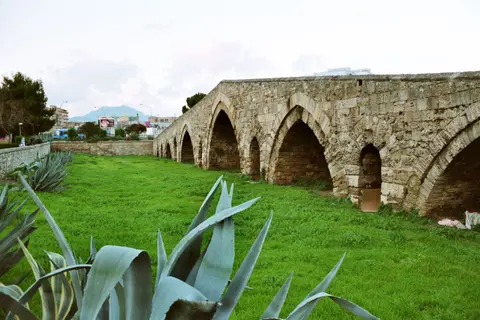
Palermo's Civic Palaces, Red-Domed Churches, and Royal Cathedral
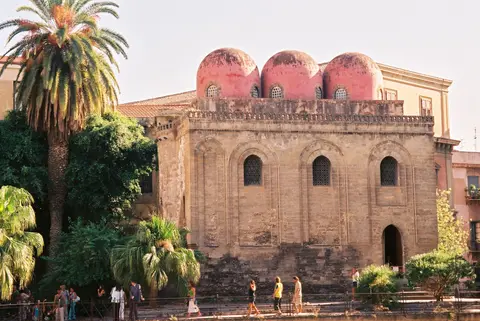
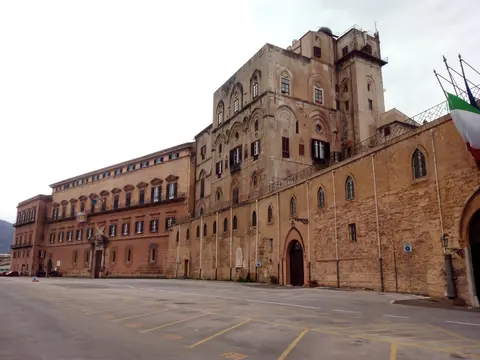
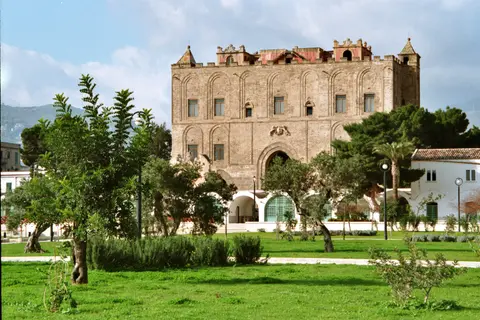
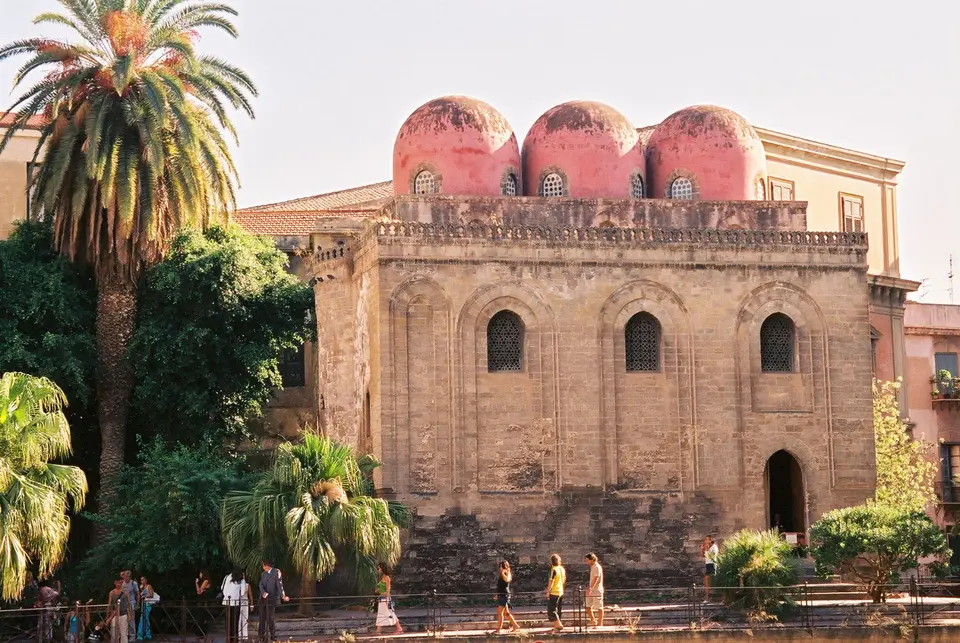
Inside Palermo, civil engineering, royal display, and sacred architecture illustrate Arab-Norman syncretism from contrasting angles. Rising above the old city, Palazzo dei Normanni encloses the celebrated Palatine Chapel, where Byzantine apse and dome mosaics sit beneath an Islamic painted wooden muqarnas ceiling and above inlaid marble pavements. Across town in a garden setting stands Zisa Palace, designed with Islamic cooling geometry as a royal summer residence, while the twelfth-century pointed-arch Admiral's Bridge survives over the former bed of the Oreto River. Nearby, the compact churches of San Giovanni degli Eremiti and San Cataldo crown cubic sandstone blocks with signature red domes over blind arcades, while La Martorana preserves glowing twelfth-century Byzantine vault mosaics.
Palermo Cathedral charts eight centuries of continuous adaptation on a single sacred plot. Norman Archbishop Walter Ophamil built the cathedral in 1185 over an earlier Byzantine basilica attributed to Pope Gregory the First and converted into a mosque during ninth-century Arab rule. The exterior preserves twelfth-century decorated eastern apses and fourteenth- and fifteenth-century tower crowns linked by two lintelled ogival arches across Via Matteo Bonello to the Museo Diocesano. Key additions include a 1465 Gothic-Catalan southern porch with a carved portal by Antonio Gambara (1426 to 1430), wooden doors by Francesco Miranda (1432), and an early sixteenth-century portal by Antonello Gagini. Between 1781 and 1801, Giuseppe Venanzio Marvuglia executed Ferdinando Fuga's neoclassical interior remodelling and added its discordant central dome.
Inside the cathedral, treasures span centuries, led by the right-aisle porphyry tombs of King Roger II, Queen Constance the First, Emperor Henry VI, Emperor Frederick II, Constance of Aragon, and Peter II of Sicily. The nave and chapels also hold a 1466 Gothic-Catalan wooden choir, Francesco Laurana's 1469 marble Madonna with Child, Manfredi Chiaramonte's thirteenth-century Crucifix, Domenico Gagini's holy water stoup, and a 1797 Pennino font. Eighteenth-century coronation monuments commemorate Victor Amadeus II of Savoy (crowned December 1713 with Anne Marie d'Orléans) and Bourbon King Charles III. Downstairs, the granite-column crypt houses Walter Ophamil, Giovanni Paternò, and Norman-era burials, while Odo of Bayeux was buried here in 1097. Finally, the Treasury displays Constance of Aragon's gold crown found in 1491, a 1452 breviary, sixteenth- and eighteenth-century sacred vestments, enamels, and the 1452 parchment carrying Archbishop Simon of Bologna's coat of arms.
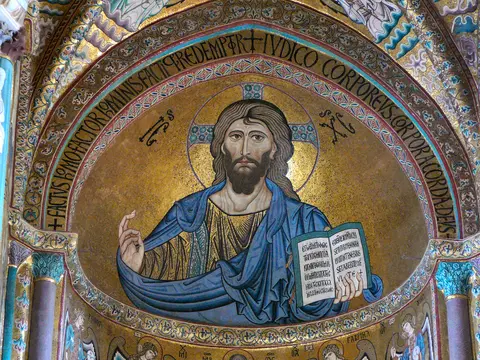
Byzantine Gold Mosaics and Cloisters at Monreale and Cefalù
Outside central Palermo, two monumental cathedrals carry the Arab-Norman mosaic tradition to colossal architectural scale. Up in the hills above Palermo, King William II launched Monreale Cathedral between 1172 and 1174. While tradition cites a dream under a carob tree yielding buried gold coins, rivalry with Archbishop Ophamil's Palermo Cathedral drove construction. The abbey gained Pope Alexander III's bull on 30 December 1174 and metropolitan rank by 1182 to 1183 before consecration in 1267. At 102 metres long and 40 metres wide, the basilica combines a Cluniac two-tower facade with a 1547 to 1569 Renaissance portico by Giovanni Domenico and Fazio Gagini. It also pairs 1179 bronze doors by Barisano da Trani with grey oriental granite and cipolin marble nave columns. The interior further preserves opus alexandrinum choir pavements and 6,500 square metres of glass mosaics installed by local and Venetian masters. An 1811 choir fire damaged organ fittings and the tombs of William the First and William II prior to restoration. North-choir burials remained intact, including Margaret of Navarre (with sons Roger and Henry) and the 1270 viscera urn of Saint Louis IX of France, joined by two seventeenth- and eighteenth-century Baroque side chapels. The nave combines the 1967 Ruffatti six-manual organ (102 stops), high two-light clerestory windows above classical Corinthian capitals omitting any triforium, and low-pitched restored painted wooden roofs. Outside stands the vast 2,200-square-metre cloister, completed around 1200 and once enclosed by twelve abbey precinct towers.
Further east along the Tyrrhenian coast, Cefalù Cathedral was begun by King Roger II in 1131 after surviving a violent sea storm. Rising like a coastal fortress behind its terraced cemetery parvis (traditionally laid with soil from Jerusalem), Cefalù places a 1472 portico by Ambrogio da Como framing the Porta Regum between twin Norman towers. Those towers carry differing fifteenth-century spires: one square with Papal flame-shaped merlons, the other octagonal with royal Ghibelline merlons. Inside its Latin-cross nave stand fourteen antique pink granite and two cipolin columns beneath an open wooden ceiling painted with motifs likely executed by Arabic craftsmen. Furnishings include a four-lion twelfth-century stone baptismal font, a fourteenth-century image of Urban V, a fifteenth-century enthroned Madonna, an Antonello Gagini workshop Madonna canvas, and Guglielmo da Pesaro's 1468 painted cross. Look also for carved corbels from 1215 to 1223 depicting masks and animal heads, plus 72 modern biblical stained-glass windows installed by Palermo artist Michele Canzoneri from 1985. In the presbytery, Constantinople mosaicists brought by Roger II completed Italy's finest Byzantine bust of Christ Pantokrator before 1170, blessing the sanctuary with the Gospel of John in Greek and Latin. Beneath him, three tiered iconographic bands depict the Virgin Mary raising her hands in obsecration, flanked by four archangels, apostles, evangelists, prophets, four cherubim, and four seraphim, plus royal and priestly portraits. The cathedral sits over a site yielding a sixth-century Paleo-Christian mosaic and later inspired Antonio Vandone's 1925 to 1928 Mogadishu Cathedral.
Access Zones Across the Nine Sicilian Monuments
Because the nine monuments span downtown Palermo, hilltop Monreale, and coastal Cefalù, grouping visits geographically cuts transit time while respecting distinct church, museum, and parliamentary access rules.
| Complex Zone | Key Highlights | Access & Ticket Rule |
|---|---|---|
| Palermo Royal & Civic Core | Palazzo dei Normanni and Palatine Chapel, Palermo Cathedral (royal porphyry tombs, Piazzi meridian), Zisa Palace | Cathedral nave accessible outside services; royal tombs, treasury, Palatine Chapel, and Zisa Palace operate ticketed entry |
| Palermo Monastic & Urban Churches | Santa Maria dell'Ammiraglio (La Martorana), San Cataldo red domes, San Giovanni degli Eremiti, Admiral's Bridge | Admiral's Bridge open freely outdoors; enclosed churches and monastic cloisters charge modest entrance fees |
| Monreale Cathedral Precinct | 102-metre mosaic basilica, Barisano da Trani bronze doors, 216-column carved cloister and lavatorium | Main church entry and cloister circuits follow separate ticket rules and liturgical dress standards |
| Cefalù Coastal Basilica | Christ Pantokrator apse mosaics, twin-tower fortress facade, Porta Regum, Romanesque cloister | Main nave generally open outside services; roof access, cloister, and treasury areas operate regulated tickets |
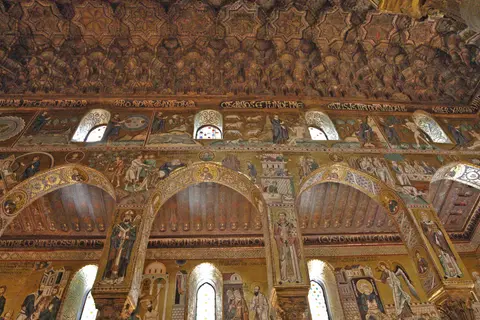
Three Architectural and Astronomical Features Across the Nine Sites
Looking closely at stonework, marble columns, and floor inlays across Palermo, Monreale, and Cefalù uncovers unexpected clues to how Sicily's medieval workshops operated.
- Carved Qur'anic Column and Imperial Porphyry at Palermo Cathedral: Inspect the left-hand column supporting Palermo Cathedral's 1465 southern Gothic-Catalan portico, which bears a carved Qur'an verse confirming its reuse from the city's earlier basilica and mosque. Inside the right aisle, examine the free-standing red porphyry sarcophagi of Roger II, Frederick II, Henry VI, and Constance the First, carved locally from an ancient Roman column shaft to echo Byzantine emperors' tombs in Constantinople.
- Astronomer Giuseppe Piazzi's 1801 Floor Meridian inside Palermo Cathedral: Trace the brass line (la meridiana) inlaid precisely north-to-south across Palermo Cathedral's floor. Built in 1801 by observatory director Giuseppe Piazzi, discoverer of Ceres, a pinhole aperture in a minor dome projects a moving solar disk onto zodiac markers and solstice endpoints at solar noon to standardise Sicilian timekeeping and Easter dates.
- Inlaid Paired Columns and Carved Capitals in Monreale's Cloister: Step into Monreale's 2,200-square-metre cloister built around 1200 to study all 216 paired white marble shafts. Alternate columns remain plain while neighbouring shafts ripple with spiral and vertical gold and coloured glass mosaic bands beneath pointed Norman arches and unique capitals, no two of which share identical foliage or biblical carvings.
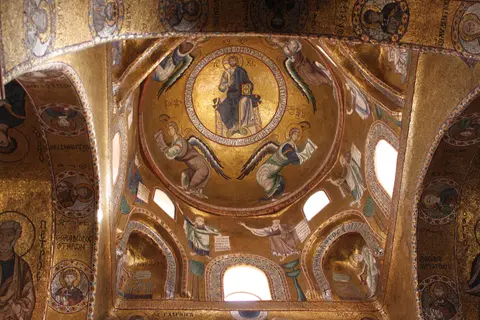
Connecting Palermo, Monreale, and Cefalù with Regional Sicily Guides
Allow two unhurried days to cover all nine Arab-Norman components, devoting day one on foot across central Palermo. That route links Palazzo dei Normanni and San Giovanni degli Eremiti to Palermo Cathedral, La Martorana, San Cataldo, Zisa Palace, and the Admiral's Bridge. Split a second day between a morning bus climb to Monreale and a coastal rail trip east to Cefalù. Remember modest shoulder-and-knee dress inside active cathedrals, and schedule Palermo Cathedral around solar noon if you hope to watch Piazzi's sunlit disk cross the bronze meridiana line.
Arriving via Falcone-Borsellino Airport 30 kilometres north-west places travellers rapidly inside Palermo, just 6 kilometres from the serial centroid. For historic food markets, coastal neighbourhoods, and lodging advice across Sicily's capital, pair this monument manual with our dedicated Palermo city guide. Readers tracing medieval cross-cultural architecture across the Mediterranean can browse additional inscribed ensembles in our UNESCO World Heritage Atlas.