Quick Field Data
- UNESCO Inscription: Ref. 831 · Cultural Site · Inscribed 1997 · Criteria (i), (ii), (iii), (iv)
- Scale & Footprint: 934-hectare archaeological zone nested inside the 1,300-hectare Valle dei Templi Archaeological and Landscape Park stretching between Colle di Girgenti, Rupe Atenea, and the southern ridge
- Access & Ticketing: Protected under Italy's Legislative Decree 42/2004, Regional Law 20/2000, and construction bans from 1966, 1968, 1971, and 1991; paid park entry covers the ridge sanctuary sectors via official ticketing offices verified online before visiting
- Arrival Logistics: 108 kilometres southeast of Palermo Falcone-Borsellino Airport (PMO) and 132 kilometres from Catania-Fontanarossa Airport (CTA), with Comiso Airport (CIY) sitting 96 kilometres away offering limited passenger schedules
Akragas Between Sican Interior Routes and the Sea
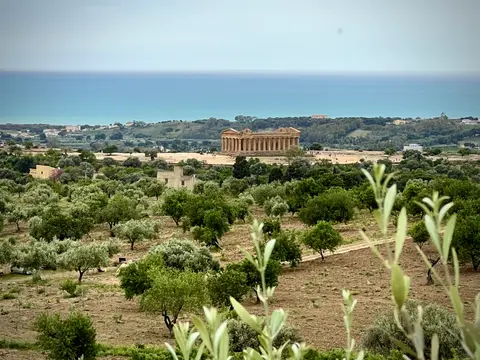
Despite its evocative Italian name, the Valle dei Templi is no valley at all: seven monumental Doric temples crown a prominent southern limestone ridge overlooking the Mediterranean shore outside modern Agrigento in southern Sicily. According to Thucydides, Greek colonists from Gela led by founders Aristonous and Pystilus, reinforced by settlers from Crete and Rhodes, founded Akragas around 582 to 580 BC. They chose a naturally fortified plateau framed by the Hypsas and Acragas rivers and linked eastward from Colle di Girgenti to Rupe Atenea. Though the last major Greek colony established in Sicily, Akragas quickly grew into one of the richest cities in the ancient Greek world.
Expansion across the fertile hinterland between the Platani and Salso rivers anchored Akragas's early rise. Archaeological excavations at indigenous Sican centres including Monte Sabbucina, Gibil-Gabil, Vasallaggi, San Angelo Muxano, and Mussomeli trace prolonged contact through commerce, acculturation, and military campaigns that reached peak intensity by the early fifth century BC. Controlling the overland corridor linking the Straits of Sicily straight north to Himera on the Tyrrhenian Sea yielded vast agricultural harvests worked by enslaved labour, prompting Akragas to mint its own coinage around 520 BC and conquer Selinus's outpost at Heraclea Minoa around 500 BC. Observing the citizens' monumental stone sanctuaries and lavish banquets, Plato famously remarked that Akragantines built as if intending to live forever yet ate as though each day were their last.
Political rule shifted swiftly from the semi-legendary sixth-century tyrant Phalaris (reputedly ruling around 570 to 550 BC and remembered in myth for burning adversaries inside a bronze bull) and later leaders Alcamenes and Alcander toward an era of extraordinary civic building under the Emmenid family.
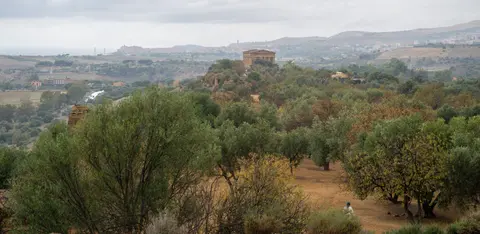
Theron, the 480 BC Victory, and Doric Ridge Sanctuaries
Seizing tyranny around 488 BC, Theron forged an alliance with Gelon of Gela and Syracuse and annexed northern neighbour Himera around 483 BC. When expelled Himera ruler Terillus appealed with Anaxilas of Rhegium and Selinus for Carthaginian aid, Theron and Gelon shattered the Carthaginian expedition at the Battle of Himera in 480 BC. Triumph secured Akragas's authority over roughly 3,500 square kilometres of central Sicily and funded massive public construction. Works included rebuilt defensive walls, the huge Kolymbethra water reservoir, underground aqueducts, and the colossal Olympeion sanctuary. Diodorus Siculus recorded construction using war captives, though archaeological stratigraphy confirms monumental works began even before the battle.
Pindar and Simonides celebrated Theron's victories at the Olympic and Panhellenic games before his successor Thrasydaeus fell in 472 BC to Hiero of Syracuse, ushering in an aristocratic civic republic later shaped by philosopher Empedocles against an oligarchic faction called the thousand. Defeat by Syracuse along the Salso river after Ducetius's 451 BC border conflict halted coinage temporarily, yet mid-fifth-century Akragas still sustained perhaps 16,000 to 18,000 citizens and 30,000 to 40,000 total inhabitants (far more plausible than Diodorus's 200,000 or Diogenes Laertius's 800,000). After staying neutral during Athens's 415 to 413 BC Sicilian Expedition, Akragas suffered catastrophic Carthaginian capture and sack in 406 BC.
Subsequent centuries reshaped the ridge. Timoleon repopulated depleted Sicilian cities between 344 and 337 BC, drawing settlers from Elaea before Akragas challenged Syracusan power under general Xenodikos. Scholars such as Giacomo Manganaro identify that Elaea, backed by a Molossian proxenia decree, with Epirote Elaea in Thesprotia devastated by Philip II of Macedon in 342 BC rather than Italian Elea. Leading a short-lived anti-Syracusan coalition embracing Gela and Enna, Akragas fell to repeated defeats by Syracusan commanders Leptines and Demophilus. Xenodikos went into exile before a short-lived kingdom rose under tyrant Phintias early in the third century BC. During the Punic Wars, Roman armies besieged Akragas in 262 BC and enslaved survivors in 261 BC. After losing the city briefly to Carthage in 255 BC, Rome recaptured it permanently in 210 BC during the Second Punic War (218 to 201 BC). Renamed Agrigentum yet retaining Greek speech, the city flourished as a loyal Roman civitas decumana, socius, sulphur-mining hub, port, and granary praised by Cicero. Scipio Africanus Minor gifted Myron's bronze Apollo, later stolen by Verres, before urban decline set in after the seventh century AD. Centuries later, Agrigento became the birthplace of Nobel laureate dramatist Luigi Pirandello (1867 to 1936) at contrada u Càvusu.
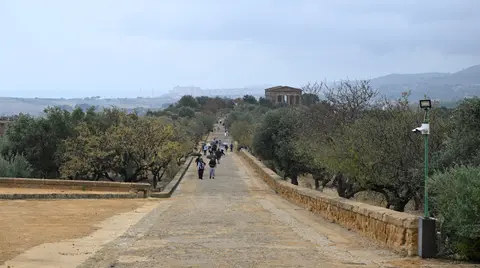
From Temple of Concordia to the Olympeion Quarry
Stretching along the southern ridge, seven Doric temples display shifting Greek architectural ambition, though only the Olympeion carries a confirmed classical dedication; remaining temple names stem from Renaissance tradition. At the easternmost bluff sits the Temple of Hera, built around 450 BC on an artificial terrace measuring 38.15 by 16.9 metres with 6 by 13 columns atop four steps. Scorched in the 406 BC Carthaginian fire and reroofed in clay under Rome with an added altar ramp, its front colonnade owes its upright silhouette to anastylosis begun from the 18th century onward.
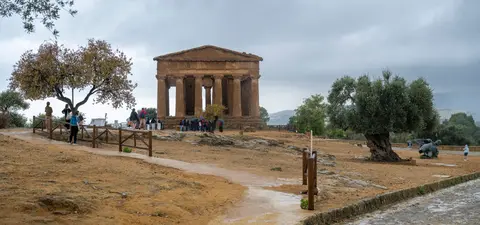
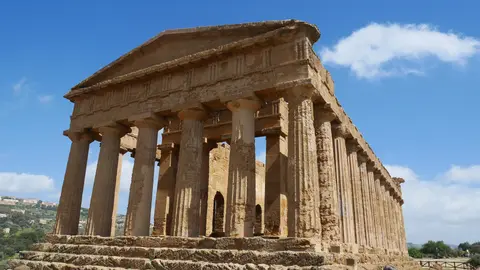
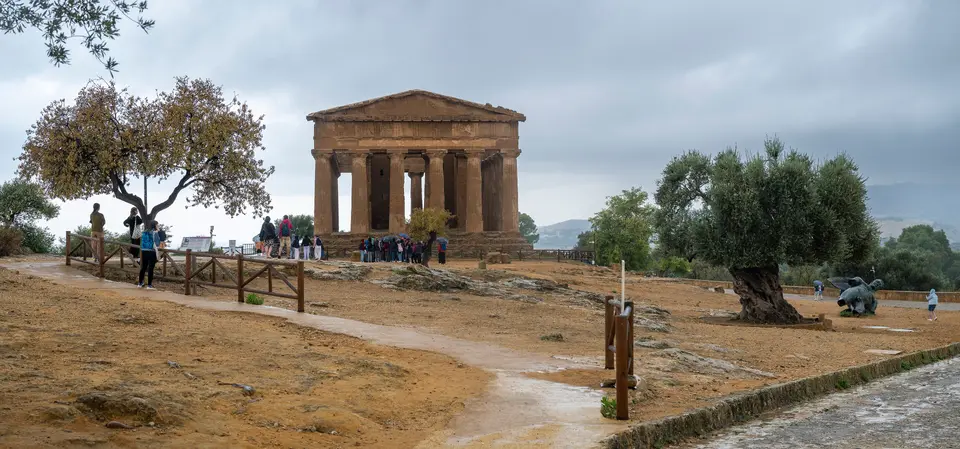
Moving westward reveals Agrigento's architectural centrepiece, the fifth-century BC Temple of Concordia, whose six-column facade inspired UNESCO's emblem. The temple rests on a 39.44 by 16.91 metre platform with 6 by 13 fluted Doric columns displaying subtle entasis beneath intact triglyphs, metopes, and pediments. Its exterior originally gleamed under marble roof tiles, lion-head gutter protomes, and polychrome stucco. Conversion into a Christian basilica in the 6th century AD saved the building from collapse. Builders reversed the entrance to the rear, sealed intercolumniations, and cut 12 arched openings through the cella walls to form a nave and two aisles. Workers destroyed the pagan altar and carved sacristies into the eastern corners, surrounded today by early medieval tombs.
Farther west rise eight upright columns of the Temple of Heracles, Agrigento's earliest ridge temple, begun in the late 6th century BC and linked tentatively to Cicero's forum temple or Polyaenus's Temple of Athena. Completed with a 470 to 460s BC entablature measuring 67 by 25.34 metres across 6 by 15 columns with wide capitals, its columns were re-erected under 20th-century patronage by British benefactor Captain Alexander Hardcastle after earthquake collapse. Beyond the Golden Gate opens the huge Olympeion field, dominated by ruins of the Temple of Olympian Zeus. Raised after 480 BC with monumental stone telamon atlases, that temple was later looted through the 18th century to build Porto Empedocle's harbour. Nearby lie two Archaic temples, an archaic double-entrance two-nave building marked by sixth-century BC vases, an L-shaped Gate V portico, and the Sanctuary of the Chthonic Gods. The same sector holds two 38-metre Hellenistic-Roman residential insulae, Tempio L (41.8 by 20.20 metres with 3rd-century BC Hellenistic entablature), and four misassembled early 19th-century columns dubbed the Temple of Castor and Pollux (31 by 13.39 metres). On the western spur, the circa 430 BC Temple of Hephaestus (43 by 20.85 metres) overlies a reconstructed 560 to 550 BC sacellum (13.25 by 6.50 metres). Outside the walls in the San Gregorio plain stands the small Temple of Asclepius (21.7 by 10.7 metres), noted by Polybius and built with fake rear semi-columns. Nearby stand the pyramidal Tomb of Theron at Gate IV, Gates VI and VII (one bastion featuring 15-metre walls), and the Roman Oratory of Phalaris (12.40 by 8.85 metres).
Late Antique Catacombs and Modern Park Protection
Beneath the classical ridge lie layered early Christian tombs cut directly into ancient cisterns and fourth-century AD subterranean galleries such as Grotte Fragapane near Gate IV, plus Byzantine arcosolia near the Temple of Hera. Pioneering excavations led by Domenico Antonio Lo Faso Pietrasanta, Duke of Serradifalco (born 1783, died 1863), gave way to Hardcastle's interwar sponsorship (honoured in 1928 as Commander of the Order of the Crown of Italy) and ongoing research by the Free University of Berlin.
Because illegal construction encroached around northern Gates VIII and IX during late twentieth-century sprawl, Sicilian authorities strengthened statutory safeguards. Following the 1966 Zone of National Interest declaration, ministerial boundaries in 1968 and 1971, Regional Decree 91 in 1991, and Regional Law 20/2000 established the financially autonomous Archaeological and Landscape Park of the Valley of the Temples, backed by Legislative Decree 42/2004. Today's Park Plan balances land-stability monitoring and 1964 Venice Charter conservation with pedestrian trails, equestrian greenways, electric shuttles, and organic traditional Mediterranean farming, including ancient arboriculture and orchards, to preserve the classical ridge setting across modern Agrigento, named Italian Capital of Culture for 2025.
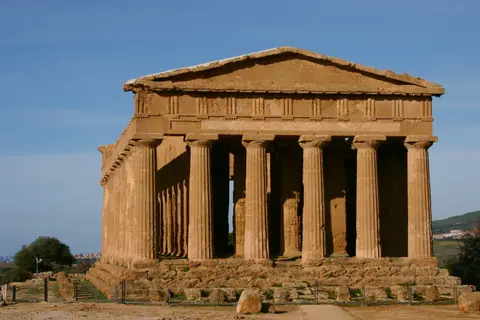
Corridors and Ticket Sectors Across the Valle dei Templi
Extending several kilometres from eastern hill terraces to western sanctuary fields, the archaeological park divides into walkable sectors linked by internal electric park shuttles and shaded olive paths.
| Complex Zone | Key Highlights | Access & Ticket Rule |
|---|---|---|
| Eastern Sacred Ridge (Hera to Heracles) | Temples of Hera, Concordia, Heracles, Byzantine arcosolia, and early medieval Christian burials | Included in main Valle dei Templi park ticket; entry barriers prevent touching original stuccoed limestone masonry |
| Olympeion Field & Chthonic Sanctuary | Ruined Temple of Olympian Zeus, Temple of Castor and Pollux columns, Gate V portico, and Archaic altars | Accessible along the paved ridge footpath west of the Golden Gate under the same park admission pass |
| Western Spur, Gate IV & Necropolis | Temple of Hephaestus, Grotte Fragapane catacombs, Tomb of Theron, and Temple of Asclepius outside walls | Longer walking route over uneven rocky terrain; verify seasonal shuttle paths and off-ridge monument access online |
| Kolymbethra & Regional Park Orchards | Ancient fifth-century BC reservoir depression cultivated with traditional Mediterranean citrus and olive groves | Managed in partnership with conservation trusts; separate supplementary admission often applies for garden terraces |
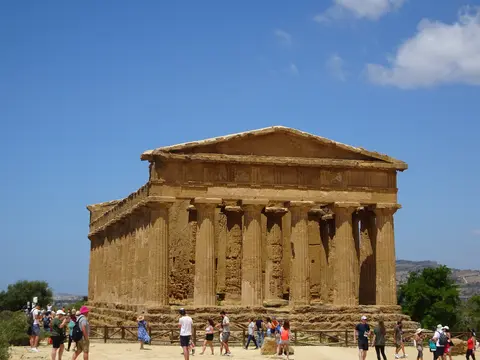
Concordia's Christian Arches, Heracles Pylons, and Entasis Profiles
Walking west along the limestone promenade from the Temple of Hera toward the Olympeion lets observant visitors read three architectural transformations straight from the masonry.
- Concordia's Twelve Christian Nave Arches: Sight through the Temple of Concordia's outer Doric peristyle into the inner stone cella wall. Rather than dismantling the pagan building, sixth-century Christian converters punched twelve wide arched openings cleanly through the load-bearing cella masonry, turning a dark sacrificial chamber into bright side-aisled basilica bays that preserved the outer roof and pediments intact.
- Roof-Inspection Staircase Pylons at Heracles and Concordia: Inspect the doorway threshold between the pronaos porch and central cella in both temples. Agrigento architects pioneered inserting thick hollow masonry pylons flanking this threshold to conceal spiral inspection stairs rising directly toward the wooden ceiling beams and marble roof tiles.
- Calculated Doric Fluting and Subtle Column Entasis: Stand obliquely along Concordia's thirteen-column flank and sight upward along any shaft's twenty vertical flutes. Each column swells imperceptibly in the lower third before tapering toward its wide capital, countering optical sag along the 39.44-metre ridge silhouette.
Begin at the eastern Gate of Hera early in the morning so downhill ridge slopes stay shaded before noon sun hits the unshaded limestone plateau. From Agrigento, link southern Sicily by road or rail northward to our Palermo travel guide or explore further classical ruins inside the UNESCO World Heritage Atlas.