Quick Field Data
- UNESCO Inscription: 2002 (Ref. 1024), serial urban ensemble spanning eight towns across southeastern Sicily, Italy; Criteria (i), (ii), (iv) and (v).
- Scale & Footprint: 112.79 hectares enclosing Caltagirone, Militello Val di Catania, Catania, Modica, Noto, Palazzolo Acreide, Ragusa and Scicli across the limestone Hyblaean plateau.
- Access & Ticketing: Historic urban squares and streets remain openly accessible under Legislative Decree 42/2004 and regional heritage acts; verify church hours, dome climbs and museum tickets locally.
- Arrival Logistics: Primary commercial flights arrive at Catania-Fontanarossa Airport (CTA), 49 kilometres north, with Palermo 173 kilometres northwest across Sicily. Closer Comiso Airport (CIY) lies 20 kilometres away with limited seasonal schedules, while Malta International Airport (MLA) sits 139 kilometres south across the sea.
Rebuilding Eight Sicilian Towns After the 1693 Val di Noto Earthquake
Spanning the southeastern third of Sicily across the pale limestone Hyblaean plateau, the historic Val di Noto preserves one of Europe's earliest settlement landscapes. Its oldest documented town, Akrai near Palazzolo Acreide, arose in 664 BC as the first inland colony founded from Greek Syracuse. Centuries of Sicel, Greek, Roman, Arab, Norman and Spanish rule layered castles, narrow alleys and stone churches across steep gorges and ridge spurs. Everything changed abruptly in 1693 when a catastrophic earthquake levelled communities across the region and claimed thousands of lives.
Spanish royal authorities granted Sicilian nobleman Giuseppe Lanza special powers to oversee regional rebuilding with local bishops and civic planners. Rather than patching fractured medieval alleys haphazardly, architects reshaped towns into wide processional squares framed by radiating streets and grid axes. Churches, convents and aristocratic palazzi stood deliberately as visual focal points closing street vistas along sloping hills. From that collective burst of post-seismic engineering emerged the sunlit style known as Sicilian Baroque, linking all eight World Heritage towns under close chronological unity.
Crucially, each municipality answered the crisis differently according to local terrain, surviving foundations and civic politics. Catania rebuilt directly on its ruined Roman and medieval footprint, whereas Noto and neighbouring Grammichele shifted completely to fresh ground, Grammichele famously adopting a hexagonal centre. Ragusa and Palazzolo Acreide built new upper quarters right beside ancient districts, while Scicli and Modica moved into partly urbanised neighbouring slopes. Meanwhile Caltagirone repaired damaged landmarks in place, so today the World Heritage inscription covers entire old towns in Caltagirone, Noto and Ragusa, distinct urban zones in Catania and Scicli, and selected monuments in Modica, Palazzolo Acreide and Militello Val di Catania.
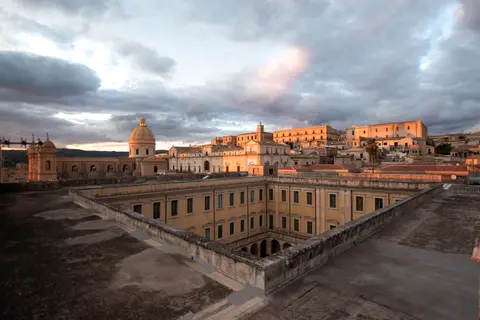
Noto's Honey-Tinted Grid and the Twin Quarters of Ragusa Ibla
Rising 32 kilometres southwest of Syracuse beneath Hyblaean slopes, Noto gave the wider Val di Noto Sicily region both its name and its purest planned urban ensemble. Medieval Noto Antica perched eight kilometres north on Mount Alveria, tracing Sicel Netum back to early Bronze Age tombs around 3000 BC and classical legends of Daedalus and Hercules. Granted to Hiero II by Rome in 263 BCE, the hill town later resisted Verres before falling to Muslim forces in 866 and surrendering in 1091 as Sicily's last Arab stronghold under Norman Count Roger and his son Jordan of Hauteville. Flourishing under Frederick II and producing Renaissance scholars such as Giovanni Aurispa and Matteo Carnelivari, Noto earned King Ferdinand III's title civitas ingeniosa in 1503 before the 1693 tremor killed over half its residents.
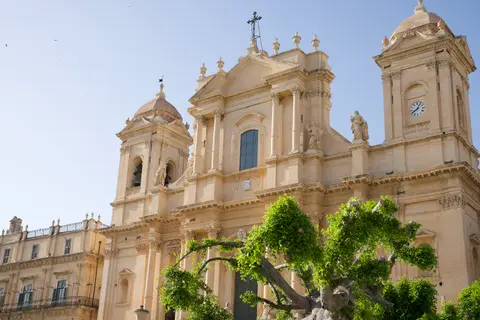
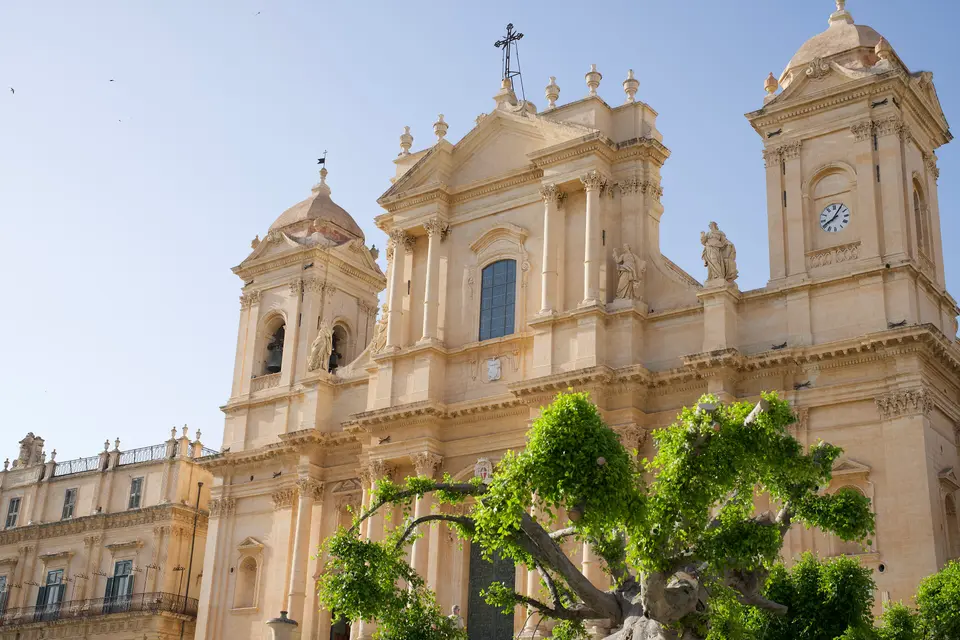
Rather than rebuild on shattered Mount Alveria, planner Giovanni Battista Landolina laid out a terraced grid on the left bank of the Asinaro River closer to the Ionian shore. Master architects Rosario Gagliardi, Vincenzo Sinatra, Paolo Labisi and Francesco Sortino sculpted soft local tufa limestone that turns warm honey gold in sunlight, inspiring critic Cesare Brandi to dub Noto the Stone Garden. Walking Corso Vittorio Emanuele reveals the Cathedral of San Nicolò di Mira finished in 1776 above wide stone stairs and repaired after parts collapsed in 1996, facing Sinatra's Palazzo Ducezio town hall with Antonio Mazza neoclassical frescoes. Nearby Via Corrado Nicolaci preserves Palazzo di Villadorata (1733), Palazzo Astuto and Palazzo di Lorenzo del Castelluccio, while Gagliardi shaped San Domenico, San Carlo al Corso, Santa Maria dell'Arco (successor to a 1212 Cistercian abbey) and 12-column oval Santissimo Salvatore (1735). Further churches including Santa Chiara, housing a 16th-century Madonna attributed to Antonello Gagini, San Francesco d'Assisi, San Corrado and San Girolamo complete this dense urban choir.
Historic events and quiet rural surroundings enrich Noto well beyond its 18th-century church facades. After losing provincial capital rank in 1817 and seeing religious guilds abolished in 1866, townspeople backed Garibaldi in May 1860 and later welcomed British Eighth Army troops under General Montgomery during Operation Husky in July 1943. Every May since the 1980s, Noto's Infiorata covers Via Corrado Nicolaci in floral mosaics, while nearby wine estates, Cavagrande del Cassibile gorge, coastal Vendicari wildlife reserve and Tellaro's Roman villa plus Nicias column lie only a short drive away. Early excavations around old Noto also uncovered Sicel cemeteries, Greek burials, Christian catacombs, Byzantine tombs and three rock-cut chambers, while Noto's stone squares appeared in Michelangelo Antonioni's 1960 film L'Avventura and Bologna astronomers operate a 32-metre radio telescope in the surrounding valley.
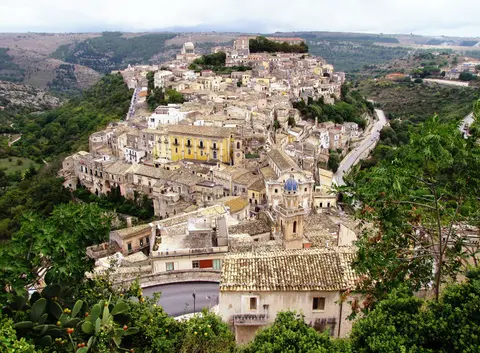
Across steep inland limestone canyons lies Ragusa, provincial capital with a 2025 population of 73,778 (including 11.5 percent foreign-born residents recorded in 2024), perched atop a 300-metre ridge between Cava San Leonardo and Cava Santa Domenica. Ancient Sicel settlements around Hybla Heraea weathered Carthaginian, Roman, Byzantine, Arab and Norman eras, rising under Norman Count Geoffrey and the Chiaramonte family before the 1693 earthquake killed roughly 5,000 inhabitants. Survivors split between Ragusa Superiore on the high Patro plateau and lower Ragusa Ibla down the eastern spur, remaining separate municipalities from 1866 until merging again in 1926 as provincial capital ahead of Modica. During the Second World War, widespread resentment of Mussolini's fascist administration led Ragusa's small garrison to withdraw without fighting before Allied troops arrived in Operation Husky, while asphalt mining from 1838 and modern export industry sustain civic life beyond historic quarters.
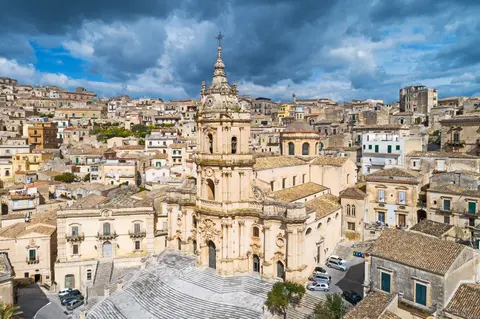
Both Ragusa districts pair late Baroque grandeur with medieval stone portals spared in 1693. Upper Town gathers around the Cathedral of Saint John the Baptist (1718 to 1778), sporting twin clocks showing Italian and French hours, a 1783 copper-covered dome, polychrome marble side chapels and nearby Hyblean Archaeological Museum exhibits. Down winding lanes past half-Gothic, half-Baroque Santa Maria delle Scale, Ragusa Ibla centres on Rosario Gagliardi's Collegiate Church and Duomo of San Giorgio begun in 1738 behind 250 steps, three Catalan-Gothic portal fragments and an 1820 Neoclassical dome. Nearby stand San Giuseppe, Knights of Malta shrine Santa Maria dell'Itria with Caltagirone ceramics and Mattia Preti art, Norman-founded Sant'Antonino, Chiesa dell'Immacolata and San Giorgio Vecchio, while Modica's towering San Giorgio Cathedral carries the stone spectacle southwest.
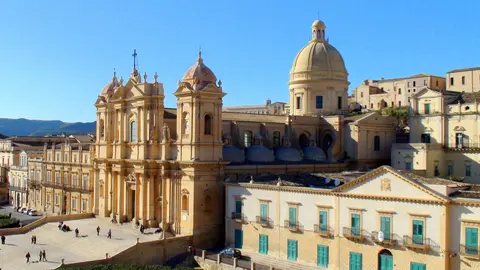
Seismic Exposure, Heritage Zoning, and Restoration Since 1996
Keeping all eight Baroque Sicily Val di Noto centres lived-in and structurally sound demands careful coordination across 112.79 hectares of mostly privately owned buildings, church holdings and municipal properties. National laws 1089/39, 1497/39, 64/74 and 431/85 with Legislative Decree 42/2004 bind 109 core monuments under strict Superintendency approval before any repair work proceeds. Municipal plans designate historic centres as Zone A conservation districts limiting interventions to faithful stone rehabilitation and maintenance. Ragusa Ibla additionally benefits from Regional Act 61/81, funding structural consolidation on both public churches and private homes so residents stay in historic neighbourhoods.
Environmental hazards continuously test soft carved tufa stone across southeastern Sicily. Permanent earthquake risks and volcanic tremors or ash linked with Mount Etna keep masonry bracing high on conservation agendas since Noto Cathedral's partial 1996 collapse. Weathering damp, traffic vibration and uneven maintenance across older palazzi require sustained restoration coordinated by Catania, Ragusa and Syracuse provincial authorities under a unified Management Plan. Because local town plans preserve historic residential layouts almost unchanged since the 18th century, everyday life continues inside lively family shops, municipal offices and parish churches rather than empty heritage zones. Supporting traditional stonework, local ceramic workshops and pedestrian calm ensures these historic towns stay genuine Sicilian homes rather than hollow tourist stages.
Access Zones Across Noto, Ragusa, Modica, and Catania
Planning a Val di Noto Sicily map circuit works best by pairing coastal lowland Noto and Syracuse valleys with highland Ragusa, Modica and Scicli, plus northern gateway Catania. Confirm cathedral visiting hours and seasonal museum passes locally before climbing steep staircases.
| Complex Zone | Key Highlights | Access & Ticket Rule |
|---|---|---|
| Noto Historic Centre | Cathedral of San Nicolò, Palazzo Ducezio, Via Nicolaci balconies, San Domenico and May Infiorata flower mosaics. | Pedestrian core along Corso Vittorio Emanuele; verify church dress rules and Palazzo Ducezio hall tickets at entrances. |
| Ragusa Superiore & Ragusa Ibla | San Giovanni Battista Cathedral, Hyblean Museum, Ponte dei Cappuccini, Santa Maria delle Scale and Duomo of San Giorgio. | Two hilltop districts linked by winding steps and local buses; park outside narrow Ibla lanes to explore on foot. |
| Modica & Scicli Canyon Towns | Stepped San Giorgio Cathedral in Modica, gorge-side stone palazzi and baroque church facades in Scicli. | Rail and highway links connect both gorge centres south of Ragusa; steep stairways require sturdy walking shoes. |
| Catania, Caltagirone, Palazzolo & Militello | Rebuilt lava-stone blocks of Catania, ceramic steps of Caltagirone, Akrai hilltop ruins and Militello churches. | Catania anchors eastern transport hubs while highland towns sit on bus and road spurs; check regional monument hours. |
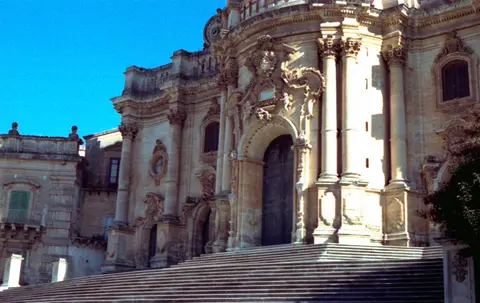
Three Sicilian Baroque Architectural Details Across the Valley
- Scenographic Staircases Framing Sloping Church Facades: Climb the 250 steps below Ragusa Ibla's San Giorgio or Modica's towering stone flights, engineered to amplify modest building footprints upward against steep valley hills.
- Sculpted Stone Brackets on Palazzo di Villadorata: Look up along Noto's Via Corrado Nicolaci to inspect grotesque stone corbels supporting wrought-iron balconies along honey-tinted tufa facades.
- Salvaged Catalan-Gothic Portals Embedded in Baroque Walls: Examine Santa Maria delle Scale and San Giorgio Vecchio in Ragusa Ibla, where pre-1693 stone doorways survived beside 18th-century reconstructions.
Planning a Val di Noto Sicily Route Near Beaches and Catania Airport
Visitors asking is Noto Sicily worth visiting discover how easily high Baroque architecture combines with rural olive groves, vineyards and clean Mediterranean coastline. Beyond central stone churches, Noto sits close to Ionian coves inside Vendicari wildlife reserve and Roman ruins near Tellaro, while Ragusa extends down to coastal Marina di Ragusa by the sea. May brings Noto's colourful Infiorata festival lining Via Nicolaci with floral carpets, whereas cooler spring and autumn weeks avoid intense midsummer glare off pale limestone squares. Rural farmsteads across the surrounding Hyblaean countryside also give road-tripping visitors quiet bases close to wine estates, coastal reserves and stone hill towns.
Giving the valley three to four days allows unhurried morning walks through Ragusa Ibla and Modica before golden afternoon light illuminates Noto's tufa steps. Most international visitors fly into Catania-Fontanarossa Airport (CTA), 49 kilometres north of the valley cluster, connecting south by regional train or rental car through Syracuse and the Hyblaean hills. Comiso Airport (CIY) lies closer at 20 kilometres with limited regional routes, while wider Sicilian journeys often pair eastern Baroque valleys with Palermo (173 kilometres northwest) or cross-strait ferries toward Malta International Airport (MLA, 139 kilometres south). Allowing evening strolls across lit church steps rounds out any cultural circuit through southeastern Sicily. Browse further European Baroque ensembles in our UNESCO World Heritage Atlas.