Quick Field Data
- UNESCO Inscription: 2013 (Ref. 1413), cultural landscape park in Kassel, Hesse, Germany; Criteria (iii) and (iv).
- Scale & Footprint: 558.7 hectares (cited up to 560 hectares) rising up to 526.2 metres on Karlsberg mountain at the foot of the Habichtswald range.
- Access & Ticketing: Administered by the State of Hesse via Museumslandschaft Hessen Kassel; park trails remain open, while museum interiors and seasonal water-display viewing follow official local schedules.
- Arrival Logistics: Major flights use Hannover Airport (HAJ), 129 kilometres north, though regional Kassel Airport (KSF) sits 11 kilometres away with limited scheduled flights. High-speed trains stop nearby at Kassel-Wilhelmshöhe, 135 kilometres east of Dortmund.
Baroque Water Engineering From the Hercules Octagon to Kassel
Climbing westward from Kassel up the Habichtswald hills, Bergpark Wilhelmshöhe spans 558.7 hectares of engineered slope. Ranked as the largest hillside park in Europe and the second largest of its kind worldwide, its creation unfolded across roughly 150 years from 1689 onward. Today it draws visitors researching Bergpark Wilhelmshöhe in Kassel for its monumental axis, royal museums and seasonal gravity-powered water displays, known locally as the Wasserspiele.
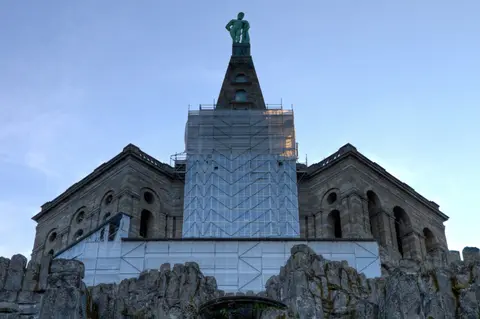
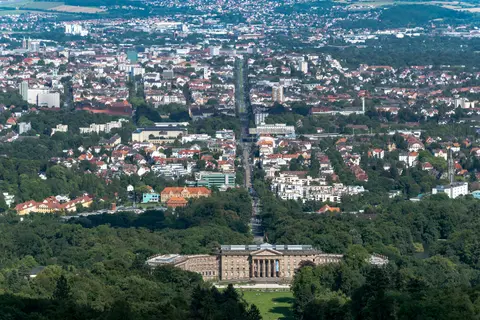
Landgrave Carl of Hesse-Kassel initiated the Baroque mountain garden in 1689 along an east-west axis extending down Wilhelmshöher Allee straight into central Kassel. In 1701, Italian architect Giovanni Francesco Guerniero began erecting the colossal Hercules Monument atop the Karlsberg summit at 526.2 metres above sea level, later publishing his hillside design in Delineatio Montis in 1706. Crowning a 40-metre stone Octagon pyramid stands an 8.5-to-11.5-metre hammered copper statue copied from the third-century Farnese Hercules by Augsburg goldsmith Johann Jacob Anthoni. Standing visible for many kilometres across northern Hesse, the colossal figure anchors the western horizon above Kassel.
Hidden reservoirs, sluices, aqueducts and waterwheels gather hill runoff behind the summit to feed an entire hillside water theatre without electric pumps. During scheduled Wasserspiele runs, released water surges beneath the Octagon into grotto basins adorned with figures of centaurs and fauns holding horns. Shifting water pressure compresses air inside sealed chambers to sound the horns acoustically. Flowing from the Vexing Grotto and Artichoke Basin down through Felsensturz Waterfall and the Giant's Head Basin, the torrent drops down the 350-metre Grand Cascade into Neptune's Basin. Originally designed in the Italian garden tradition and French formal Baroque style, these terraced basins channel water eastward down a sightline anchored in central Kassel.
Below Neptune's Basin, water leaves formal Baroque stone terraces to wind across wild Romantic ravines, bridges and artificial ruins installed later in the eighteenth and nineteenth centuries. Channels drive two hydraulic organs, tumble down the Steinhöfer Waterfall added by Karl Steinhöfer in 1793, cross beneath the Teufelsbrücke above Höllenteich pond and rush across the Roman Aqueduct ruin. At the conclusion of the display near Schloss Wilhelmshöhe, natural pressure shoots the Grand Fountain geyser 50 metres above the castle lake, ranking as the tallest fountain in the world when built in 1767. Nearly sixty years later, in 1826, Elector William II commissioned the park's last major waterworks monument, the Grosser Wasserfall, completing this tiered downhill spectacle. Visitors walking the lower slopes today trace how eighteenth-century taste gradually softened formal symmetrical canals into winding woodland streams, reflective ponds and naturalistic rocky cascades.
English Romantic Ruins, Imperial Politics, and Schloss Wilhelmshöhe
Lower sections of Bergpark Wilhelmshöhe document an artistic shift from formal Italian and French Baroque symmetry toward naturalistic English landscape design. Long before Baroque terraces, Canons Regular from Mainz established Weißenstein monastery here in 1143, which Landgrave Philip I secularised during the Protestant Reformation and Landgrave Maurice rebuilt as a hunting lodge between 1606 and 1610. In 1785, Landgrave Wilhelm IX, later Elector Wilhelm I, launched a broad expansion replacing rigid parterres with winding woodland vistas and artificial ruins.
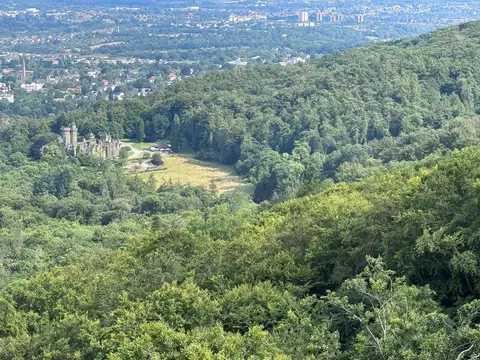
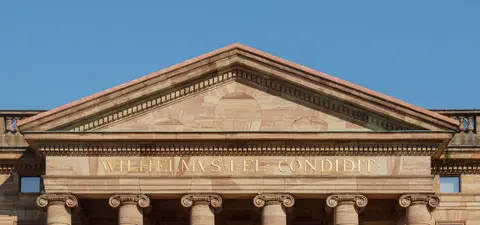
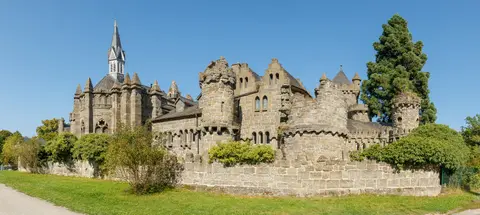
Between 1786 and 1798, architects Simon Louis du Ry and Heinrich Christoph Jussow designed the Neoclassical palace Schloss Wilhelmshöhe at the eastern foot of the water axis. During this expansion, Jussow also constructed the multi-arched Roman Aqueduct and the Löwenburg, a romantic artificial medieval castle complete with towers and courtyard walls, while developing the lower lake known as the Lac and adjacent fountain pond. Art historian Georg Dehio later praised the integrated hillside composition as perhaps the grandest synthesis of landscape and architecture attempted during the Baroque era.
Nineteenth- and twentieth-century European statecraft repeatedly brought emperors and commanders to these palace wings. When Napoleon formed the Kingdom of Westphalia, his brother Jérôme Bonaparte governed from the palace under the name Napoleonshöhe, ordering side wings connecting its three pavilions under governor Heinrich von Blumenthal until the Battle of the Nations on 19 October 1813 ended French rule. Following Prussia's annexation of Hesse-Kassel in 1866 after the Austro-Prussian War, the estate passed from the House of Hesse to the House of Hohenzollern. After the Battle of Sedan in 1870, defeated French Emperor Napoleon III resided at Schloss Wilhelmshöhe for six months as a prisoner before entering exile in Britain.
From 1899 to 1918, German Emperor Wilhelm II chose Wilhelmshöhe as his personal summer retreat after attending school in Kassel, turning the park into a centre of European politics. Immediately following the November 1918 armistice, Paul von Hindenburg transferred German Army High Command from Spa to Schloss Wilhelmshöhe to organise troop withdrawal until moving to Kolberg in February 1919. Allied bombing heavily damaged the middle wing during the Second World War, prompting functionalist architect Paul Friedrich Posenenske to reconstruct the exterior and build modern gallery spaces inside between 1968 and 1974. Later renovations from 1994 to 2000 restored historic proportions without rebuilding the central dome, decades after West German Chancellor Willy Brandt and East German Prime Minister Willi Stoph met here in 1972.
Today, Schloss Wilhelmshöhe operates as a museum housing classical Graeco-Roman antiquities, graphic arts, historic wallpapers and Empire furniture collected by William I and Jérôme Bonaparte, with select furnishings loaned to Bellevue Palace in Berlin. Its Old Masters picture gallery focuses on sixteenth- and seventeenth-century German, Italian, French and Spanish painters, complemented by Germany's second-largest Rembrandt collection including Saskia and Frans Hals's The Man with the Slouch Hat. Visitors pacing both the hillside gardens and palace halls find architectural heritage spanning twelfth-century monastic roots, Baroque waterworks and twentieth-century museum reconstruction.
Water Catchment Protection and Cascade Masonry Conservation
Keeping a steep hillside waterworks functioning three centuries after Guerniero's first plans demands coordinated engineering and forest management. Protected under federal German laws including the Regional Planning Act, Town and Country Planning Code, Federal Nature Conservation Act, Environmental Impact Assessment Act and Federal Forest Act, the park also falls completely under Hesse's Act on the Protection of Cultural Monuments. Woodlands feeding the upper water catchment across the Habichtswald range are managed sustainably by Hessen-Forst's Wolfhagen forestry office. Only the New Waterfall no longer operates today; every other cascade, grotto, conduit and fountain relies on its historic gravity-fed infrastructure.
Prolonged twenty-first-century stone and copper conservation projects have steadily repaired frost weathering and mortar erosion across the Octagon, Hercules statue and 350-metre Grand Cascade. As a result, sections of the monument remain periodically framed in scaffolding during phased repairs. The park joined the European Garden Heritage Network in 2009 and earned UNESCO inscription at Phnom Penh on 23 June 2013. Today it operates under a Steering Committee and expert Steering Board linking the Hessian Ministry of Higher Education, Research and Arts, City of Kassel, Kassel County and Museumslandschaft Hessen Kassel.
Implementing the 2008 to 2010 Management Plan with local citizen working groups and North Hesse regional planning rules keeps development well controlled around park edges. Under Kassel's Urban Development Concept, planners work to close remaining through-roads, finalise Wilhelmshöher Allee as a formal boulevard, protect long-distance mountain views and update storm risk preparedness across the wooded catchment. Local residents in surrounding buffer neighbourhoods are consulted on urban planning changes so modern traffic never erodes quiet garden paths.
Access Zones Across Bergpark Wilhelmshöhe in Kassel
Exploring Bergpark Wilhelmshöhe in Kassel involves steep elevation gains between the lower palace lawns and the 526.2-metre Hercules plateau. Check official Museumslandschaft Hessen Kassel notices before arrival for current admission charges, Wasserspiele days and designated hillside car parks.
| Complex Zone | Key Highlights | Access & Ticket Rule |
|---|---|---|
| Hercules Monument & Octagon | Forty-metre stone pyramid, copper Farnese Hercules statue, summit views across Hesse and upper cascade reservoirs. | Park terraces around the summit are open on foot; check official site rules for Octagon platform entry and upper car park fees. |
| Baroque Cascades & Waterfalls | 350-metre Grand Cascade, Neptune Basin, Teufelsbrücke, Steinhöfer Waterfall, Roman Aqueduct and 50-metre Grand Fountain. | Open park paths follow the water route downhill; seasonal Wasserspiele demonstrations operate on posted afternoon schedules. |
| Löwenburg & Upper Woodlands | Eighteenth-century artificial medieval castle designed by Heinrich Christoph Jussow amid shaded Habichtswald trails. | Woodland paths surround the ruin freely; confirm interior courtyard or tower access via Museumslandschaft notices. |
| Schloss Wilhelmshöhe & Ponds | Neoclassical palace wings, Old Masters picture gallery, classical antiquities, Lac basin and fountain pond. | Lower parkland opens freely to pedestrians; check official museum ticketing and seasonal hours for gallery entry. |
Three Hydraulic and Architectural Details at Bergpark Wilhelmshöhe
- Gravity-Fed Hydro-Pneumatic Water Organs: Stand near the upper grottoes below the Octagon during water displays to listen for air compressed inside underground chambers sounding bronze horns without electrical machinery.
- Hammered Copper Sheets of the Hercules Statue: Look upward at the monumental Farnese Hercules copy from the viewing parapet to see how Johann Jacob Anthoni joined thin copper plates over an internal structural armature.
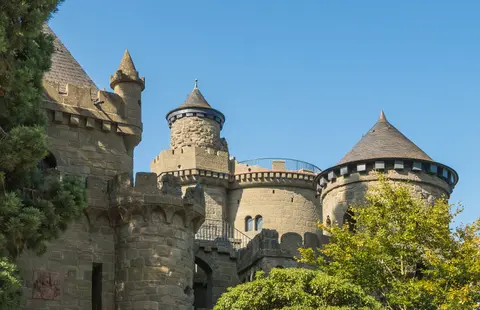
- Staged Artificial Ruin Masonry at Löwenburg: Walk around the exterior walls of Jussow's Löwenburg to spot deliberately weathered stone blocks and broken crenellations crafted to evoke romantic medieval age.
Seasonal Water Displays, Parking, and Routes From Dortmund
Timing a visit around the seasonal Wasserspiele turns a park stroll into a lively walk following rushing water downhill from the Hercules reservoir to the castle pond. Visitors arriving by car check official Kassel signage for designated Bergpark Wilhelmshöhe parking near both the lower palace lawns and the upper Hercules plateau visitor centre. Because forest trails climb more than 200 vertical metres up toward the Karlsberg summit, many walkers ride local Kassel public transit uphill and descend steadily past the cascades, waterfalls and Löwenburg toward Schloss Wilhelmshöhe.
Structuring a full-day visit lets travellers connect open woodland walks with indoor museum collections inside Schloss Wilhelmshöhe and Löwenburg. Setting aside morning hours for quiet Habichtswald forest paths and the Hercules viewing terrace before afternoon water displays keeps foot traffic comfortable along steep cascade stairways. Visitors planning indoor stops should check current Museumslandschaft notices for museum ticketing, seasonal Wasserspiele operating days, local parking fees and active conservation scaffolding. Outside display days, visitors still explore the dry cascade steps, Romantic bridges and calm lower castle lakes at their own pace across the open 558.7-hectare reserve.
High-speed German rail services stop directly at Kassel-Wilhelmshöhe station on the Hanover to Würzburg line, connecting Bad Wilhelmshöhe quickly with central and western cities including Dortmund (135 kilometres west). Long-haul air travellers generally fly into Hannover Airport (HAJ), 129 kilometres north, and transfer south by rail, whereas nearby Kassel Airport (KSF) lies 11 kilometres northwest with far fewer scheduled commercial flights. Browse more historic palace landscapes across Europe inside our UNESCO World Heritage Atlas.