Quick Field Data
- UNESCO Inscription: 1999 (Ref. 897), cultural fortress complex south of Eisenach in Thuringia, Germany; Criterion (iii).
- Scale & Footprint: 27.3 hectares enclosing the fortified hilltop precinct and adjacent wooded slope protections.
- Access & Ticketing: Owned and administered by the Wartburg Foundation of Eisenach; check official site notices for current Wartburg Castle tickets, guided palace entries and seasonal opening hours.
- Arrival Logistics: Regional flights arrive at Erfurt-Weimar Airport (ERF), 46 kilometres east, while Frankfurt sits 149 kilometres southwest.
Medieval Origins, Saint Elisabeth, and the Sängerkrieg
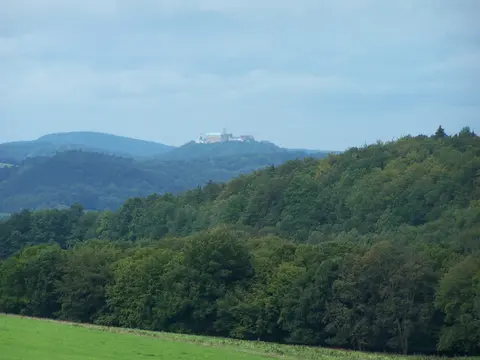
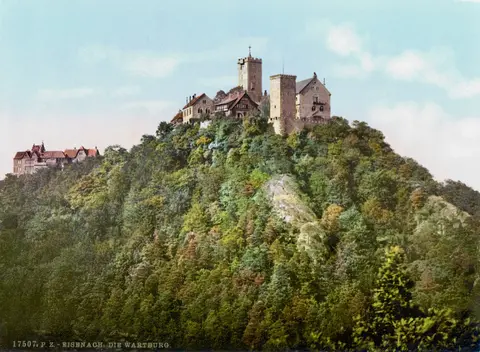
Resting on a steep southwest-facing precipice at 410 metres above sea level, Wartburg Castle commands the northern edge of the Thuringian Forest above Eisenach. Below its ramparts lie the Mariental valley to the southeast and the Hörsel valley to the north, which carried the medieval Via Regia trade road. Just south of the ridge runs the historic Rennsteig trail. Both its hilltop defensive setting and its dense archival record anchor nearly a millennium of Thuringian and European history.
Count Louis the Springer, known in German as Ludwig der Springer, laid the fortress foundations around 1067 to guard the borders of his lands. Together with its larger sister stronghold Neuenburg in present-day Freyburg, Wartburg secured the extreme frontiers of his territory. Tradition holds that he transported clay from his own estates onto the hilltop so he could swear the fortress stood upon his soil. Etymologists usually derive the name from the German word Warte, meaning watchtower, while folklore cites a play on words linking mountain (Berg), castle (Burg) and wait (warte). Bruno, Bishop of Merseburg, first mentioned the site in writing as Wartberg in 1080 during his chronicle of the Saxon wars.
During the Investiture Controversy, Louis opposed Salian King Henry IV, and in 1131 King Lothair of Supplinburg elevated his son Louis I to Landgrave in Thuringia. Between 1172 and 1211, Landgrave Hermann I made Wartburg one of the foremost princely courts in the German Reich. Poets including Walther von der Vogelweide, Wolfram von Eschenbach and Ovid translator Albrecht von Halberstadt enjoyed his patronage, with Wolfram writing part of Parzival at Wartburg in 1203. Courtly fame inspired legend around the 1206 or 1207 Sängerkrieg minstrels' contest, which composer Richard Wagner later immortalised in his opera Tannhäuser.
Spiritual devotion soon joined courtly literature on the ridge. Sent to Eisenach at age four in 1211, Saint Elisabeth of Hungary lived at Wartburg Castle until 1228 as betrothed consort and later wife of Landgrave Ludwig IV. Celebrated for charitable outreach to the poor, she married Ludwig in 1221 before he died on Crusade in 1227. Leaving Wartburg with her confessor Father Konrad for Marburg, Elisabeth died there in 1231 aged 24 and was canonised just five years later. After Heinrich Raspe died at the fortress in 1247, Henry III of Meissen succeeded him; following lightning fire damage in 1317 or 1318, builders reconstructed the Palas chapel in 1320, keeping the castle as the seat of Thuringian landgraves until 1440.
Martin Luther's Exile, the 1817 Festival, and Neo-Romanesque Revival
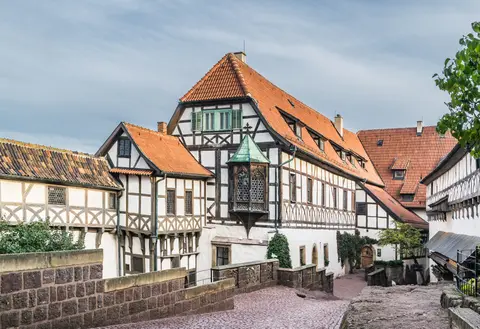
A turning point in European religious and linguistic history unfolded inside the timber-framed Vogtei quarters between May 1521 and March 1522. Excommunicated by Pope Leo X and outlawed after refusing to recant at the Diet of Worms, Martin Luther required urgent shelter. Elector Frederick the Wise arranged for him to live hidden at Wartburg Castle under the alias Junker Jörg, or Knight George. Wearing knightly attire during ten secluded weeks, Luther translated the Christian Greek scriptures from ancient Greek into vernacular German.
Although earlier German translations existed, Luther's Wartburg work quickly became the widest-circulated version across German-speaking regions. Its vivid phrasing helped forge a unified, accessible written German language out of scattered dialects. Castle tradition still recalls the small room where Luther supposedly hurled an inkwell at the Devil during long winter nights of translation. Two decades later, religious conflict took a harsher turn when Anabaptist farmer Fritz Erbe from Herda refused to renounce his faith and spent eight years imprisoned in the South Tower dungeon from 1540 until his death in 1548. Buried near Saint Elisabeth's chapel, Erbe left behind a handwritten wall signature rediscovered by researchers in 1925.
Over the following centuries, the fortress slipped gradually into neglect, despite briefly sheltering the ruling Saxe-Weimar family after the Thirty Years' War. While outbuildings and the old keep decayed, the stone Palas and Vogtei kept intact roofs. In 1777, Johann Wolfgang von Goethe spent five weeks drawing the historic halls and suggested forming a museum. Acting on Goethe's proposal, Grand Duchess Maria Pavlovna and her son Grand Duke Karl Alexander established the Kunstkammer art collection that grew into today's museum.
Political idealism returned to the hill on 18 October 1817 during the first Wartburg Festival. Roughly 500 students belonging to new German Burschenschaften fraternities gathered to celebrate victory over Napoleon four years earlier and the 300th anniversary of the Reformation. Speakers including Heinrich Hermann Riemann, Ludwig Rödiger and Hans Ferdinand Massmann condemned conservatism and called for German unity under the motto Honour, Freedom, Fatherland. With absentee support from Friedrich Ludwig Jahn, students symbolically burned parchment slips naming conservative texts like August von Kotzebue's History of the German Empires and the Code Napoléon, with future assassin Karl Ludwig Sand among those present. Another gathering followed during the Revolutions of 1848. Meanwhile, from 1838 onward, Grand Duke Karl Alexander and Princess Sophie of the Netherlands commissioned architect Hugo von Ritgen to rebuild Wartburg as a Neo-Romanesque cultural monument finished in 1890, one year after Ritgen's death, directly inspiring King Ludwig II's plans for Neuschwanstein Castle.
Palas Romanesque Masonry, Armoury Losses, and Hillside Preservation
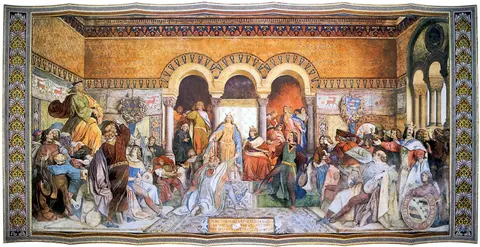
Built primarily between 1157 and 1170, the Palas remains the largest building at Wartburg and one of the finest preserved secular Romanesque structures north of the Alps. Ground-level chambers and principal upper halls such as the Rittersaal and Speisesaal retain original stone pillars, carved arches and twelfth-century wooden beam ceilings. Yet visitors stepping through upper rooms quickly observe how nineteenth- and early twentieth-century taste shaped interior imagery. Kaiser Wilhelm II commissioned mosaic panels depicting Saint Elisabeth's life inside the Elisabeth-Kemenate between 1902 and 1906, while Moritz von Schwind painted scenes of the Sängerkrieg in the Sängersaal and the triumph of Christianity across the top-floor Festsaal, which inspired Neuschwanstein's Sängerhalle. Even wallpaintings in the Landgrafenzimmer and Elisabethengalerie reflect nineteenth-century historicism rather than medieval murals.
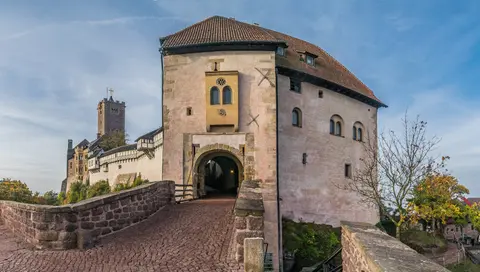
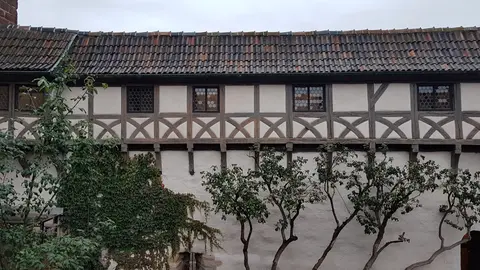
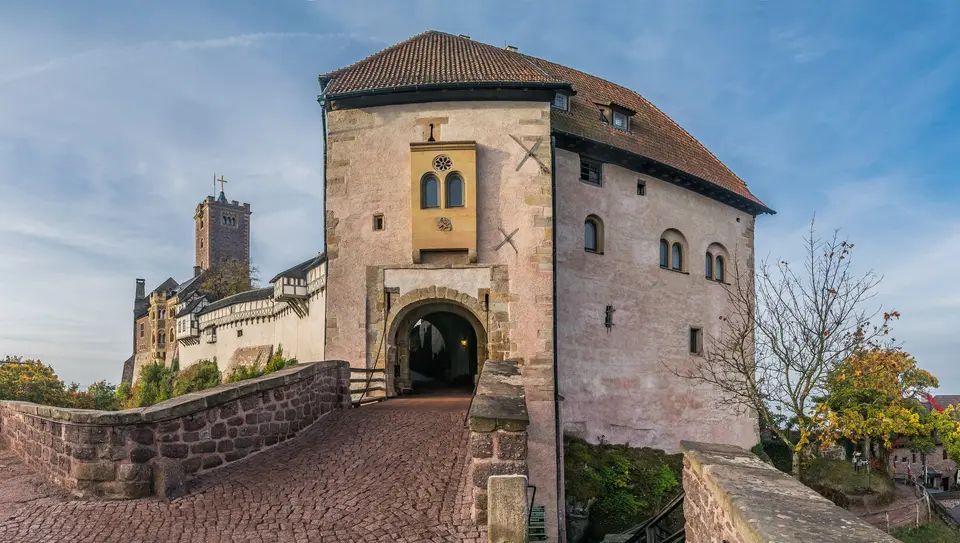
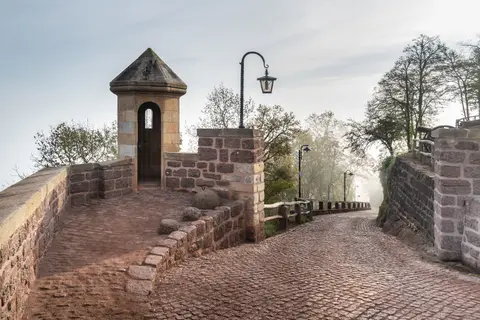
Approaching the monument still follows its largely unaltered medieval defensive geometry across a sole drawbridge and stone barbican. Immediately inside the first gate spreads the Vorburg, a fourteenth- and fifteenth-century courtyard framed by half-timbered structures including the Elisabethengang covered walkway, the Vogtei bailiff's lodge and the Margarethengang. Above the walls rises the Grand Duke's bedroom overlooking the forest, demonstrating how Karl Alexander wove royal apartments directly beside older defensive ramparts and the medieval South Tower.
Twentieth-century administration saw Wartburg transition from ducal control after the 1918 German Revolution into public guardianship under the Wartburg Foundation established in 1922 and legally reorganised in 1992. At the close of the Second World War in 1946, Soviet occupation forces confiscated the castle's prized Rüstkammer armoury of roughly 800 pieces, including historic arms linked to King Henry II of France, Frederick the Wise, Pope Julius II and Bernhard von Weimar. Apart from two helmets, two swords, a prince's armour and a boy's armour discovered in temporary storage, plus minor returns from the USSR in the 1960s, most of that armoury collection remains missing despite diplomatic petitions.
Under East German governance between 1952 and 1954, major restoration crews peeled back excessive nineteenth-century overlays across the Palas to restore cleaner Romanesque stonework and added a new external stairway. The state later staged national jubilees on the hill in 1967 for the 900th anniversary of foundation, 450th Reformation anniversary and 150th festival anniversary, followed by Martin Luther's 500th birthday commemorations in 1983. Drawing roughly 500,000 visitors every year, the castle and its entire hill receive layered statutory protection across Thuringia and Eisenach. Wooded slopes below the ramparts form a protected nature reserve acting as a green buffer. Today the Wartburg Foundation's Board of Directors coordinates restoration and visitor management with Thuringian monument authorities, federal ministries and the on-site Bauhütte der Wartburg craft team.
Access Zones Across Wartburg Castle, Eisenach
Entering Wartburg Castle takes visitors across the sole medieval bridge and barbican into sequential courtyards before interior guided routes begin. Check official foundation schedules ahead of arrival, as Wartburg Castle hours and Palas admission rules vary by season.
| Complex Zone | Key Highlights | Access & Ticket Rule |
|---|---|---|
| Drawbridge, Barbican & Vorburg | Unchanged medieval entrance gatehouse, Elisabethengang walkway, Margarethengang and half-timbered Vogtei housing the Luther Room. | Courtyard access requires checking current Wartburg Castle tickets at the gate; pedestrian paths climb from Eisenach. |
| Romanesque Palas | Twelfth-century Rittersaal, Speisesaal, Sängersaal frescoes, Festsaal banquet hall and mosaic-lined Elisabeth-Kemenate. | Interior state rooms typically operate via timed or guided tours managed by the Wartburg Foundation. |
| South Tower & Ramparts | Medieval fortification masonry, historic dungeon cell of Fritz Erbe and elevated lookout over the Thuringian Forest. | Rampart walks open seasonally within the castle precinct; verify tower stairway access at the ticket desk. |
| Kunstkammer Museum | Paintings, sculptures, historical furnishings and Reformation memorabilia descended from Goethe's 1777 museum proposal. | Integrated into ticketed museum circuits inside the upper complex; check official schedules for conservation closures. |
Three Architectural Details Inside Wartburg Castle
- Twelfth-Century Palas Arcades: Step inside the ground-floor stonework and upper arcaded loggias of the Palas to compare authentic 1157 to 1170 late-Romanesque limestone capitals with nineteenth-century Neo-Romanesque restorations above them.
- Half-Timbered Framing of the Vorburg: Walk along the narrow courtyard beside the Vogtei and Margarethengang to examine projecting fifteenth-century timber-framed upper galleries resting directly on medieval stone defensive walls.
- Stone Barbican and Drawbridge Approach: Pause at the outer bridge to inspect the sole historic entrance funnel designed to force approaching riders beneath steep defensive masonry and flanking sentry openings.
Planning Directions, Tickets, and Visits to Wartburg Castle
Learning how to get to Wartburg Castle starts at Eisenach in western Thuringia, directly below the northern castle precipice. Road directions to Wartburg follow signposted streets climbing south out of Eisenach toward hillside car parks and trailheads, while walkers ascend shaded forest paths from the town centre or the Mariental valley. Because hill gradients climb sharply up to 410 metres, sturdy footwear helps even when visitors combine hillside shuttles with the final cobbled walk across the drawbridge.
Checking official Wartburg Foundation updates before leaving town confirms current Wartburg Castle tickets, seasonal opening hours, guided Palas tour languages and temporary conservation notices. Early mornings and shoulder seasons bring quieter courtyard photography across the stone ramparts, wooden galleries and half-timbered facades while avoiding midday tour coach peaks. Many travellers review Wartburg Castle facts and floor plans beforehand so they can balance time inside Luther's quiet timber study in the Vogtei with the sweeping painted halls of the Romanesque Palas.
International visitors usually fly into Erfurt-Weimar Airport (ERF), 46 kilometres east, before continuing west by regional rail or highway to Eisenach. Long-distance German trains also link Eisenach smoothly with major hubs including Frankfurt (149 kilometres southwest), making the hilltop fortress straightforward to integrate into a wider central European itinerary. Continue exploring historic European castles and cultural monuments inside our UNESCO World Heritage Atlas.