


























Quick Field Data
- UNESCO Inscription: 1983 (Criteria i, vi; 12th-century Knights Templar stronghold and 15th- to 16th-century headquarters of the Order of Christ symbolizing both the Christian Reconquest and Portugal's opening to other civilisations during the Manueline Age of Discovery).
- Scale & Footprint: Hilltop medieval castle enclosure, 16-sided Romanesque Charola (rotunda), Manueline church nave, and eight historic cloisters overlooking the Nabão River in the city of Tomar, Centre of Portugal.
- Access & Ticketing: Administered by the Portuguese Republic as a National Monument; outer castle walls and gardens are accessible while tickets are required for the Charola alongside the church and eight-cloister circuit, so check the official site.
- Arrival Logistics: Situated atop the western hill above Tomar near the Nabão River in central Portugal, easily reached by regional train or road north from Lisbon.
From Gualdim Pais’s Templar Frontier Citadel to the Maritime Order of Christ
Dominating the western skyline of Tomar from the top of a hill above the Nabão River in the Centre of Portugal, the Castle and Convent of Christ originated as the frontier headquarters of the Knights Templar (formally the Poor Knights of the Temple). Following early Templar presence in 1118, Grand Master Dom Gualdim Pais founded the Castle of Tomar and its fortified Romanesque oratory around 1160 as the cornerstone of a defensive line securing the young Christian kingdom's border against the Moors north of the Tagus River. In 1190, Gualdim Pais and his knights successfully resisted a major six-day siege by the forces of Caliph Abu Yusuf al-Mansur, who had captured strongholds further south, a defence commemorated by a plaque near the castle entrance. The stone keep stood undefeated.
After the Templar Order was suppressed across most of Europe between 1312 and 1314, King Denis of Portugal petitioned Pope John XXII, who on 14 March 1319 instituted the Knights of the Order of Christ, transferring the former Templar knights and assets to the new order and converting the Tomar stronghold into its permanent seat in 1356 and 1357. During the leadership of Prince Henry the Navigator (Infante Dom Henrique) between 1417 and 1450, the Order of Christ financed and directed Portugal's 15th-century maritime discoveries while adding the Chapel of São Jorge in 1426, an open choir in the Templar rotunda, and two Gothic cloisters, namely the Cemetery Cloister (circa 1430) and the Washing Cloister, under master builder Fernão Gonçalves.
When King Dom Manuel (Manuel I, appointed governor of the Order in 1484 before ascending the Portuguese throne in 1495) convened the General Chapter around 1492 and reformed the order in 1503 (expropriating the old Vila de Dentro within the castle walls alongside closing the Sun Gate and Almedina Gate and appointing master builder Francisco Lopes on 11 October 1504), he transformed the monument into a celebration of Portugal's global maritime reach, ordering the construction of the Manueline church nave in 1506 and its rebuilding from 1510. His successor King John III demilitarised the knights into a cloistered religious community following the rule of Bernard of Clairvaux and commissioned a monumental Renaissance cloister in 1557. In 1581, after a royal succession crisis, the Portuguese nobility assembled at the Convent of Christ and officially recognised Philip II of Spain (crowned as Philip I, in Portugal) as monarch, beginning the Iberian Union (1581 to 1640) during which the convent's Pegões Aqueduct was completed in 1614.
The Sixteen-Sided Templar Charola, Eight Cloisters, and the Chapterhouse Window
Built across five centuries, the Convent of Christ combines Romanesque alongside Gothic, Manueline, Renaissance, and Mannerist and Baroque architectural elements inside the outer defensive walls of the 1160 Castle of Tomar. Within the castle citadel (alcáçova) rises the central Keep, one of the oldest residential and defensive keeps introduced to Portugal by the Templars, while the outer walls feature round towers, a military innovation learned by the Templars in Normandy and Brittany that proved far more resistant to siege attacks than square towers.
Within Portugal, the middle of complex stands the late 12th-century Romanesque round church (charola or rotunda), built by Gualdim Pais on the model of Jerusalem's Church of the Holy Sepulchre Rotunda and the Dome of the Rock (Mosque of Omar). Externally a 16-sided polygonal structure reinforced by strong buttresses alongside round windows and a belltower, the interior encloses a central octagonal choir and two-storey drum linked by arches to a surrounding ambulatory. Its late 12th-century Romanesque column capitals, carved with vegetal and animal motifs alongside a scene of Daniel in the Lions' Den, reflect the influence of sculptors working simultaneously on the Cathedral of Coimbra. During King Manuel's renovation beginning in 1499, the rotunda was sumptuously decorated beneath its Byzantine dome with polychrome statues of saints and angels under gilded Gothic canopies carved by Flemish sculptor Olivier de Gand and Spaniard Hernán Muñoz, alongside mural frescoes and painted biblical panels attributed to the workshop of court painter Jorge Afonso (while Gregório Lopes's Martyrdom of Saint Sebastian panel painted for the Round Church is now preserved in Lisbon at the National Museum of Ancient Art).
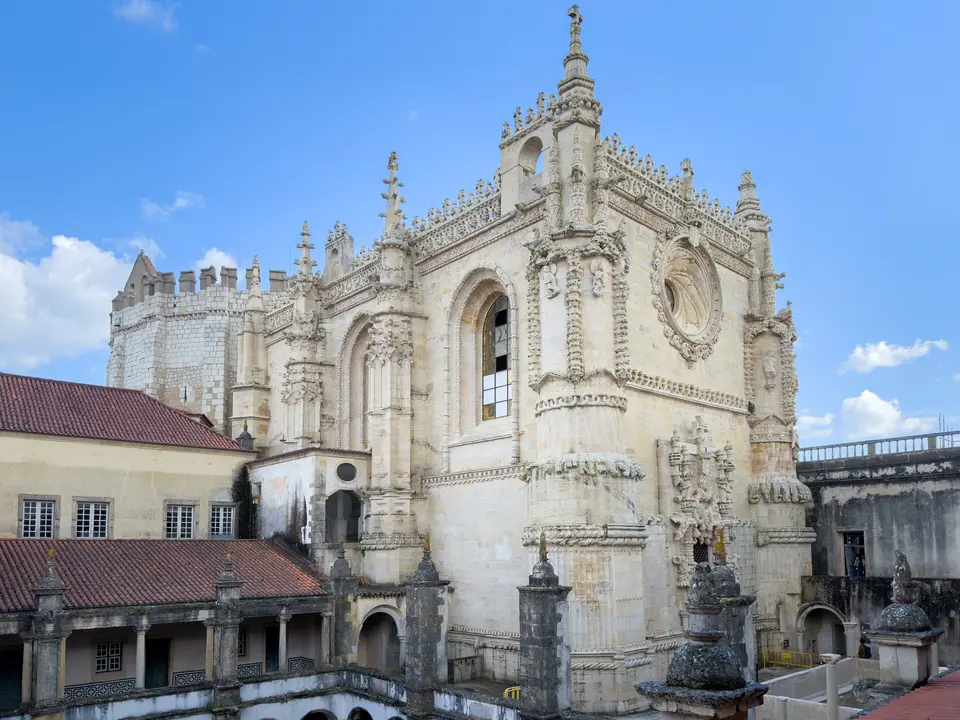
Connected to the Romanesque rotunda by a wide interior arch, the rectangular Manueline church nave (rebuilt from 1510 by Portuguese architect Diogo de Arruda and Spaniard João de Castilho, or Juan de Castillo, with ribbed vaulting over a former sacristy and high choir) is entered through Castilho's circa 1530 lateral portal carved with the Virgin and Child alongside biblical Prophets. On the exterior western facade of the nave, visible from the Saint Barbara Cloister, opens Diogo de Arruda's celebrated Janela do Capítulo (the Window of the Chapter House): a masterpiece of Manueline sculpture carved with ship ropes alongside corals, vegetal motifs, the Cross of the Order of Christ, King Manuel's armillary sphere, a human figure at the base representing the designer, a circular upper window and balustrade, two string courses of knotted ropes, and round angle buttresses encircled by giant garters alluding to King Manuel's investiture in the Order of the Garter by English King Henry VII. Surrounding the church spread eight cloisters constructed from the 15th to the 17th centuries, including the sober Gothic Cemetery and Laundry (Washing) Cloisters to the northeast alongside the Sacristy, Infirmary, and the Knights Hall and pharmacy, as well as King John III's 1557 Renaissance cloister.
Field Route from the Castle Keep through the Charola and Cloisters
Because the complex spans five centuries of additions across the hilltop, tracing the buildings chronologically from the 12th-century castle to the 16th-century cloisters clarifies the layout.
- Approaching via the Castle Citadel and Keep: Ascend from the town of Tomar through the outer walls of the 1160 Castle of Tomar (noting the round defensive towers, the 1190 siege plaque commemorating the defence against Abu Yusuf al-Mansur, and the former Vila de Dentro) to inspect the central Templar Keep in the alcáçova before walking across the terrace to João de Castilho's circa 1530 lateral church portal.
- Inspecting the Charola, Manueline Nave, and Chapterhouse Window: Enter the 16-sided Romanesque Charola to examine the late 12th-century Daniel in the Lions' Den capitals alongside the post-1499 polychrome statues by Olivier de Gand and Hernán Muñoz and the biblical panels of Jorge Afonso's workshop; walk west under the connecting arch into the vaulted Manueline nave, then step out into the Saint Barbara Cloister to study Diogo de Arruda's Chapterhouse Window and the Order of the Garter angle buttresses.
- Exploring the Eight Cloisters and Convent Complex: Follow the circuit through the eight 15th- to 17th-century cloisters, comparing Fernão Gonçalves's pointed-arch Gothic Cemetery Cloister (circa 1430) and Washing Cloister to the northeast (alongside the Sacristy and Infirmary as well as the Knights Hall and pharmacy) with the monumental 1557 Renaissance cloister ordered by King John III and the outer views of the 1614 Pegões Aqueduct.
Conservation Continuity and the Central Portugal Heritage Circuit
Although invading French Napoleonic troops destroyed the carved Manueline choir stalls in the early 19th century, the Convent of Christ was declared a Portuguese National Monument on 10 January 1907 and inscribed on the UNESCO World Heritage List in 1983, with careful modern restorations preserving the 16th-century paintings alongside the frescoes and gilt statuary of the Charola as well as the carved limestone of the Chapterhouse Window. Travellers visiting from Lisbon can explore Tomar alongside companion Portuguese monuments in our UNESCO World Heritage Atlas.
