Quick Field Data
- UNESCO Inscription: 2018 (Ref. 1559, inscribed July 2018; reserve established 1978, UNESCO Biosphere Reserve 1986), natural biodiversity sanctuary in Tongren, Guizhou Province, south-west China; Criterion (x).
- Scale & Footprint: 40,275-hectare core heritage reserve (within a 567-square-kilometre national reserve area) rising from roughly 480 to 2,570 metres at Mount Fenghuangshan, enclosed by a 37,239-hectare buffer zone.
- Access & Ticketing: Protected state land falls under the Protection and Management Bureau of Fanjingshan Natural Heritage and China's National Forestry and Grassland Administration. Only a small zone opens to public tours under timed controls, so verify reserve entry quotas ahead of travel.
- Arrival Logistics: Served by Tongren Fenghuang Airport (TEN), 62 kilometres east of the Wuling mountain sanctuary. Long-distance domestic rail and air connections extend southeast across southern China toward Hong Kong (830 kilometres).
Metamorphic Island Geology Above the Wuling Karst Sea
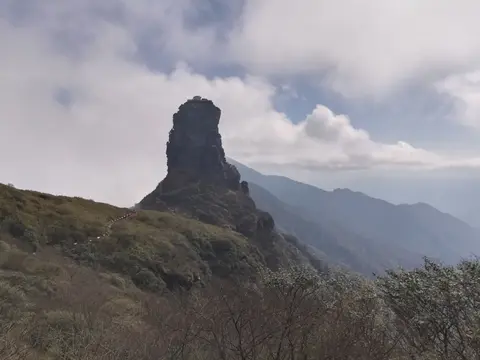
Rising in Tongren Prefecture inside south-west China's Guizhou Province, fanjingshan guizhou china crowns the Wuling mountain range. Climbing from valley floors near 480 to 500 metres to 2,570 metres at Mount Fenghuangshan, the Fanjingshan peak in China packs over 2,000 metres of steep vertical relief inside a 40,275-hectare core reserve. Unlike vast soluble limestone plains spanning neighbouring districts of south-west China, Fanjingshan protrudes as a solid island of ancient metamorphic rock surrounded completely by karst. That stark geological contrast isolates fragile upland habitats high above warmer lowland valleys.
This lithological boundary turned fanjingshan china into an ecological island preserving ancient species across millions of years. Monsoonal rainfall across damp metamorphic slopes feeds about 20 headwater streams flowing into both the Wujiang and Yuanjiang river systems before draining into the Yangtze River basin. Whereas porous karst caves drain surface rainwater rapidly underground, solid metamorphic bedrock retains deep humic soils and persistent mountain mist. Because of this geological buffer, subtropical ecosystems survived severe Pleistocene and Tertiary climate swings uninterrupted since 65 million to two million years ago. Surrounding lowland landscapes evolved differently on soluble karst, isolating upland plants and animals on Fanjingshan as completely as sea water isolates an oceanic island.
Global scientific interest in fanjingshan china discovery spans deep palaeontology as well as planetary astronomy. Researchers named a newly identified fossil chondrichthyan fish genus discovered in Guizhou Province Fanjingshania after the massif. Skywatchers also honoured the mountain after astronomers in 2005 identified Asteroid 215021 Fanjingshan through the PMO NEO survey. Official naming citation M.P.C. 118221 entered the international asteroid catalogue on 8 November 2019.
Guizhou Snub-Nosed Monkeys, Primeval Beech, and Tertiary Relicts
Straddling two biogeographic ecoregions, Jian Nan subtropical evergreen forests (64 percent) and Guizhou Plateau broadleaf and mixed forests (36 percent), Mount Fanjingshan stacks three altitudinal vegetation belts across 2,000 metres of elevation. Evergreen broadleaf woods dominate lowlands below 1,300 metres, thriving in warm monsoonal valleys. Between 1,300 and 2,200 metres, mixed evergreen and deciduous broadleaf woodland drapes misty steep ridges. Above 2,200 metres, hardy mixed deciduous broadleaf trees, conifers and subalpine scrub crown wind-exposed summits, while mid-to-upper ridges protect the largest contiguous subtropical primeval beech forest known anywhere, dominated by Fagus longipetiolata, Fagus lucida and Fagus engleriana. Protecting every tier together preserves an unbroken botanical sequence across Guizhou's humid subtropical mountain climate.
Botanical surveys document 3,724 plant species inside the 40,275-hectare boundary, representing roughly 13 percent of China's entire recorded flora. Bryophyte richness reaches 791 species, including 74 endemic to China, marking a huge concentration of mosses and liverworts thriving on damp bark and stone. Thirty-six gymnosperm species establish Fanjingshan among the richest conifer centres worldwide, hosting 46 locally endemic plants and 1,010 Chinese endemics. Key relicts include the endangered Fanjingshan fir (Abies fanjingshanensis), restricted entirely to Fanjingshan's upper ridges, the endangered flowering tree Bretschneidera sinensis and 64 globally threatened IUCN Red List plants. Together these species make Fanjingshan a crucial refuge for Tertiary flora vanished across wider East Asia.
Animal life is equally concentrated across intact canopies and cold mountain streams, recording 450 vertebrate species and 2,317 invertebrate species (including 245 local endemics). Most celebrated of all is the endangered Guizhou snub-nosed monkey (Rhinopithecus brelichi), also called the Guizhou golden monkey, whose entire worldwide home range sits strictly inside Fanjingshan's protected boundary. Maintaining ecological connectivity across neighbouring forest belts directly sustains viable breeding groups for these restricted-range primates. Surrounding buffer villages respect longstanding customary rules forbidding forest clearing and hunting on upper mountain slopes, reinforcing formal reserve patrols.
Thirty-eight globally threatened IUCN Red List animals inhabit these ridges together with four strictly local vertebrate endemics. Flagship species include the critically endangered Chinese giant salamander (Andrias davidianus) sheltering in rocky headwater streams and endangered forest musk deer (Moschus berezovskii) moving through mossy undergrowth. Vulnerable Reeve's pheasant (Syrmaticus reevesii) and vulnerable Asiatic black bear (Ursus thibetanus) also depend on quiet mid-elevation beech and broadleaf stands far from lowland roads.
Fanjingshan China Temples, Maitreya Faith, and Reserve Management
Beyond biological rarity, the fanjingshan chinese name reflects fifteen centuries of Buddhist devotion across rugged Wuling cliffs. Fanjing abbreviates Fantian Jingtu, meaning Brahma's Pure Land, linking Fantian (Brahma) with Pure Land Buddhism. That sacred lineage establishes mount fanjingshan china as the traditional bodhimanda (enlightenment sanctuary) of Maitreya Buddha, ranking just below China's Four Sacred Mountains of Buddhism. Monastic transport gained momentum during the Tang dynasty after Hou Hongren built the Zangke Road in 639 CE, opening steep mountain corridors that allowed county gazettes to document early Buddhist temples. Subsequent Song and Yuan dynasties expanded shrine networks further up the forested slopes.
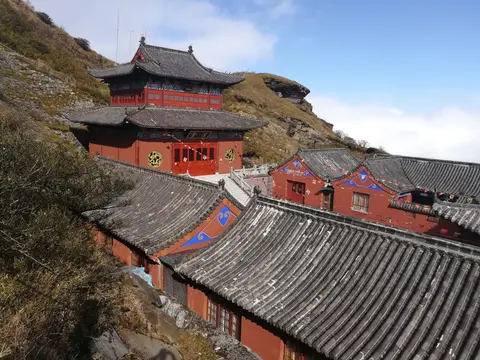
During the Ming and Qing dynasties, devotion to Tianguan Maitreya flourished across Pure Land and Linji monastic halls until late-sixteenth-century warfare damaged shrines during the Bozhou rebellion. After suppressing the revolt, the Wanli Emperor ordered monk Miaoxuan to rebuild Golden Peak and Cheng'en Temple, inaugurating Fanjingshan's temple golden era across rocky spires. Later turmoil accompanying the fall of the Qing dynasty and the Cultural Revolution destroyed many structures and dispersed monks. Since the 1980s, Buddhist revival restored Cheng'en Temple, Huguo Chan Temple, Great Golden Buddha Temple and Longquan Temple. Opened in 2010, the Fanjingshan Buddhist Cultural Park includes a Golden Hall sheltering a five-metre Maitreya Buddha statue crafted from 250 kilograms of gold and thousands of gems, reputedly the largest gold Maitreya statue in existence.
Uniting wildlife conservation with tourist interest in fanjingshan temples guizhou china requires coordinated multi-tenure protection. The 40,275-hectare World Heritage site merges three contiguous areas inside its 37,239-hectare buffer: Fanjingshan National Nature Reserve (established 1978, Biosphere Reserve 1986 across 567 square kilometres), Yinjiang Yangxi Provincial Nature Reserve and a small National Non-Commercial Forest. Because the national reserve spans broader slopes than the inscribed perimeter, aligning Biosphere Reserve zones cleanly with core and buffer boundaries simplifies unified management.
In August 2017, Guizhou established the Protection and Management Bureau of Fanjingshan Natural Heritage, followed in March 2018 by unified national oversight under China's National Forestry and Grassland Administration within the Ministry of Natural Resources. Separate protected-area plans govern reserve habitats, ecotourism development across Guizhou Fanjingshan National Nature Reserve and targeted Guizhou snub-nosed monkey conservation. Village environmental bylaws inside core and buffer settlements reinforce provincial park protections across surrounding ridges, regulating forest foraging and local farming practices. Joint monitoring tracks environmental quality, natural disasters, human impact and village activity, while voluntary resident relocation programmes follow free, prior and informed consent with fair compensation, social benefits, skills training and preserved cultural rights.
Although current staffing levels remain modest, tight coordination with local police and strict containment of tourism to one small public zone keep fragile snub-nosed monkey territory quiet. Maintaining continuous forest corridors between Fanjingshan National Nature Reserve, Yinjiang Yangxi Provincial Nature Reserve and the National Non-Commercial Forest prevents habitat fragmentation across isolated high-altitude mammal populations.
Periodic conservation effectiveness evaluations direct funding and staffing toward priority habitats, while ongoing biological inventories clarify rare species distributions inside little-studied mountain valleys. Keeping tourist crowds confined within steep eastern stairways leaves vast western beech woods completely undisturbed across seasonal wildlife breeding months.
Access Zones Across Fanjingshan Guizhou China
Because only a small portion of the reserve opens to public visits to safeguard Guizhou snub-nosed monkey ranges, itineraries stay focused on regulated stairways and temple summits. Verify official entry quotas and weather alerts before departing Jiangkou County gates.
| Complex Zone | Key Highlights | Access & Ticket Rule |
|---|---|---|
| Red Clouds Golden Summit and Jinding Peak | Twin cliff-perched Buddhist temple halls, high-altitude metamorphic rock pinnacles and steep ridge staircases. | Restricted public visitor corridor reached from official trailheads; advance timed park entry tickets and weather checks required. |
| Cheng'en Temple and Mid-Slope Forest Belt | Rebuilt Ming-lineage Dharma Hall of Cheng'en Temple, primeval Fagus beech stands and clear mountain stream pools. | Accessible along paved visitor stairways and regulated reserve corridors; stay strictly inside fenced paths to protect beech soils. |
| Fanjingshan Buddhist Cultural Park | Opened in 2010 at the mountain approach featuring a Golden Hall housing a five-metre, 250-kilogram gold Maitreya Buddha statue. | Publicly accessible cultural precinct outside core wildlife reserves; verify entrance gates and local transport from Jiangkou. |
| Core Biodiversity and Yangxi Reserve Sector | Entire home range of the Guizhou snub-nosed monkey, Fanjingshan fir habitats, Chinese giant salamander streams and research zones. | Closed to general tourism; protected strictly by Fanjingshan Natural Heritage Bureau patrols and local village rules. |

Three Geological and Ecological Features on Mount Fanjingshan
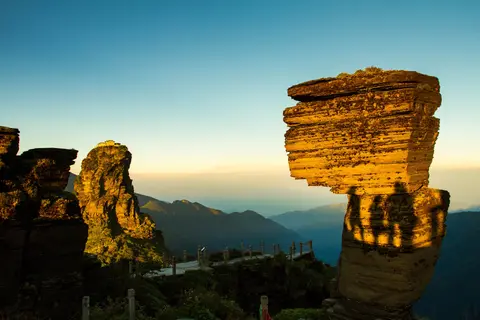
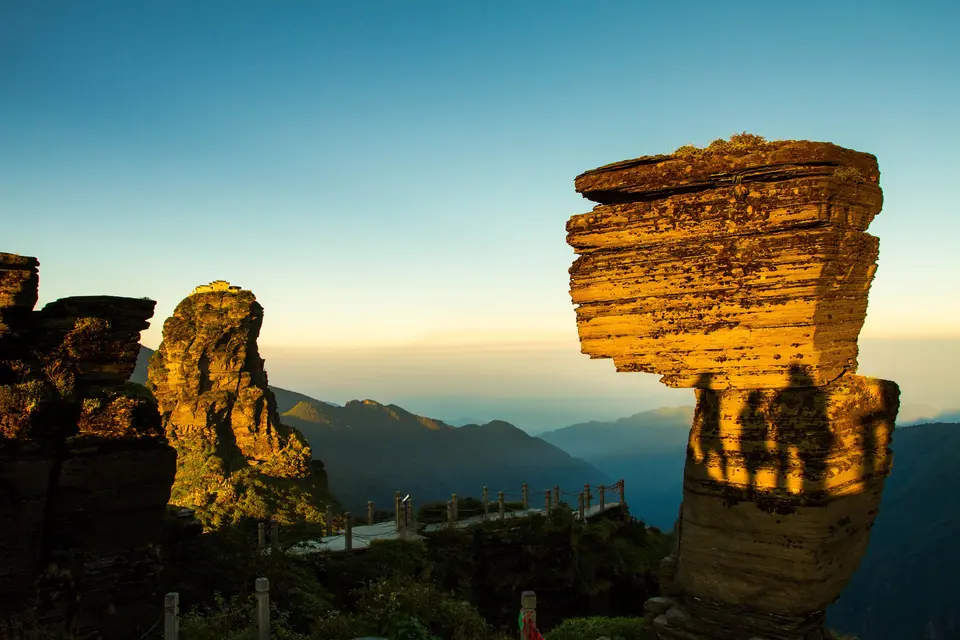
- Metamorphic Rock Uplift Above Karst Plains: Compare sheer layered metamorphic pinnacles at Golden Summit against surrounding limestone hills across Tongren. This ancient rock island isolated Fanjingshan's plants and primates from lowland karst valleys.
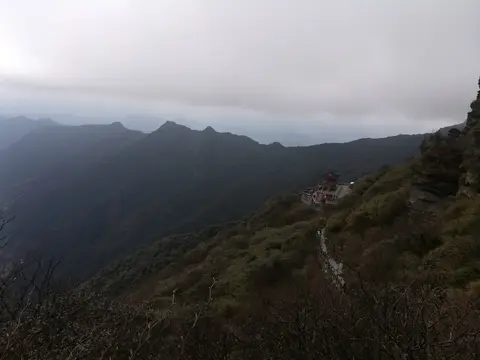
- Three Distinct Altitudinal Beech and Conifer Tiers: Watch forest composition change steadily across mountain climbs from subtropical evergreens below 1,300 metres. Mid-elevation slopes sustain dense Fagus beech stands before giving way to dwarf scrub above 2,200 metres.
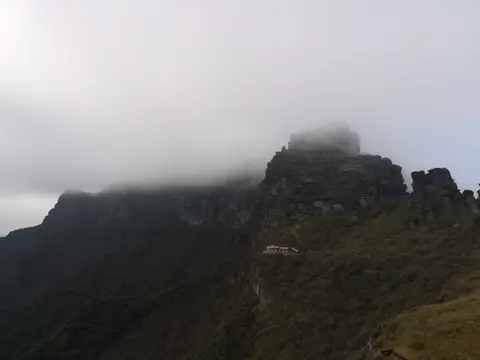
- Cliff-Anchored Ming-Lineage Timber and Stone Halls: Inspect how temple builders anchored Cheng'en Temple and the summit halls atop Red Clouds Golden Summit cleanly onto wind-scoured rock spurs without disrupting surrounding forest streams.
Mount Fanjing Trail Planning, Seasons, and Tongren Arrival
Timing climbs across fanjingshan guizhou china involves tracking cloud cover and sharp temperature shifts across more than 2,000 metres of elevation gain. Summer monsoons generate sudden cloudbursts, heavy mountain mist and slick granite steps across exposed summits above 2,200 metres, whereas clearer spring and autumn periods improve ridge visibility above Golden Summit and primeval beech canopies. Layered windproof and waterproof clothing stays practical even when Jiangkou County valleys begin dry and mild. Giving yourself a full day for mountain ascents leaves room to wait out passing fog across the upper pinnacles.
Air and rail connections bring visitors directly into eastern Guizhou before mountain road transfers to park gates. Travellers fly into Tongren Fenghuang Airport (TEN), positioned 62 kilometres east of Fanjingshan, before continuing overland into Jiangkou County entrances. Because the Protection and Management Bureau of Fanjingshan Natural Heritage tightly caps daily public numbers across the small open corridor and Biosphere Reserve zoning rules keep core habitats quiet, checking official booking slots early prevents turn-backs at entrance checkpoints. Respecting marked trail fences protects shallow moss beds and rare alpine shrubs growing directly beside stone stairs.
Travellers pairing Guizhou's ancient metamorphic forest island with wider southern China mountain reserves frequently connect southeast by domestic rail or air toward Hong Kong (830 kilometres southeast). Explore additional primeval forests and limestone sanctuaries across China inside our UNESCO World Heritage Atlas.