Quick Field Data
- UNESCO Inscription: 2023 (Ref. 1670), three-part serial cultural monument in Hassan and Mysuru districts, Karnataka, southern India; Criteria (i), (ii) and (iv).
- Scale & Footprint: 10.47 hectares combined across three stone compounds: Chennakeshava Temple (Belur), Hoysaleswara Temple (Halebidu) and Keshava Temple (Somanathapura).
- Access & Ticketing: Protected under the AMASR Act 1958 (2010 amendment) and overseen by the Archaeological Survey of India (ASI) and Karnataka authorities. Belur stays an active place of worship under the Muzrai Department, whereas Halebidu and Somanathapura are non-living ASI sites (check official notices for belur halebidu temple timings).
- Arrival Logistics: Main international hub is Kempegowda International Airport Bengaluru (BLR), 162 kilometres straight-line from the ensemble centroid (roughly 210 to 220 kilometres west by road via NH 75 to Halebidu and Belur). Mysore Airport (MYQ) sits 85 kilometres from the centroid (closer to Somanathapura, with limited flights), Cochin International Airport (COK) lies 304 kilometres southwest, and wider regional travel links south toward Colombo (772 kilometres).
Hoysala Empire Origins and the Belur Halebidu and Somanathapura Triad
Inscribed by UNESCO in 2023, the hoysala temples of belur halebidu and somanathapura preserve three defining monuments of southern India's Hoysala Empire across Karnataka. Ruling large portions of Karnataka between roughly 1000 and 1346 CE, Hoysala kings built around 1,500 temples across 958 centres while expanding agrarian taxation, revenue systems and state administration. Two serial sites lie inside Hassan district and the third stands in Mysuru district, answering frequent questions on belur halebidu which district administers them. Together, the hoysala temples belur & halebidu and Somanathapura display 150 years of evolving royal stone workshops.
Royal patronage launched the triad at Belur on the banks of the Yagachi (historic Badari) River. Known in medieval records as Velapura or earthly Vaikuntha, Belur acted as early Hoysala capital when King Vishnuvardhana ascended in 1110 CE. In 1117 CE, Vishnuvardhana consecrated the east-facing Chennakeshava Temple (originally Vijayanarayana, measuring 178 by 156 feet) to Vishnu, viewed by architectural scholar Dhaky as his magnum opus celebrating Ramanujacharya's Sri Vaishnavism. Supporting temples near Belur inside the 443.5-by-396-foot walled court include Queen Shantala Devi's twin-sanctum Kappe Chennigaraya shrine (124 by 105 feet), dedicated to Venugopala and Chennigaraya. West of the main temple stands the 12th-century Viranarayana temple (70 by 56 feet), displaying 59 large reliefs of Vishnu, Shiva, Brahma, Bhairava, Lakshmi, Parvati, Saraswati and Mahabharata scenes featuring Bhima. Southwest sits the Somyanayaki shrine, whose smaller tower preserves local tradition's miniature model of Chennakeshava's lost main spire, while northwest stands the Andal (Ranganayaki) shrine featuring 31 deity images plus carved Venugopala, Mohini, Lakshmi and elephant friezes. A damaged stone couple in namaste under a canopy plus Ballala II's 1175 CE kitchen, grain store and northeast water tank complete the compound.
Shortly afterward, Vishnuvardhana moved the royal capital 16 kilometres northeast to Dorasamudra, modern Halebidu, launching the largest Hoysala monument dedicated to Shiva. Commissioned by royal officer and merchant Ketamalla Dandanayaka after a 1121 CE land grant and completed around 1150 CE, Hoysaleswara Temple bears the names of Vishnuvardhana and Queen Shantaladevi. Built on a twin-shrine dvikuta plan with two identical 16-pointed star sanctums sharing a central pillared hall, its paired chambers house the Hoysalesvara and Shantalesvara Shivalingas.
A century later, military commander Somanatha Dandanayaka commissioned the third monument under King Narasimha III. Completed around 1258 CE and consecrated in 1268 CE in Somanathapura, 38 kilometres east of Mysore, Keshava Temple represents the mature trikuta (triple-celled) form dedicated to Vishnu as Keshava, Janardhana and Venugopala. Enclosed within a rectangular prakara courtyard lined with 56 perimeter shrine cells, Somanathapura shows how Hoysala builders unified compound geometry before art historian James C. Harle notes the Hoysala style closed mid-fourteenth century after King Veera Ballala III and his son fell in war against the Madurai Sultanate.
Chloritic Schist Craft, Stellate Plans, and Signed Sculptures
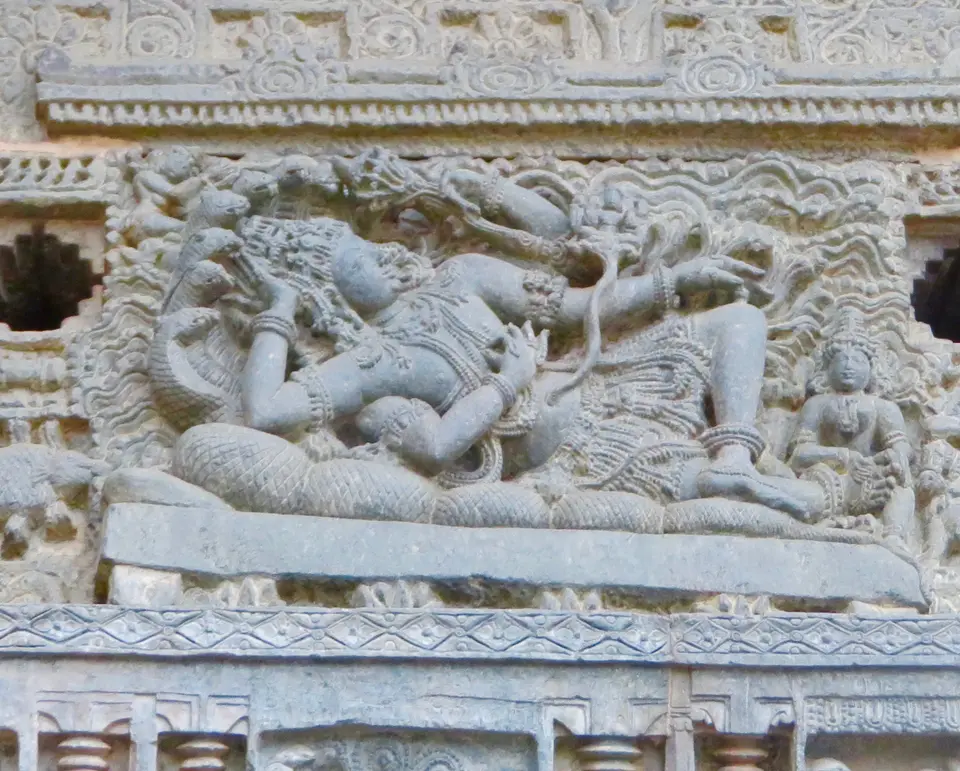
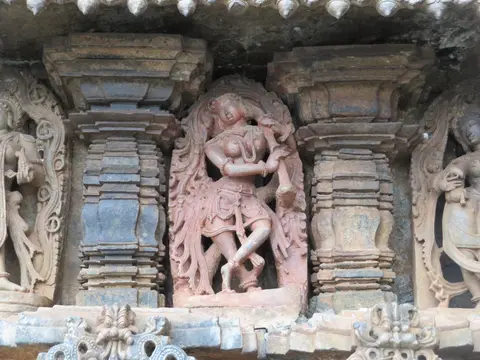
Art historian Adam Hardy classifies this distinctive twelfth-to-thirteenth-century style as the Karnata Dravida tradition. Rather than adopting a single inherited template, Hoysala master builders deliberately fused northern Nagara spire forms, southern Dravida tower tiers, central Bhumija bands and western Chalukyan pillar mouldings into a fresh state aesthetic. Working in smooth chloritic schist (soapstone), quarryable soft enough for razor-sharp detailing before hardening upon air exposure, sculptors covered almost every square centimetre of wall space with narrative reliefs and miniature shrine towers.
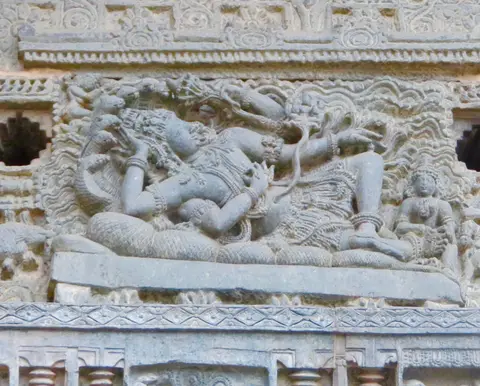
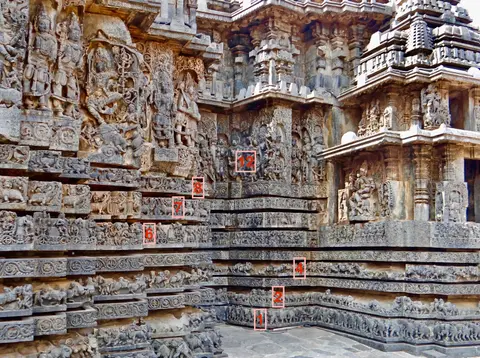
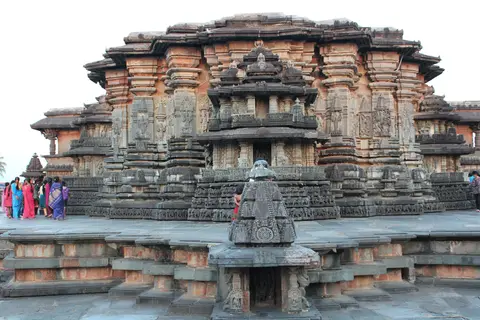
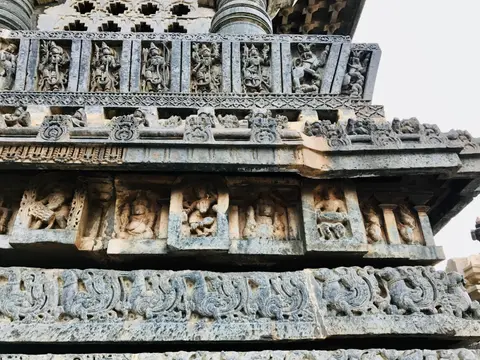
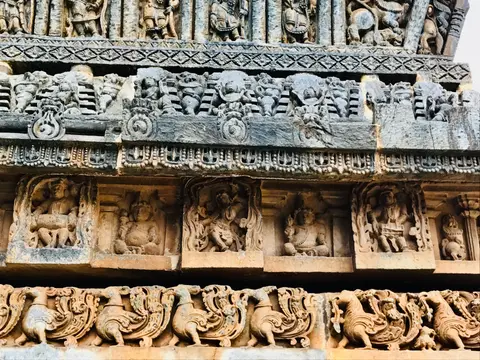
Stellate (star-shaped) geometry anchors every temple within the three-site UNESCO ensemble. Rather than resting straight on the ground, each shrine sits atop an elevated jagati platform mirroring the 16-pointed star contour of the sanctum walls. Devotees perform pradakshina (ritual circumambulation) directly along this three-foot-high stone terrace, reading carved horizontal bands at eye level. Multi-tiered adhisthana plinths wrap continuously around every protruding and recessed wall angle, stacking eight crisp relief tiers at Halebidu. Lower rows depict marching elephants, roaring lions, scrolling foliage and mythical makaras, followed upward by epic panels from the Ramayana, Mahabharata and Bhagavata Purana. At Belur, similar plinth bands pair dancers and musicians with hamsa birds beneath rich devotional iconography.
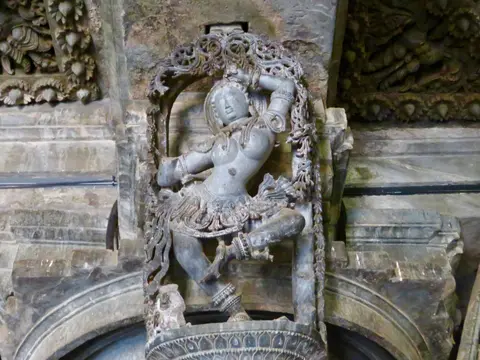
At Belur, 42 outward-leaning bracket sculptures called madanikas grace pillar capitals, paired with pierced stone screens (jalis) added under Veera Ballala III (1292 to 1343) with high fortress walls. Originally, the main mandapa stood open without a high boundary wall so devotees could study interior stone carvings in bright daylight. When Somayya Danayaka enclosed the temple for military security, perforated stone screens dimmed the inner hall while filtering enough light for darshana toward the garbha griya. Multi-faith artistic breadth marks Belur's walls, which honour Vaishnava deities beside Shaiva, Shakta, Jina and Buddha imagery across 118 recorded inscriptions. Unusually for medieval Indian temple art, scores of stone panels carry carved signatures naming individual sculptors, testifying to high artistic status across Hoysala society, joined by repeated royal emblem sculptures depicting Sala battling a tiger.
Across the wider Hoysala heartland, this distinctive temple culture shaped over 1,500 documented shrines across 958 centres over three centuries. Because Chennakeshava Temple at Belur retains unbroken worship rituals and festivals since 1117 CE, its living ceremonial setting contrasts meaningfully with the quieter archaeological preservation of Halebidu and Somanathapura. Viewing all three serial sanctuaries together reveals how architectural patronage shifted from royal capital temples to high-ranking military and merchant endowments.
Raids, Vijayanagara Repairs, and Soapstone Surface Conservation
Repeated fourteenth-century invasions severely tested all three monuments across southern Karnataka. Delhi Sultanate armies under Malik Kafur for Alauddin Khalji and under Muhammad bin Tughluq raided Belur and Halebidu around 1326 CE, burning Belur's gateway and damaging sculptures across Halebidu and Somanathapura. Later Vijayanagara monarchs backed substantial repairs under Harihara II. Craftsmen added four granite pillars in 1381, raised a gilded kalasa finial in 1387 and erected Belur's seven-storey brick eastern gopuram in 1397, adding Andal, Saumyanayaki, Rama, Narasimha shrines and an entrance dipa-stambha. Similarly, sixteenth-century Vijayanagara grants repaired Somanathapura's north tower, veranda and temple platform using visibly contrasting stonework.
Subsequent centuries mixed periodic local restoration with early princely preservation. Belur recorded repairs in 1709, 1717, 1736 and 1774 under an officer of Hyder Ali during Wadiyar rule, before late-nineteenth-century engineers dismantled Belur's failing brick-and-mortar sanctum tower to protect lower masonry, leaving Belur and Halebidu flat-roofed today. By 1924, Mysore princely orders protected both Hassan temples, removing later intrusive structures such as Belur's Naganayakana mandapa in 1935 and adding masonry buttresses against leaning walls at Halebidu and Somanathapura while recording repairs in stone inscriptions.
Following Indian independence, all three complexes passed under Archaeological Survey of India (ASI) protection in 1951 under the AMASR Act 1958 (2010 amendment). After April 2014 tentative listing, INTACH Bengaluru Chapter, ASI and Karnataka's Department of Archaeology, Museums and Heritage compiled the 2022 nomination dossier. ASI engineers waterproofed roofs with lime mortar, reinforced fractured beams using concealed stainless-steel T-girders, rebuilt Somanathapura's leaning cloisters in 2011 and 2012, and treated moss and soot using dilute organic acids followed by microcrystalline wax or acrylic coatings. Today, an Apex Committee chaired by Karnataka's Chief Secretary coordinates Hassan and Mysuru District Committees, the National Monument Authority, private buffer owners and Belur's active Muzrai worship schedule across six objectives spanning conservation, development control, artistic continuity, sustainable tourism, impact assessment and community outreach.
Access Zones Across Belur, Halebidu, and Somanathapura Temples
Grouping belur halebidu tourist places cleanly between Hassan district's twin capitals and Mysuru district's trikuta compound keeps driving distances efficient. Respect active worship etiquette at Belur while checking official ASI gates at Halebidu and Somanathapura.
| Complex Zone | Key Highlights | Access & Ticket Rule |
|---|---|---|
| Chennakeshava Temple, Belur (Hassan) | Consecrated 1117 CE living Vishnu shrine, Vijayanagara gopuram, madanika brackets, Kappe Chennigaraya and Viranarayana temples. | Active Hindu worship site; remove shoes before entering the courtyard and follow Muzrai and ASI etiquette rules. |
| Hoysaleswara Temple, Halebidu (Hassan) | Largest Hoysala Shiva monument on a twin-shrine dvikuta plan with eight-tier adhisthana plinth friezes and nearby historic tank. | Protected non-living ASI monument 16 kilometres from Belur; check gate boards for current admission tickets and site museum access. |
| Keshava Temple, Somanathapura (Mysuru) | 1268 CE triple-celled trikuta Vishnu complex enclosed inside a 56-cell prakara cloister 38 kilometres east of Mysore. | Protected non-living ASI monument; verify official ASI notices for opening windows and photography restrictions. |
Three Sculptural and Engineering Details on the Hoysala Temples
- Carved Sculptor Signatures on Narrative Panels: Scan lower wall registers and bracket bases at Belur and Halebidu for short medieval Kannada inscriptions naming individual artists. Personal sculptor signatures rarely appear on medieval Indian temples.
- Sixteen-Pointed Stellate Sanctum Geometry: Walk around the elevated jagati terrace at Halebidu or Somanathapura to observe rotated square plans. Star-shaped corners multiply light-and-shadow facets across soft chloritic schist walls.
- Eight-Tier Horizontal Adhisthana Plinth Bands: Read the continuous lower friezes upward from ground level: elephants, lions, foliage scrolls, mythical makaras, musicians and dancers leading straight into Ramayana and Mahabharata narrative panels.
Belur Halebidu Distance From Bangalore, Hassan Rail Links, and Timing
Calculating belur halebidu from bangalore travel routes keeps Karnataka road circuits smooth across both districts. From Kempegowda International Airport Bengaluru (BLR), positioned 162 kilometres straight-line from the three-site centroid, highway routes run west along four-lane National Highway 75 for roughly 210 kilometres to Halebidu (around four hours) or 220 kilometres to Belur (around 3.5 hours). Hassan town supplies the nearest railway junction connecting directly to Karnataka's major cities, lying 35 kilometres southeast of Belur and 30 kilometres southeast of Halebidu. Meanwhile, historic Mysore city anchors southern road and rail links 38 kilometres west of Somanathapura.
Checking belur temple to halebidu distance highlights why visitors effortlessly pair both Hassan temples in one day, separated by just 16 kilometres of local highway. Touring Belur's living Chennakeshava court during cooler morning worship hours before driving 16 kilometres northeast to examine Halebidu's carved exterior plinths lets afternoon sunlight illuminate south- and west-facing soapstone reliefs. Reserving a separate half-day near Mysore covers Somanathapura's enclosed 56-cell compound cleanly. Verify local ASI boards ahead of arrival for belur halebidu temple timings, festival hours and footwear counters.
Alternative air links include Cochin International Airport (COK), 304 kilometres southwest, or regional Mysore Airport (MYQ), 85 kilometres from the serial centroid (closest to Somanathapura, though handling fewer scheduled flights than Bengaluru). Regional South Asian circuits linking southern India's temple architecture with coastal island heritage also extend south toward Colombo (772 kilometres). Explore more Asian sacred architecture inside our UNESCO World Heritage Atlas.