





















Quick Field Data
- UNESCO Inscription: 2025 · Criterion (iv)
- Scale & Footprint: A serial site of four palace complexes in Swabia and Upper Bavaria: Neuschwanstein Castle, Linderhof Palace, the King's House on Schachen and Herrenchiemsee New Palace
- Access & Ticketing: Outside views are open to all; Neuschwanstein's interior is seen only on a guided tour, and each palace has its own tickets
- Arrival Logistics: Neuschwanstein stands above Hohenschwangau near Füssen, Linderhof is in the Graswang valley near Ettal, Schachen is reached on foot, and Herrenchiemsee lies on an island in the Chiemsee
Four Private Worlds for a Romantic King
King Ludwig II reigned in Bavaria from 1864 to 1886. Between 1868 and 1886 he built four palaces as private retreats. UNESCO notes that they were not made for government or court life. They were places of seclusion, designed under the king's close control to express his own romantic vision.
Each palace draws on a different source. Ludwig admired the operas of Richard Wagner, the medieval Wartburg castle and the Palace of Versailles. UNESCO describes the palaces as staged architecture for imagined worlds. They follow the historicist and eclectic styles of the late nineteenth century and aim to be total works of art.
UNESCO notes that the builders used the best artists and craftsmen of the time and the newest technology. The palaces remain largely unchanged since the king's death.
The four sites lie far apart. Neuschwanstein is in Swabia, above the village of Hohenschwangau. Linderhof lies in the Graswang valley near Ettal, and Schachen high above Garmisch-Partenkirchen. Herrenchiemsee is on an island in the Chiemsee in southern Bavaria. All four belong to the Free State of Bavaria and are run by the Bavarian Palace Department.
Neuschwanstein, Linderhof, Schachen and Herrenchiemsee
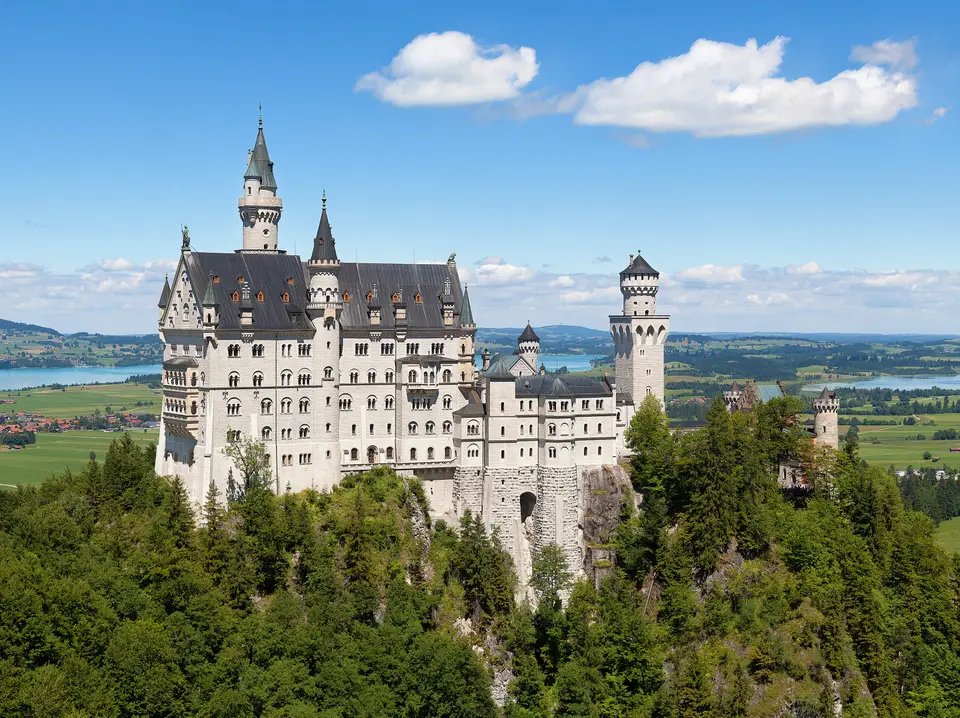
The foundation stone of Neuschwanstein was laid on 5 September 1869. The stage designer Christian Jank drew the first plans, and the architect Eduard Riedel put them into practice. Georg von Dollmann took over in 1874 and Julius Hofmann in 1884. Ludwig moved in during 1884, while the main building was unfinished. He spent only 172 days there in total.
Only about fifteen rooms were completed. The Singers' Hall, 27 by 10 metres, combines two rooms of the Wartburg. The Throne Hall measures 20 by 12 metres and is 13 metres high. Hofmann modelled it on the All Saints Court Church in the Munich Residence. Ludwig died on 13 June 1886 at Lake Starnberg. Within six weeks the regent opened the castle to the public.
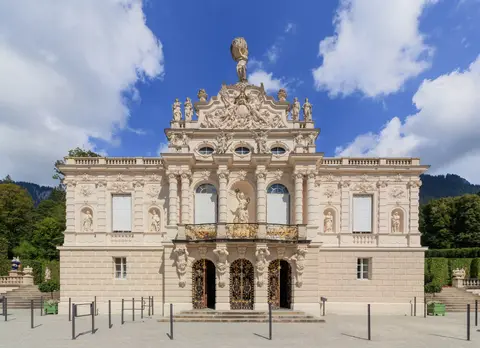
Linderhof is the smallest palace and the only one Ludwig completed. He lived there most of the time from 1876. Its dining table could sink to the kitchen below, be laid and rise again, so the king could eat without servants. In the park, the Venus Grotto is an artificial cave built between 1875 and 1877 for a scene from Wagner's Tannhäuser. In 1878 it was lit by electric arc lamps powered by 24 dynamos.
The park at Linderhof was designed by Carl von Effner. A cascade of thirty marble steps falls towards the palace, and a fountain in front of it sends a jet of water nearly 25 metres high. The park also holds the Moorish Kiosk, designed for the Paris International Exhibition of 1867 and later bought by Ludwig, and Hunding's Hut, inspired by Wagner's Die Walküre.
The King's House on Schachen was built from 1869 to 1872 to designs by Georg von Dollmann. Outside it looks like a modest Alpine chalet. Upstairs, the Turkish Hall fills the whole floor with Oriental decoration. An alpine garden at about 2,000 metres stands next to it.
Herrenchiemsee New Palace was begun on 21 May 1878 as a homage to Louis XIV and Versailles. Its Hall of Mirrors has 17 arches, the same number as at Versailles. Only the central part was built, and 50 of the 70 planned rooms were unfinished at Ludwig's death. He stayed there only a few days in September 1885.
Visiting the Palaces Today
Neuschwanstein draws well over a million visitors a year, and up to 6,000 a day in summer. The other palaces are quieter. Each needs its own day, so most travellers pick one or two.
- Book Neuschwanstein and Walk the Gorge: Visits to Neuschwanstein are by guided tour only, and tickets are sold online. Leftover tickets for the same day may be sold at the Ticket Center in Hohenschwangau. Photography inside is not allowed, and backpacks and prams cannot be taken in. The Marienbrücke over the Pöllat gorge gives the best-known outside view, but it may close in bad winter weather.
- Combine Linderhof and Hike to Schachen: At Linderhof, allow time for the park, the grotto and the kiosk after the palace tour. The grotto had a full renovation from 2024 to 2025. The King's House on Schachen is reached only on foot or along a 10-kilometre forest road. The hike from Schloss Elmau or Garmisch-Partenkirchen takes about three hours and climbs about 1,000 metres.
- Take the Boat to Herrenchiemsee: Herreninsel is the largest island in the Chiemsee and can only be reached by boat. Next to the New Palace, the Old Palace is a former Augustinian monastery where the 1948 Constitutional Convention prepared the German Basic Law. Find more palaces and gardens in our UNESCO World Heritage Atlas, and start from Munich, our closest city guide.
