Quick Field Data
- UNESCO Inscription: Inscribed on 7 July 2008 (Ref. 1276) as a Cultural site under Criteria (ii) and (iv) shared between Switzerland and Italy.
- Scale & Footprint: Protects 152.42 hectares of railway track bed, stations, viaducts, and tunnels across the 61.67-to-67-kilometre Albula line and 61-kilometre Bernina line linking Thusis, St. Moritz, and Tirano.
- Access & Ticketing: Ordinary regional Rhaetian Railway trains run frequent open-seating services along the UNESCO corridor with valid rail passes or point-to-point fares. Dedicated bernina express tickets require mandatory seat reservations checked on the official Rhaetian Railway website.
- Arrival Logistics: Major Italian airports include Il Caravaggio International Airport in Bergamo (BGY, 93 kilometres south), Milano Linate (LIN, 125 kilometres), and Milan Malpensa (MXP, 129 kilometres). Lugano Airport (LUG, 91 kilometres) carries limited regional flights, while standard-gauge trains link Tirano to Milano (126 kilometres) and Zurich to Chur.
Narrow-Gauge Alpine Breakthrough and the Albula Spiral Descent
Until the late nineteenth century, Graubünden in southeastern Switzerland stayed largely bypassed by major European rail trunk lines, leaving the spa town of St. Moritz a 14-hour stagecoach ride from Chur. In 1888, Dutch hotelier Willem Jan Holsboer launched a bold narrow-gauge mountain network from Landquart to Davos because tight gorges lacked space for standard-gauge curves. Renamed Rhaetian Railway (Rhätische Bahn, RhB) in 1895 under engineer-director Achilles Schucan and placed under cantonal state ownership after a June 1897 referendum, the company grew rapidly into Switzerland's second-largest rail operator with 385 kilometres of track across 10 lines and 102 stations. After Swiss federal legislators rejected competing Julier Pass and Scaletta proposals on 30 June 1898, crews started building the Albula line from Thusis on 15 October 1898.
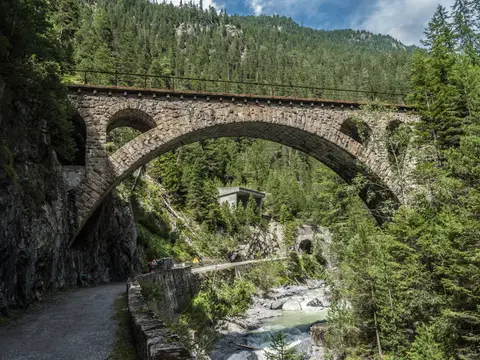
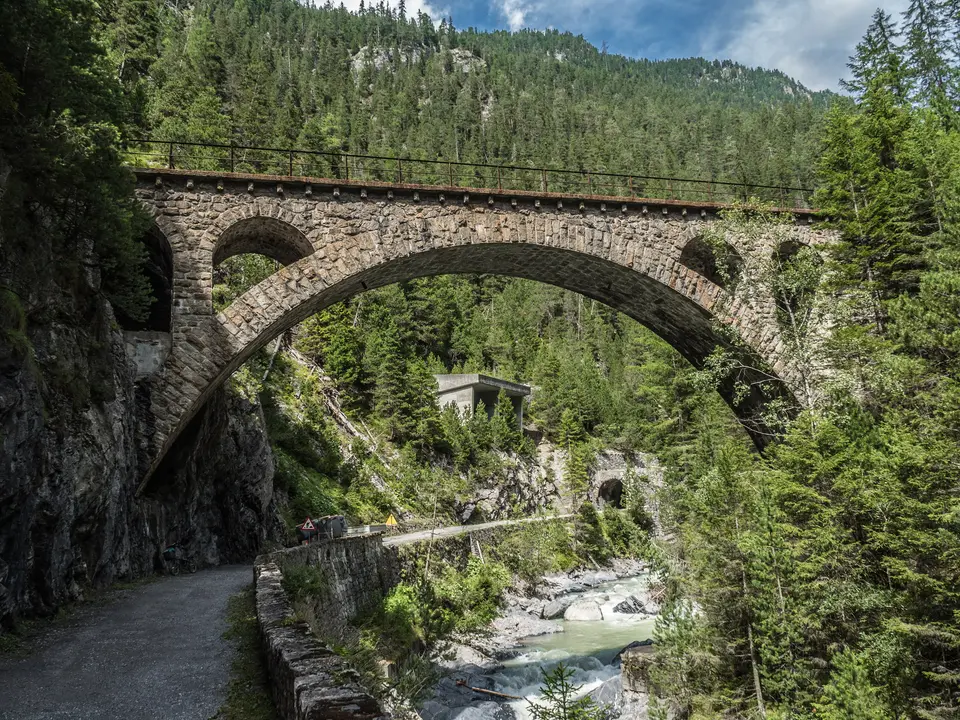
Opened from Thusis to Celerina on 1 July 1903 and extended into St. Moritz on 10 July 1904, the Albula railway stretches roughly 61.67 to 67 kilometres through rugged Domleschg and Engadin terrain. Engineered originally for steam locomotives before wartime coal shortages prompted electrification in 1919, builders capped gradients at 3.5 percent and specified generous curve radii. Staying within that gentle gradient required extraordinary masonry engineering: UNESCO counts 42 tunnels and covered galleries plus 144 viaducts and bridges across the Albula corridor (55 major bridges and 39 tunnels in line inventories). Behind Thusis, tracks cross the Hinterrhein and scale Schinschlucht gorge over the 89-metre-high Solis Viaduct, the highest span on the RhB network, before passing the 137-metre Schmittentobel Viaduct to reach Filisur.
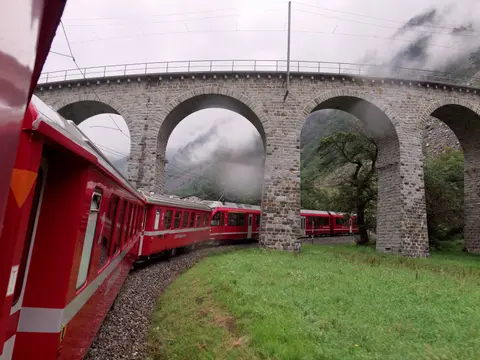
Two feats define this ascent between Thusis (697 metres) and St. Moritz (1,774 to 1,775 metres). Just west of Filisur rises the 65-metre-high Landwasser Viaduct, curving on a tight 100-metre radius straight into a tunnel mouth bored inside a vertical cliff wall. Above Bergün/Bravuogn (1,373 metres), engineer Friedrich Hennings faced a 400-to-417-metre vertical climb toward Preda (1,789 metres) within only five to six and a half kilometres as the crow flies. Rather than laying a cogwheel rack, Hennings twisted the track like a corkscrew through two curved tunnels, three spiral tunnels, and four viaducts. That winding geometry added 12 kilometres of length (including the 660-metre Rugnux Spiral Tunnel slowed by icy four-degree-Celsius mountain water) so trains cross above themselves twice beside a parallel rail history trail. Past Preda, trains enter the 5,864-to-5,866-metre Albula Tunnel beneath the Rhine-Danube watershed at 1,815 to 1,820 metres altitude. Completed early on 29 May 1902 by 1,316 workers despite 16 fatal accidents, the historic bore gained a modern parallel replacement tunnel between 2015 and 2024 before emerging down Val Bever toward St. Moritz.
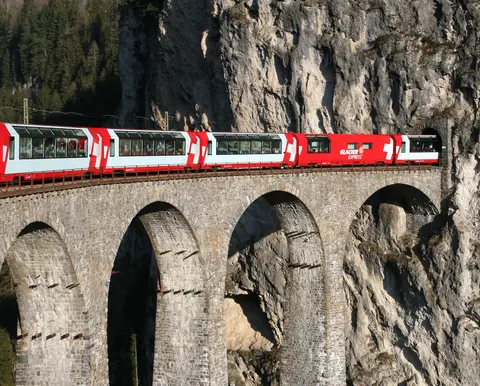
Crossing the Bernina Pass by Adhesion Rail From St. Moritz to Tirano
Continuing south across Europe's main alpine divide, the 61-kilometre Bernina line completes the transborder UNESCO corridor into northern Italy. Formed the year after Albula's 1904 opening without cantonal subsidies, the Bernina-Bahngesellschaft was financed by Kraftwerke Brusio hydroelectric investors seeking mountain construction access and alpine tourism. The line opened in stages between 1908 and 5 July 1910. Operated electrically from inception and absorbed into the Rhaetian Railway in 1943 after early financial struggles, the route connects St. Moritz through Pontresina (1,774 metres) and Val Bernina up to the continental summit at Ospizio Bernina (2,253 to 2,254 metres) before plunging 1,824 metres down to Tirano in Italy's Lombardy province.
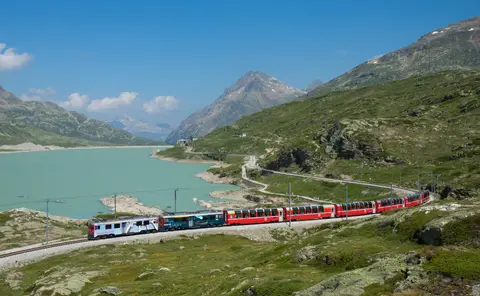
That climb ranks as Europe's highest railway pass, the continent's highest adhesion crossing, and one of the steepest pure-adhesion railways worldwide, tackling grades up to seven percent using simple steel wheel friction with no rack-and-pinion gears. After crossing the Inn River and the 689-metre Charnadüra Tunnel II past Punt Muragl's 1907 funicular, trains skirt Morteratsch station two kilometres below the Morteratsch Glacier, sweep around the Montebello Curve opposite Piz Bernina and Piz Palü, and pass Diavolezza and Bernina Lagalb cableways. Heavy winter snow and avalanche terrain demanded long protective roofs above Lago Bianco's 283-metre dam (the watershed dividing the Danube and Po rivers), including the 175-metre Arlas Gallery, Scala Tunnel, and 348-metre Sassal Mason Gallery.
Beyond Ospizio Bernina, the descent through Alp Grüm marks both the alpine tree line and the Swiss Italian-language frontier. Switching downward via two sharp 180-degree loops through Upper Palü Gallery, Palü Tunnel, and four half-circle bends past Cavaglia into Poschiavo, trains shift from alpine shelf tracks to street-running tramway sections through Le Prese along 965-metre Lake Poschiavo. Below Brusio, the open-air Brusio Spiral Viaduct coils through a complete circular stone loop solely to drop altitude within the valley floor before clearing customs at Campocologno, crossing Madonna di Tirano square, and terminating in Tirano beside Italian RFI main lines. Today, both regional carriages and the bernina express train highlight this continuous alpine transition on one unbroken metre-gauge track.
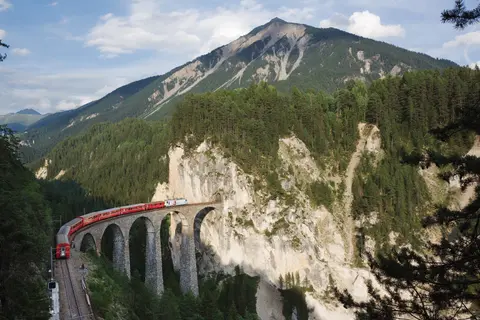
Electrical Engineering Dual Systems and Century-Old Railway Conservation
Uniting two independently engineered alpine lines created subtle technical complexity still active on every daily departure. Whereas the Albula route operates under Rhaetian Railway's main 11-kilovolt alternating-current network adopted in 1919, the Bernina section runs on direct current raised from 750 volts to 1,000 volts in 1935. Consequently, St. Moritz keeps separate platforms for the two currents. Meanwhile, Pontresina station operates a distinctive switchable catenary over Track 3 that toggles live between alternating and direct current with illuminated crew signals, permitting through-trains like the Heidi Express and Bernina Express to exchange locomotives cleanly.
Preserving an active 1,000-millimetre narrow-gauge mountain railway as a UNESCO site relies on routine operation rather than static museum freezing. Across the entire 385-kilometre RhB network, 80 percent of passenger income comes from alpine tourism while 40 percent of riders are everyday commuters travelling with freight wagons of up to 140 tonnes on Bernina formations. Modernised fleets including 15 ABe 8/12 railcars introduced from 2010 and dual-power electric-diesel locomotives (capable of operating without overhead power) run with vintage historic cars. Meanwhile, remote signalling managed since 2005 from Landquart's Rail Control Centre and double-track passing loops at Thusis, Filisur, and Preda keep hourly traffic moving smoothly. After a landslide injured eleven passengers near Tiefencastel in 2014, engineering teams reinforced mountain protection while completing a new replacement Albula bore by 2024. Continual masonry upkeep preserves original 1904 stone viaducts in working order, spotlit globally when Google Street View mapped the line in 2011 and when RhB ran a record 100-car, 1.9-kilometre passenger train across 25 kilometres in 2022.
Access Zones Along the Bernina Express Route Between Thusis and Tirano
Traversing the full bernina express route from Graubünden across into Lombardy takes visitors through distinct elevation zones. Whether riding panoramic carriages with seat reservations or boarding standard hourly regional trains that allow opening windows for photographs, travellers can step off at key engineering landmarks.
| Complex Zone | Key Highlights | Access & Ticket Rule |
|---|---|---|
| Thusis to Filisur (Albula Gorge & Landwasser). | Schinschlucht canyon, 89-metre Solis Viaduct, Schmittentobel Viaduct, and the curved 65-metre Landwasser Viaduct entering a cliff tunnel. | Covered by standard RhB regional tickets and Swiss rail passes. Panoramic Bernina Express trains require separate seat reservations. |
| Bergün/Bravuogn to Preda Spiral Section. | Three spiral tunnels, two curved tunnels, four viaducts climbing 417 metres, parallel rail history nature trail, and the Albula Tunnel portal. | Regular hourly regional trains stop at Bergün and Preda for trail hikers. Check official RhB seasonal guides before hiking snow lines. |
| St. Moritz, Pontresina & Ospizio Bernina. | Switchable dual-voltage Track 3 at Pontresina, Morteratsch Glacier approach, Lago Bianco watershed dam, and 2,253-metre pass summit. | Year-round rail operation across the Bernina Pass. Check Diavolezza and Muottas Muragl lift operators separately for mountain connections. |
| Alp Grüm, Brusio Spiral & Tirano Terminal. | Alpine tree-line lookout, Palü zigzag loops, street-running Le Prese lakeside section, circular Brusio Spiral Viaduct, and Italian RFI link. | Valid passport or Schengen border identification needed when crossing Campocologno between Switzerland and Tirano in Italy. |
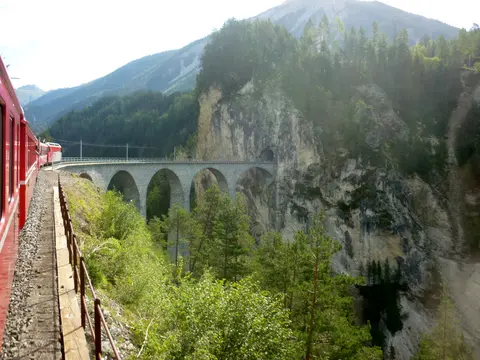
Three Civil Engineering and Trackside Details on the Rhaetian Railway
- Landwasser Viaduct's Curved Cliff-Tunnel Entry: Watch from left-side train windows heading south out of Tiefencastel toward Filisur, or walk the valley viewpoint trail beneath the piers. Three limestone arches swing along a 100-metre radius curve and plunge directly into a black tunnel portal carved sheer into the vertical dolomite rock face.
- Pontresina Track Three Dual-Voltage Overhead Catenary: Look up at the overhead electrical wires and luminous current signs above Platform 3 inside Pontresina station. Because Albula trains use 11-kilovolt alternating current and Bernina lines run on 1,000-volt direct current, operators electrically flip that single track's overhead wire to swap locomotives smoothly.
- Brusio's Open-Air Circular Stone Spiral Viaduct: Lean toward the windows just south of Brusio station before reaching the Italian border at Campocologno. Unlike Bergün's hidden mountain spirals inside rock tunnels, Brusio's arched stone bridge loops completely in open valley air so the track climbs beneath itself on a uniform seven-percent grade.
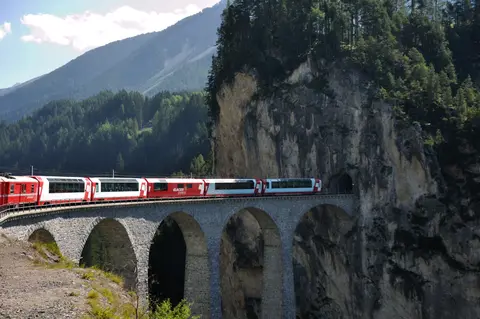
Best Time to Visit the Bernina Express From Zurich or Milano
Choosing the best time to visit bernina express scenery shifts character dramatically across the seasons. Summer and early autumn clear snow off alpine meadows around Preda and Lago Bianco, pairing emerald glacial water at Poschiavo with open hiking along the Bergün-Preda rail history path and Morteratsch Glacier trail. Winter turns the entire corridor into a snowy alpine crossing (launched year-round in 1913 behind timber and concrete avalanche barriers), letting passengers watch snowploughs and frosted conifers from heated carriages. Travellers booking seats often check bernina express tickets official channels early for panoramic windows, though regional red trains traverse identical tracks every hour without reservation surcharges and let riders hop off freely at intermediate passes.
Connections work smoothly from both sides of the Alps. Travellers asking how to get to bernina express from zurich board Swiss Federal Railways standard-gauge services straight into Chur or Landquart to meet narrow-gauge RhB departures up to St. Moritz and onto the bernina express tirano to st moritz sector. From northern Italy, riders taking the bernina express from milan travel standard-gauge RFI regional rails northward through Valtellina into Tirano before stepping across the square onto RhB platforms. Bergamo (BGY, 93 kilometres), Linate (125 kilometres), and Malpensa (129 kilometres) handle major international flights while closer Lugano Airport (LUG, 91 kilometres) serves limited regional services. Visitors wondering what to do after bernina express rides can continue straight south from Tirano into Lombardy via our guide to Milano (126 kilometres) or explore more European heritage routes in the UNESCO World Heritage Atlas.