Quick Field Data
- UNESCO Inscription: 2009 (Ref. 1312), cultural maritime lighthouse in A Coruña, Galicia, northwestern Spain; Criterion (iii).
- Scale & Footprint: 86.12-hectare coastal headland park preserving the 55-metre lighthouse atop a 57-metre rock bluff, sculpture garden, Monte dos Bicos rock carvings and Muslim cemetery.
- Access & Ticketing: Protected as a Spanish National Monument under the Tower Management Plan Monitoring Committee; verify official municipal booking pages for Tower of Hercules tickets and timed interior stair climbs.
- Arrival Logistics: Stands on a peninsula 2.4 kilometres from central A Coruña and its port. Major commercial flights arrive at Santiago-Rosalía de Castro Airport (SCQ), 54 kilometres south, with Madrid 510 kilometres southeast; closer A Coruña Airport (LCG) sits 10 kilometres away with regional links.
Farum Brigantium: First-Century Roman Design by Gaius Sevius Lupus
Guarding the harbour entrance of A Coruña on Galicia's rugged Atlantic coast, the Tower of Hercules holds a singular place in maritime engineering history. Constructed during the late first century AD under Roman rule, it remains the only fully preserved Roman lighthouse still operating for navigation today. Inscribed on 27 June 2009 and designated a National Monument of Spain, the beacon rises 55 metres (180 feet) tall from a 57-metre rocky headland, ranking as Spain's second-tallest lighthouse after Andalusia's Faro de Chipiona. Known until the 20th century as Farum Brigantium, its Latin title farum stems from Greek Pharos, honouring Egypt's celebrated Lighthouse of Alexandria.
Roman builders erected or rebuilt the beacon during the reign of Emperor Trajan, possibly adapting earlier Phoenician coastal signalling foundations and Alexandrian structural plans. A Latin foundation inscription preserved at the tower base reads MARTI AVG.SACR C.SEVIVS LVPVS ARCHITECTVS ÆMINIENSIS LVSITANVS.EX.VO, dedicating the work to Mars Augustus and naming Lusitanian architect Gaius Sevius Lupus from Aeminium, modern Coimbra in Portugal. Unlike the sleek vertical silhouette visible today, the original Roman tower stood shorter and broader at roughly 34 metres (112 feet) high, wrapped by an external spiral access ramp leading fuel supplies upward. Because heavy firewood and oil supplies had to ascend continuously during storms, that rising exterior ramp turned daily lighthouse operation into an engineered masonry spiral rather than an internal stairwell. A domed crowning chamber likely sheltered the open beacon fire atop this thick masonry core, guiding shipping far offshore.
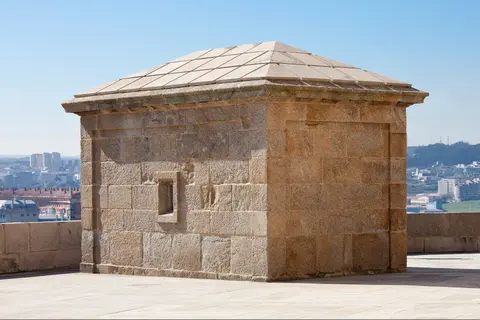
Classical texts confirm the tower's strategic fame along western European sea lanes linking Hispania with Britain across treacherous Atlantic waters. Writing between 415 and 417 AD in Historiae adversum Paganos, historian Paulus Orosius described Brigantia's lofty lighthouse erected among few memorable works for looking towards Britannia. Because Roman geographers saw western Galicia as Finisterra, the figurative end of the Earth, steady coastal illumination helped captains avoid reefs along the shipwreck-prone Costa da Morte. Excavations conducted in the 1990s exposed buried Roman stone foundations together with a small rectangular Roman building sitting immediately adjacent to the tower base, confirming how an entire service compound supported beacon keepers on this exposed cape. That unbroken Atlantic navigation chain continued through medieval trade and modern maritime signalling right into the present century.
Debate persists among regional historians over whether ancient Brigantia lay directly under modern A Coruña or 25 to 26 kilometres inland at Betanzos. Advocates for Betanzos trace phonetic evolution from Brigantium through Breganzo to Betanzos, noting maps and literary accounts up to the 17th century that identified their town as former Brigancia. They also cite King Alfonso IX of León founding a new port in the 13th century at uninhabited Clunia, whose Proto-Celtic meadow root klouni evolved via Cruña into Coruña. Supporters of A Coruña counter that Betanzos's shallow fluvial harbour could never dock Roman warships when Julius Caesar supposedly arrived with more than a hundred triremes, whereas Roman cemeteries and burials survive beneath central A Coruña. Early medieval Viking raids later drove coastal inhabitants inland toward O Burgo in Culleredo, yet Farum Brigantium itself clearly anchored this rocky Atlantic headland from Roman antiquity onward.
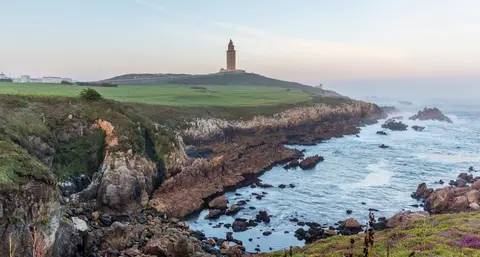
Eustaquio Giannini's 18th-Century Casing and Atlantic Maritime Legends
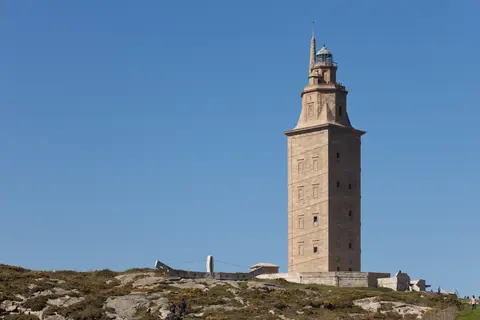
Centuries of Atlantic gales and medieval stone quarrying stripped away the outer spiral ramp, leaving the 34-metre Roman core weathered until Bourbon maritime upgrades began. During the late 18th century, naval engineer Eustaquio Giannini directed an exemplary architectural restoration designed to shield ancient masonry rather than replace it. Giannini wrapped the surviving Roman shaft in crisp neoclassical granite cladding while carving diagonal exterior stone bands faithfully marking the vanished spiral ramp's ascending angle. Above the three ancient vaulted levels he added a 21-metre (69-foot) fourth storey formed from two octagonal tiers supporting the active lantern.
UNESCO evaluators highlighted Giannini's intervention because technical upgrades protected the Roman structural core while keeping the monument continuously working for maritime shipping. Judged as a living technological monument requiring periodic functional renewal, the lighthouse retains authentic first-century walls inside its 18th-century stone casing. Stepping inside the Tower of Hercules today brings visitors straight inside vaulted square stone rooms where much-repaired Roman and medieval walling remains directly visible. Three chambers per level divide internal space around a stout masonry spine engineered to withstand fierce winter Atlantic gales across nearly two millennia. Regular conservation tracking sustains both historic stonework and modern navigational lamps working together above the cape.
Two thousand years of Atlantic seafaring turned this Galician beacon into a vessel for Greco-Roman, Celtic and medieval pilgrimage legends. One enduring myth merges Celtic and classical motifs, telling how Hercules battled the giant tyrant Geryon for three days and nights before slaying him, burying his head with his weapons, and ordering a town built overhead. That legend still defines A Coruña's municipal coat of arms, portraying the lighthouse above a skull and crossbones symbolising Geryon's head. Later medieval crusader naval accounts including De expugnatione Lyxbonensi and De itinere Frisonum misread ancient stones to credit Julius Caesar, recording Holy Land fleets disembarking here to walk inland toward Santiago de Compostela.
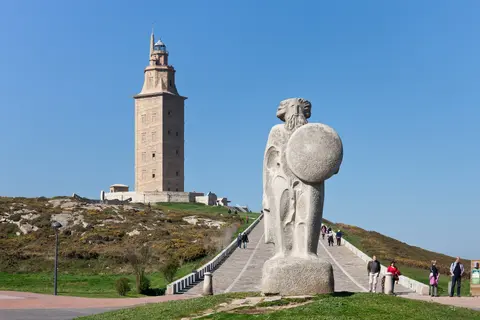
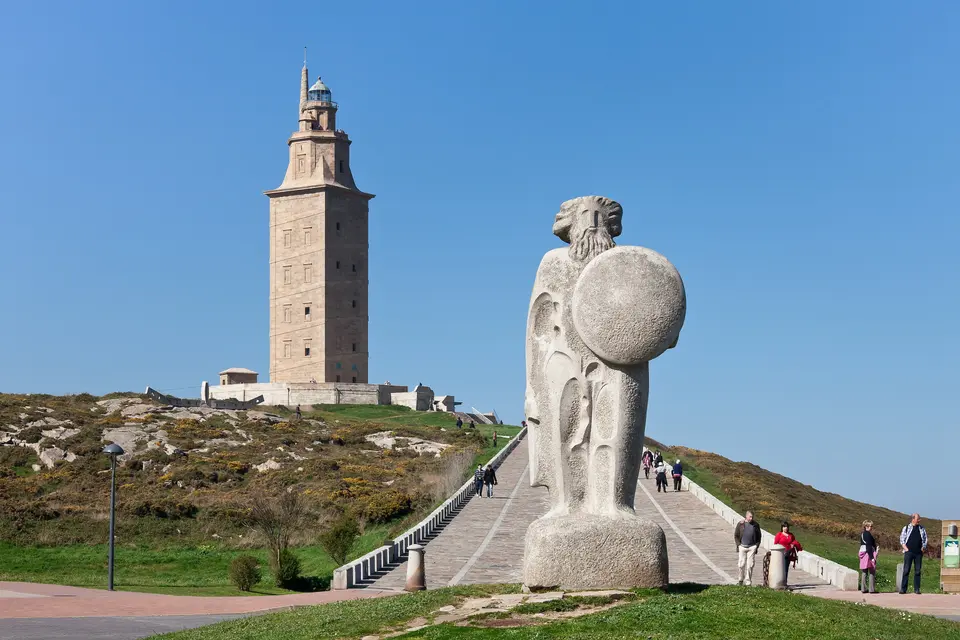
An equally famous Galician-Irish origin story appears in the 11th-century Irish compilation Lebor Gabála Érenn, the Book of Invasions. According to its narrative, Celtic founder King Breogán built a tower so lofty that his sons spotted a distant green coast northward across the sea and sailed forth to populate Ireland. According to that tale, Breogán's descendants remained in Ireland as Celtic ancestors of modern Irish communities. A monumental granite statue of King Breogán now stands sentinel along the approach walk near the lighthouse, connecting Celtic Atlantic lore with Roman engineering.
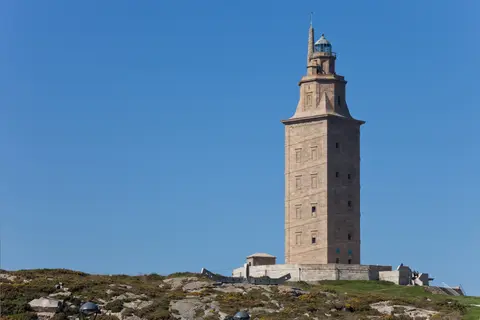
Headland Sculpture Park, Monte dos Bicos Carvings, and Site Care
Protecting 86.12 hectares around the headland shields the coastal horizon from urban high-rises and waterfront sprawl. Across windy Atlantic lawns spreads an outdoor sculpture garden displaying modern figurative and abstract pieces by Spanish sculptors Pablo Serrano and Francisco Leiro facing ocean cliffs. Embedded in headland granite sit Iron Age rock carvings at Monte dos Bicos together with an old Muslim cemetery and scenic coastal walking loops. Wandering the open peninsula shows how prehistoric carvers, Roman surveyors, medieval mariners and modern sculptors each marked the same Atlantic headland.
Careful statutory stewardship balances heavy coastal footfall with delicate masonry conservation under Spain's national heritage laws. The Tower Management Plan Monitoring Committee conducts scientific checks on granite desalination, mortar erosion and structural damp inside salt-sprayed Atlantic air. Strengthening the coordinating authority of that monitoring committee continues improving visitor routing, parking edges, educational signage and archaeological care across the wider 86.12-hectare peninsula park. Clear coastal footpaths keep hikers safely away from fragile Iron Age outcrops while maintaining uninterrupted access around active maritime beacon equipment.
Access Zones Around the Tower of Hercules Peninsula
Exploring the lighthouse headland takes one to two hours on foot along coastal promenades leading north from central A Coruña. Check official municipal tourism notices for Tower of Hercules tickets, stair climb capacity limits and windy-weather restrictions before heading out.
| Complex Zone | Key Highlights | Access & Ticket Rule |
|---|---|---|
| Lighthouse Base & Roman Foundations | 1990s excavated Roman footings, rectangular service structure and Latin inscription naming Gaius Sevius Lupus. | Open exterior platform around the square granite shaft; follow protective barriers around excavated stonework. |
| Interior Roman Vaults & Lantern Balcony | 34-metre Roman masonry interior chambers, Giannini's 21-metre octagonal upper stages and Atlantic sea panorama. | Timed interior ascent via stairways; verify Tower of Hercules tickets and storm closures on official notices. |
| Headland Sculpture Park & Breogán Statue | Monumental statue of King Breogán, works by Pablo Serrano and Francisco Leiro and cliffside walking trails. | Free open parkland paths along the 86.12-hectare peninsula; stay behind cliff safety boundaries in high winds. |
| Monte dos Bicos & Muslim Cemetery | Iron Age rock carvings and historic burial grounds tucked across coastal slopes northeast of the tower. | Accessible by marked footpath loops across the reserve; avoid stepping directly onto carved rock outcrops. |
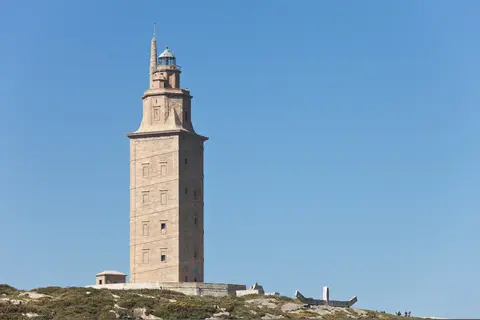
Three Roman and Neoclassical Masonry Details at the Lighthouse
- Diagonal Exterior Ramp Banding Across Granite Cladding: Trace the angled stone ribs wrapping Eustaquio Giannini's 18th-century facade, intentionally echoing the vanished Roman external spiral ramp upward.
- Cornerstone Dedicatory Inscription to Mars Augustus: Inspect the protected Latin stone near the tower base recording Lusitanian architect Gaius Sevius Lupus of Aeminium from the late first century AD.
- Exposed Roman Core Masonry Inside Lower Vaults: Climb inside the square chambers to observe coarse first-century Roman stone courses and doorway arches preserved safely within neoclassical walls.
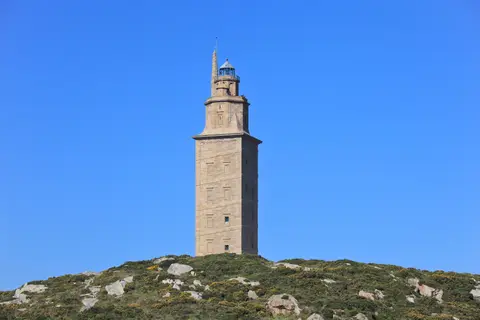
Visiting Inside the Tower of Hercules From A Coruña Cruise Port
Cruisers and city day-trippers figuring out how to get to Tower of Hercules from cruise port docks face a short coastal transfer of roughly 2.4 kilometres from central A Coruña. City buses, taxis and waterfront promenades trace the peninsula edge north from downtown plazas straight past coastal beaches to the sculpture park lawns. Because timed entry slots regulate narrow interior staircases, securing Tower of Hercules tickets ahead via official municipal channels prevents waiting in exposed coastal winds. Early mornings and late sunsets illuminate granite faces warmly while leaving Atlantic walkways uncrowded. Clear seasonal weather allows clear seaward views along northern shipping lanes, though Atlantic squalls bring sudden spray across outer paths.
Stepping inside the tower rewards visitors with both close-up views of intact first-century Roman masonry and sweeping panoramas across Galicia's Rías Altas bays and A Coruña harbour. Combining the lighthouse ascent with walks through A Coruña's old town streets, glass-balconied harbour avenues and regional beaches fills a half-day comfortably. Visitors arriving by coastal rail, cruise ship or rental vehicle can circle the peninsula headland after sunset to watch the active beam sweeping Atlantic approaches much as ancient oil fires did nearly two millennia ago. Longer Galician tours frequently pair this northern Atlantic landmark with inland Betanzos, coastal Costa da Morte headlands or historic pilgrim routes running south toward Santiago de Compostela.
Air travellers arriving across northwestern Spain fly mainly into Santiago-Rosalía de Castro Airport (SCQ), 54 kilometres south, linked northward by rail and highway straight into A Coruña. Closer A Coruña Airport (LCG) operates just 10 kilometres south of the centre with narrower domestic routes, while overland rail corridors connect southeast toward Madrid (510 kilometres away). Checking coastal tide forecasts and seasonal municipal opening times ahead makes combining the lighthouse climb with harbourside walks smooth and memorable. Explore further Roman engineering landmarks across Iberia inside our UNESCO World Heritage Atlas.