Quick Field Data
- UNESCO Inscription: Inscribed in 2013 (Ref. 1387) as a Cultural site under Criteria (ii) and (iv).
- Scale & Footprint: Encompasses 36.2 hectares split between the hilltop Alta quarter around the Royal Palace of Alcáçova and the lower valley monastic colleges along Rua da Sofia.
- Access & Ticketing: Historic courtyards, streets along Rua da Sofia, and campus squares open free on foot. Entering Biblioteca Joanina, Saint Michael's Chapel, the Royal Palace halls, and the Botanical Garden uses timed university of coimbra tickets checked on official university channels.
- Arrival Logistics: Major commercial flights arrive at Francisco de Sá Carneiro Airport in Porto (OPO, 117 kilometres north), while smaller Viseu Airport (VSE, 73 kilometres northeast) carries limited regional flights. Mainline rail and road routes connect swiftly north to Porto (106 kilometres).
Royal Charters, Lisbon Transfers, and the Permanent Move to Coimbra
Standing high above the Mondego River, the historic university of coimbra portugal represents one of Europe's oldest continuously operating seats of higher learning. King Dinis established the original Studium Generale (Estudo Geral) in Lisbon by his royal charter Scientiae thesaurus mirabilis dated 1 March 1290, following preparations begun by 1288. Pope Nicholas IV ratified the charter on 9 August 1290, authorising Faculties of Arts, Law, Canon Law, and Medicine as the second oldest university on the Iberian Peninsula. Yet medieval tensions between students, townsfolk, and royal authority pushed the young institution back and forth across the country during its first two centuries.
In 1308, strains over church autonomy and street conflicts drove the university north to Coimbra, already respected for scholarly instruction at the twelfth-century Monastery of Santa Cruz, occupying ground around Estudos Velhos where the main library later rose. King Afonso IV shifted classes back to Lisbon in 1338 before returning them to an expanding Coimbra in 1354. Another royal decree under King Fernando transferred the faculties to Lisbon in 1377, where they stayed for over a century and a half and gained papal permission for Theology around 1380. Finally, in 1537 under King João III (1521 to 1557), the crown moved every faculty and the entire royal book collection permanently to Coimbra, installing scholars inside the hilltop Royal Palace of Alcáçova, formally purchased from the royal family in 1597.
That sixteenth-century relocation triggered sweeping pedagogical reform designed to place Portuguese scholarship beside Paris and Salamanca. King João III recruited eminent canonists, theologians, and physicians from Spanish and European centres. Scholars included Martín de Azpilcueta, Manuel de Costa, and Antonio Francisco Suárez in Law, plus Alfonso de Prado and Antonio de Fonseca in Theology. Physicians Francisco Franco and Rodrigo Reinoso taught Medicine while Scottish Latinist George Buchanan joined the College of Arts before Jesuit masters absorbed the college and compiled the eleven-volume Cursus conimbricenses commentary on Aristotle. For vast spans (1290 until Évora opened in 1559, and 1759 to 1911 when Lisbon and Porto launched universities), Coimbra functioned as Portugal's sole university. Alumni over the centuries include statesmen, Prime Ministers, Presidents, national poet Luís de Camões, mathematician Pedro Nunes, and Nobel laureate António Egas Moniz.
Two later upheavals physically remade the campus without erasing its medieval core. Following the 1759 expulsion of the Jesuits, Enlightenment reforms led by the Marquis of Pombal under King José I, chartered in December 1770, reorganised the university by adding Faculties of Mathematics and Natural Philosophy. Former Jesuit buildings passed to Medicine for clinics and laboratories while new chemistry laboratories, an astronomical observatory, a publishing press, and the Botanical Garden expanded across Alta. Nearly two centuries later, between the 1940s and 1960s under Estado Novo urban programmes, planners rebuilt large sections of the Alta hill into monumental modernist faculty buildings around the medieval palace. After deferring adoption slightly from 2006 to maintain academic quality, Coimbra completed transition into Europe's Bologna Process system across all eight faculties in 2008 to 2009.
Biblioteca Joanina, Enlightenment Laboratories, and Sofia Street Colleges
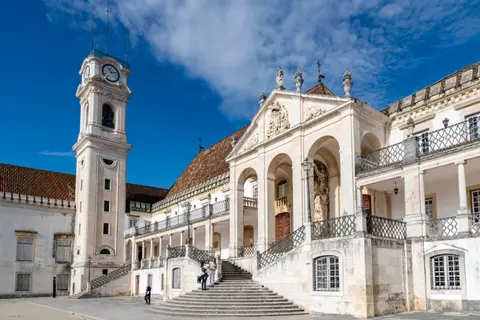
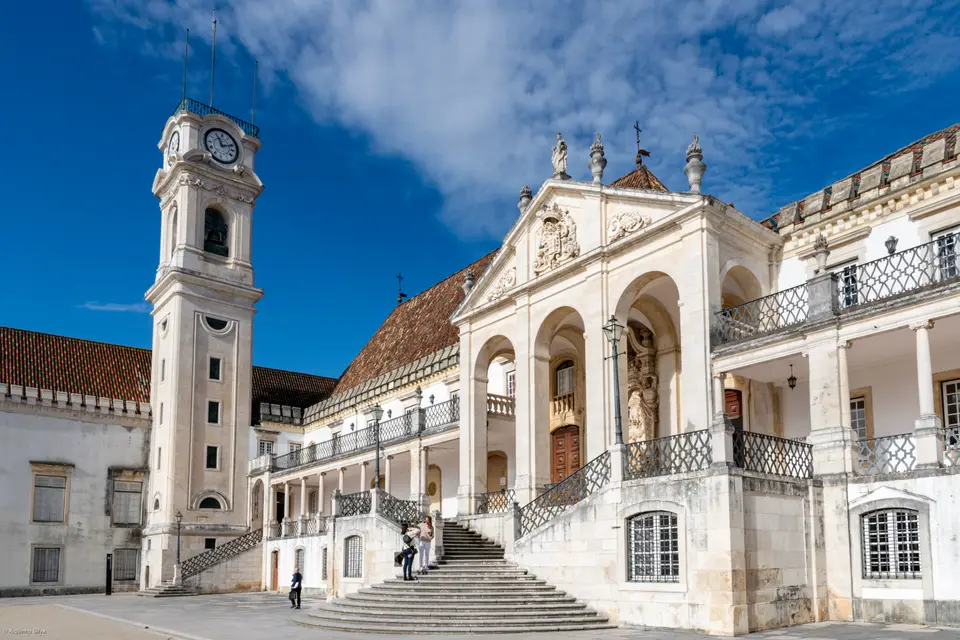
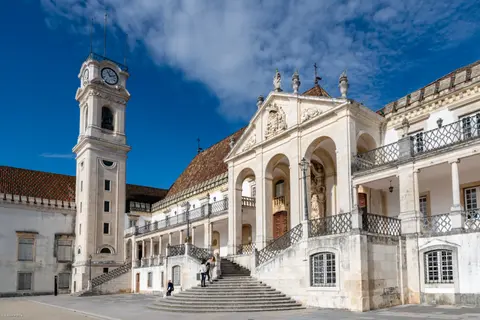
Today Coimbra operates as a lively working academy enrolling roughly 25,000 students across eight faculties, with more than 15 percent coming from abroad. The eight faculties cover Letters, Law, Medicine, Sciences and Technology (the largest by student and classroom numbers), Pharmacy, Economics, Psychology and Education Sciences, and Sports Sciences and Physical Education. Beyond the historic hilltop core of Pólo I, modern expansion added engineering at Pólo II (1990s to 2000s), medicine and the university teaching hospital HUC at Pólo III (1980s to 2000s), Economics (1970s), and Sports Sciences, plus Portugal's National Legal Medicine Institute. Around the central courtyard stand the sixteenth-century Royal Palace halls, Saint Michael's Chapel, the Via Latina ceremonial gallery, the university clock tower, the Gil Vicente Academic Theatre, and museums of science, sacred art, and academic history.
Standing directly on the courtyard edge, the celebrated university of coimbra library opened during Europe's Enlightenment after King John V launched building works between 1717 and 1728 before the first books arrived in 1750. Originally named the Casa da Livraria, the university of coimbra biblioteca joanina rises across three floors holding over 70,000 historic volumes on its main upper galleries and roughly 200,000 to 250 thousand works overall spanning sixteenth- to eighteenth-century law, geography, medicine, philosophy, and theology. Entering beneath the national coat of arms, visitors cross three grand halls joined by gilded arches. Painted ceilings by Simões Ribeiro and Vicente Nunes pair with exotic Brazilian woods lacquered in chinoiserie motifs by Portuguese artists and Domenico Duprà's 1725 portrait of King John V.
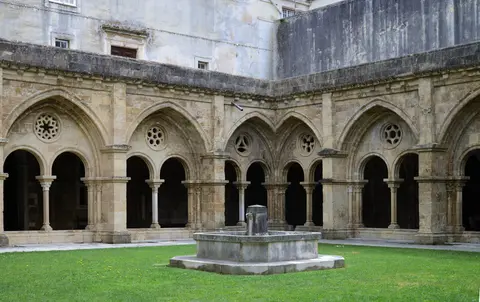
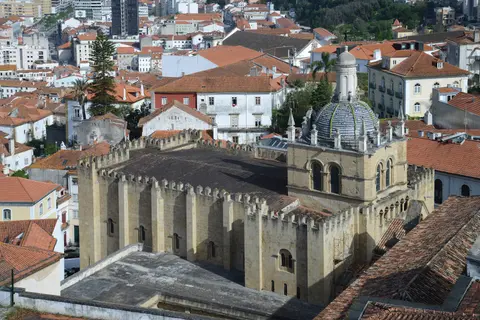
Beyond the library's thick stone shell, the World Heritage perimeter drops down the hill to encompass the sixteenth-century avenue of Rua da Sofia and historic religious colleges lining the lower town. Along the upper slopes rise sixteenth- and seventeenth-century colleges including Jesus, Holy Trinity, St. Jerome, St. Benedict, St. Anthony of the Quarry, and St. Rita. Down along flat Rua da Sofia stand the twelfth-century Cathedral of Santa Cruz and a cohesive sequence of monastic colleges. Notable lower facades include St Michael (later seat of the Inquisition and old Royal College of the Arts), Holy Spirit, Our Lady of Carmel, Our Lady of Grace, St Peter of the Third Order, St Thomas, New St Augustine, and St Bonaventure. Protecting both upper palaces and lower monastic alleys relies on Law 107/2001, Decree-Law 309/2009, and the Association RUAS uniting university, municipal, and cultural heritage managers.
Global Lusophone Academic Networks and Historic Town Integration
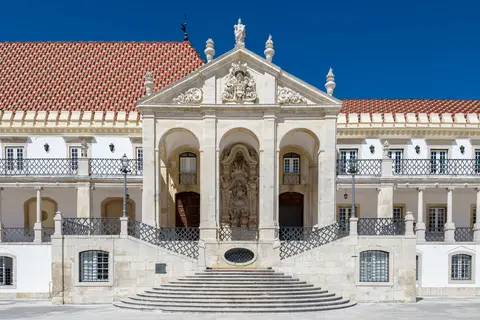
What distinguishes Coimbra from secluded cloistered campuses is total architectural and civic fusion with its surrounding town. Because faculties expanded organically from the 1537 Royal Palace through religious college streets down into the Santa Cruz quarter, urban facades along Rua da Sofia mirror academic administration directly in stone. Every reform wave, from humanist Renaissance and Enlightenment science to twentieth-century state architecture, left a tangible layer inside the same 36.2-hectare urban perimeter. Governance overseen by the Rector, Senate, University Assembly, and Administrative Council coordinates directly with municipal planning boards to curb surface parking, refine vehicular rules, and protect hilltop silhouettes from oversized modern construction nearby.
Beyond Portugal's borders, Coimbra's rules, governance traditions, and courtyard design served as the institutional prototype for higher education across former Portuguese territories in Brazil, Africa, and Asia. That enduring role in cultivating Portuguese literature, scientific publishing through the eighteenth-century University Press, and European scholarly exchange continued in 1985 when Coimbra helped establish the Coimbra Group of historic European research universities. Today, museums of sacred art, academic history, and science sit directly beside active teaching halls, keeping ceremonial student culture and research work alive inside one living hilltop district.
Access Zones Across Coimbra's Alta and Sofia Campus
Coimbra's 36.2-hectare World Heritage zone splits geographically between the steep Alta hilltop campus and the flat lower boulevard of Rua da Sofia. Timed ticket slots govern historic library interiors, whereas exterior courtyards, gardens, and lower streets remain easy to navigate on foot.
| Complex Zone | Key Highlights | Access & Ticket Rule |
|---|---|---|
| Paço das Escolas & Royal Palace of Alcáçova. | Historic royal palace courtyard, Via Latina gallery, Saint Michael's Chapel, ceremonial halls, and hilltop overlooks over the Mondego. | Open exterior courtyard access stays free during daytime periods. Indoor ceremonial rooms require official timed university passes. |
| Biblioteca Joanina (Baroque Library). | 1717 to 1728 three-room Baroque book vault with gilded South American woodwork, chinoiserie lacquer, and rare historic volumes. | Strict capacity protection uses timed university of coimbra library tickets booked online or at campus desks in advance. |
| Eighteenth-Century Alta & Botanical Garden. | Marquis of Pombal chemistry laboratories, Science Museum, Astronomical Observatory, University Press, and 1940s faculty plazas. | Campus avenues and main Botanical Garden terraces welcome walkers freely. Science Museum galleries sell separate entry passes. |
| Rua da Sofia & Santa Cruz Colleges. | Twelfth-century Santa Cruz Monastery and sixteenth-century colleges including Carmo, Graça, Santo Agostinho, and São Tomás. | Public avenue and church portals remain open on foot. Individual monastic cloisters follow separate parish or municipal schedules. |
Three Architectural and Preservation Details at Coimbra's Historic University
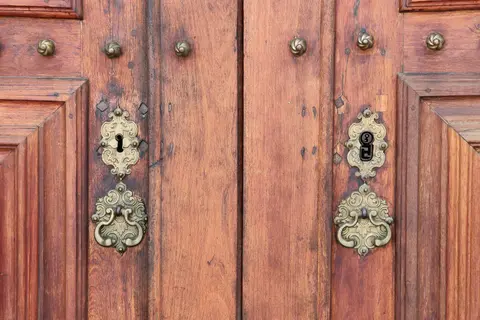
- Two-Metre Stone Vault Walls and Teak Door at Biblioteca Joanina: Step through the carved portal of the Baroque library and notice the massive depth of its stone entrance jambs and dense teak door. Measuring roughly 2.11 metres thick, the masonry blocks summer heat and winter chills, holding interior temperatures steady between 18 and 20 degrees Celsius at around 60 percent relative humidity.
- Oak Bookcases and Nocturnal Bat Colony Conservation: Look closely at the dense oak shelving supporting gilded exotic South American woods inside the three reading chambers. Oak emits a natural scent that deters paper-eating insects, while a resident colony of bats emerges nightly to consume stray pests after workers drape heavy leather sheets across every reading table.
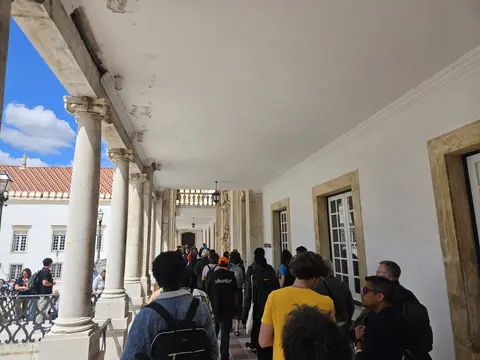
- Via Latina Ceremonial Portico Above Paço das Escolas: Walk up the broad limestone staircase to the arched colonnade running along the Royal Palace facade. Built so Latin served as the sole spoken scholarly tongue inside the campus enclosure, this elevated gallery frames Coimbra's historical transformation from medieval royal citadel into Portugal's national university.
How to Get to Coimbra University From Porto and Timing Campus Visits
Travellers checking how to get to coimbra find the city set midway between Lisbon and Porto along Portugal's main Atlantic rail and motorway spine. Once at the town's lower riverfront stations, knowing how to get to coimbra university simply means climbing uphill on foot or taking local city buses from Rua da Sofia straight up into the steep Alta quarter. Visiting mid-week during the academic year shows 25,000 students moving between lectures across historic courtyards, while booking an official university of coimbra tour or timed entry slot well ahead prevents disappointment at Biblioteca Joanina during busy summer months.
Spring and early autumn deliver comfortable hill walking weather between the Botanical Garden, lower Rua da Sofia cloisters, and steep stone stairs leading up to Paço das Escolas. Together, the hilltop royal library, Enlightenment museum halls, and monastic college street show how centuries of academic tradition shaped an entire Portuguese hill town. International visitors arrive most conveniently via Francisco de Sá Carneiro Airport in Porto (OPO, 117 kilometres north), noting that Aerodromo Goncalves Lobato in Viseu (VSE, 73 kilometres) carries strictly limited regional flights. Pair Coimbra smoothly with northern Portugal's Atlantic hub using our guide to Porto (106 kilometres north) or compare historic European universities across the UNESCO World Heritage Atlas.