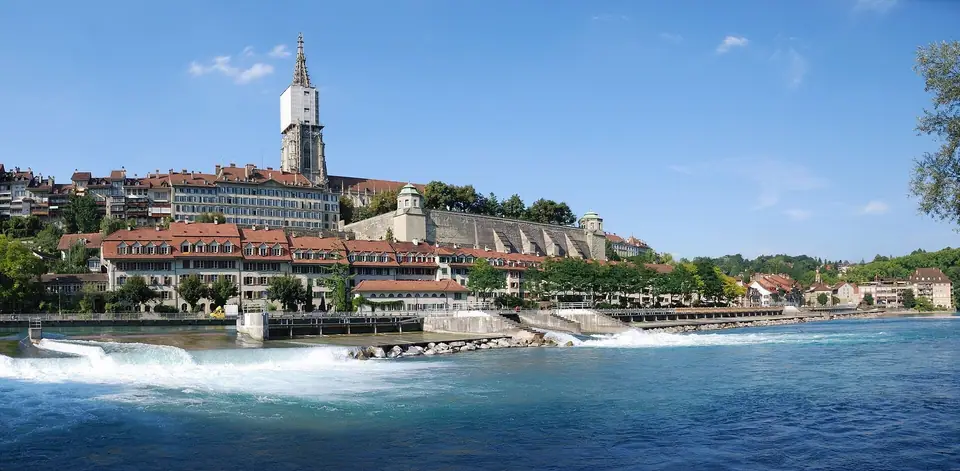
Bern Minster, Münsterplattform & Nydeggkirche: Gothic Spires Above the Aare
Inside the 100.6-metre late-Gothic Bern Minster, Erhart Küng's 294-figure Last Judgement portal, the chestnut-shaded Münsterplattform, and the 1341 Nydeggkirche.
Rising above the southern rooftops of the Old Town, the Bern Minster (Berner Münster) is the largest late-Gothic church in Switzerland and the defining vertical landmark of the city skyline. Together with the chestnut terrace of the Münsterplattform beside it and the smaller Nydeggkirche at the eastern tip of the peninsula, it traces Bern's religious evolution from a thirteenth-century castle chapel to a Protestant collegiate church. Pair your visit with a walk along Kramgasse and Gerechtigkeitsgasse or take the Mattelift down to the Matte riverfront.
Approaching Münsterplatz through the narrow arcades of Münstergasse or Kramgasse creates a dramatic spatial contrast: the low vaulted walkways suddenly open onto a quiet square framed by patrician palaces, the Moses Fountain, and the soaring openwork stone masonry of the western belfry.
From the 1421 Foundation Stone to Daniel Heintz's Nave Vaults
After an earlier Romanesque chapel and thirteenth-century church proved too small for the expanding city-state, Bern summoned Ulm cathedral master Matthäus Ensinger to lay the foundation stone of the new three-aisled sandstone basilica on 11 March 1421. Construction continued until Daniel Heintz completed the 18-metre-high reticulated groin vaults of the central nave in 1573.
Inside the nave, those late-Gothic net vaults carry painted bosses displaying the heraldic shields of Bernese patrician families and allied cantons. Because the city adopted the Protestant Reformation in 1528 and removed the side altars and saints' relics, the interior feels bright, austere, and unified, drawing the eye directly down the sandstone piers toward the choir. Carved stone pulpits, memorial tablets, and historic organ cases along the aisles reflect five centuries of civic and liturgical craftsmanship.
Completing the 100.6-Metre Spire in 1893
Because weak subsoil beneath the western tower showed cracks, builders halted the belfry at roughly 55 metres in 1598. Between 1889 and 1893, cathedral architect Eduard von Rodt followed neo-Gothic plans by August Beyer to crown the octagonal upper belfry and openwork spire at 100.6 metres, making it the tallest church tower in Switzerland. From across the Aare gorge on the Kirchenfeldbrücke or the Rosengarten hillside, that delicate stone pinnacle anchors every view of the UNESCO World Heritage peninsula.
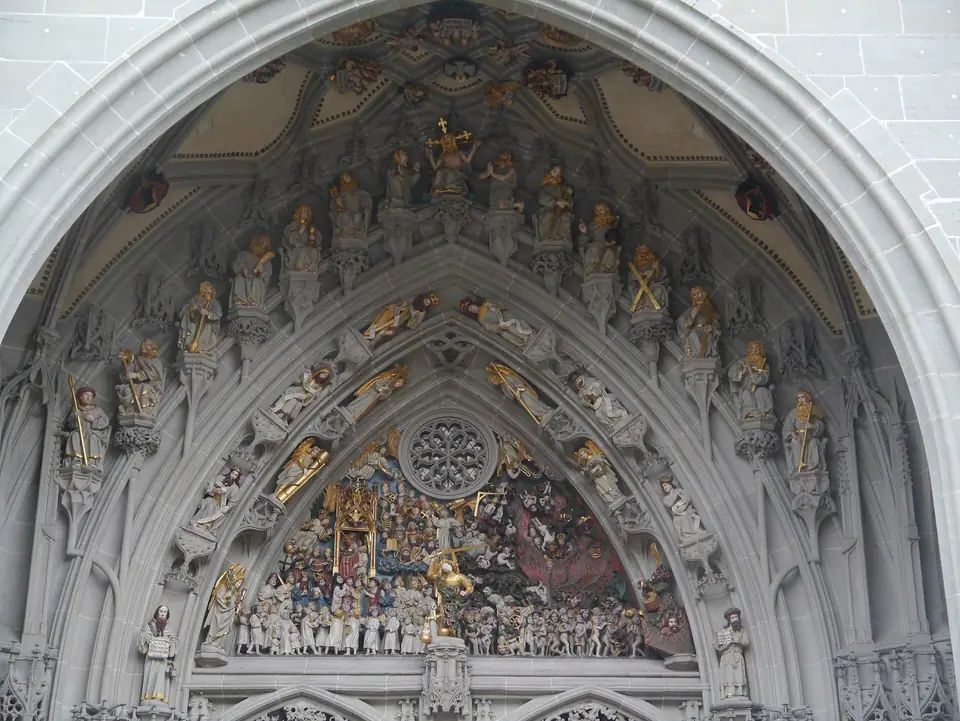
Erhart Küng's 294-Figure Last Judgement Portal
Whereas the Protestant Reformation of 1528 stripped the Minster's side altars, the west portal's sandstone sculpture of the Last Judgement survived intact. Carved between 1460 and 1485 largely by Westphalian master Erhart Küng, the tympanum and archivolts contain 294 figures (47 freestanding statues and 247 smaller reliefs) separating the clothed elect on Christ's right from the naked damned on his left, flanked by the Wise and Foolish Virgins.
Standing beneath the western porch allows you to inspect the expressive facial details, flowing drapery, and polychrome paint traces on the prophets, apostles, angels, and demons arching overhead, while the central figure of Archangel Michael weighs souls on his balance right at eye level above the doors. Because the porch was sheltered from direct weather by the deep western bay, the medieval carving retains remarkable crispness.
Fifteenth-Century Choir Stained Glass and the 312 Tower Steps
Inside the choir, 85-square-metre fifteenth-century stained-glass windows, including the Ten Thousand Martyrs, the Three Kings, and the doctrinal Host Mill Window (1448 to 1453), glow above Renaissance choir stalls carved by Jacob Ruess and Heini Seewagen between 1522 and 1525. Climbing 254 steps reaches the lower viewing gallery at 46 metres, and 312 steps reach the upper gallery at 64 metres beside the 9.94-ton Grosse Glocke cast in 1611.
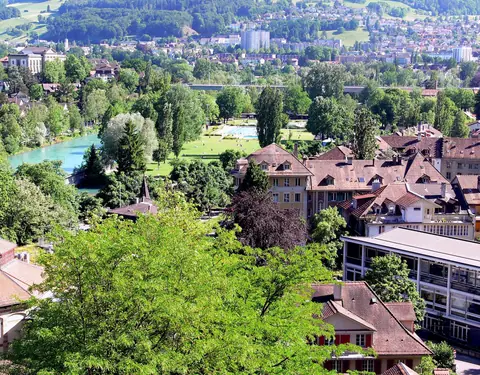
The spiral stone ascent inside the belfry is well worth the effort on a clear morning: from the outer stone balustrade, you look straight down onto the geometric pattern of red-tiled Old Town roofs, the curving green loop of the Aare, and the distant white wall of the Bernese Alps.
Münsterplattform Terrace and the 1897 Mattelift
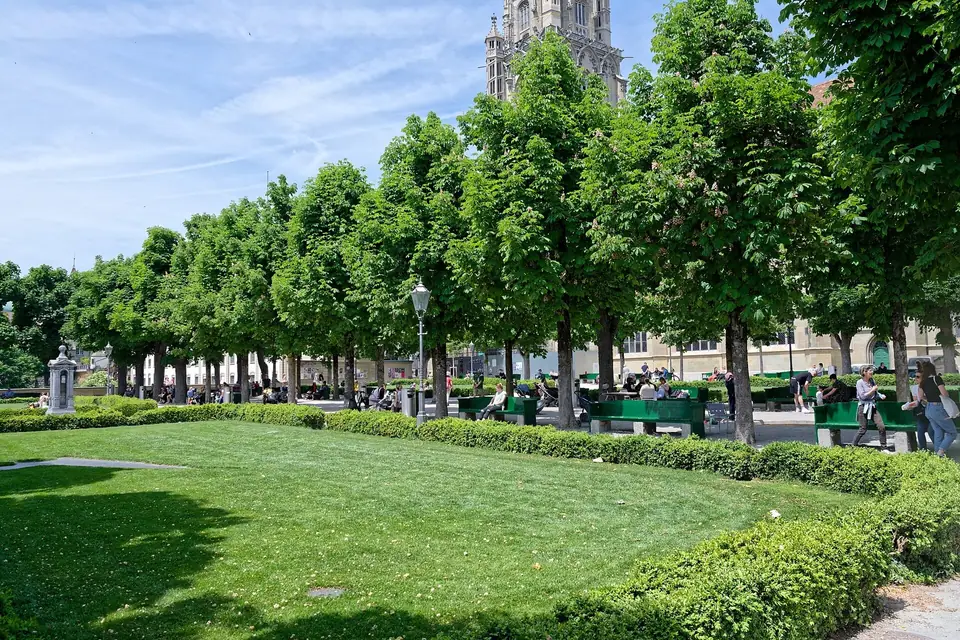
South of the Minster, the Münsterplattform was engineered between 1334 and 1514 by raising a 22-metre sandstone retaining wall and filling the slope as the former cemetery before being planted with horse chestnuts. Its balustrade looks straight down over the Matteschwelle weir and the Matte, linked to the terrace by the 183 wooden steps of the fourteenth-century Mattentreppe and the electric Mattelift opened in 1897.
Today the shaded gravel alleys of the terrace host open-air café tables, boules players, and regular craft markets, offering one of the calmest vantage points over the Kirchenfeldbrücke and the southern riverbanks.
The Nydeggkirche on the Zähringer Castle Site
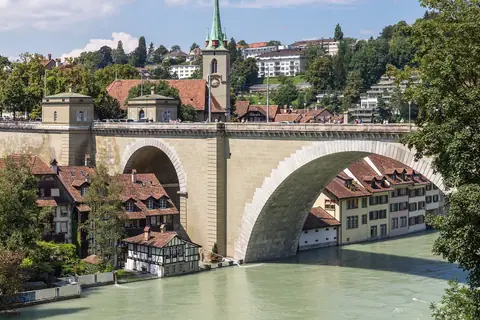
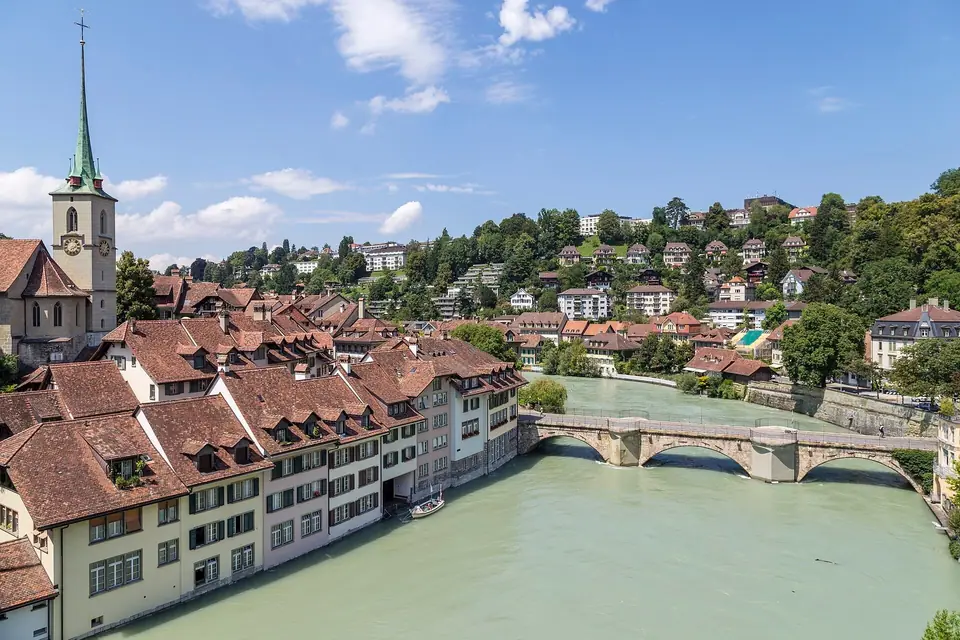
At the eastern end of Gerechtigkeitsgasse, the Reformed Nydeggkirche stands on the foundations of Duke Berchtold V's twelfth-century Nydegg Castle, demolished around 1268; built from 1341 to 1346 and enlarged between 1480 and 1504, it features bronze relief doors cast by Franz Fischer in 1956 beside the Nydeggbrücke.
Connecting the Minster Quarter with the Eastern River Loop
After visiting the Nydeggkirche, descend the cobbled courtyard steps to the medieval Untertorbrücke or continue across the high bridge to the bear enclosures and rose gardens. Walking along Münstergasse and Herrengasse on the return loop also reveals quiet patrician courtyards and the historic burger library; check our 3-day Bern itinerary for step-by-step routing through the lower Old Town.
Visitors planning to climb the spiral stone staircase of the Minster belfry should wear comfortable walking shoes and allow plenty of time to pause at the intermediate gallery before continuing to the upper viewing platform. Inside the octagonal belfry chamber, timber beams and iron frames support the historic bells cast for the protestant city-state, and exhibitions along the ascent explain how nineteenth-century masons reinforced the lower piers to carry the neo-Gothic openwork spire.
Back at ground level on Münsterplatz, take a moment to admire the surrounding patrician facades, including the late-Gothic and Baroque townhouses that frame the quiet square. Unlike the commercial bustle of Marktgasse and Spitalgasse, the streets immediately around the collegiate church and down along Herrengasse maintain a contemplative, scholarly atmosphere suited to slow architectural walks.
If you continue eastward down to the Nydeggkirche and the river crossing, notice how the steep terrain drops away on three sides of the church courtyard, showing why the medieval Zähringer dukes chose this narrow rocky spur for their initial fortress above the river ford. Shaded stone benches around the church portals offer a peaceful place to rest before crossing the bridge.
Traveller tips
Real advice from people who have been to Bern Minster, Münsterplattform & Nydeggkirche: Gothic Spires Above the Aare. Every tip is read by our team before it goes live.
No tips yet. Been here? Yours could be the first.
Thank you! Your tip will appear here after a quick review.
More in Bern
Continue exploring Bern with related neighbourhood, food, and planning guides