


























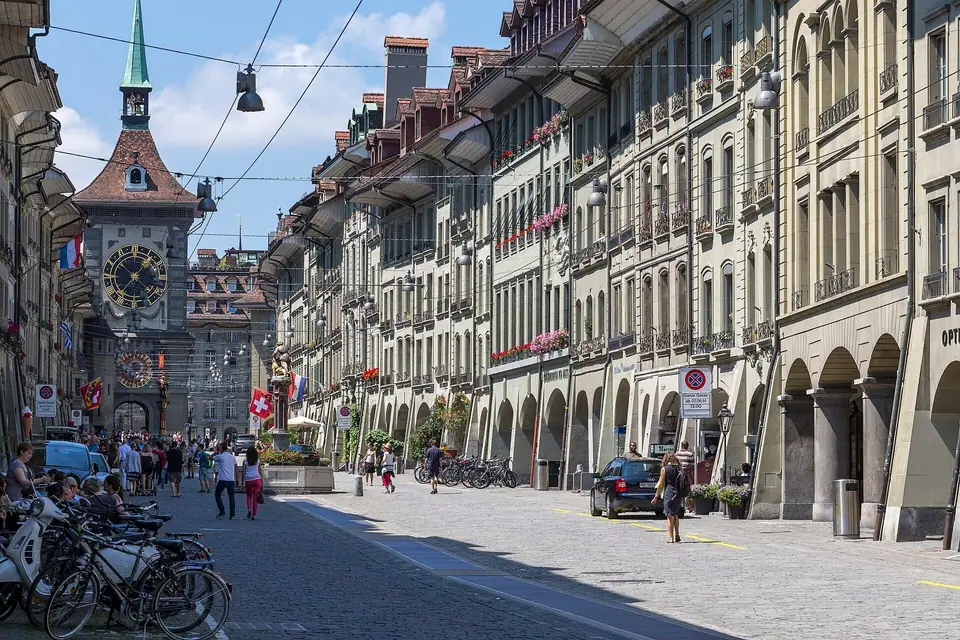
Old Town Arcades, Kramgasse, Zytglogge & Bern's Renaissance Fountains
Walking Bern's six kilometres of covered sandstone Lauben, the 1530 Zytglogge astronomical clockwork, and Hans Gieng's painted Renaissance street fountains.
Inscribed on the UNESCO World Heritage List in 1983, the Old Town of Bern (Innere Stadt) owes its visual unity to local stone. After the fire of 14 May 1405 reduced the medieval timber town to ash, the council mandated reconstruction in greenish-grey sandstone quarried at Ostermundigen and Krauchthal. Builders projected the upper storeys over continuous ground-floor arcades supported by stone piers and groin vaults, creating six kilometres of sheltered walkways known as the Lauben. Combine this walk with the Bern Minster and the Einstein House at Kramgasse 49.
Walking the full length of the central ridge reveals how carefully medieval and Baroque masons harmonized private townhouses with public infrastructure. Deep roof overhangs known as Himmel protect the upper facades from driving rain, while stone window jambs, carved family coats of arms, and ornamental iron grilles lend subtle variety to the uniform olive-grey masonry.
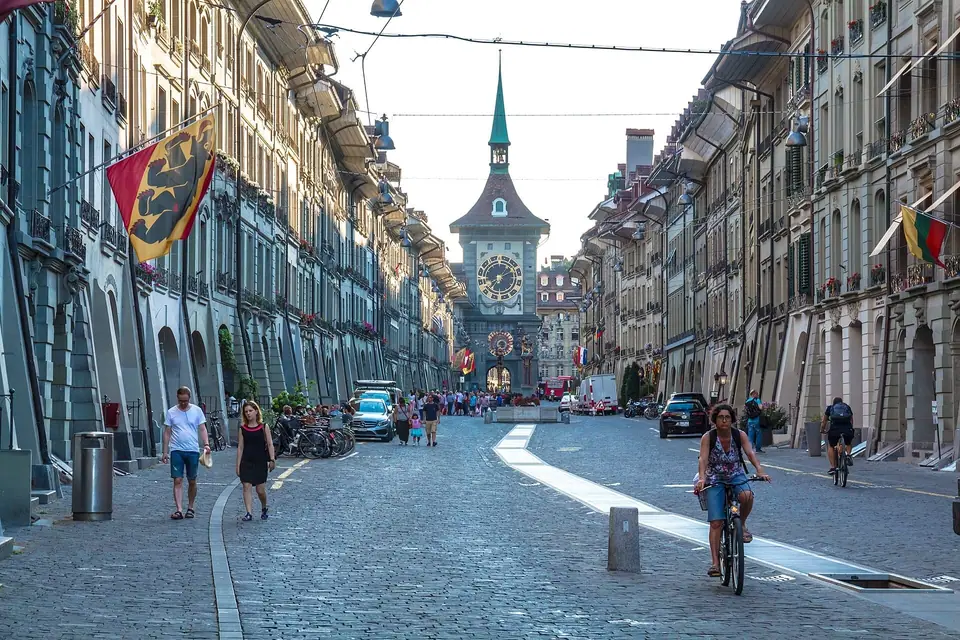
The Zytglogge: Guard Tower, Women's Prison, and Timekeeper
Standing at the western boundary of the 1191 Zähringer foundation, the 54.5-metre Zytglogge was erected between 1218 and 1220 as a hollow gate tower, raised after the 1256 Savoy expansion, used as a women's prison (for priests' mistresses, called Pfaffendirnen) after 1344, and converted into the city's central timekeeper after the 1405 fire. Because all official distance measurements across the canton radiated outward from its archway, the tower functioned for centuries as the geographical and civic zero point of the republic.
Look closely at the stone passage beneath the tower: painted murals, historic length standards set into the wall, and the contrast between the broad western facade facing Marktgasse and the ornate eastern clock face overlooking Kramgasse show how the medieval fortification adapted as the city grew around it.
Kaspar Brunner's 1530 Clockwork and Astronomical Dial
Between 1527 and 1530, smith master Kaspar Brunner forged the wrought-iron clock mechanism that still ticks inside the tower today. On the eastern facade facing Kramgasse, the astrolabe dial tracks the sun, moon phases, zodiac signs, and weekday, while a mechanical rooster, fool, armoured bears, Father Time (Chronos), and the gilded knight Hans von Thann perform four minutes before every hour.
Visitors who book an interior tour can climb the worn spiral steps behind the dial to stand beside Brunner's heavy iron frame, where ropes, stone counterweights, and hand-forged gear wheels drive both the exterior hands and the mechanical figures. From the upper louvred windows beneath the spire, you can also look straight down the curving roofs of Kramgasse toward the eastern river loop.
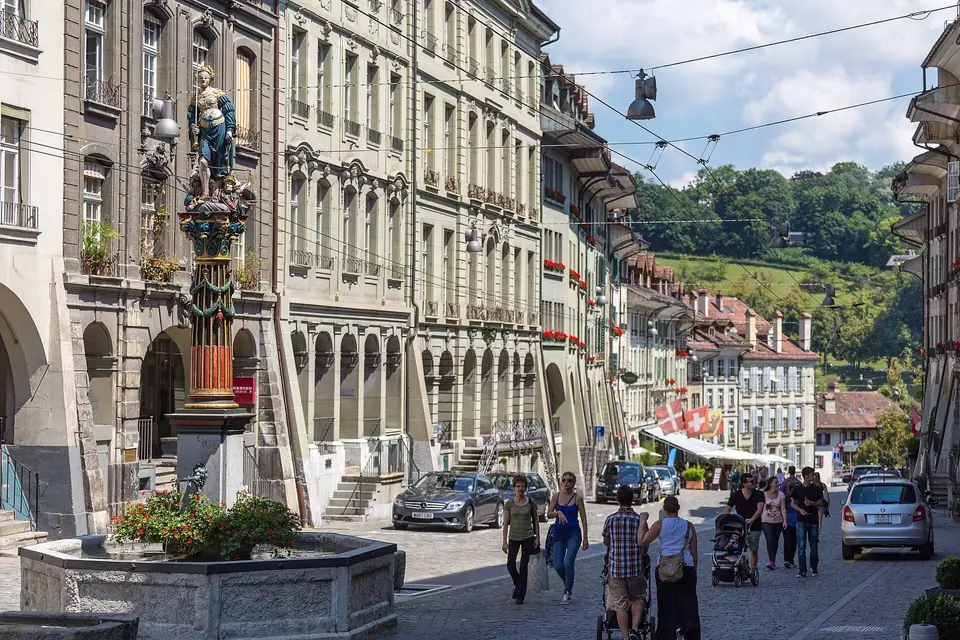
Kramgasse, Gerechtigkeitsgasse, and Vaulted Cellar Doors
East of the Zytglogge, the main street descends in a gentle S-curve as Kramgasse, the former marketplace and aristocratic address of the Old Town, before continuing as Gerechtigkeitsgasse toward Nydegg. Along both sides, slanting wooden or iron cellar flaps (Kellerhälse) sit between the arcade piers; built to slide wine barrels into cool storage vaults, many now open onto cellar theatres, ateliers, and restaurants.
This underground layer is one of the defining quirks of Bernese urban life. During the twentieth century, artists and actors converted dozens of damp coal and wine vaults beneath the Kramgasse and Gerechtigkeitsgasse arcades into intimate cabaret stages, jazz clubs, craft shops, and candlelit bars, accessed by lifting the heavy street-level doors and descending steep stone steps straight from the pavement.
The Covered Stadtbach Stream Channel
Down the centre of the street runs the stone channel of the Stadtbach, diverted into the peninsula at the town's founding to flush waste and fight fires, now covered by grates along Kramgasse and visible through open slots on Marktgasse and Spitalgasse. Together with the parallel rear alleys of Rathausgasse, Postgasse, and Münstergasse, this central water spine dictated the long, narrow parcel layout of every medieval burgher house on the ridge. Stepping into those quieter flanking lanes lets you compare the grand commercial arcades of the main axis with the calmer residential courtyards behind them.
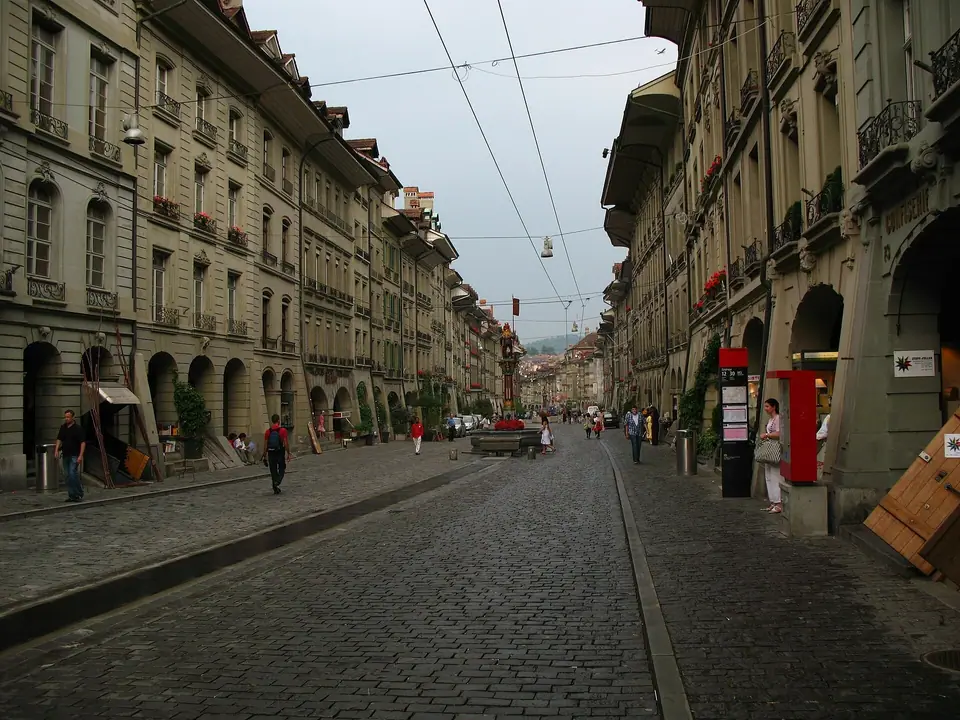
Eleven Sixteenth-Century Figure Fountains by Hans Gieng
Between 1542 and 1546, Bern replaced its wooden water troughs with limestone fountains crowned by painted Renaissance sculptures, most carved by Fribourg master Hans Gieng:
- Gerechtigkeitsbrunnen (1543): On Gerechtigkeitsgasse, blindfolded Justitia holds her sword and scales above a Pope, Emperor, Sultan, and Bernese Schultheiss; the 1543 original stands in the Bern Historical Museum after the statue was toppled in 1986 and replaced by a copy.
- Zähringerbrunnen (1535): Created by Hans Hiltprand on Kramgasse, this armoured bear carries two swords, a Zähringer lion banner, and a cub eating grapes between his feet.
- Samson, Venner, and Moses Fountains: Additional columns along Kramgasse, Rathausgasse, and Münsterplatz depict Samson opening the lion's jaws (1544), a standard-bearer (1542), and Moses with the Ten Commandments (1791).
- Kindlifresserbrunnen (1545): North of the Zytglogge on Kornhausplatz, Gieng's ogre devours a naked child while holding a sack of youngsters above a frieze of armed bears.
Guild Houses and Baroque Townhouses Along the Spine
Between the fountains, look for the sculpted stone emblems of the historical guilds (Zünfte) above the arcade arches on Kramgasse, Marktgasse, and Rathausgasse. Former guild halls and patrician mansions built during the seventeenth and eighteenth centuries introduce French-inspired limestone facades, wrought-iron balconies, and tall mansard roofs into the medieval streetscape. Because the arcades remain privately owned easements attached to each house while serving as public walkways, shop displays sit tucked behind the stone piers rather than crowding the street, preserving clear sightlines all the way from the Zytglogge down to the eastern river bend; see our Bern travel guide and food guide for dining rooms inside these historic buildings.
When walking beneath the Lauben on a sunny morning or a rainy afternoon, pay attention to how the stone masonry changes subtly from block to block. In the eastern sector along Gerechtigkeitsgasse and Kramgasse, older late-Gothic piers with chamfered edges and uneven vaulting sit beside symmetrical eighteenth-century Baroque townhouse fronts built for wealthy patrician families who served on the city council. Many doorways still preserve brass bell pulls, carved stone house signs, and arched fanlights that reflect the domestic wealth of the early modern republic.
Photographers looking for clear compositions along the main axis should walk Kramgasse early in the morning before delivery vans and shoppers gather around the fountains. Standing near the Samson Fountain or the Zähringer Fountain and looking west toward the gilded astronomical dial of the Zytglogge frames the curving cobblestone street, the red-and-black cantonal banners, and the receding stone arches in a single classic perspective.
Traveller tips
Real advice from people who have been to Old Town Arcades, Kramgasse, Zytglogge & Bern's Renaissance Fountains. Every tip is read by our team before it goes live.
No tips yet. Been here? Yours could be the first.
Thank you! Your tip will appear here after a quick review.
More in Bern
Continue exploring Bern with related neighbourhood, food, and planning guides
Bear Park (BärenPark), Nydeggbrücke & Rosengarten Viewpoint
Bern, Switzerland
Aare River Swimming, Marzilibad, Marzilibahn & the Matte Quarter
Bern, Switzerland
Gurten Mountain Funicular & Emmental Day Trips from Bern
Bern, Switzerland

What to Eat in Bern: Berner Platte, Rösti, Mandelbärli & Zibelemärit
Bern, Switzerland
