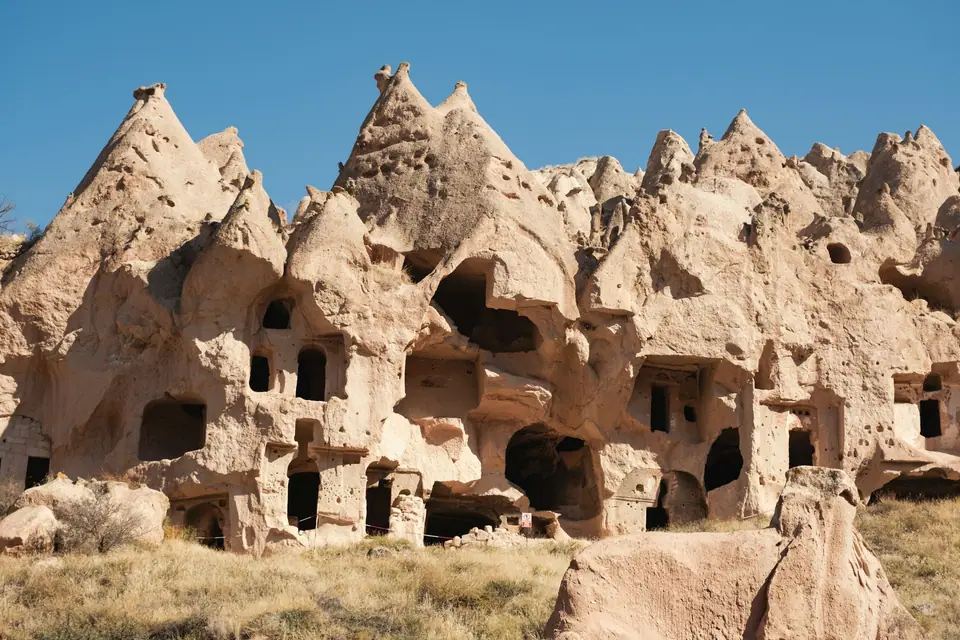
Photo by Burak Arslan on Unsplash
Göreme Open Air Museum Guide
A visitor guide to exploring painted rock-cut churches and monastic settlements at Göreme Open Air Museum.
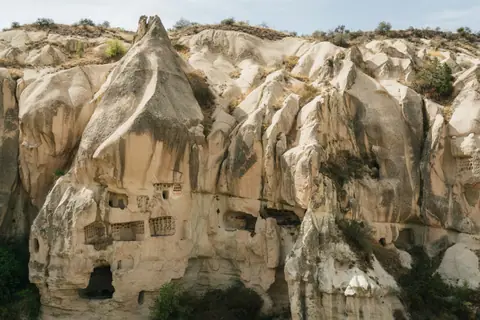
Göreme Open Air Museum stands as one of the most significant historical landscapes in central Anatolia. Monastic communities carved sanctuaries, dining halls, and dwellings directly into the soft volcanic tuff across this valley. Together with Zelve Open Air Museum, the site preserves rock-cut structures dating from the 4th to the 11th century CE. Monks transformed natural caves into meeting places, chapels, and houses that still display extensive sacred murals. Today, travellers visit this historic valley to study early Christian art and understand how communal monastic life developed in the region.
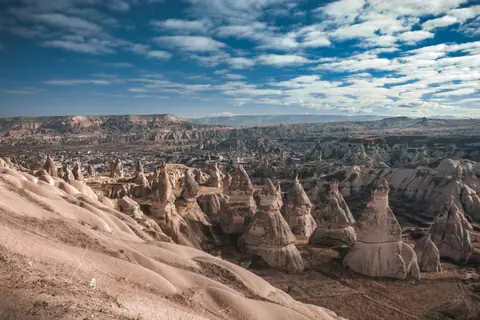
Understanding the dramatic setting requires looking deep into regional prehistory. Cappadocia was filled with lakes and streams 9 million years ago. Over millions of years, volcanic activity deposited thick layers of ash that solidified into soft stone. Subsequent erosion created the distinctive spires, cones, and gullies seen across the province. Local populations found this rock straightforward to carve with simple hand tools. Monks hollowed out complex retreats that offered insulation against winter cold and summer heat. When combined with regional history, these geological features explain why ecclesiastical communities chose to build deep within the valley system.
Monastic Architecture and Early Cave Settlements
Early hermits settled in these cliffs to pursue quiet contemplation away from major civic centres. Over several centuries, informal solitary hermitages evolved into organized coenobitic communities. Communal living required shared domestic facilities, communal kitchens, and dedicated spaces of worship carved together with family chambers. Similar subterranean architectural traditions developed elsewhere across the province. For instance, Derinkuyu Underground Village is an eight-story underground complex built thanks to the geological formation of the region. Derinkuyu Underground Village contains designated areas such as a kitchen, living room, and place of worship. Monastic complexes applied comparable planning above ground, cutting multi-level monasteries directly into exposed cliff faces.
Visitors can easily connect their exploration of the valley with wider regional travel plans. The complex fits neatly into an organized route, such as the Cappadocia 2-Day Itinerary. Taking time to study the exterior carving reveals how master stonecutters created mock architectural features. They sculpted barrel vaults, columns, and domes out of solid rock where structural supports were never physically required. These details mirrored classical masonry churches, allowing rock-hewn sanctuaries to reflect traditional Byzantine liturgical architecture.
Walking the Main Church Circuit
The standard route through the museum follows a paved uphill path looping past the major chapels. Near the entrance stands a tall rock outcrop known as the Nunnery. This rock formation contains several storeys of communal dining rooms and residential chambers linked by interior tunnels. Visitors then progress to the Chapel of St. Basil, a modest space dedicated to the influential Cappadocian church father who shaped communal monastic rules.
Continuing along the main path brings visitors to the Apple Church, known locally as Elmalı Kilise. This sanctuary features four rock pillars supporting a central dome with painted scenes from the life of Christ. In sections where surface paint has weathered away, older red geometric decoration appears beneath the plaster. Close by stands the Church of St. Barbara, which presents walls covered in red ochre designs applied directly to the stone. These depictions feature crosses, abstract shapes, and unusual insect patterns that continue to intrigue historians.
Further along the path, the Snake Church takes its name from a painting of St. George and St. Theodore confronting a dragon. On the adjacent wall, a portrait of the hermit Onuphrius displays his long flowing beard. Moving past these smaller chapels allows visitors to observe how painting methods advanced across the valley from basic pigment washes to intricate layered plaster techniques.
The Dark Church and Tokalı Church
The Dark Church, or Karanlık Kilise, represents an artistic pinnacle within the complex. UNESCO dates the church to the end of the 12th or the start of the 13th century. The vaulted ceilings retain rich blue mineral pigments, detailed portraits of saints, and elaborate narrative scenes covering the biblical cycle from the Annunciation through the Crucifixion. Ticketing for the church can differ from the main museum, so check the official site before you queue.
Beside this sanctuary sits the Sandal Church, named for distinct carved depressions beneath the painting of the Ascension. After completing the main museum loop, visitors should walk down toward the exit road to locate Tokalı Church. Because Tokalı Church sits outside the main perimeter fence across the road, many visitors accidentally overlook it. Standard museum tickets include entry to this impressive hall. Tokalı Church contains an expansive transverse nave decorated with deep blue lapis lazuli pigments and comprehensive narrative friezes illustrating biblical history.
Valley Hikes and Regional Exploration
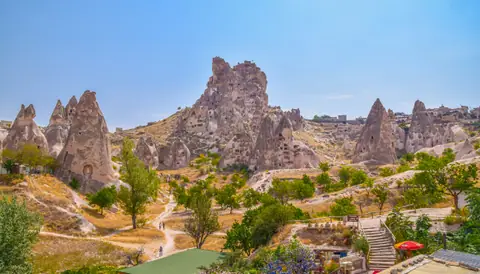
The natural terrain surrounding the museum invites further exploration on foot. Cappadocia offers extensive trekking paths winding through eroded ravines and historic settlements. A hiking trail loop exists between Gül Valley and Meskendir Valley, providing accessible footpaths lined with wild flora and historic rock façades. In addition, visitors can hike across Aşk, Paşabağ, Güvercinlik, and Ihlara Valleys to experience varied geological formations. Walking these trails helps travellers understand how agricultural villages and religious retreats interacted across the rural landscape.
Those wishing to see the broader terrain from above frequently book morning flights across the plains. Hot air balloon flights in Cappadocia last between 1 and 1.5 hours, providing wide views across fairy chimneys and ridge lines. To organize additional activities around the central valleys, consult our guide to the Best Things to Do in Cappadocia. Cultural traditions also thrive in surrounding craft centres. Avanos is an area in Cappadocia renowned for pottery production, where local artisans use clay collected from the Red River. Experiencing these nearby villages gives context to the artistic heritage preserved within the rock sanctuaries.
Visitor Etiquette and Preservation Rules
Preserving these ancient surfaces requires careful visitor cooperation. Moisture, skin oils, and sudden temperature shifts accelerate the degradation of fragile mineral pigments. Touching plaster surfaces or carving graffiti into the soft stone is strictly forbidden throughout the grounds. Camera flash is prohibited inside all churches because sudden bursts of light damage sensitive paints over repeated exposures. Museum wardens actively patrol chapel interiors to enforce photography guidelines.
Paths across the complex feature uneven stone stairs, sloping inclines, and low doorways cut into solid rock. Sturdy walking footwear with reliable grip is recommended for exploring multi-level rooms. Church interiors are compact, meaning spaces become crowded when tour parties gather inside single chambers. Planning visits early in the day or late in the afternoon allows for quieter viewing conditions. By respecting conservation rules, visitors help protect these delicate rock-cut sanctuaries for future generations.
Where it is
- 1Göreme Open Air Museum
- Kayseri Erkilet International Airport (ASR) · about 58 km from here in a straight line
- Directions in Google Maps
Stations and taxi ranks: OpenStreetMap. Airports: OurAirports. Distances are in a straight line.
Traveller tips
Real advice from people who have been to Cappadocia. Every tip is read by our team before it goes live.
No tips yet. Been here? Yours could be the first.
Thank you! Your tip will appear here after a quick review.
More in Cappadocia
Continue exploring Cappadocia with related neighbourhood, food, and planning guides