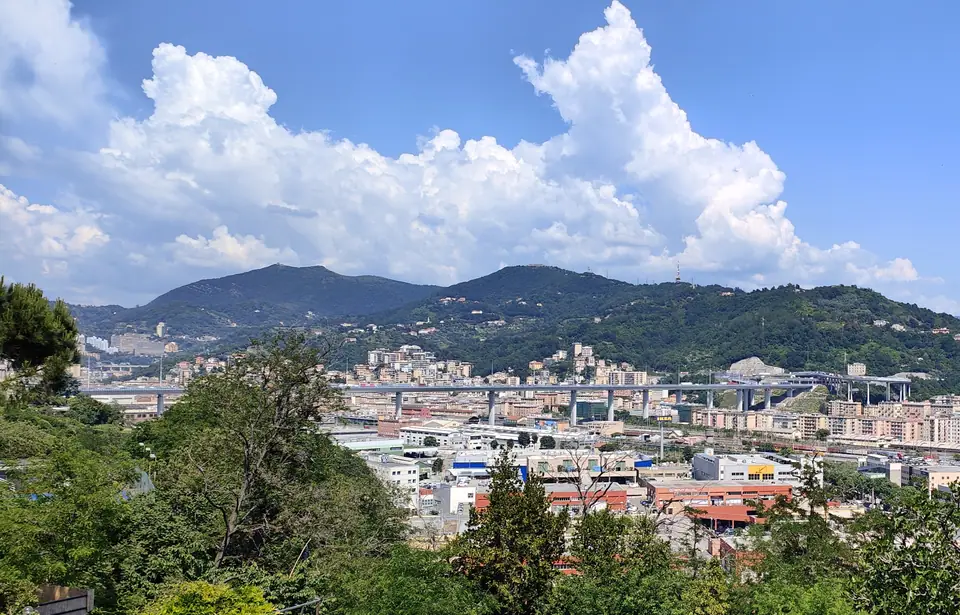
Photo: Al*from*Lig · CC BY-SA 4.0
Ponte Morandi, the Polcevera Collapse and Renzo Piano's Span
In Genoa's Val Polcevera, Riccardo Morandi's 1967 viaduct gave way to Renzo Piano's 2020 span and the 2024 Memoriale 14.08.2018.
Three kilometres north-west of Porto Antico docks, Genoa leaves Renaissance marble courtyards behind for concrete piers, steel viaducts and quiet civic memory. Stretching above the Polcevera stream between Sampierdarena and Certosa stands the engineering story that reshaped twenty-first-century Genoa. Every motorway arrival from France or Piedmont and Lombardy funnels directly across this industrial river valley. Stepping beneath the span on foot reveals how clearly the 2020 replacement bridge and 2024 memorial tell modern Genoa's story from street level.
While beachgoers head east towards Nervi, walking up the Val Polcevera opens a completely different chapter of the port city. Freight yards, nineteenth-century worker tenements and sunlit park groves crowd tightly beneath forty-five-metre bridge piers. Pairing a morning Metro ride north to Brin with level streets along Via Campi makes visiting effortless without a car.
Riccardo Morandi's 1967 viaduct and the August 2018 collapse
Roman civil designer Riccardo Morandi engineered the Polcevera Viaduct between 1963 and 1967. Motorway traffic opened across the finished deck on 4 September 1967 above a dense working valley. The raised roadway carried Genoa's A10 Savona route forty-five metres above factories, apartment rows and the stony Polcevera riverbed. Directly below those lofty legs ran busy cargo sidings and trunk rail tracks climbing towards Turin and Milan. Stretching 1,182 metres across a 210-metre central gap, the viaduct balanced upon three soaring concrete A-frame pylons.
Unlike exposed steel cable-stayed bridges built later, Morandi encased prestressed steel tension strands inside thick cast-concrete stay shells. Engineers hoped solid concrete sleeves would shield high-tensile steel from salty port air while reducing deck sway. Elevated spans cleared crowded Certosa rooftops cleanly without clearing entire residential blocks below.
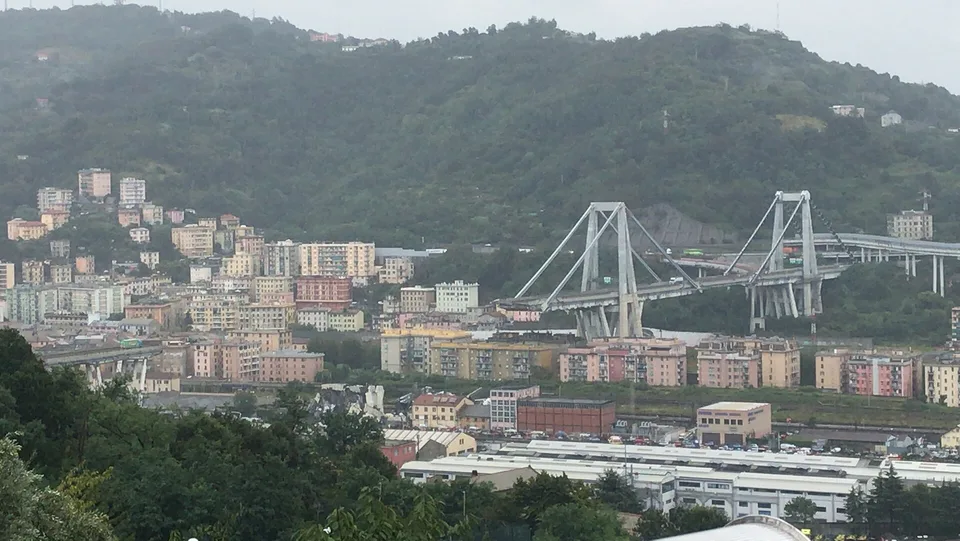
In practice, thick outer concrete shells concealed internal steel strands beyond routine visual inspection without destructive cutting. Decades of damp marine wind, industrial exhaust and surging heavy lorry traffic stressed stay anchorages relentlessly. From the 1970s onwards, highway crews carried out repeated reinforcement works across stays and trestle joints. On the stormy morning of 14 August 2018, Pier 9 snapped suddenly beneath violent downpours. Over two hundred metres of elevated roadway plunged onto workshops, rail tracks and riverbanks below.
Forty-three people lost their lives that morning, sixteen suffered injuries, and hundreds of neighbours evacuated surrounding flats overnight. Genoa's key east-west motorway link snapped in seconds, forcing port lorries and coastal traffic onto crowded urban streets for nearly two years. Remaining spans stood silently across the valley until controlled demolitions brought down the surviving concrete towers in June 2019.
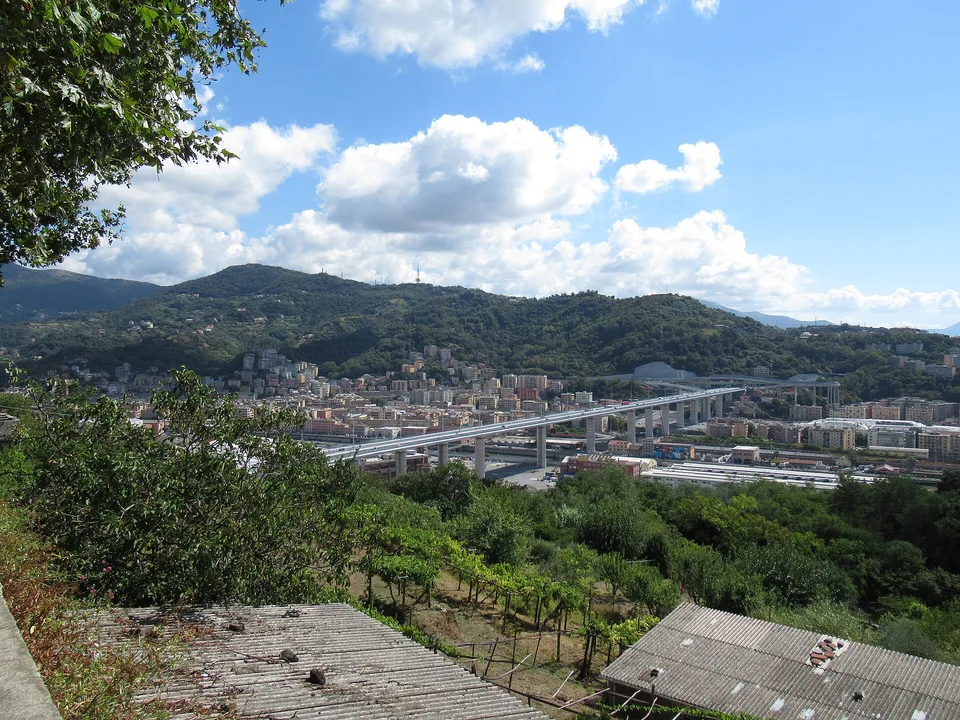
Renzo Piano's Ponte Genova San Giorgio across nineteen spans
Rebuilding across the Polcevera demanded calm structural clarity rather than towering cables or heavy concrete masts. Genoa-born architect Renzo Piano donated a clean continuous steel-and-concrete beam design built swiftly and inaugurated on 3 August 2020. The deck stretches 1,067 metres across nineteen spans forty-five metres high. Its horizontal beam rests lightly on eighteen slender elliptical concrete piers.
Viewed from ground level along Via Campi, the pale steel underside curves gently like a slender white ship hull. Daylight slips easily past smooth oval piers onto workshops, gardens and flats once shadowed below. Automated robotic carts travel underside maintenance rails to wash solar arrays and scan steel joints for tiny signs of fatigue. Along the central barrier stand forty-three slender vertical light masts honouring the forty-three victims. Deck solar panels power those lights cleanly across the span.
Walking beneath the bridge lets visitors see how calmly the replacement deck sits within the industrial valley floor. Instead of raising giant pylons above nearby ridges, the slim beam draws one pale horizontal line between Certosa slopes and Sampierdarena.
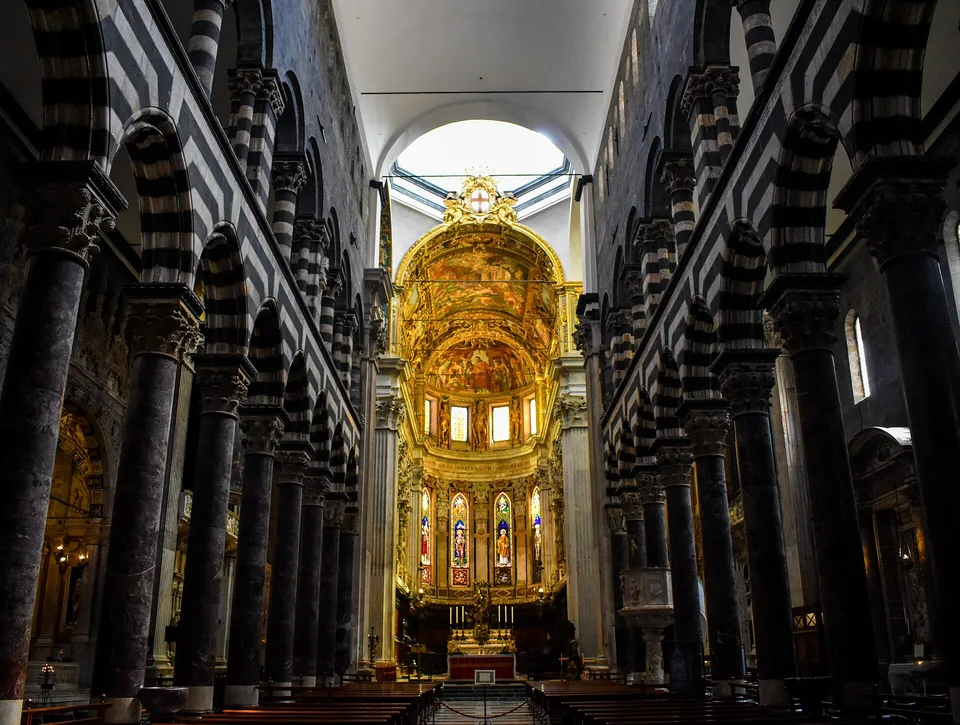
Standing beneath Ponte Genova San Giorgio shows deliberate restraint: no giant concrete towers compete with surrounding valley ridges, while eighteen pale elliptical piers allow daylight to reach Certosa streets once shadowed below.
Visiting Memoriale 14.08.2018 in the Polcevera valley
On 15 December 2024, Genoa inaugurated Memoriale 14.08.2018 right beneath the new bridge beside former Pier 9 along Via Campi in Certosa. Stefano Boeri Architetti created the surrounding Parco del Polcevera e il Cerchio Rosso regeneration plan linking public remembrance with neighbourhood green space. Outside the hall sits the forty-three-tree Radura della Memoria clearing. A red steel pedestrian ring connects both Polcevera banks cleanly across the valley. Shaped closely with the Victims' Families Committee inside a salvaged industrial hall, it joins quiet grief with public reflection on urban engineering.
Five focused exhibition rooms trace The Bridge, The Collapse, The Rescues, The Media and The Valpolcevera. Original recovered concrete bridge fragments sit beside courtroom records, news archives and spoken accounts from survivors, firefighters and local residents. Adjoining rooms house a private Casa delle Famiglie support space and a sunlit Luminous Bioclimatic Greenhouse nurturing coastal Mediterranean plants.
Admission stays completely free year-round, opening weekday mornings from Tuesday through Friday with extended hours across Saturdays and Sundays. Remember that galleries close completely every Monday. Check Monday closures and weather warnings ahead before leaving central Genoa. Ride Genoa's Metro line northwards to Brin terminus in Certosa. Flat signposted pavements then lead smoothly down Via Campi without hillside climbs or parking hassle.
Stepping back outside leaves easy daylight for walking beside the valley stream along the red pedestrian circle. Local corner cafes near Metro Brin offer espresso stops. The underground line then carries travellers swiftly back beside central Porto Antico docks or Piazza De Ferrari.
Strolling across the landscaped riverside lawn connects Via Campi calmly with everyday Certosa street life. From central Metro platforms, walkers easily continue into Centro Storico stone quarters or harbour bakeries along Sottoripa. Visiting the modern Polcevera span rounds out Genoa's wider maritime and industrial story cleanly.
Where it is
- 1Ponte Morandi, the Polcevera Collapse and Renzo Piano's Span
- Genoa Cristoforo Colombo Airport (GOA) · about 4 km from here in a straight line
- Milano Linate Airport (LIN) · about 117 km from here in a straight line
- Directions in Google Maps
Stations and taxi ranks: OpenStreetMap. Airports: OurAirports. Distances are in a straight line.
Traveller tips
Real advice from people who have been to Genoa. Every tip is read by our team before it goes live.
No tips yet. Been here? Yours could be the first.
Thank you! Your tip will appear here after a quick review.
More in Genoa
Continue exploring Genoa with related neighbourhood, food, and planning guides