


























Photo: Radosław Botev · CC BY 3.0 pl
Castle Towers to Modernist Plazas: Walking Kaunas in Six Stops
A field-tested route across Kaunas linking medieval Santaka Park, the 1935 Aleksotas Funicular, Laisvės alėja, Vienybės aikštė museums, and Žaliakalnis.
Kaunas rewards walking because its contrasting eras sit laid end to end across a flat corridor. Medieval brick vaults cluster on the western peninsula beside green confluence lawns. Those lanes then give way smoothly to nineteenth-century avenues and 1930s functionalism. Following these six connected stops traces that full arc on foot. One historic funicular ride adds river views, leaving outer fortress or lakeside sites for separate half-days.
Stop One: Santaka Meadows, Castle Walls and Town Hall
Begin on open grass at Santaka Park where quiet Nemunas currents absorb the faster Neris beneath leafy willow banks. Climb slightly inland to Kaunas Castle. Its restored conical red-brick tower houses a branch of Kaunas City Museum opened in 2011 inside fourteenth-century foundations. Step south past brick-vaulted St George the Martyr's Church onto cobbled Town Hall Square (Rotušės aikštė). Across the stones rises the freshly renovated 53-metre White Swan Town Hall opposite twin Jesuit towers.
Two short blocks closer to the Nemunas stand Kaunas's finest Gothic guild and monastic works. Inspect stepped red-brick gables at Perkūnas House on Aleksoto street before pausing inside riverside Vytautas the Great Church. Builders raised it around 1400, and exterior flood plaques still mark pre-dam river surges. Loop north past Kaunas Cathedral Basilica whenever time permits. Save deeper historical chronology for our Old Town history guide.
Stop Two: Riding the 1935 Aleksotas Funicular Over the River
Cross Vytautas the Great Bridge south from Vytautas Church onto the left bank of the Nemunas. Steep clay cliffs climb straight toward Aleksotas above the bridge abutment. There sits the lower timber boarding shed of the Aleksotas Funicular, running continuously since 1935 under municipal operator Kauno autobusai. Standard transit cards, contactless bank taps, or coins pay for the brief steep climb in historic wooden carriages.
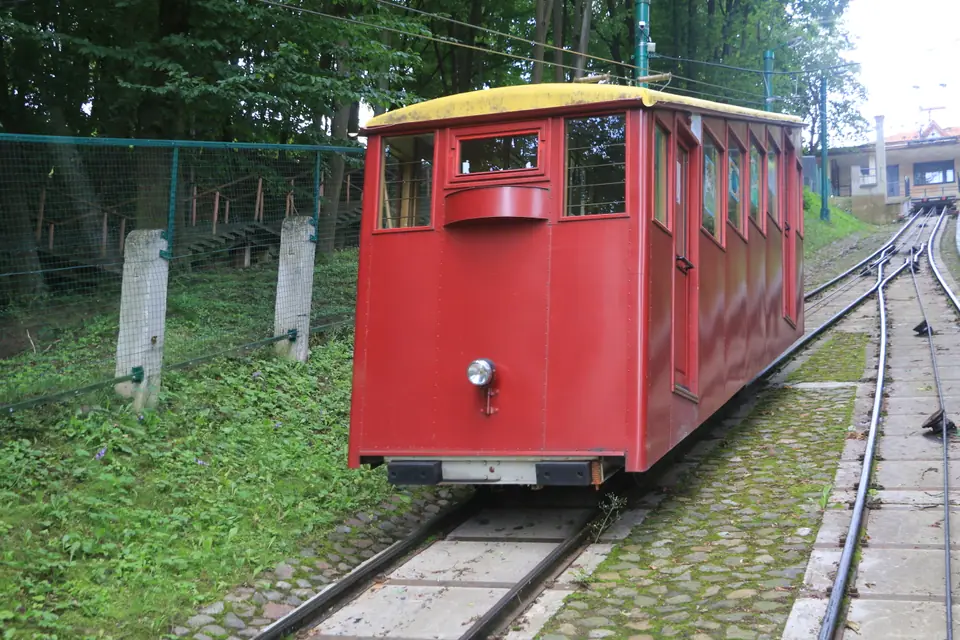
Stepping onto the upper terrace opens Kaunas's cleanest skyline overview back toward the Old Town peninsula. Red tile roofs, Cathedral belfries, the Town Hall spire, and green Žaliakalnis hills stack clearly across the river bend below. Ride back down on the rails or walk down parallel timber steps before recrossing toward Vilniaus gatvė and Centras.
Stop Three: Walking Linden-Shaded Laisvės Alėja Eastward
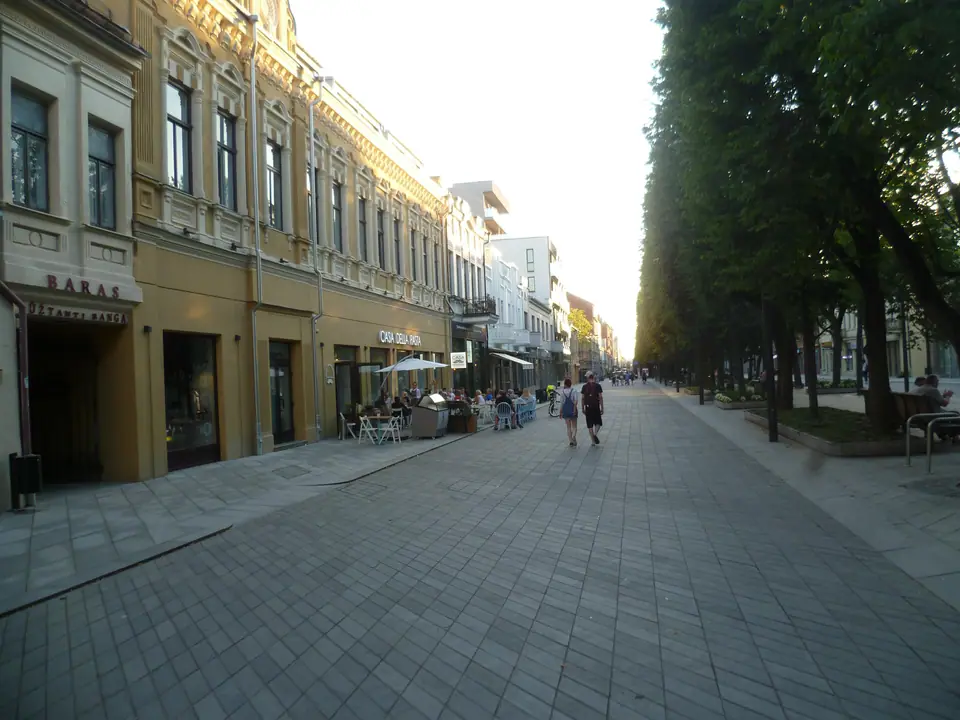
Join pedestrian Laisvės alėja (LYCE-vess ah-LEH-ya, Freedom Avenue), spanning 1.6 unbroken kilometres beneath double rows of mature linden trees. Refurbished as a fully car-free promenade in 1982, this flat walk stitches medieval lanes directly into interwar Naujamiestis. Pause outside the State Musical Theatre garden where stone markers honour 19-year-old Romas Kalanta's 1972 freedom protest.
Keep eyes lifted above ground-floor bookshops and cafés for rounded corner windows and limestone relief plaques. At number 102 rises Feliksas Vizbaras's 1931 Kaunas Central Post Office. Historic postal halls now host cultural exhibitions beneath Folk-Deco geometric floors. Farther east, Neo-Byzantine white domes of the 1895 St Michael the Archangel's Church (Soboras) close the long avenue vista cleanly.
Stop Four: Vienybės Aikštė Museums and Yard Murals
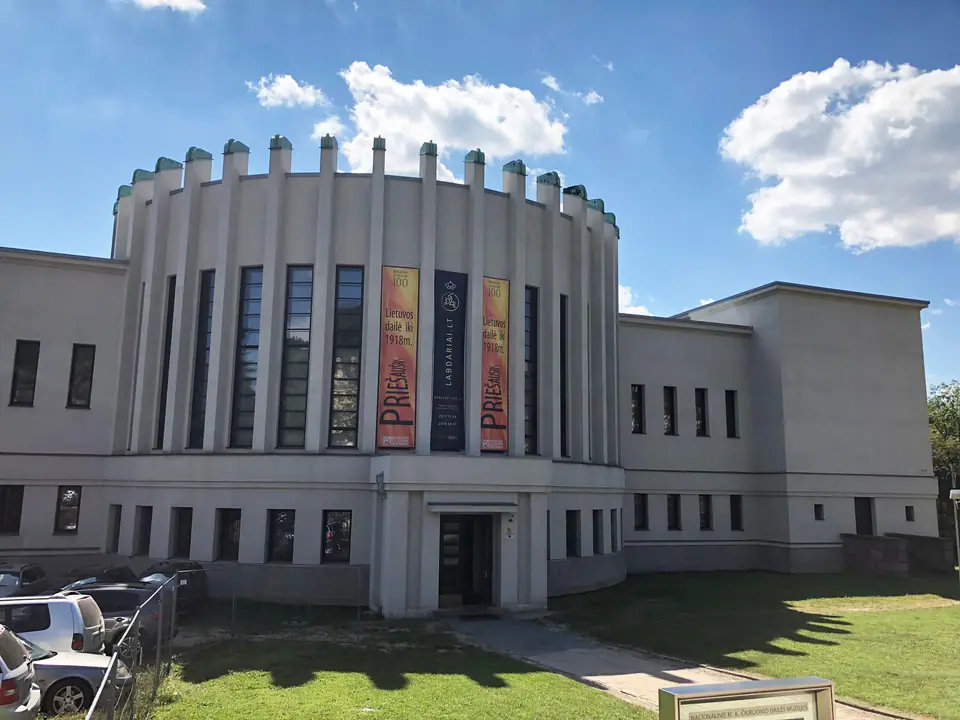
Turn one block north off Laisvės alėja onto paved Vienybės aikštė (Unity Square), ceremonial heart of interwar civic optimism. Twin 1936 exhibition wings anchor the square behind the 1928 Freedom Monument and singing carillon bell tower. Inside the western hall, the Vytautas the Great War Museum traces medieval Baltic campaigns, aviation pioneers Darius and Girėnas, and modern independence struggles. Adjoining galleries in the M. K. Čiurlionis National Museum of Art showcase symbolist paintings and music by Mikalojus Konstantinas Čiurlionis, whose 150th birth anniversary Kaunas marked in 2025.
Two quirky neighbours sit right around the museum block for curious afternoons. Step two minutes uphill to the Devils' Museum (Velnių muziejus). Painter Antanas Žmuidzinavičius assembled over 3,000 folk carvings, masks, and devil sculptures here across roughly 70 countries. Nearby on E. Ožeškienės street 21A, artist Vytenis Jakas turned an interwar courtyard into Kiemo galerija (Yard Gallery), painting portraits of former Jewish and Lithuanian neighbours across brick walls. Anyone wanting to enter the private Art Deco Museum (Gedimino g. 48) or Amsterdam School Museum (Vytauto pr. 58-6) must book guided tickets online ahead, as neither admits casual walk-ins.
Stop Five: Žaliakalnis Stairs, Resurrection Basilica and Oak Woods
Normally visitors rode Kaunas's second historic cable railway up onto the green ridge, yet field conditions changed recently. Opened in 1931, the private Žaliakalnis Funicular ceased passenger runs in May 2025 and stayed closed through 2026 due to rotted wooden track sleepers awaiting overhaul. Climb uphill instead via leafy pedestrian stone stairs such as Kauko laiptai, or hop ascending buses up Savanorių prospektas.
On the plateau edge rises monumental Christ's Resurrection Basilica, crowned by a 70-metre white concrete tower and 7-metre rooftop cross. Lift or stairs lift visitors onto its wide roof deck above timber villas. From there, level paths enter Ąžuolynas, one of Europe's largest urban groves of ancient oaks. Inside that same green belt sit the 1939 EuroBasket Sports Hall and the Lithuanian Zoo, reopened across nearly 16 modernised hectares in late 2023.
Stop Six: Nemunas Island and Outlying Half-Day Trips
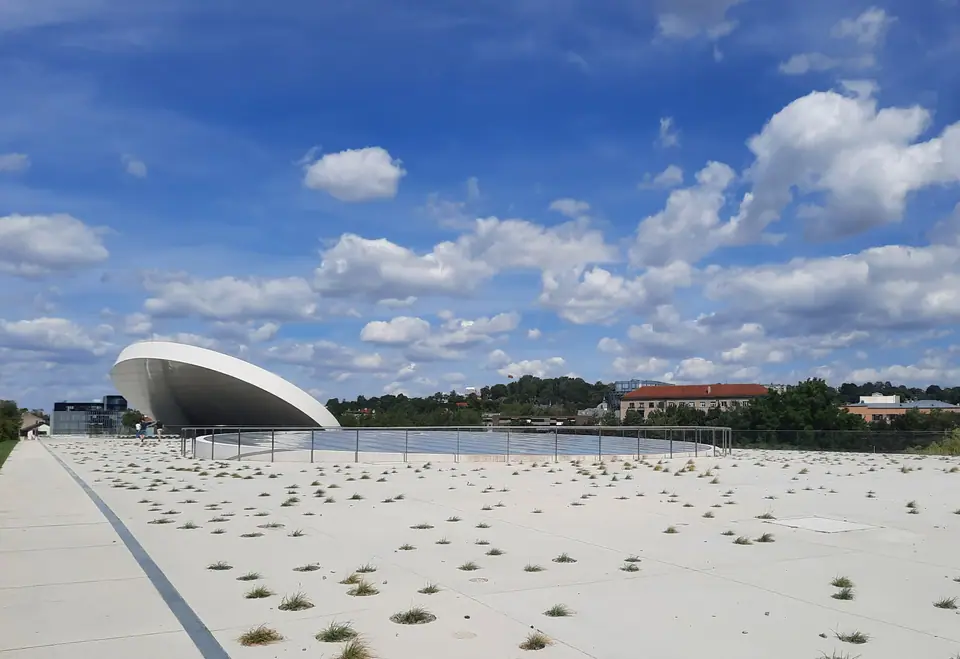
Descend south across pedestrian bridges onto flat Nemunas Island, linking parkland lawns directly behind Laisvės alėja. Beside the 2011 Žalgiris Arena basketball stadium gleams the tilted silver roof disk of Mokslo sala (Science Island). Lithuania's national science and planetarium hub opened in December 2024 with roughly 140 hands-on exhibits. Leave outer sites for dedicated city transit trips so central walks stay relaxed.
- Monday museum closures: Major branches including Kaunas Castle, Town Hall, Čiurlionis Museum, War Museum, and the Ninth Fort close on Mondays. Keep Mondays for squares, Santaka walks, Ąžuolynas oaks, and the Aleksotas Funicular.
- Advance apartment bookings: Both the Art Deco Museum and Amsterdam School Museum run structured two-hour guided visits strictly by advance online booking through official portals.
- Ninth Fort half-day: Allow a sober half-day north via Bus 23 to walk Tsarist casemates and Holocaust memorial grounds covered in our Ninth Fort guide.
- Pažaislis Monastery outing: Ride eastern trolleybuses 5, 9, or 12 to Kauno marios for seventeenth-century Baroque frescoes and pine lakeshores detailed in our Pažaislis briefing.
Where it is
- 1Kaunas
- Vilnius International Airport (VNO) · about 93 km from Kaunas in a straight line
- Directions in Google Maps
Stations and taxi ranks: OpenStreetMap. Airports: OurAirports. Distances are in a straight line.
Traveller tips
Real advice from people who have been to Kaunas. Every tip is read by our team before it goes live.
No tips yet. Been here? Yours could be the first.
Thank you! Your tip will appear here after a quick review.
More in Kaunas
Continue exploring Kaunas with related neighbourhood, food, and planning guides
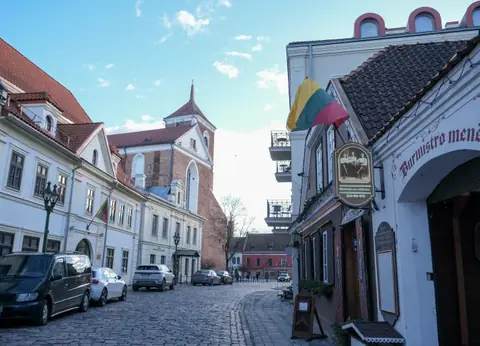
Senamiestis Cobbles to Naujamiestis Avenues: Where to Stay in Kaunas
Kaunas, Lithuania
Baltic Light, Oak Gold and Winter Frost: Best Time to Visit Kaunas
Kaunas, Lithuania
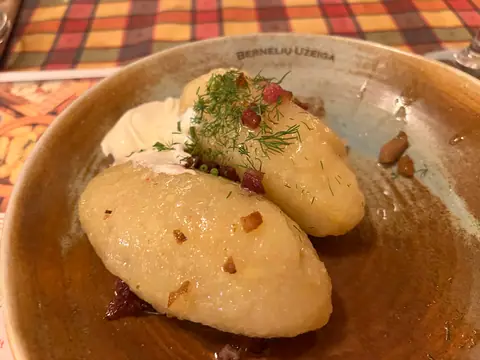
What to Eat in Kaunas: Potatoes, Sour Cream and Bakeries
Kaunas, Lithuania
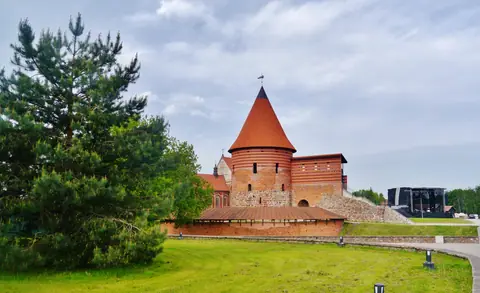
Kaunas Castle and Old Town: Confluence and White Swan
Kaunas, Lithuania
