


























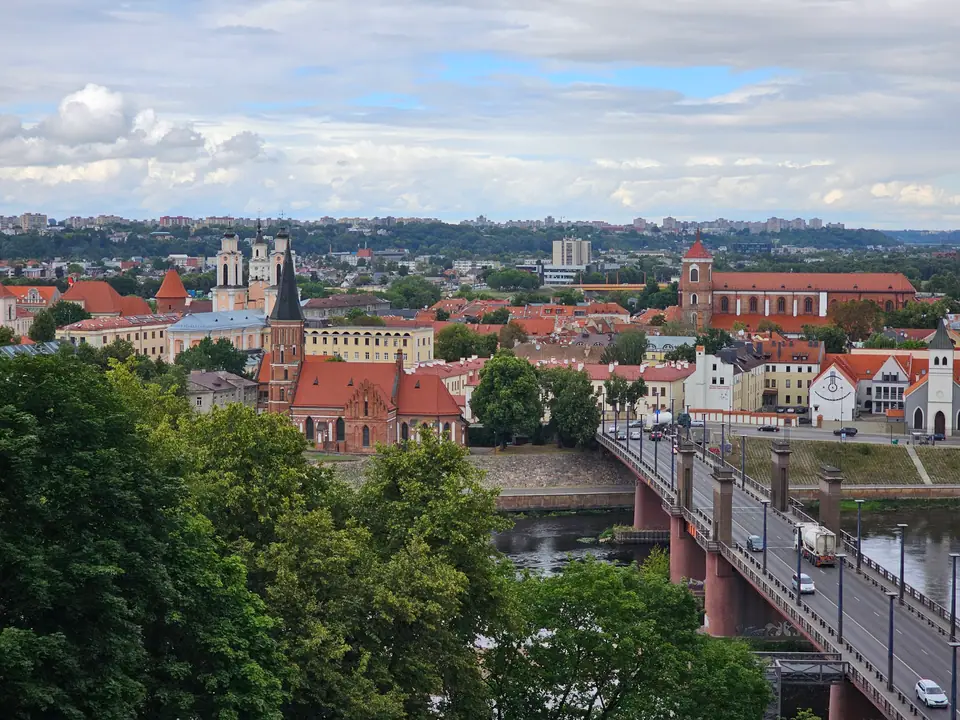
Photo: Renata3 · CC BY-SA 4.0
Kaunas at the River Fork: Brick Fortresses to Modernist Boulevards
How Lithuania's second city grew from a medieval Hanseatic confluence town into an interwar provisional capital inscribed by UNESCO for modernist design.
Kaunas (KOW-nas) sits across south-central Lithuania on the broad terrace where the River Nemunas meets its largest tributary, the River Neris. Home to roughly 304,000 municipal residents across 157 square kilometres, Lithuania's second-largest city trades the baroque hills of Vilnius for an unusually legible urban timeline. One straight pedestrian spine links a fourteenth-century red-brick fortress at the river fork with the clean concrete geometry of an interwar Baltic capital. Walking from cobbled church squares onto linden-lined avenues reads like turning pages across local history without climbing steep city hills.
Where the Nemunas Joins the Neris
Geography explains why armies, merchants, and architects repeatedly converged on this bend of water. The broad Nemunas curves northward from wooded plains before cutting sharply west beside Aleksotas cliffs. There it collects the faster Neris at grassy Santaka Park. Flood-meadow terraces separated medieval settlement on the lowland tongue from higher gravel ridges to the east and north. Steep clay slopes across the river at Aleksotas and above Centras in Žaliakalnis (zhah-lyah-KAHL-niss) frame natural amphitheatres above the water.
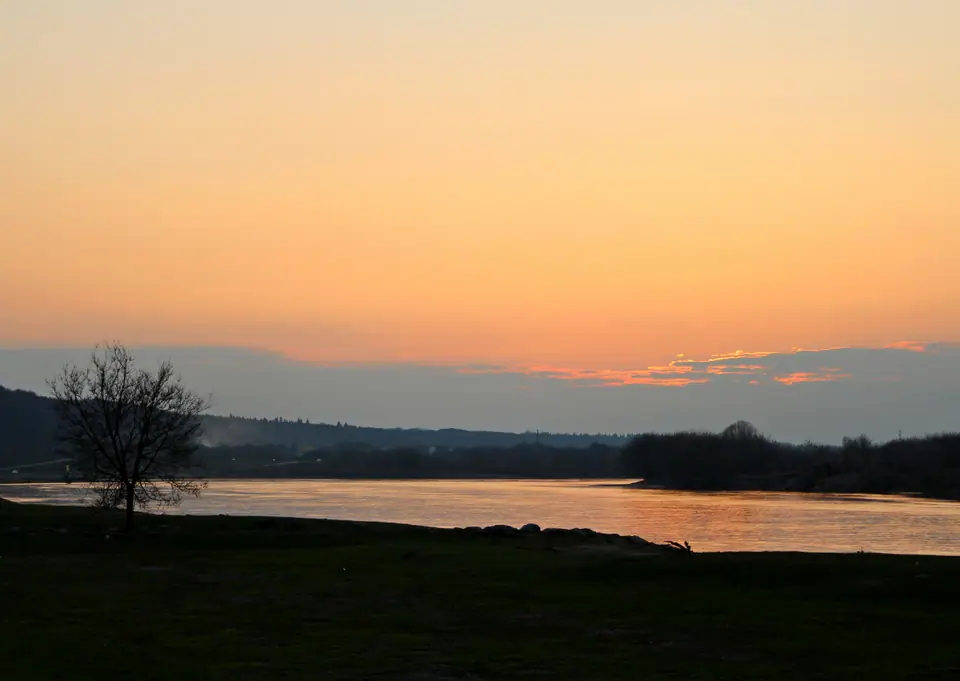
That topography keeps daily distances compact for anyone arriving on foot. Medieval streets cluster inside Senamiestis (seh-nah-MYEH-stiss) near the western point. Imperial nineteenth-century avenues then expand straight eastward through flat Naujamiestis (now-yah-MYEH-stiss). You cross almost every central landmark along one continuous, level pedestrian corridor between the castle moat and St Michael the Archangel's Church. Steep climbs enter solely when ascending toward residential hills on foot or riding the historic funicular up Aleksotas.
Medieval Fortifications and Hanseatic Trade
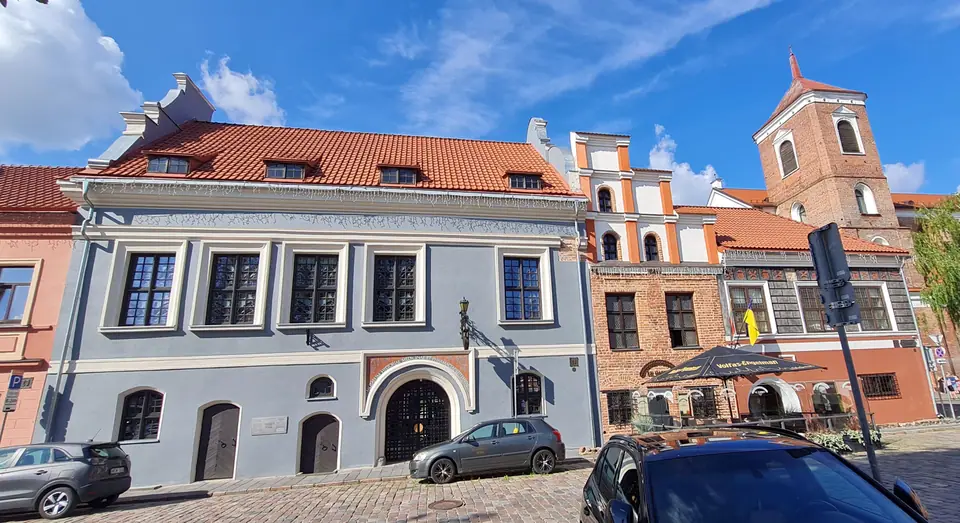
Written chronicles first mention Kaunas in 1361 as an advance bastion shielding Grand Duchy river approaches from Teutonic Knight raids. Teutonic forces besieged and burned the first masonry fortress in April 1362. Grand Duke Vytautas retook the river junction permanently after 1404 and granted Kaunas Magdeburg self-government rights in 1408. That charter sparked brick churches and riverfront guild stonework. By 1441, Kaunas joined the Hanseatic League and opened the Grand Duchy's only permanent Hansa kontor trading house along the quays.
Later centuries brought harsher shifts under distant empires that rebuilt streets in very different stone. Following the 1795 partitions of the Polish-Lithuanian Commonwealth, Tsarist administrators named Kaunas capital of Kovno Governorate in 1843. Imperial tracks linked the city to St Petersburg and Warsaw rail corridors by 1862. Russian military engineers encircled outer ridges with brick-and-concrete fortresses before 1914, banning taller civilian masonry near defensive sightlines. Outer defensive rings still shape city districts explored in our Old Town survey and the Ninth Fort memorial.
Two Interwar Decades as Provisional Capital
Everything changed abruptly after World War I when Polish forces seized Vilnius and left independent Lithuania without its historical capital. Kaunas stepped in as provisional capital from 1920 until 1939. The Constituent Assembly met here on 15 May 1920, and central ministries stayed until June 1940. Under reformist mayor Jonas Vileišis between 1921 and 1931, municipal territory expanded from 18 to 40 square kilometres. City population jumped roughly eightfold toward 154,000 by 1939. Young architects trained across Germany, France, Italy, and Russia built schools, ministries, banks, and cooperative flats in restrained European modernism.
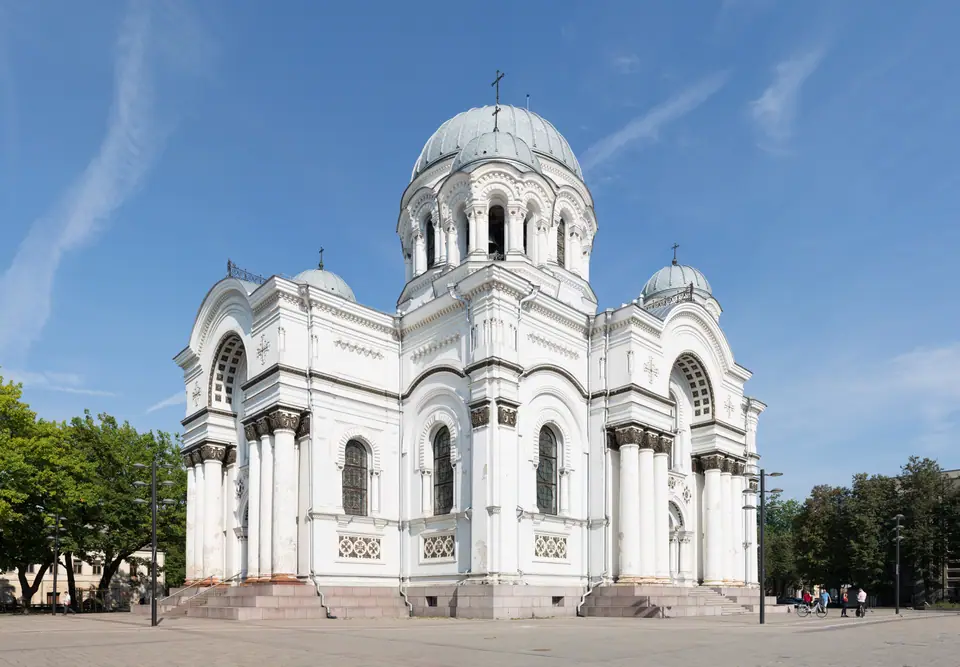
That compressed burst of civic optimism earned global heritage recognition decades later. On 18 September 2023, UNESCO inscribed Modernist Kaunas: Architecture of Optimism, 1919 to 1939 onto the World Heritage List under Criterion (iv). Protected grids stretch across flat Naujamiestis and terraced Žaliakalnis. Earlier honours included the 2015 European Heritage Label, UNESCO City of Design status in 2015, and European Capital of Culture in 2022. Readers find full architectural routes inside our modernist field guide.
Kaunas never needed theatrical imperial boulevards; between 1920 and 1939, local architects turned modest residential blocks and public post offices into quiet monuments of Baltic statehood.
Wartime Loss and Post-War Civic Defiance
Walking these calm interwar avenues demands remembering how abruptly that pluralistic city fractured after 1940. Before the Second World War, roughly 30,000 Jewish citizens made up around one quarter of Kaunas. An earlier 1897 census recorded nearly 35 percent, or 25,500 Jewish residents. During summer 1940, Japanese consul Chiune Sugihara and Dutch honorary consul Jan Zwartendijk issued over 2,200 transit visas in Žaliakalnis before Soviet authorities shuttered foreign missions. Nazi occupation from 1941 brought catastrophic genocide across the Seventh and Ninth Forts, devastating the city's Jewish community.
Post-war decades forged a stubborn civic identity around quiet cultural resistance and basketball passion. On 14 May 1972, 19-year-old student Romas Kalanta died by self-immolation for Lithuanian freedom beside Laisvės alėja. By 9 October 1988, Sąjūdis reform rallies raised Lithuania's pre-war yellow-green-red tricolour openly before independence returned in 1990. Local club Žalgiris, founded in 1944, still unites the city inside modern 2011 Žalgiris Arena on Nemunas Island.
Daily City Tempo Around the River Forks
Contemporary Kaunas pairs careful municipal restoration with easygoing student streets rather than museum-town stiffness. Freshly renovated Kaunas Town Hall galleries sit back at work facing repaved Rotušės aikštė. Across the footbridge on Nemunas Island, sleek Mokslo sala (Science Island) opened in December 2024. Independent coffee roasters occupy interwar ground floors beneath timbered gables. Meanwhile, cyclists follow wooded river trails stretching east past Šančiai toward Kaunas Reservoir.
Practical travel habits stay straightforward inside Lithuania's Schengen and Eurozone borders. Passports from non-EU states such as the UK need issue dates within 10 years on arrival and at least 3 months validity beyond departure. Visa-free stays permit up to 90 days in any 180-day window. Bank cards work smoothly everywhere except cash-only counters like historic Spurginė, and municipal well water drinks clean from the tap. National rules restrict alcohol off-sales on Sunday afternoons for buyers aged 20 or older. Plan a multi-day stay with our central walking sequence, or pair Kaunas overland with Riga, Tallinn, and Gdańsk via regional links.
Where it is
- 1Kaunas
- Vilnius International Airport (VNO) · about 93 km from Kaunas in a straight line
- Directions in Google Maps
Stations and taxi ranks: OpenStreetMap. Airports: OurAirports. Distances are in a straight line.
Traveller tips
Real advice from people who have been to Kaunas. Every tip is read by our team before it goes live.
No tips yet. Been here? Yours could be the first.
Thank you! Your tip will appear here after a quick review.
More in Kaunas
Continue exploring Kaunas with related neighbourhood, food, and planning guides
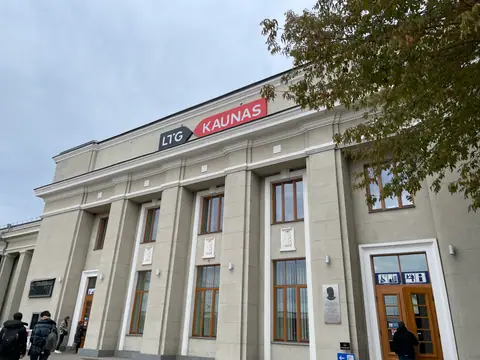
Kaunas Arrivals: Airport Bus 29G, LTG Rail and Contactless Transit
Kaunas, Lithuania
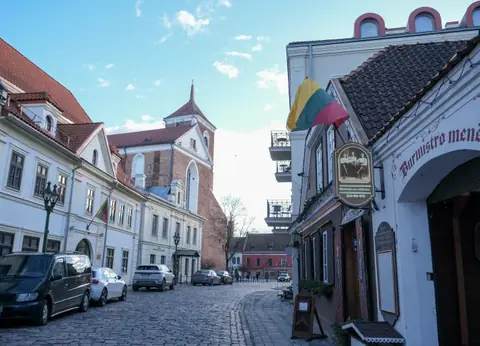
Senamiestis Cobbles to Naujamiestis Avenues: Where to Stay in Kaunas
Kaunas, Lithuania
Baltic Light, Oak Gold and Winter Frost: Best Time to Visit Kaunas
Kaunas, Lithuania
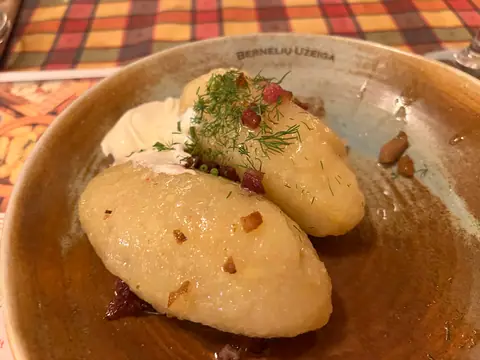
What to Eat in Kaunas: Potatoes, Sour Cream and Bakeries
Kaunas, Lithuania
