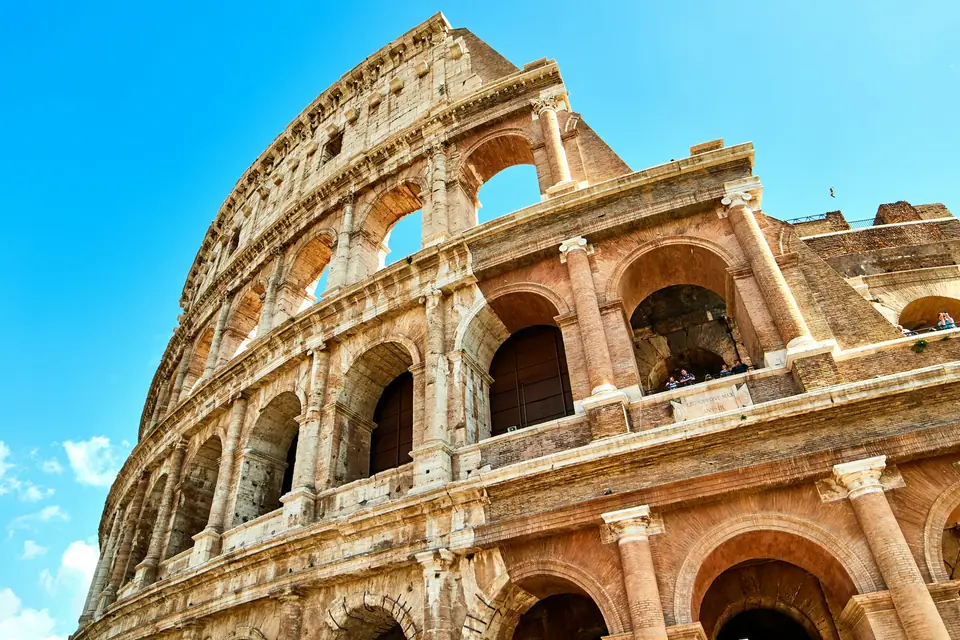
Photo by Mathew Schwartz on Unsplash
Colosseum Guide: Tickets, Arena, Underground & Forum
How to book official Parco archeologico del Colosseo tickets, choose between the Arena and Hypogeum, and walk the Forum.
Emperor Vespasian began building the Flavian Amphitheatre (Anfiteatro Flavio) around 72 AD on the drained site of Nero's artificial lake, part of the sprawling Domus Aurea. His son Titus inaugurated the stadium in 80 AD with a hundred days of games, and it remains the largest ancient amphitheatre ever built. Known since the Middle Ages as the Colosseum after the bronze Colossus of Nero that stood nearby, the elliptical structure measures 189 by 156 metres. Its outer travertine wall rises 48.5 metres across four storeys of Doric, Ionic, and Corinthian arcades. Inside, up to 50,000 spectators sat beneath a retractable canvas awning (velarium) rigged by sailors from the imperial fleet. Visiting smoothly requires understanding the official ticketing rules of the Parco archeologico del Colosseo before you travel.
How to book official named tickets and avoid reseller markups
Since late 2023, the archaeological park has enforced strictly nominative (named) timed-entry ticketing to combat automated scalping. Every ticket must bear the visitor's exact first and last name as shown on their passport or government ID card. Staff verify your original ID against the ticket at the turnstiles before security screening. Always purchase directly through the official Parco archeologico del Colosseo ticketing portal rather than third-party reseller sites that bundle unnecessary audio guides at inflated rates. Standard tickets open for booking on a rolling basis up to 30 days ahead. Limited-capacity underground slots release in smaller batches and require checking the official calendar early.
Comparing Colosseum ticket types: Standard, Arena, Underground, and Attic
Every ticket issued by the Parco archeologico del Colosseo includes combined access to the Roman Forum (Foro Romano) and the Palatine Hill (Palatino). Choose between four main access levels inside the amphitheatre itself:
- Standard 24-Hour Ticket (First & Second Tiers) / Full Experience with Arena Floor: The Standard 24-Hour ticket covers the ground-level promenade and the second-tier gallery of the Colosseum at a fixed entry time. It includes one single entry to the Roman Forum and Palatine Hill within 24 hours. The Full Experience with Arena ticket extends validity across two days and adds the SUPER sites inside the Forum and Palatine. In addition, it grants direct access through the eastern Gladiator's Gate (Porta Libitinaria) onto the reconstructed wooden arena floor.
- Full Experience with Underground & Arena (Ipogeo) / Full Experience with Attic (Attico): The Underground (Ipogeo, ee-poh-JEH-oh) upgrade takes small accompanied groups beneath the arena floor into the two-level stone substructure added by Emperor Domitian. There, 32 trapdoors, bronze-counterweight lifts, and timber ramps once hoisted leopards, bears, and scenery directly into the games above. The Attic (Attico) ticket uses a panoramic glass lift to reach the uppermost fourth and fifth belvedere levels nearly 50 metres above the arena.
Walking the Roman Forum, the Via Sacra, and the Palatine Hill
Do not treat the Roman Forum and Palatine Hill as an afterthought; together they span more than 40 hectares and require two to three hours on foot. After exiting the Colosseum, pause beside the 21-metre marble Arch of Constantine, erected in 315 AD to commemorate Constantine's victory at the Milvian Bridge. Then enter the archaeological park along the ancient processional road of the Via Sacra (VEE-ah SAH-krah):
- Arch of Titus (81 AD). Marks the Velian ridge entrance. Its interior vault reliefs show Roman soldiers carrying the seven-branched Menorah and spoils from the 70 AD siege of Jerusalem.
- Basilica of Maxentius and Constantine. Three colossal coffered concrete barrel vaults rising 35 metres high. It once served as the largest civic law hall in the Forum.
- House of the Vestal Virgins and Temple of Vesta. A tranquil courtyard lined with marble statues of the chief priestesses (Virgines Vestales) who tended Rome's sacred hearth fire beside the circular podium of Vesta.
- Temple of Antoninus and Faustina (141 AD). Preserved intact because it was converted in the Middle Ages into the church of San Lorenzo in Miranda. Deep rope grooves remain visible on its cipollino marble columns from an aborted demolition attempt.
- Curia Julia (Roman Senate House) and Arch of Septimius Severus (203 AD). Stand at the political heart of the Republic and Empire beside the Rostra speaker's platform and the site of Julius Caesar's cremation altar.
- The Palatine Hill (Colle Palatino). Climb the shaded Farnese Gardens ramp above the Forum to reach the legendary birthplace of Rome. Here Emperor Domitian's vast palace complex (Domus Flavia and Domus Augustana) and the sunken Stadium of Domitian look straight down over the 600-metre-long grass oval of the Circus Maximus.
What are the SUPER sites inside the Forum and Palatine?
Holders of the Full Experience ticket should look for the rotating SUPER (Seven Unique Places to Experience in Rome) interiors inside the Forum and Palatine. Because fragile wall paintings require climate control, standard 24-hour tickets do not open these doors. Highlights include sixth-to-eighth-century Byzantine frescoes inside the church of Santa Maria Antiqua and the painted studies inside the House of Augustus (Casa di Augusto). Nearby sit the frescoed rooms of the House of Livia, Nero's subterranean Cryptoporticus tunnel, and the sculpture halls of the Palatine Museum.
Arrival logistics, bag rules, and best photo angles
Ride Metro Line B or Line C to Colosseo station, or walk ten minutes downhill from Monti. Arrive 20 to 30 minutes before your printed time slot with your original passport or ID card ready. Remember that suitcases and large backpacks are forbidden, and there is no cloakroom on site. Bring a reusable water bottle as detailed in our packing guide to refill at the drinking fountains inside the Colosseum and on the Palatine Hill. Restrooms sit near the Colosseum ground-tier arcades and beside the Palatine Museum. For the cleanest exterior photograph of the intact northern facade, walk up the steps to the pedestrian bridge on Via Nicola Salvi above the metro exit. Pair your morning visit with the schedule in our 3-day Rome itinerary.
Where it is
- 1Colosseum
- Ciampino–G. B. Pastine International Airport (CIA) · about 13 km from here in a straight line
- Directions in Google Maps
Stations and taxi ranks: OpenStreetMap. Airports: OurAirports. Distances are in a straight line.
Traveller tips
Real advice from people who have been to Rome. Every tip is read by our team before it goes live.
No tips yet. Been here? Yours could be the first.
Thank you! Your tip will appear here after a quick review.
More in Rome
Continue exploring Rome with related neighbourhood, food, and planning guides