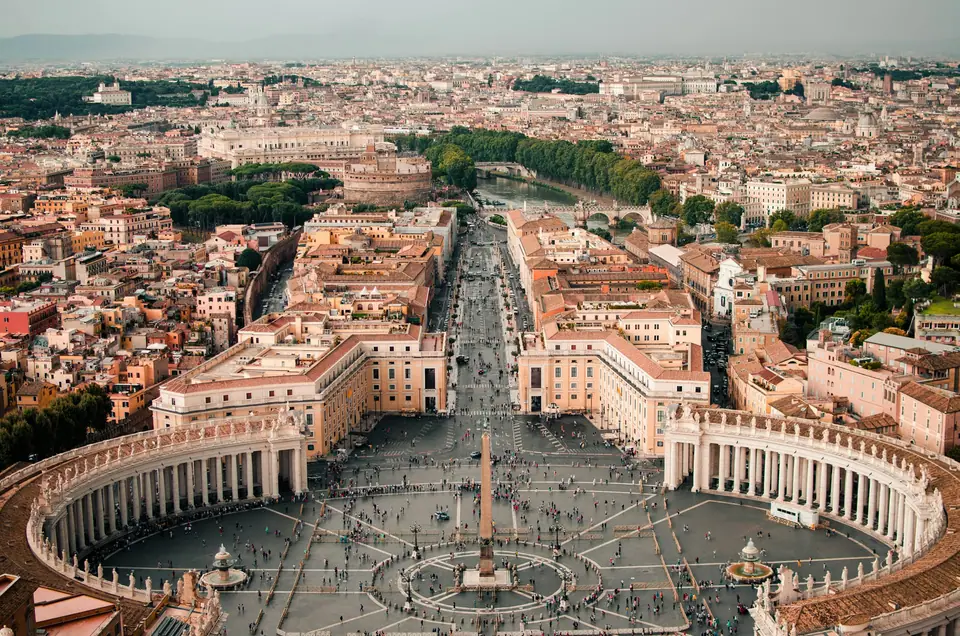
Photo by Caleb Miller on Unsplash
Vatican Guide: Museums, Sistine Chapel & St Peter's
How to navigate the Vatican Museums, Sistine Chapel, and St Peter's Basilica without exhaustion, including dress codes and dome steps.
Vatican City (Stato della Città del Vaticano) covers just 44 hectares (0.44 square kilometres) on the west bank of the Tiber. Established as an independent state by the 1929 Lateran Treaty, it is the smallest sovereign country on earth. For visitors, a trip to the Vatican consists of two completely separate entrances and operational rules. First comes the ticketed Vatican Museums and Sistine Chapel, entered from the northern ramparts on Viale Vaticano. Second comes the free-entry St Peter's Basilica, entered through the security colonnade on St Peter's Square, a fifteen-minute walk away around the exterior walls. Treating them with a clear half-day plan prevents exhaustion along the seven kilometres of papal galleries.
Booking official Musei Vaticani tickets and calendar closures
Always purchase timed-entry admission directly through the official Musei Vaticani ticketing portal up to 60 days ahead. Third-party street sellers along Viale Vaticano and Via Leone IV cannot offer faster security lines than a standard pre-booked online voucher. Check the official liturgical and civic calendar before planning your day:
- Weekly Sunday Closure vs Free Last Sunday: The Vatican Museums close every Sunday throughout the year, except on the last Sunday of each month (unless it falls on Easter, 29 June, 25 December, or 26 December). On that free Sunday morning, unreserved queues stretch hundreds of metres along the exterior walls, so paid weekday slots are far calmer.
- Papal Wednesday Audiences in St Peter's Square: When the Pope is in residence on Wednesday mornings, the Papal General Audience (Udienza Generale) fills St Peter's Square. That liturgy keeps the basilica interior closed to regular sightseeing until midday. On Wednesdays, book the Vatican Museums first in the morning and visit St Peter's Basilica in the afternoon.
Step-by-step route from the museum entrance to the Sistine Chapel
Every visitor in the Vatican Museums follows a one-way architectural sequence that ends at the Sistine Chapel (Cappella Sistina, kahp-PEL-lah sees-TEE-nah). Rather than trying to examine every glass case, focus your energy on six essential highlights along the route:
- Pinecone Courtyard (Cortile della Pigna) and Terrace. Pause by the four-metre first-century AD bronze Roman fountain pinecone. Here backlit graphical panels explain Michelangelo's ceiling frescoes before you enter the chapel itself, where guides are not permitted to speak aloud.
- Pio-Clementino Museum and Octagonal Courtyard (Cortile Ottagono). Houses the foundational antique sculptures of the Renaissance papacy. Highlights include the first-century BC marble Laocoön and His Sons (unearthed on the Esquiline Hill in 1506) and the classical Apollo Belvedere. Nearby in the Room of the Muses sits the muscular marble fragment of the Belvedere Torso.
- Gallery of the Candelabra and Gallery of Woven Hangings. Walk through the marble candelabra arcade into the long hall hung with sixteenth-century Flemish wool-and-silk wall hangings woven in Brussels from designs by Raphael's workshop.
- Gallery of Maps (Galleria delle Carte Geografiche). A 120-metre-long corridor commissioned by Pope Gregory XIII in 1580. Cartographer Ignazio Danti painted forty giant topographical frescoes depicting every region of the Italian peninsula beneath a gilded Mannerist barrel vault.
- The Raphael Rooms (Stanze di Raffaello). Four papal reception apartments painted by Raphael and his workshop between 1508 and 1524 for Pope Julius II. Inside the Stanza della Segnatura sits The School of Athens (Scuola di Atene), framing Plato and Aristotle at the centre with portraits of Leonardo da Vinci, Michelangelo, Bramante, and Raphael himself.
- The Sistine Chapel. Built between 1473 and 1481 for Pope Sixtus IV, the papal conclave chapel features fifteenth-century side-wall frescoes by Botticelli, Perugino, Ghirlandaio, and Pinturicchio. Overhead spans Michelangelo's ceiling, painted between 1508 and 1512 across nine Genesis panels including the Creation of Adam. The entire altar wall displays his sombre Last Judgment (Giudizio Universale, painted 1536 to 1541). Silence is required and all photography or video recording inside the chapel is strictly prohibited. Before leaving the museums, descend the double-helix Momo Spiral Staircase (1932) near the main exit.
Entering St Peter's Basilica and climbing Michelangelo's Dome
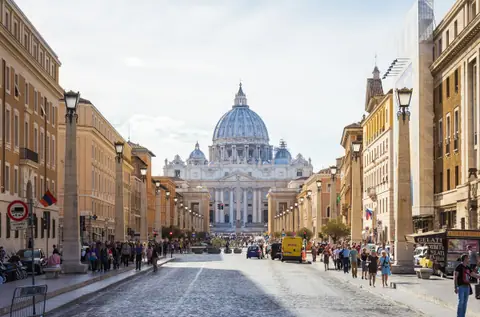
Consecrated in 1626 over the fourth-century Constantinian basilica marking the traditional burial site of Saint Peter, St Peter's Basilica (Basilica di San Pietro) spans an interior length of 186 metres beneath a 45-metre nave vault. Entry to the main basilica floor is free after airport-style screening beneath Gian Lorenzo Bernini's 284-column elliptical colonnade in St Peter's Square:
- Lift + 320 Steps to the Cupola / Full 551-Step Stair Climb: Located inside the right portico of the basilica, the separate ticketed entrance to Michelangelo's Cupola (136.5 metres high) offers two options. Taking the lift to the roof terrace leaves 320 steps up the curving, sloped double shell of the dome to the outdoor lantern gallery. The full stair option climbs all 551 steps from ground level along broad spiral ramps.
- Basilica Floor Masterpieces vs Papal Grottoes (Grotte Vaticane): Immediately inside on the right stands Michelangelo's 1499 marble Pietà behind protective glass. Beneath the central dome rises Bernini's 29-metre bronze Baldacchino (cast in 1624 to 1633) and the bronze Cathedra Petri in the apse. A free staircase near the central piers leads down into the Papal Grottoes housing royal and papal tombs before exiting toward the square.
If you have an extra hour inside the museums before descending the exit stairs, step into the quiet Pinacoteca Vaticana (Vatican Picture Gallery). Its eighteen chronological rooms hold Leonardo da Vinci's unfinished St Jerome in the Wilderness, Caravaggio's dramatic Entombment, and Raphael's final masterpiece, The Transfiguration. Outside on the square, look for the Swiss Guards wearing their historic blue, red, and yellow striped Renaissance uniforms at the Bronze Door (Portone di Bronzo). You can also send a postcard with official Vatican City postage stamps from the yellow postboxes. Ride Metro Line A to Ottaviano or Cipro for the museum entrance on Viale Vaticano. Make sure your shoulders and knees are covered as explained in our Rome dress code guide, and find lunch spots away from Via della Conciliazione in our Prati neighbourhood section.
Where it is
- 1Vatican
- Ciampino–G. B. Pastine International Airport (CIA) · about 16 km from here in a straight line
- Directions in Google Maps
Stations and taxi ranks: OpenStreetMap. Airports: OurAirports. Distances are in a straight line.
Traveller tips
Real advice from people who have been to Rome. Every tip is read by our team before it goes live.
No tips yet. Been here? Yours could be the first.
Thank you! Your tip will appear here after a quick review.
More in Rome
Continue exploring Rome with related neighbourhood, food, and planning guides